Log inSign up
NASA Armstrong
NASA
9,046 posts
Image
user avatar
NASA Armstrong
NASA
@NASAArmstrong
The Armstrong Flight Research Center is NASA's primary center for atmospheric flight research & operations.
Edwards, California
nasa.gov/centers/armstr…
Joined March 2009
108
Following
509.2K
Followers
  • Pinned
    user avatar
    NASA Armstrong
    NASA
    @NASAArmstrong
    Nov 19, 2025
    The X-59 has touched down at its new home! On Oct. 28, 2025, the X-59 completed its first flight, taking off from the @LockheedMartin Skunk Works facility in Palmdale, California, and landing at @EdwardsAFB after a 67-minute flight. The quiet supersonic research aircraft then
    user avatar
    NASA Aeronautics
    NASA
    @NASAaero
    Nov 19, 2025
    X-59 has officially completed its first flight ever! The @NASA X-59 quiet supersonic research aircraft took to the skies for the first time Oct. 28, marking a historic moment for the field of aeronautics research. ✈️A culmination of all the right stuff: go.nasa.gov/3K3QsnC
    Image
    00:00
    49K
  • user avatar
    NASA Armstrong
    NASA
    @NASAArmstrong
    1h
    Flight tests turn bold ideas into real breakthroughs. ✈️ For 80 years, NASA Armstrong has pushed the limits of flight, shaping safer, more efficient tech used across U.S. aviation today. Every mission is a chance to discover something new for the aviation industry. 🔗:
    An F-15 research aircraft sits on the ramp at NASA’s Armstrong Flight Research Center in Edwards, California, on Tuesday, March 17, 2026. Credit: NASA/Carla Escamilla
    NASA test pilots Jim Less, left, and Nils Larson walk away from a hangar at NASA’s Armstrong Flight Research Center in Edwards, California, on Thursday, Feb. 4, 2026. Credit: NASA/Christopher LC Clark
    An F-15 aircraft flies above the world’s largest compass rose above NASA’s Armstrong Flight Research Center in Edwards, California, on Monday, April 20, 2026. Credit: NASA/Jim Ross
    1.5K
  • user avatar
    NASA Armstrong
    NASA
    @NASAArmstrong
    4h
    #OTD in 1961, Major Robert M. White was the first pilot to exceed Mach 5 in an aircraft. Flying the X-15, White reached an altitude of 107,700 feet and a speed of 3,603 miles per hour. The highly successful X-15 program provided valuable data that contributed to the development
    Major Robert M. White is seen here next to the X-15 aircraft after a research flight. Credit: NASA
    7.6K
  • user avatar
    NASA Armstrong
    NASA
    @NASAArmstrong
    6h
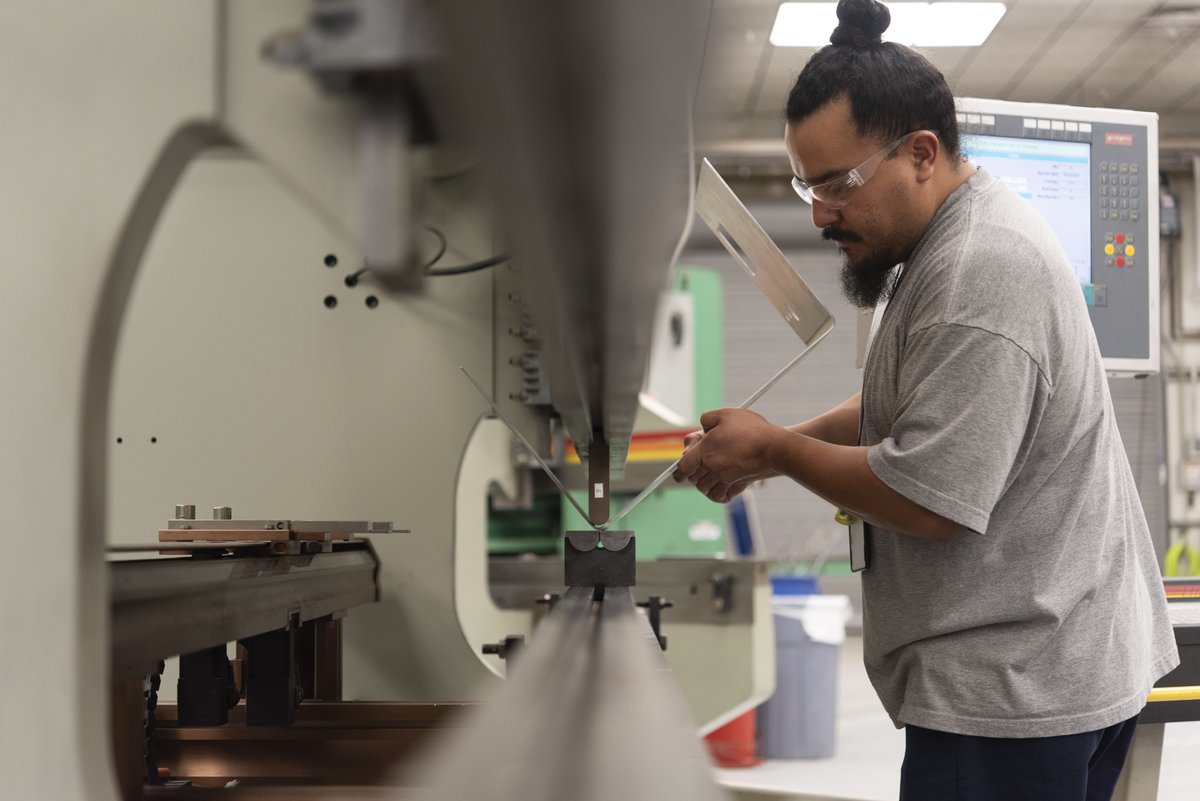
    Before NASA aircraft take flight, innovation happens on the ground. NASA Armstrong’s Experimental Fabrication Branch transforms digital designs into mission-ready hardware, supporting flight research, advanced manufacturing, and STEM outreach. Every component they build
    Alexis Moreno, an engineering technician, works with a fabrication machine in the Experimental Fabrication Branch at NASA’s Armstrong Flight Research Center in Edwards, California, on Monday, Nov. 6, 2023.
Credit: NASA/Genaro Vavuris
    An engineering technician works in the Experimental Fabrication Branch at NASA’s Armstrong Flight Research Center in Edwards, California, on Thursday, March 14, 2023.
Credit: NASA/Steve Freeman
    Ron Harris, an engineering technician, works in the Experimental Fabrication Branch at NASA’s Armstrong Flight Research Center in Edwards, California, on Thursday, March 14, 2023.
Credit: NASA/Steve Freeman
    An engineering technician works in the Experimental Fabrication Branch at NASA’s Armstrong Flight Research Center in Edwards, California, on Thursday, March 14, 2023.
Credit: NASA/Steve Freeman
    2.7K
  • user avatar
    NASA Armstrong
    NASA
    @NASAArmstrong
    Jun 22
    Airborne observations are giving scientists clearer insights into floods, glaciers, and forests across the tropics. Data from 17 flights with NASA’s C-20A aircraft is improving flood preparedness, glacier monitoring, and forest assessments while also supporting calibration for
    NASA’s C-20A takes off from NASA’s Armstrong Flight Research Center in Edwards, California, on Wednesday, April 29, 2026. Credit: NASA/Jim Ross
    Alvin Mitchell, a NASA C-20A aircraft quality assurance inspector, completes preflight checks at NASA’s Armstrong Flight Research Center in Edwards, California, on April 29 for a mission over Central California. Credit: NASA/Ryan Kline
    7.8K
  • NASA Armstrong reposted
    user avatar
    NASA Technology
    NASA
    @NASA_Technology
    Jun 17
    Hello, Griffin-1! We’re pleased to have helped advance the Hazard Detection Lidar technology that will scan and analyze the Moon’s terrain in real-time to map and select the safest landing site. Learn more: go.nasa.gov/4fSlkFo Credit: @astrobotictechnology
    Image
    00:00
    Astrobotic’s Griffin-1 lunar lander sits inside a clean room at the company’s facility. The lander is covered in dark solar panels and mounted on a wheeled test stand. Engineers in white clean-room attire work nearby, with the Astrobotic logo and a large American flag visible in the background. Credit: Astrobotic
    user avatar
    NASA Moon Base
    NASA
    @NASAMoonBase
    Jun 15
    A Moon Base lander is one step closer to the lunar South Pole.  @astrobotic recently unveiled the Griffin-1 lunar lander, now ready for environmental testing at @NASAJPL ahead of its late-2026 launch. Griffin-1 will deliver payloads supporting Moon Base Phase One.
    68K
  • user avatar
    NASA Armstrong
    NASA
    @NASAArmstrong
    Jun 16
    Our thoughts are with everyone at Edwards Air Force Base and across the Antelope Valley community following yesterday's B‑52 crash. NASA stands with our neighbors and all who are affected during this difficult time.
— NASA's Armstrong Flight Research Center
    6.2K
  • NASA Armstrong reposted
    user avatar
    NASA Aeronautics
    NASA
    @NASAaero
    Jun 12
    ✈️ ANOTHER MILESTONE UNLOCKED: NASA’s X-59 reaches speed, altitude for future quiet supersonic flight testing! NASA's X-59 experimental aircraft achieved a major milestone June 12, reaching Mach 1.4 (about 924 mph) and an altitude of 55,000 feet – its fastest and highest flight
    NASA’s X-59 quiet supersonic research aircraft reached its target speed and altitude for future community overflights for the first time during a flight on Friday, June 12, 2026. The milestone marked the first time the aircraft flew at Mach 1.4 and 55,000 feet — conditions it will fly when gathering community response data to its quiet sonic thump.
    365K
  • user avatar
    NASA Armstrong
    NASA
    @NASAArmstrong
    Jun 11
    NASA’s ER-2 soared to an altitude of 65,000 feet to support GEMx (NASA-USGS Geologic Earth Mapping Experiment), collecting data to help map rare Earth minerals across the Southwest. 26 flights. 125+ hours. A growing record dataset that’s helping to advance Earth and mineral
    A NASA ER-2 high-altitude aircraft takes off from NASA’s Armstrong Flight Research Center in Edwards California on Tuesday, March 31, 2026, to support the Geological Earth Mapping Experiment (GEMx) airborne science mission. Credit: NASA/Carla Escamilla
    Mechanic Francisco Rodriguez and crew chief Darin Whittington installed the Airborne Visible/Infrared Imaging Spectrometer (AVIRIS) instrument into a NASA ER-2 high-altitude aircraft at NASA’s Armstrong Flight Research Center in Edwards, California, on Wednesday, March 11, 2026. Credit: NASA/Jim Ross
    13K
  • NASA Armstrong reposted
    user avatar
    NASA
    @NASA
    Jun 9
    Introducing Artemis III. Four astronauts. Three launches. Two dockings. One splashdown. In 2027, the Artemis III mission will practice docking the Orion spacecraft with two lunar landers in low Earth orbit — the capability we need to return humanity to the Moon’s surface.
    Image
    00:00
    2M
  • NASA Armstrong reposted
    user avatar
    NASA
    @NASA
    Jun 9
    LIVE: Meet the crew of our next Artemis mission. We're sharing the latest updates on Artemis III:
    1.3M
  • user avatar
    NASA Armstrong
    NASA
    @NASAArmstrong
    Jun 8
    NASA’s X-59 just cleared a huge milestone with its first supersonic flight. Next up: the first mission conditions flight at Mach 1.4 and an altitude of 55,000 feet, key for future community overflights. Bonus: You can follow the upcoming flight live on NASA’s flight tracker.
    NASA’s X-59 quiet supersonic research aircraft completed its first supersonic flight Friday, June 5, 2026, marking the first time the aircraft exceeded the speed of sound in support of NASA’s Quesst mission. The milestone represents a major step in flight testing as the aircraft expands into the supersonic portion of its flight envelope. Credit: NASA / Lori Losey
    23K
  • NASA Armstrong reposted
    user avatar
    NASA Aeronautics
    NASA
    @NASAaero
    Jun 6
    ✈️ A historic moment for the X-59 and NASA's Quesst mission. Watch the moment the X-59 exceeded the speed of sound for the first time ever, marking a major milestone on the path toward demonstrating quiet supersonic flight over land. The display shows Mach 1.07, but the
    Image
    00:00
    40K

New to X?

Sign up now to get your own personalized timeline!

Create account

By signing up, you agree to the Terms of Service and Privacy Policy, including Cookie Use.

Terms·Privacy·Cookies·Accessibility·Ads Info·© 2026 X Corp.
Don't miss what's happening
People on X are the first to know.
Log inSign up
Image
REPLAY
user avatar
NASA
@NASA
NASA's Artemis III Announcement
Advertisement
Advertisement