Log inSign up
NASA Science
NASA
20.6K posts
Image
user avatar
NASA Science
NASA
@NASAScience_
Powered by data, driven by discovery, made for everyone.
science.nasa.gov
Joined September 2010
84
Following
1.3M
Followers
  • NASA Science reposted
    user avatar
    NASA Universe
    NASA
    @NASAUniverse
    2h
    Every household needs a multitool … ours is the Swift observatory! At launch, Swift was a first-of-its kind spacecraft designed to study fleeting gamma-ray bursts, the most powerful explosions in the cosmos, using its Ultraviolet/Optical, X-ray, and Burst Alert telescopes. ⬇️
    This infographic, titled “Astrophysics Multitool: NASA’s Neil Gehrels Swift Observatory,” is in shades of blue with pops of green, purple, and orange. A line of illustrations bisects. Below the title reads “Original Objectives: To discover and quickly localize GRBs (gamma-ray bursts) and observe their afterglows in visible, ultraviolet, and X-ray light.” Below that reads, “Since launching on Nov. 20, 2004, Swift has …” To the right of the illustrations are boxes highlighting science Swift has contributed to. Each is labeled with the science area and has five examples. The top box is labeled “GRBs,” and the first example is “ Detected thousands of GRBs.” The next is “Stars,” and its first example is “Spotted megaflares from red dwarf stars.” The next box is “Near Earth,” with “Measured water released by comets.” Finally, the last box is “Black Holes,” and with “Discovered new black holes.” The image is watermarked “Credit: NASA’s Goddard Space Flight Center.”
    7.4K
  • user avatar
    NASA Science
    NASA
    @NASAScience_
    3h
    A NASA-sponsored team developed an open-source tool that uses machine learning to speed up identification of potential flash floods, delivering near real-time insights to help communities respond faster. Explore how this data-driven tech tracks extreme weather and produces
    A satellite image shows a large, tightly wound cyclone over the northeastern Pacific Ocean. The storm features a distinct spiral shape with a well‑defined center and broad bands of clouds fanning outward. The western coastline of the United States and Canada, including Washington, Oregon, and British Columbia, is visible to the right, partly covered by cloud cover from the storm system.
    5.5K
  • NASA Science reposted
    user avatar
    Nancy Grace Roman Space Telescope
    NASA
    @NASARoman
    4h
    The Roman Space Telescope was packed inside the CHARIOT, placed on the Pegasus barge, and pulled by tug boats approximately 820 nautical miles to @NASAKennedy. Next, this cosmic titan will be placed on a work platform called the Pantheon for post-shipment inspection. Soon, it
    A wide shot of an enormous gray and white canister sitting on a barge in the water. At the left, a large building has a huge opening like a vertical rectangular slot. On the front of this building there’s a large NASA “meatball” logo and an American flag.
    8.6K
  • NASA Science reposted
    user avatar
    NASA Webb Telescope
    NASA
    @NASAWebb
    Jun 22
    You might have heard of interstellar comet 3I/ATLAS. We don't get the opportunity to study objects like this often. Webb took a look at the comet's composition. It's showing us how unusual our own solar system might be. Here's what we've learned 👇
    NIRSpec map of specific chemical and molecular signatures in comet 3I/ATLAS. Three images, two on top and one on the bottom left show different signatures, H2O, CO2, and CO. Each signature looks like a pixelated dot. H2O is blue, CO2 is yellow, and CO is red.
    148K
  • user avatar
    NASA Science
    NASA
    @NASAScience_
    Jun 18
    NASA has selected the DAPHNE mission to study how Earth’s atmosphere drives space weather, helping improve predictions that protect tech and astronauts. Twin satellites will launch no earlier than 2029. More: go.nasa.gov/4vf3LE5
    Image
    242K
    user avatar
    NASA Science
    NASA
    @NASAScience_
    Jun 18
    Led by Aimee Merkel at the University of Colorado Boulder, the DAPHNE mission is a key step toward protecting astronauts on their journeys to the Moon, Mars, and beyond while improving space weather forecasting here on Earth.
    Image
    00:00
    6.6K
  • NASA Science reposted
    user avatar
    Nancy Grace Roman Space Telescope
    NASA
    @NASARoman
    Jun 17
    Have you caught yourself 'Roman' around the internet looking for mission updates? We now have a blog! Stay up to date on all things Roman: science.nasa.gov/blogs/roman/
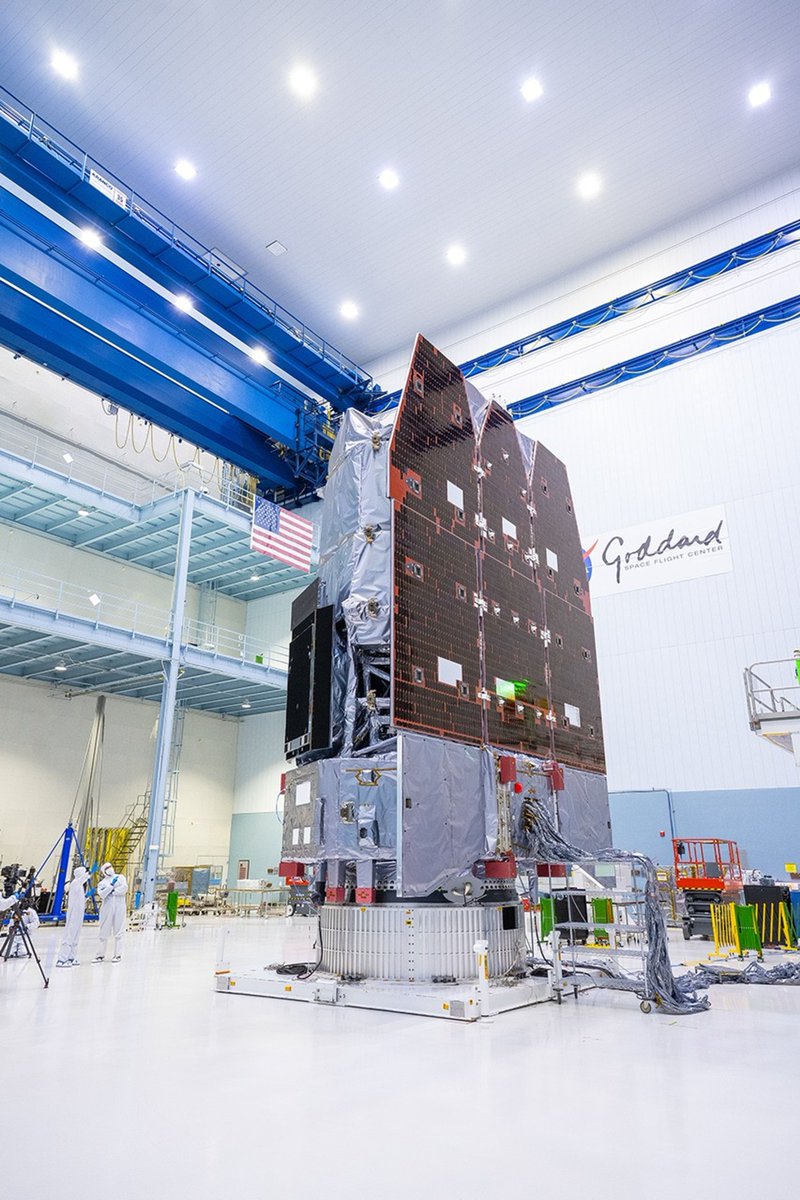
    The integrated Roman Space Telescope in Goddard’s large white clean room. Six large red solar panels covered in black squares lined up in three columns next to each other are opened up on the observatory. Two people in head to toe white clean room jumpsuits are standing to the left of the telescope, looking up at it.
    22K
  • NASA Science reposted
    user avatar
    NASA Universe
    NASA
    @NASAUniverse
    Jun 17
    These stars took sibling rivalry to the next level! Our Fermi telescope found two supernova remnants that are likely the debris from a stellar pair where one star exploded, sending the other hurtling through space … and then it blew up too: go.nasa.gov/4vQ51NP #AAS248
    This multiwavelength scene shows the Jellyfish Nebula supernova remnant, the interstellar cloud it’s interacting with, and a distinctive curving filament to its upper left. Visible light is shown in yellow, UV from NASA’s Neil Gehrels Swift Observatory is shown in violet, and infrared light from NASA’s retired WISE mission appears in cyan, red, and orange. On a mottled reddish background speckled with stars, yellow threads of gas at center right trace out a dome-shaped structure from which curving tendrils extend toward the lower right. Blue and red filaments trace a ring around the dome’s base. A violet arc stretches right to left just above the center of the image, and irregular orange gas clouds become thicker toward the upper left. The image is watermarked “Credit: NASA Goddard Space Flight Center and M. Michailidis et al. 2026; optical: DSS; infrared: NASA/WISE/JPL-Caltech/UCLA; ultraviolet: NASA/Swift.”
    25K
  • NASA Science reposted
    user avatar
    NASA
    @NASA
    Jun 17
    LIVE: Experts from NASA, Katalyst Space, and Northrop Grumman preview the mission to boost the orbit of our Swift Observatory. Raising Swift's altitude will extend its mission lifespan. youtube.com/live/ymp7dIUvp…
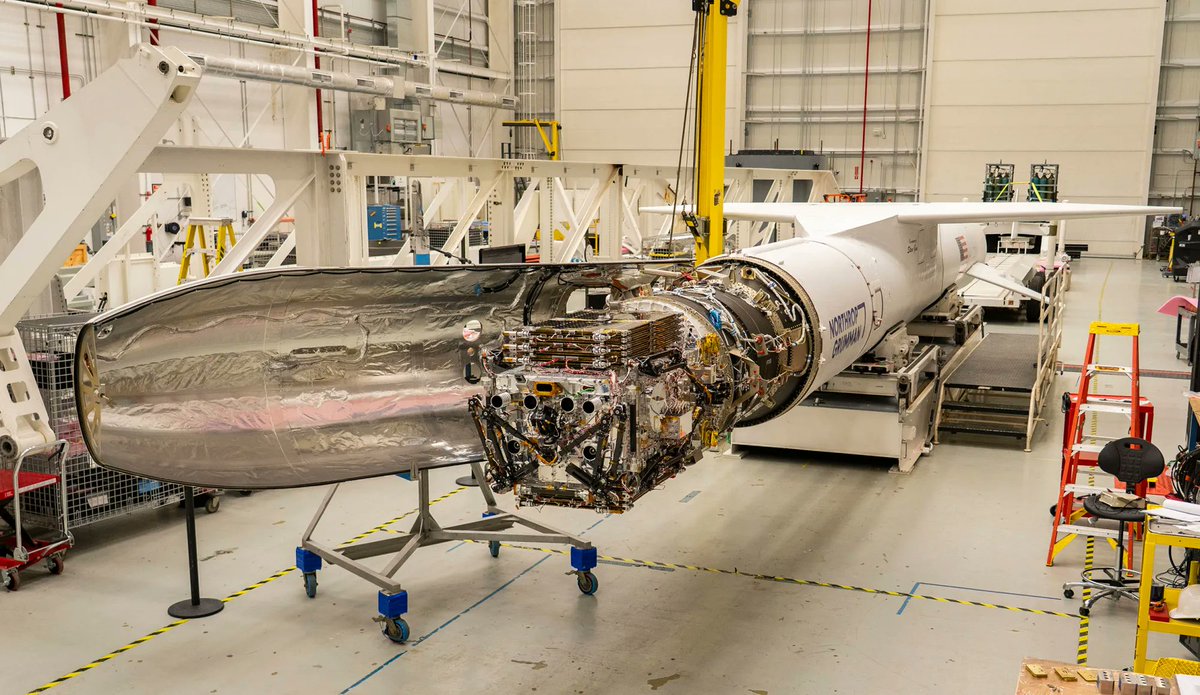
    Katalyst Space’s LINK robotic servicing satellite awaits encapsulation inside a Northrop Grumman Pegasus XL on June 8, 2026, at NASA’s Wallops Flight Facility in Virginia. The satellite is in the middle, with part of the Pegasus rocket's silver interior visible. Credit: NASA/Ron Beard
    526K
  • NASA Science reposted
    user avatar
    NASA Science
    NASA
    @NASAScience_
    Jun 16
    Extending mission lifetimes takes bold innovation and teamwork. Join us Wednesday, June 17 at 11am ET, to preview of one of our most daring undertakings: the @katalystspace mission to boost the orbit of @NASA’s Swift observatory: go.nasa.gov/4vRV1ni
    Overhead view inside a dark thermal vacuum test chamber. At the center, a satellite sits on a circular platform surrounded by testing equipment, reflective panels, ladders, cables, and measurement targets. Two people in white cleanroom suits stand nearby looking up toward the camera, while spotlights illuminate the spacecraft against the otherwise black chamber interior.
    13K
  • user avatar
    NASA Science
    NASA
    @NASAScience_
    Jun 16
    Extending mission lifetimes takes bold innovation and teamwork. Join us Wednesday, June 17 at 11am ET, to preview of one of our most daring undertakings: the @katalystspace mission to boost the orbit of @NASA’s Swift observatory: go.nasa.gov/4vRV1ni
    Overhead view inside a dark thermal vacuum test chamber. At the center, a satellite sits on a circular platform surrounded by testing equipment, reflective panels, ladders, cables, and measurement targets. Two people in white cleanroom suits stand nearby looking up toward the camera, while spotlights illuminate the spacecraft against the otherwise black chamber interior.
    13K
  • NASA Science reposted
    user avatar
    Learn With NASA
    NASA
    @LearnWithNASA
    Jun 16
    Calling all science sleuths! 🕵️🔎 The new @NASAScience_ "Shock Detectives" project is recruiting volunteers to help scientists examine data about the "bow shock" created when the solar wind encounters Earth’s magnetic field. Ready to help? Learn more: science.nasa.gov/citizen-scienc…
    Cartoon of Earth with a surprised face wearing a Sherlock Holmes' style hat and holding a magnifying glass to observe a swirl of particles bending around it and a satellite, with the title Shock Detectives
    5.5K
  • NASA Science reposted
    user avatar
    International Space Station
    NASA
    @Space_Station
    Jun 15
    Big splashdown, bigger science! 🌊🧪 One heavy, science-packed Dragon spacecraft is coming home, wrapping up SpaceX’s 34th resupply mission to station. Learn how returning samples and hardware prepare humans for deep-space exploration and improve life on Earth.
    Image
    NASA’s SpaceX CRS-34 Dragon Returns Packed with Space Station Science - NASA
    From nasa.gov
    44K
  • NASA Science reposted
    user avatar
    Learn With NASA
    NASA
    @LearnWithNASA
    Jun 15
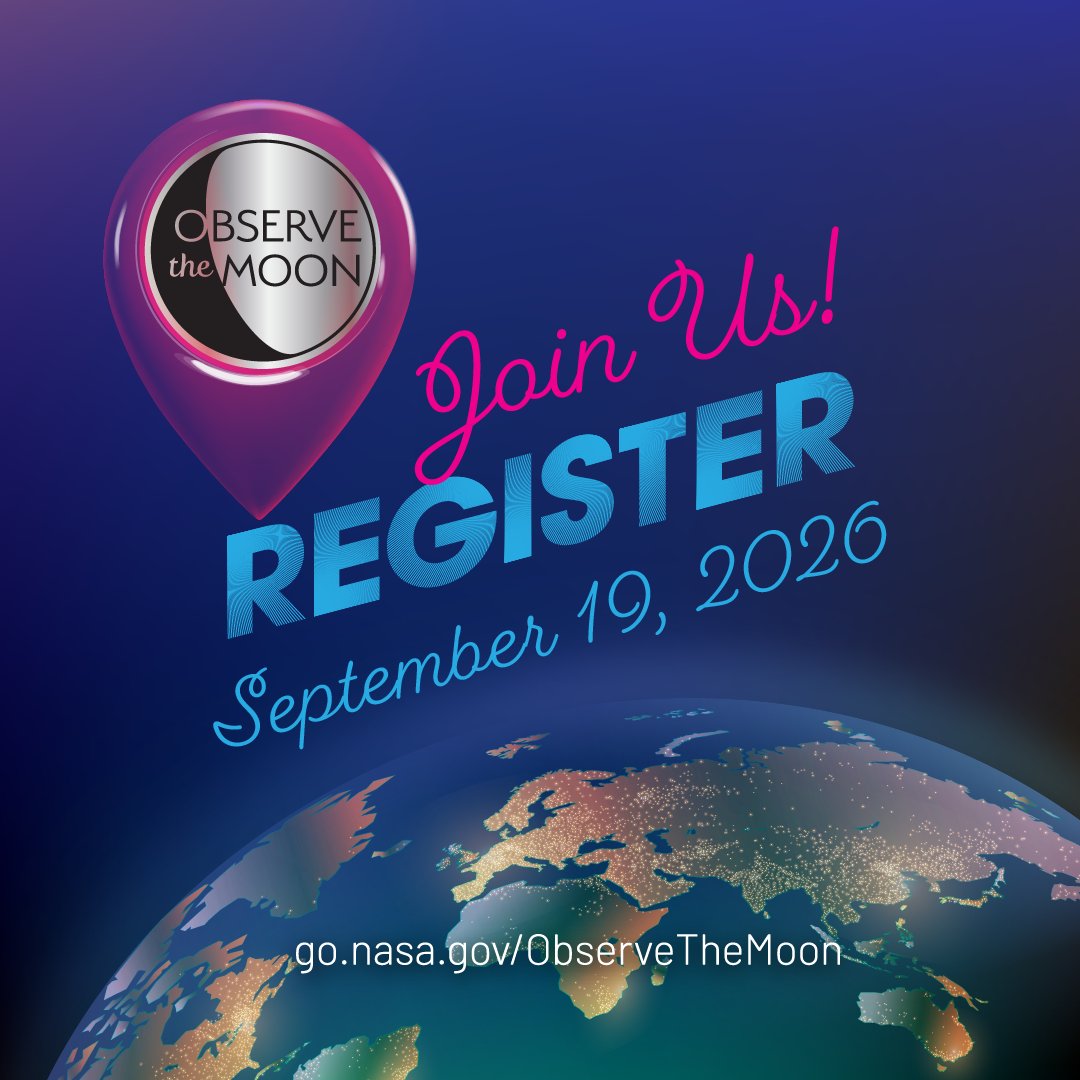
    Get ready for a worldwide Moon appreciation moment 🌓 Last International Observe the Moon Night, an estimated 1 million people in 128 countries celebrated our nearest neighbor in space together. Who will you observe the Moon with this year? Sign up: go.nasa.gov/ObserveTheMoon
    Illustrated graphic showing a portion of Earth, with major land masses appearing gold-brown and blue-green. The text "Join Us! Register September 19, 2026" is centered. At upper left, a simple representation of a waxing gibbous Moon with the words “Observe the Moon” is shown inside of a location pin.
    44K

New to X?

Sign up now to get your own personalized timeline!

Create account

By signing up, you agree to the Terms of Service and Privacy Policy, including Cookie Use.

Terms·Privacy·Cookies·Accessibility·Ads Info·© 2026 X Corp.
Don't miss what's happening
People on X are the first to know.
Log inSign up
Advertisement
Advertisement