SpAItial is pioneering spatial foundation models (SFMs), a groundbreaking AI paradigm that generates virtual environments that behave like the real world.
🚀Echo-2 is here - our new world model!
These aren’t videos. These are 𝟑𝐃 𝐬𝐜𝐞𝐧𝐞𝐬. Generated from a single image.
- Stunning visual quality.
- Real-time rendering.
- Interactive camera control.
- Physically grounded.
🧵More details👇
New from SpAItial. You can now:
- Create 3D world directly from the Claude desktop app using the new SpAItial AI plugin
- Create worlds with your agents using the SpAItial MCP. Works for Claude Code, Codex, OpenCode, VS Code, Windsurf etc
Create, edit, refine your worlds
A fun way to try the new Claude Fable. I asked it to train a bot using RL to navigate 3D worlds created with @SpAItial_AI.
This is all running in the browser including RL training! Link to demo and code in comments
What you can do:
-> Train a bot from scratch, watch it learn
Photoreal walls. Real geometry. Bots. WebRTC and all open source.
Here's how built a fully multiplayer, browser-playable Quake III arena where every level is a 3D world created from a single Image using Echo-2 🧵👇
SplatArena: Multiplayer arena is LIVE 🚀🚀🚀
Quake3-style combat. Drop in, frag your friends, and play on a world generated by Echo-2.
Play now, directly in your browser:
arena.spaitial.io
The best part: it's all open source (GPLv2). Repo + local setup docs here 👇
github.com/spaitial-ai/sp…
Build a map from your own .spz and run the whole stack locally. Point Cursor/Claude at the README and it'll walk you through setup.
The rendering trick: two stacked canvases.
Back canvas = @playcanvas renders the photoreal splats (.sog, GPU sort, LOD). Front canvas is ioquake3 compiled to WASM draws players, weapons, HUD.
The BSP is invisible, as it only does collision + depth so you don't shoot through
Multiplayer is WebRTC.
Signaling rides through the edge to an in-cluster proxy. Once ICE settles, media is a direct UDP DataChannel browser to game-server pod.
One game = one Agones GameServer pod (q3ded) on Kubernetes, with warm pools per region across EU + US.
Having a few hours this afternoon after @CVPR? Consider visiting Red Rocks 20 minutes outside of Denver!
For some inspiration, here's a world processed by @SpAItial_AI Echo-2 HQ model from a single phone image!
Link to the world in🧵
❄️ New @playcanvas engine example: real-time Depth of Field on Gaussian Splats, powered by the engine's post-processing stack — with scene depth driven by a proxy mesh.
Thanks to @SpAItial_AI for the Gaussian Splat + mesh generation 🙏
Live link 👇
Fun weekend project: using @AIatMeta Sam3 to segment objects inside a @SpAItial_AI scene.
Pipeline:
-> Generate a world on @SpAItial_AI app and export as .ply
-> @playcanvas viewer to render splat + a uniform spatial grid over splat centers
-> Capture frames + camera pose,
Excited to share that our paper MeshSplatting received an Oral at CVPR 2026! 🎉
I’ll be presenting the CVPR oral:
🗓 Friday, June 5
🕐 13:00 - 14:15
📌 Mile High Ballroom 1A - 2A
Have a look at meshsplatting.github.io for more information.
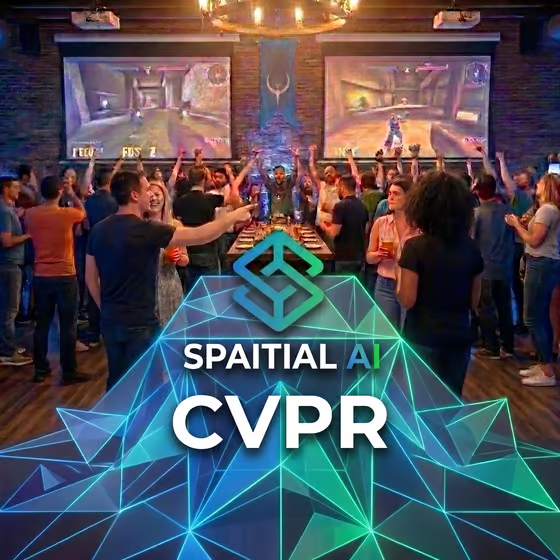
SpAItial ❤️ CVPR'26
We're hosting a welcome event tonight, Wed June 3d 6pm-9pm, and welcome you to CVPR on the first day of the conference!
Come meet the team and get a first look at Echo-2, our latest physically-grounded world model. We'll have plenty of drinks, dinner, and
SplatArena: Multiplayer arena is LIVE 🚀🚀🚀
Quake3-style combat. Drop in, frag your friends, and play on a world generated by Echo-2.
Play now, directly in your browser:
arena.spaitial.io
Releasing Echo-2 HQ, an improved model that delivers greater detail and sharper results.
You can zoom in super close and discover remarkable appearance fidelity. Available via API and in the app. Try it out!
Check out some of the scenes below👇