Log inSign up
Jonathan Pritchard
1,847 posts
Image
user avatar
Jonathan Pritchard
@jkpritch
My lab at Stanford studies human population genetics and complex traits.
Stanford University
pritchardlab.stanford.edu
Joined April 2012
343
Following
15.2K
Followers

New to X?

Sign up now to get your own personalized timeline!

Create account

By signing up, you agree to the Terms of Service and Privacy Policy, including Cookie Use.

Terms·Privacy·Cookies·Accessibility·Ads Info·© 2026 X Corp.
Don't miss what's happening
People on X are the first to know.
Log inSign up
  • Pinned
    user avatar
    Jonathan Pritchard
    @jkpritch
    Oct 1, 2023
    I'm delighted to release the first half of my new open-access online textbook in human population genetics: web.stanford.edu/group/pritchar…
    Image
    683K
  • user avatar
    Jonathan Pritchard
    @jkpritch
    Mar 31, 2023
    Sharing this in case it's useful: I find that students often have a hard time conceptualizing quantitative parameters in genomics and popgen Here's a cheat-sheet I put together for teaching. It's also part of a textbook I have been writing on human genetics (more on that below)
    Image
    209K
  • user avatar
    Jonathan Pritchard
    @jkpritch
    Feb 20, 2024
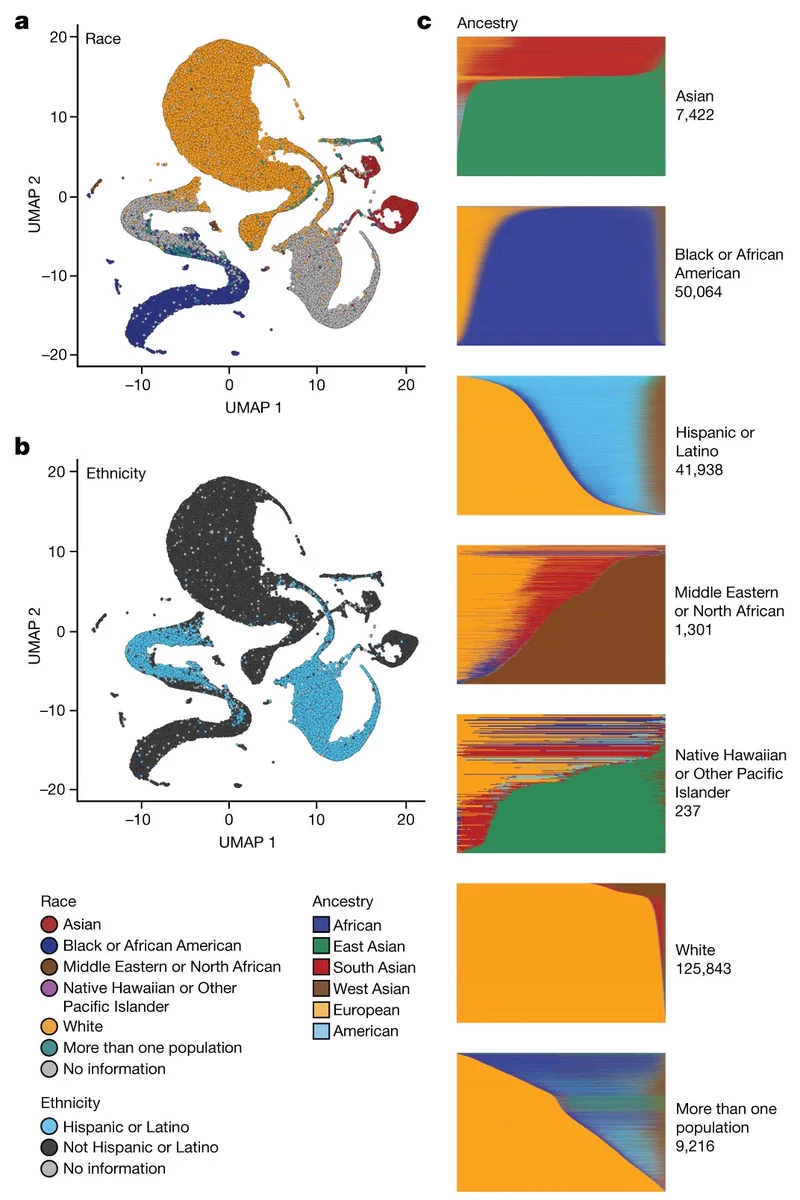
    It's a pity that All of Us used UMAP to visualize ancestry variation in their new marker paper, out today in Nature. The UMAP algorithm, by design, exaggerates the distinctiveness of the most frequent ancestries, a message that can be misinterpreted by the public.
    Image
    704K
  • user avatar
    Jonathan Pritchard
    @jkpritch
    Apr 19, 2024
    Two new chapters from my open-access textbook in human population genetics are now online: - Population structure: I. Ancestry estimation - Population structure: II. More about admixture web.stanford.edu/group/pritchar…
    user avatar
    Jonathan Pritchard
    @jkpritch
    Oct 1, 2023
    I'm delighted to release the first half of my new open-access online textbook in human population genetics: web.stanford.edu/group/pritchar…
    Image
    120K
  • user avatar
    Jonathan Pritchard
    @jkpritch
    Apr 16, 2022
    I was thinking about how a paper that has been on bioRxiv for a year got massive attention on here when it came out in Nature this week. To me this shows that our community still needs to do more to promote and disseminate the great work in preprints.
  • user avatar
    Jonathan Pritchard
    @jkpritch
    Sep 14, 2021
    Today marks the 25th anniversary of Neil Risch and Kathleen Merikangas' classic 2-page paper that articulated GWAS as the future of human genetics. A short thread. www-leland.stanford.edu/~huatang/gene2…
    Image
  • user avatar
    Jonathan Pritchard
    @jkpritch
    Sep 23, 2024
    Two new chapters from my free online book in human genetics out this weekend! These complete Part 3 of the book, on human population structure and history: 3.3: Inferring human prehistory from genetic data [this thread] 3.4: Ancient DNA [next thread] web.stanford.edu/group/pritchar…
    user avatar
    Jonathan Pritchard
    @jkpritch
    Oct 1, 2023
    I'm delighted to release the first half of my new open-access online textbook in human population genetics: web.stanford.edu/group/pritchar…
    Image
    62K
  • user avatar
    Jonathan Pritchard
    @jkpritch
    Nov 7, 2019
    Delighted to share our latest work, on ancient DNA of individuals from in and around Rome, spanning the last 12,000 years. At its peak Rome was the largest city of the ancient world with 1M inhabitants, controlling an empire of 70M people science.sciencemag.org/content/366/64…
  • user avatar
    Jonathan Pritchard
    @jkpritch
    May 3, 2019
    Our new work on understanding the architecture of complex traits "Trans effects on gene expression can drive omnigenic inheritance" is out today cell.com/cell/fulltext/… Great collaboration with @XuanyaoLiu @yang_i_li
    Image
  • user avatar
    Jonathan Pritchard
    @jkpritch
    Jan 26, 2025
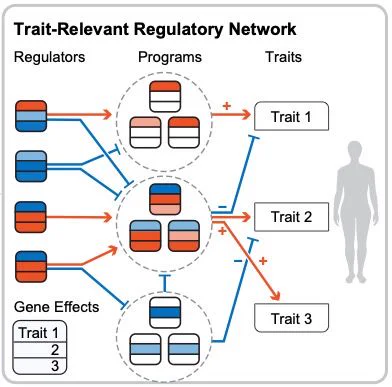
    Modern GWAS can identify 1000s of hits but it can be hard to turn this into biological insight. What key cellular functions link genetic variation to disease? I'm excited to present our new work combining associations + Perturb-seq to build interpretable causal graphs! A🧵
    Image
    64K
  • user avatar
    Jonathan Pritchard
    @jkpritch
    Sep 23, 2024
    Two new chapters from my free online book in human genetics out this weekend! These complete Part 3 of the book, on human population structure and history: 3.3: Human prehistory [separate thread] 3.4: Ancient DNA: a genetic time capsule [this thread] web.stanford.edu/group/pritchar…
    user avatar
    Jonathan Pritchard
    @jkpritch
    Oct 1, 2023
    I'm delighted to release the first half of my new open-access online textbook in human population genetics: web.stanford.edu/group/pritchar…
    Image
    42K
  • user avatar
    Jonathan Pritchard
    @jkpritch
    Feb 17, 2021
    Our work on genetic architecture of molecular traits is out now: elifesciences.org/articles/58615 We studied GWAS of urate, IGF1 and testosterone-chosen because much is already known about their biology. Eg for testosterone we see clear enrichment of GWAS hits in the biosynthesis pathway
    Image
    Image
  • user avatar
    Jonathan Pritchard
    @jkpritch
    Apr 23, 2020
    I share my surname with Stanford's QB coach, so I regularly get emails from football recruits (unlike my lab applications these list hand-size). But this is something new. Do we need an offensive graduate assistant? Wants to be promoted from offensive intern. How offensive?
    Image
  • user avatar
    Jonathan Pritchard
    @jkpritch
    Apr 22, 2020
    Our latest: "GWAS of three molecular traits highlights core genes and pathways alongside a highly polygenic background": biorxiv.org/content/10.110… We use urate, IGF-1, and testosterone as model molecular traits to learn general principles about the architecture of complex traits.
    Image
    biorxiv.org
    GWAS of three molecular traits highlights core genes and pathways alongside a highly polygenic...
    Genome-wide association studies (GWAS) have been used to study the genetic basis of a wide variety of complex diseases and other traits. However, for most traits it remains difficult to interpret...
Advertisement
Advertisement