
RAI Institute
39 posts

RAI Institute
@rai_inst
We aim to solve the most important and fundamental problems in robotics and AI. (Formerly The AI Institute)
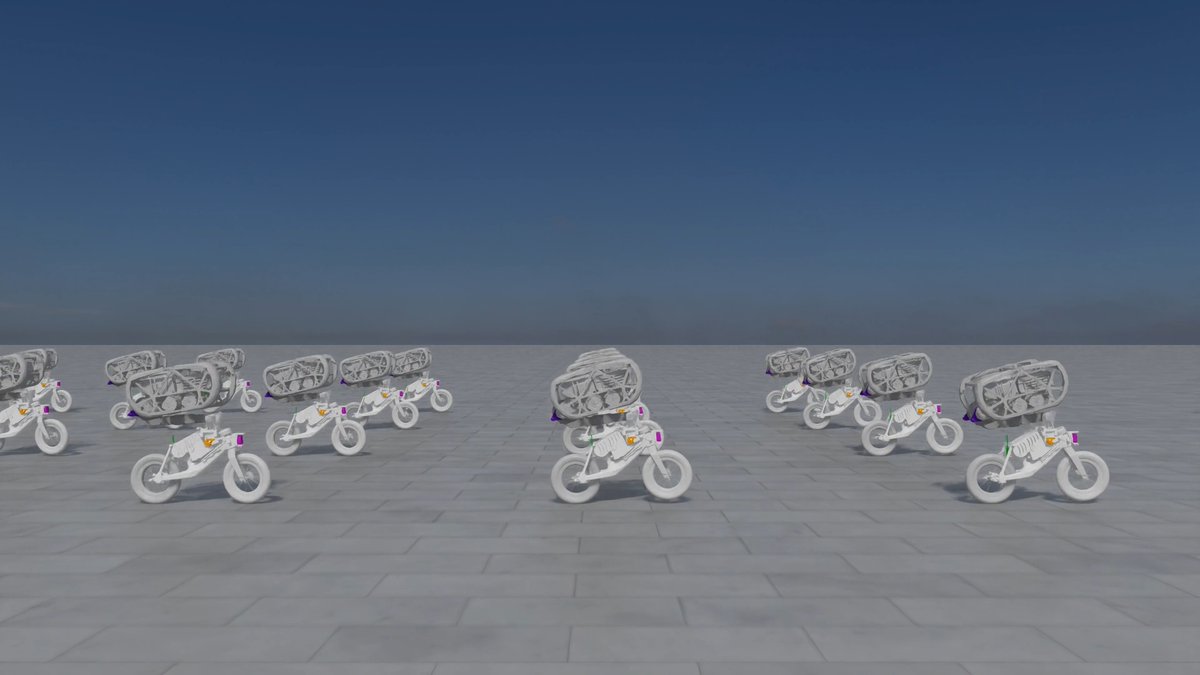
- Using reinforcement learning we have expanded the range of techniques the Ultra Mobile Vehicle (UMV) uses to handle terrain and obstacles, including hops, out-of-plane balance, and level-ground flips. Millions of physics-based simulations provide training data to support
 00:00
00:00 - Using reinforcement learning, we trained policies for @BostonDynamics Spot that allow the robot to achieve record running speeds of 11.5 mph (5.2 m/s) — over three times faster than Spot's default max speed.
 00:00
00:00 - In this demo, Ultra Mobile Vehicle (UMV) drives, turns, jumps, tricks, and comes to a sudden stop called a track-stand. All of the driving, landings, balance, and track-stands are done using reinforcement learning.
 00:00
00:00 - See Spot perform dynamic whole-body manipulation. Using a combination of reinforcement learning (RL) and sampling-based control, the robot is able to autonomously drag, roll, and stack tires weighing 15 kg (33 lb), well above its maximum arm lift capacity. Learn more about
 00:00
00:00 - Reinforcement learning is used to speed the production of behavior for the @BostonDynamics Atlas humanoid robot. At the heart of the learning process is a physics-based simulator that generates training data for a variety of maneuvers.
 00:00
00:00 - Getting robots to move swiftly and effortlessly through the unstructured world is more challenging than it seems. The RAI Institute is building robots that think, plan, and move like athletes - robots with mobility and intelligence of a professional bike trial rider that can
 00:00
00:00 - Researchers from RAI Institute present Diffuse-CLoC, a new control policy that fuses kinematic motion diffusion models with physics-based control to produce motions that are both physically realistic and precisely controllable. This breakthrough moves us closer to developing
 00:00
00:00 - Introducing Theia, a vision foundation model for robotics developed by our team at the Institute. By using off-the-shelf vision foundation models as a basis, Theia generates rich visual representations for robot policy learning at a lower computation cost. theaiinstitute.com/news/theia
 GIF
GIF - Replying to @rai_instThe control policy tracks and controls retargeted human motion data. Each maneuver is created with data from about 150 million runs of the simulator and transferred zero-shot to the hardware. This work is part of a collaboration between the RAI Institute and @BostonDynamics .
- Announcing our new partnership with @BostonDynamics! We're teaming up to advance humanoid robotics through reinforcement learning. Learn more —
- The next generation of robots is right around the corner. Help us shape the future. Join our team — theaiinstitute.com/careers
 00:00
00:00 - “The key of RL is to discover new behavior and make this robust and reliable under conditions that are very hard to model. That’s where RL really, really shines.” Marco Hutter and Farbod Farshidian discuss the latest progress from the Institute.
- Current robotic systems face constraints in loco-manipulation due to task-specific designs and fixed joint configurations, limiting adaptability in diverse environments. The ReLIC (Reinforcement Learning for Interlimb Coordination) framework being presented at #CoRL2025
 00:00
00:00


