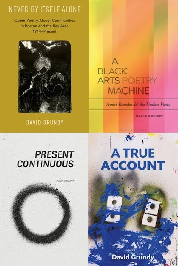
A True Account, a book of poems, recently came out from The 87 Press, with cover art by the great Candace Hill-Montgomery. Here's the write-up:
A True Account collects works written between 2013 and 2020, published by a variety of small presses in the UK and the US. Here are variously refracted the student movement, austerity, general election, referendum, the crisis of 2020 or 2019 or any year you care to name; the Massacre of the Innocents, the housing question, the October Revolution in November; Sappho, Mingus, Storm Ophelia; Rukeyser, Rilke, Rodefer; the aesthetics of resistance, the insistence of history: luxury and voluptuousness, peace and pleasure, beauty and order, the questions that still remain unanswered and the problems that remain unsolved. “Wanting poetry to save my life, to shame my life, as LONG as the WORLD is WIDE, and as WIDE as the WORLD is LONG.”
“Lyrically gorgeous and real poetry. This book is a bright spot in a bleak time.” - Peter Gizzi
--Also out, a cassette release of me reading my 2014 long poem The Problem, The Questions, The Poem on Ben Hall's cassette label Ornette Coleman Fiend Club--available here.
--On Christian Wolff in Artforum. This piece came out just days before the disgraceful firing of AF's editor David Velasco over the publication of the 'Open Letter from the Art Community to Cultural Organizations' against the ongoing mass murder in Gaza, and the subsequent resignation of Zack Hatfield and Chloe Wyma, whose editorial guidance over the pieces I've published in Artforum over the past few years has been exemplary. An open letter of October 27th, criticizing the actions of AF's owners, Penske Media Corporation, can be found and signed here.
***
Meanwhile, in person, for those of you in or around Berlin, I'll be giving two talks in December, both at the Freie Universität: on Monday, December 4th I'll be giving a lecture on Amiri Baraka and the Advanced Workers (details here), and then the following Tuesday, 12th December, I'll be giving a seminar on my current project on free jazz, Survival Music (Room 319, John F Kennedy Institut for American Studies, Lansstraße 7-9, 14195 Berlin, 2pm-4pm). And this month, at the kind invitation of Dimitra Ioannou, I'll be giving a talk at the A Glimpse of Festival, critical institute for Arts and Politics, Politechniou 8, 104 33 Athens, Greece, on the weekend of November 25th/26th.
Keith Rowe (Solo) London Review Bookshop, 22/06/2011
During a brief introduction, Rowe explained that he would be playing two sets: interpretations of, first, a page from Cornelius Cardew’s ‘Treatise’, and second, Christian Wolff’s ‘Edges’. In certain anniversary years of Cardew’s birth, he plays Treatise throughout the year; this year (the 75th anniversary), he was up to page 68 (which is slow progress, apparently). However, as he made clear, the piece was being used as a point of departure, rather than being ‘played’ as such: thus, while he began the performance by keeping a fairly close eye on the score (looking at it continuously as he made one particular manoeuvre), things soon started to lead away from that in the flow, or succession, of improvised ideas. In any case, Treatise is a particularly open piece, designed to encourage thought, care and attention in interpretation, but also to allow the individual to make the music they might make anyway, in a more coherent, or at least, structured, manner: to group ideas that might, otherwise, flow somewhat diffusely or digressively, around a central series of specific points. One might also note that there’s a rather different set of parameters involved in solo, as opposed to ensemble interpretations: whereas (according to one way of playing the score) the ensemble may feed back on itself, certain people’s interpretations of certain symbols informing other individuals’ interpretations in dialogic fashion, the solo performer is interacting solely with the score itself. Rowe remarked, in deadpan fashion, that we wouldn’t notice much difference between the Cardew and the Wolff pieces – he was placed very much in the foreground, with the two composers somewhere in the background of his musical thinking, perhaps serving to focus the occasion (rather than taking an entirely free ‘let’s see what happens’ approach, an exploration of playing as a wholly sufficient and interesting category in itself, à la Derek Bailey), but by no means providing a ‘key’ to understanding the performance, which one could appreciate in and for itself with no knowledge of the scores that were being played (or departed from).
Before describing the music, it might be useful to mention the reduced size of Rowe’s set-up – a small mixing board, two radios (one tuned to BBC Radio 3 (perhaps pre-recorded, as three distinct, and quite different pieces of classical music were used), the other to BBC Radio 5 Live (mainly John McEnroe offering his pundit’s opinion on the second day of the Wimbledon tennis championships, which was happening at the same time across the city)), a fan, an electric toothbrush, brillo pads, stones, pedals, metal objects, and, of course, the ‘guitar’ itself – a modified fretboard, laid flat on the table. I’ll come back to the point later, but it struck me that this set-up offered, on the one hand, an element of risk – what if none of the sounds on offer really seemed to be working, and another option was desired that simply wasn’t there? – and conversely, of stability – the opportunity to really focus in on a specific set of materials and concerns, generating an immediate sense of focus, a certain usefully freeing limitation (if that makes sense).
Anyhow, 'Treatise' began abruptly, one might even say violently: abrasive, sharp, metallic sounds of fairly short durations, chosen deliberately for their jarring effect: at several points, as Rowe scraped a string or rubbed it with a brillo pad, a grimace of concentration, even anger, seemed to cross his face – albeit mixed with a certain glee in pushing things ‘out there’, in taking a particular action to its noisiest extreme. As the set progressed, a more familiar approach asserted itself, with drones coming in and out (often generated by holding an electric toothbrush over a particular string, e-bow style) – this leading at times to the sort of beating frequencies and timbres that have become common in the more drone-oriented areas of ‘eai’. Things were, however, still broken-up – one sensed that, despite having (presumably) decided to take this approach before he started, Rowe was still feeling his way in, which gave the music a palpable sense of discovery, invention. Things weren’t ramshackle, but they were unconcerned with propriety (despite the parallels he likes to draw between his own work and classical music, and his use of fairly substantial classical excerpts in the second set). It was above all about improvisation (in contrast to the more conceptual work on the recent duo with Radu Malfatti, during which, at certain times, one senses that Rowe was rather less than comfortable (for instance, the fact that the recording of Jurg Frey’s ‘Exact Dimension Without Insistence’ had to be pieced together from three separate takes, because Rowe found it too hard to limit himself to the score’s narrow confines). (I don’t mean to disparage the collaboration, or the Frey score, but to suggest that Rowe may be heard at his best in a situation more akin to the LRB gig.)) Actions here are directed, intended, precise – particularly given the use of the aforementioned small set-up, much reduced in size from those we have seen used in the past– but relations between sounds do not follow a straight narrative pattern. One might say that the second set did follow some sort of linear trajectory, beginning from sparseness – slow, scrubbing and scooping of metal on metal, as objects were moved up and down the strings, with ‘peripheral’ white hiss faded in and out – and moving into the loudest section of the evening, a particularly violent scraping action that made the blue lights on the PA flash and crackle. Nonetheless, this very loose movement towards crescendo (and I’m inevitably simplifying the actual process, the attempt to recall what happened flattening out the actual details of its unfolding) was hardly smooth progress, and certainly not indicative of the general feel the music took. Let’s consider, as more representative, the endings of the two sets: Treatise stopping when Rowe dropped a metal object onto the floor by mistake (he’d just about finished anyway, but the sudden accidental clang made a nice abrupt snap out of ‘the zone’.) A wry smile; “That’s it.” And that was it. Edges, meanwhile, finished with Rowe reaching over and switching off the small desk-lamp which had been lighting the score, as the sounds he’d been making simultaneously ceased. A brief silence (traffic whooshes and whispers leaking in from upstairs), but not luxuriating in it – and from the darkness, “that’s it,” again. There was something very unaffected about this, possessing more in common than one might think (contrary to my earlier suggestion) with Derek Bailey’s no-nonsense approach: the desire to use one’s materials (developed as they are through detailed and constant thought and philosophical investigation) in the situation that exists as one finds it, rather than imposing ‘high art’ into a world it won’t fit. One thinks of the story about Zen archers that Rowe likes to repeat, illustrating as it does the importance of knowing the room, judging the room, being a part of ‘a perfectly ordinary dimension of reality’. Or again, his insistence on not practicing, on not rehearsing, of being actually terrified of his instrument: this is not, as solo improvising can so easily become, the slotting together of a selected assortment of tricks, effects, techniques, patterns in a slightly different order to your last performance, but what he calls “searching for the sound in the performance.”
Some might argue that this shows a sort of contempt for that audience – as if, because Rowe doesn’t woodshed at home, his stage performances become that wood-shedding, rather than a considered, crafted musical piece – and the process is somewhat (ok, very much) antithetical to the notion that dominates some forms of popular music, of putting on a choreographed stage show in which each element fits. (Then again, perhaps that extreme choreography is more a characteristic of an increasingly commodified and ‘whitened’ strain of pop – Madonna, Lady Gaga – where spectacle, costume changes, and dance routines take the place of shifts and discoveries in the music itself. James Brown, by contrast, might have put on a tight –a very tight – show, but there was still space for the music to breathe, for discoveries to be made within those tight parameters that were the music’s raison d’etre.) What Rowe is doing, then, is not showing contempt for his audience (which, in any case, consists on this occasion of no more than thirty or forty people (the venue, in the LRB basement, wouldn’t allow for any more)), but respect for them: taking for granted their willingness to participate in the thought processes he manifests through the sound he creates, to follow the music where it goes, to embrace the possibility of abruptness or jarring transitions or seeming ‘failures’ (where a new technique is tried out and falls flat or seems out of place). It’s an attitude that, perhaps, emerges only from years of playing this music, of developing something of a thick skin, but also of knowing that one is performing in an intimate setting, for an audience who are sympathetic and willing listeners, willing to go (again) where the music demands: an attitude exemplified by the way he played through the sound of a mobile phone going off, that sound then becoming, briefly, a not-unwelcome part of the texture, rather like the found material heard on the radios – not to suggest that “anything goes”, or that any interruption is valid (as in Cage’s 0’00”) (and, indeed, the use of radios seemed rather more pre-ordained, in the manner of sampling, than random or aleatoric) – but that there is a high degree of flexibility to the aesthetic, a flexibility that doesn’t compromise serious dedication to a particular set of goals and methods. Accident and discipline here go hand-in-hand: as in the occasional sounding of the ‘guitar’s’ open strings as ‘accidental’ by-product of other actions, rather the main intention. Another example: at one point during ‘Edges’, a low wadge of feedback conjured up, for me at least, the ‘hard’ sound of the rock guitar – but it happened so quickly that it barely registered as such. While I’ve suggested that Rowe could be considered more and more as a player of ‘electronics’ in recent years, his use of a modified, table-top version of the guitar (like a small chunk sawn off from a ‘real’ instrument), and that aforementioned occasional striking of open strings, reminds one that he does still have some interest in the instrument as such, even if aspects of its heritage rankle with him. Perhaps it’s simply the uncontrollable resonance of history and tradition, asserting itself against or despite departures from it (in contrast to the parodic play with cliché and genre in Amalgam days, and in contrast to the very conscious use, in this performance, of radio’d classical music as something to dialogue with, a technique somewhat reminiscent of the way that Keston Sutherland’s ‘high modernist’ poetry consciously dialogues with poets of the past, even as it studs and stutters itself with mangled fragments of the hyper-modern, the global-technological-late capitalist sphere). In fact, though, it may be that very emergence of historical fragments from outside immediate intention which allows individual artistic development to take place: the shock of something unexpected – either unexpectedly new, or unexpectedly, and disturbingly, familiar – leading to that existential moment where one is forced into a decision – ‘where do I go from here? what do I do now?’ – and where one then makes that decision, where one then acts. From the Paris Transatlantic interview, once more:
“You can't escape history, you can't escape memory - but I can honestly say, even now I will discover things I've never done in my life, and I constantly search for that. To a casual observer it might sound like something I've done before, and I know it isn't. I'm the judge of that, and I'm pretty severe with myself. I do not like the idea of reproducing something I've done before. I will happen on it, I'll suddenly find myself doing something I've done before…
DW: And then do you say "Whoa, I've done that before.." and stop, or do you accept it?
KR: I'll accept it, and then quickly counterpose it with something…Stop it abruptly, so something unethical to it…”
Un-ethical? The fact that Rowe even talks in terms of ethics brings us back to Cardew – ‘Towards an Ethic of Free Improvisation’ – and brings home the fact that this is, in fact, profoundly ethical music-making; well-suited to the visual coincidence (or was it intention?) that found Rowe setting up his table between LRB bookshelves marked ‘Music’, ‘Religion,’ and ‘Cultural Studies.’ Not that the music inspires religious devotion (though Richard Pinnell’s review of the gig under consideration is indeed a fervent response), but that it argues, and earns for itself a certain weight, a certain importance that one might be hard-pressed to think music could now have (except as all-encompassing distraction, as identikit-background-noise to music-video theatricals.) And, really, thank fuck for that.