Showing posts with label Digi-scoping. Show all posts

Friday, 3 October 2025

The Day of the Jackal: Canine Supremacy—The Candid Truth

A wetland patch was the setting yesterday for an intense territorial dispute. It unfolded at Bomiriya, in one of my local wetland patches —a place of life and death, defined by its receding water-line. The stakes were primal, the battle lines drawn in the mud and reed.


Image

Birding during the golden hour with the first rays of light hitting me from behind, I observed a pair of Golden Jackals (Canis aureus)—a first record for this site. They were on a sun-drenched strip of embankment, claiming their ground—There was a clear statement of ownership.


Jackals are opportunistic architects of the ecosystem; their lives a constant ledger of risk and reward. Unlike their domestic counterparts—for whom free food is a guarantee—for the jackal, there was no such thing as a "free lunch." Survival is a matter of wits and finely tuned fieldcraft.


Their tranquility was abruptly shattered by the arrival of two local domestic dogs. These were the pampered overlords of the patch of road, fuelled by ease and the bravado of an assured next meal. 


They approached, a hysterical blur of raised tails and frantic barks, projecting an image of hyper-agitated dominance. The dogs' tails were held high, hind legs slightly spread, every posture screaming an ill-considered challenge, their adrenaline-fueled energy palpable.


Calm Before the Charge

Yet, the jackals remained an image of raw, assertive calm. They watched, their eyes holding a measure of the wildness the dogs had long forgotten.


Then, the tactical masterstroke: one jackal, oozing an unsettling composure, began a slow, deliberate advance. The invisible FDL (forward defence line) of dogs breached, albeit slowly. This subtle shift in momentum proved to be a powerful mind game sending subliminal messages across enemy lines. 


Image

The alpha dogs—so confident moments before—read the unspoken message: This was not a game. Their aggressive posturing instantly collapsed. In a dizzying moment of reversal, the dogs retreated, vacating the very ground they had so hysterically claimed.


The pioneer jackal moved to occupy the vacated spot, sniffing the terrain and sending an angry snarl. Then, the second jackal too filled the frame, completing the strategic manoeuvre, as they both scent-sniffed the abandoned territory. 


A resonant snarl from the newcomer—a sound of pure, untamed intent—was ominous. 


Meanwhile, a wise crow from above uttered an SOS of the imminent danger, and a lapwing, sensing the ground-based threat, flew off uttering signals of distress—all of which fell on deaf ears for the wannabe canine thugs, blinded by their unrelenting NIMBY attitude. 


Observing the tell-tale signs of submission in the dogs' hurried withdrawal, the jackals launched their attack.


It was a terrifying spectacle of raw canine power. The dogs turned tail, bolting towards the road. To that submissive behaviour, I wasted no time in jibing at them for their folly. The jackals, masters of the open marsh, halted their pursuit, allowing the dogs a foolish attempt at a counter-charge. This time, the jackals executed a military-styled tactical withdrawal, melting into the reedy cover of the open marsh. This was a sanctuary the dogs dared not enter, a place of awkward footing and vulnerabilities.


Decisive Retreat

From this hidden fortress, the jackals launched their devastating final ploy. One jackal zeroed in on a fleeing dog. Outmaneuvered, the other dog was dangerously caught off guard. Yet the charging jackal, though briefly distracted by it, stayed fixed on the original target taken. The chase was on, a primal sprint that ended when the panicked dog hurtled toward the only human observer of the scene. 


Under the rush of cortisol and primal instinct, the idiom of "Man's best friend" was discarded. At that moment, and in this marsh, the truth was simple: a dog's best friend was a man. The dog’s energy, a tangible wave of primal terror, radiated the famous Lankan SOS: "බුදු අයියේඅපි ඉවරායි! (Buddha Brother! We are Screwed!)"


The jackal that pursued the dog, sensing the abrupt presence of the "buzzkillington," that is yours truly, veered off. Had I not been planted myself like a pillar, it would have been sure breakfast for the wild canines.


Establishing the Canine Status Quo

Establishing the Canine Status Quo

The dogs' decision to confront their wild cousins was an act of profound folly, a failure to recognize they were challenging the undisputed masters of the marsh, underestimating a primal force they had long forgotten.


The confrontation was over, but the comedy was not. The defeated domestic duo, quickly abandoning the high-stakes conflict, got distracted by a new alpha arriving at the road, drawn by the commotion. Their aggression, so brutally exposed by the jackals, was immediately redirected onto an easier target—perhaps a convenient excuse to cover up the faux pas.

Meanwhile, the true victors executed a masterful, unhurried withdrawal. 


The Golden Jackals simply moved purposefully back toward the safety of their furthest embankment and, after giving some assertive glances, unhurriedly penetrated deep into the reeds, disappearing seamlessly into the protective curtain of the marsh. 


They melted back into the habitat that defined them—the wild space that the dogs, for all their bluster, would never truly own.


It was a clear victory of calm conviction and superior fieldcraft—a potent reminder that in the wild, the established canine status quo dictates that the truly free spirit will always dominate the domesticated heart.


I was lucky enough to capture this entire, suspenseful exchange on camera. You've read the story—now, get ready for the raw, high-definition proof. Stay tuned—the video footage is coming soon, and it's even more intense than the narrative suggests! 

#CanineStatusQuo

#WildVsWired

#TacticalWithdrawal

#marshwars

#BomiriyaUnplugged


PS. Huge Thanks to Dr. Priyantha Wijesinghe for privately lobbying me to review my old nature blog Gallicissa! You're a lovely specimen of a human being and I wish to dedicate this post to you! 


Thursday, 30 September 2010

Absolute Birding–March, 2010

For its number of ridiculously easy photo moments of not-so-easy birds, a 14-day Absolute Birding tour that I guided in March, 2010, will always rank high on my mind's list. I mean birds like this Dull-blue Flycatcher that sat on a fern stem and forgot to fly.

Image

Like this Sirkeer Malkoha, which accosted us so close that I could only capture it with my point and shoot, Coolpix 5100 with just x 4 optical zoom. As the shadow reveals, we were birding at the midday heat on this occassion.

Image

Like this endangered Sri Lanka Whistling Thrush that sat before us delivering its exuberant song, rewarding an early morning vigil beside a ravine in a cloud forest.

Image

Like this Small Pratincole that froze close to the jeep track at the Bundala National Park; we got the message—that it may be nesting nearby—and left the scene, leaving it at peace.

Image

And like this Grey-headed Canary Flycatcher, which tested our fast action photography skills under low light at the Hakgala Botanical Gardens. It was busy foraging for a juvenile.

Image

All these were recorded when I guided David Thrussel and Chris Holtby from the UK on a 14-day Absolute Birding tour from 14–27 March, 2010. Dave and Chris wielded Canon 40D cameras fitted with Canon 100-400mm, and Canon EF 300mm f/4.0 L lenses respectivelty. Chris also used 1.4 x converter at the start, but soon gave it up, opting for higher clarity without it. My rig at that time was similar to Dave's. (Since the middle of this year, I use Canon EOS1D Mark IV; my 40D now collects dust.)

We found 230 species of birds including all 33 endemic birds currently recognised. A top highlight was seeing 12 out of the 15 resident night birds in Sri Lanka. My previous best tally of night birds on a tour lasting 14-days or more was when I showed 10 night birds in early 2009, guiding two Brits.

The dozen night birds seen on this tour were Indian Scops Owl (Katunayake, Kithulgala, and Tissa), Serendib Scops Owl (Kithulgala), Oriental Scops Owl (Sigiriya), Brown Hawk Owl (Kithulgala), Brown Fish Owl (Sigiriya), Brown Wood Owl (Kandy), Spot-bellied Eagle Owl (Kandy), Chestnut-backed Owlet (Kithulgala), Jungle Owlet (close to Tissa), Little Indian Nighthar (Udawalawe, Yala, and Sigiriya), Jerdon's Nightjar (Yala, and Sigiriya), and Sri Lanka Frogmouth (Kithulgala, and Sinharaja). We heard an Indian Jungle Nightjar at Sigiriya, but it didn't cooperate.

A pair of Indian Scops Owls was seen at a daytime roost at Tissa. Here's one of them.

Image

We saw the Jungle Owlet at a patch close to Tissamaharama on three out of three days we birded there. During one of these occasions, it waited long enough to let me digiscope it using my Swarovski ATM-80HD scope and Nikon Coolpix 5100 coupled with a Swarovski Universal Digiscoping Adapter (UDA).

Image

Before meeting Dave and Chris, I have always been reluctant to try high ISO, slow-shutterspeed, handheld captures of birds in dimly lit rain forest conditions because the results have been mostly unsatisfactory. Yes, I used to be picky bird photographer. This made my approach to bird photography largely one-dimensional—engaging on it only when the ambient light was favourable.

However, this approach underwent a radical transformation after meeting Dave and Chris.

Their bold and unrelenting approach to photographing birds, often in conditions that I usually preferred to just enjoy watching birds, was too hard not to copy. Of course there was an invisible competitive element to it too: three boys with similar toys.

Image

The result?
I was able to get captures such as above roosting Sri Lanka Frogmouths—shot 1/40 at ISO1250—an altogether uncharted territory before March, 2010!

Saturday, 3 October 2009

Quote, unquote

Quote, unquote

The treatment, arrived last Monday. Since then the weather has turned lousy for bird photography, with heavy monsoon rains and high gusts not helping the cause. This Yellow-eared Bulbul was in a small feeding party of birds led by Sri Lanka White-eyes at the Victoria Park in Nuwara Eliya, where I found myself on the first outing with my new toy.

Yellow-eared Bulbul

If you are new here, we are talking about the Canon 100-400mm lens, "the treatment" I sought to cure APOBPS, the critical condition that this blog was diagnosed with. This is my first "L series" lens and won't be the last. For the record, it was a brand new one and it put me back by Rs. 185,000 (US$ 1,623). I got it through the local Canon dealer after months of waiting.

The results so far may not relfect those of a 185,000 buck lens yet, but I am sure will get there. This Scaly-bellied Munia was feeding on some seeds, not too far from the aforementioned feeding party.

Scaly-bellied Munia

This Crested Hawk Eagle found close to Kithulgala was too far for my lens and I had to resort to digiscoping to get this one.

Crested Hawk Eagle

Although the weather has not been too favourable for bird photography, it has been not too bad for macro. The quote, unquote critter above, with a face only a mother can love, was found on my neighbour's live fence. It is a Tree hopper (family: Membracidae). Here's a lateral view of it.

Tree hopper

The winds have brought about some pleasant changes in the environment. These include the arrival of migrant birds in search of warmer weather. Noteworthy ones seen by me so far include Grey Wagtail, Forest Wagtail, Blue-tailed Bee-Eater, Barn Swallow, Bright Green Warbler and Common Sandpiper. I am very much looking forward to the Sri Lankan 'birding season', which spans from mid October to late April.

windy

Monday, 15 December 2008

Birding with a Royalist

Another trip to Sinharaja 'World Heritage' rain forest. My visitors this time were Chandanie Wanigatunge and her son Lahiru. Chandanie is a specialist physician and a senior lecturer in pharmacology at a top university in Sri Lanka. Lahiru, a Royalist, was the birder of the two, having got hooked on birds at the age of 6, following a school project. He had just turned 13—the age at which I myself got hooked on birds following a school project at St Peter’s.

Blue-tailed Bee-eater
I wasted no time in reminding Lahiru the 41-0 thrashing we gave to Royal at the School’s under-20 Rugby in 2007. This was very special for me as it was the first victory that I witnessed over Royal, having tasted many bitter and painful defeats—even in 1995, the year that I passed out, the year in which we were a formidable force in schools' rugby. We lost to Royal that year too! That was also the year Lahiru was born, I learnt.

Moving on to matters that are birding, we made our first wayside birding stop on the way to Sinharaja scoring a Crested Serpent Eagle sentinelled on a wayside lamp post. Several migrant Blue-tailed Bee-eaters and a Brown Shrike brought about more stops, thereafter.

Reaching Sinharaja, we bagged several False Lanternflies glued to a wayside tree near the ticket office. After obtaining our permits, and meeting our local guide, we reached our overnight base, Martin’s Simple Lodge, in time for a power lunch—a Sri Lankan rice and curry. It was a bit gloomy when we got there.

False Lanternfly
This pawpaw tree with splayed leaves smack in front of Martin’s restaurant/lounging/birding balcony was obstructing all decent angles for scoping birds that visit the trees in front. And it was blocking the spectacular view of the primary forest, yet nobody had done anything to get rid of it.

Pawpaw tree the pain
And the frigging tree produced no pawpaws! After careful diplomacy, I got the nod of approval for "selectively logging" this alien angiosperm. And soon, it was delegated to a person in martin's ‘inner circle,’ as it's usually done.

We went for our first walk to the forest, anticipating some soggy play. And as expected we made use of our brollies several times as it rained in an ‘on-off’ fashion. No mixed-species bird flocks. However, by the time we finished, we had a moderate haul of birds, with Sri Lanka Junglefowl, Legge’s Flowerpecker, Sri Lanka Crested Drongo, Crimson-backed Flameback, Bright Green Warbler, Dark-fronted Babbler, Black-capped Bulbul, Indian Swiftlet and Brown-breasted Flycatcher all in our list.

Birding was tough work today due to the rainy weather. We returned to Martin’s a bit early as the skies were looking really ominous. And the Pawpaw tree was still standing to cause more misery. Checklist and dinner and we retired early, as we had a 6 o’clock appointment with a flock of Sri Lanka Blue Magpies the following morning.
Asian Brown Flycatcher
We gathered at the restaurant/lounging area for a cuppa just before six the following morning. Distant raucous calls of the Sri Lanka Blue Magpies announced that they were on schedule. When the calls were closing in, I alerted everybody to get ready. Soon, about three Blue Magpies came to land on the railings, chairs and tables to find easy moth-prey under lights. It was amazing how confiding they were, at times even landing within three feet from us! After five minutes or so they vanished into the jungle but soon returned for a second serving.

Reaching a sun-lit edge after breakfast, we had good birding with Orange Minivets, Sri Lanka Hanging Parrots, Sri Lanka Green Pigeons and more Legge's Flowerpeckers keeping us regularly busy. When Chandanie was busy photographing a wood spider, I took Lahiru to see a nest of a Sri Lanka Scimitar Babbler found by our local guide earlier. As we were seeing this nest built on an embankment, I heard faint calls of a few Ashy-headed Laughingthrushes moving in the undergrowth, and soon went for them.

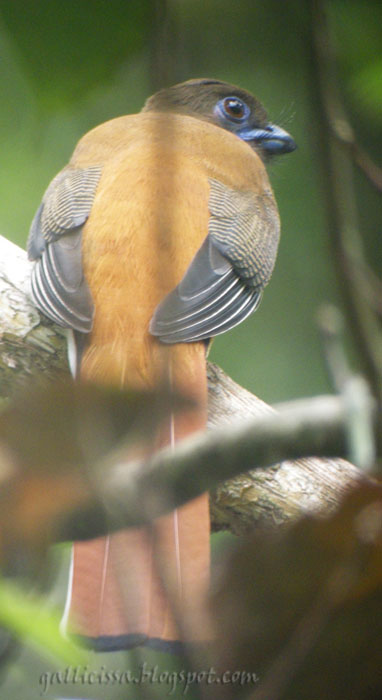
It was then that we realised that we had caught what was actually a tail-end of a mixed species bird flock. The laughingthrush calls that I picked were heard from an otherwise muted mixed species bird flock. Which also looked to be in fast forward mode! Quick footwork to keep up with them gave Lahiru an overdose of lifers. These included Ashy-headed Laughingthrush—which betrayed the presence of the flock, Sri Lanka Crested Drongo—the playmaker of the flock, Red-faced Malkoha—enough said, and Sri Lanka Scimitar Babbler. A Malabar Trogon eluded Lahiru, but I made amends by drawing a female after a pitched vocal dual lasting fifteen minutes! Brilliant scope views amply rewarded our perseverance.

Malabar Trogon
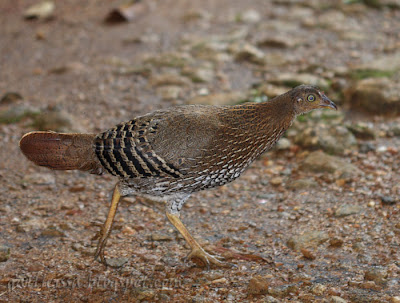
Some of the Sri Lanka Junglefowls are also getting quite tame around the main trail, and we had a male and a female posing nicely for us.

Sri Lanka Junglefowl
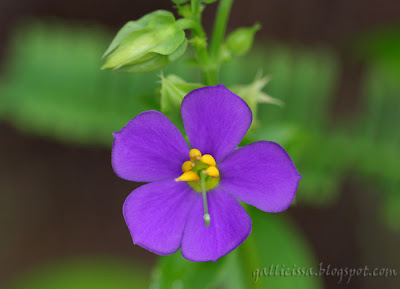
Few trees were in bloom, and a top highlight among them was this showy endemic Exacum trinervium (Binara in Sinhala).
Binara
When we returned to Martin’s before heading back home, the Pawpaw tree was still there, assaulting my senses. A man’s go to do what a man’s got to do and I had to execute this task myself before the "permit" expired. All for the benefit of the birding community!

Thursday, 4 December 2008

Masala

A masala post, bluuurp. Excuse me!

These days, there are regular sightings of Yellow Bitterns, and Black Bitterns at my local wetland patch . Their resident populations seem to have got boosted by migrant populations as it usually happens.
A new bird got added to my bathroom birding list. And it is is this lovely Black-rumped Flameback.

Black-rumped Flameback
The bathroom birding list comprise of birds seen from the bathroom windows (and occasionally doors), when occupied variously in it. My bathroom takes the form of a decent bird watching hide because of its strategic position. Other birds to have made to this pretty exclusive list include Brown Hawk Owl (aka. Brown Boobook) and Orange-headed Thrush! (One bird photographer even called over to photograph the latter using my bathroom as a hide!).

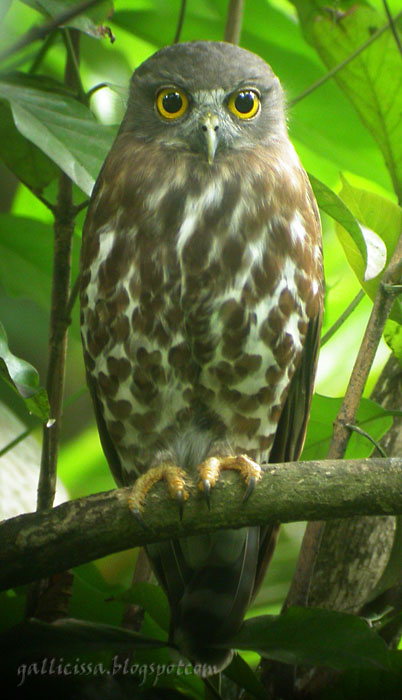
Brown Hawk Owl
Brown Hawk Owl vocalisations are a regular feature at the dusk soundsape these days. I observed a pair calling and chasing each other in what appeared to be a courtship ritual yesterday. I did not use a flash light, as it would disturb them. It’s the beginning of the breeding season for a lot of birds including this one.

BTW, the above picture of Brown Hawk Owl, shot at my yard, will appear in the Thayer Birding Software’s Gold Edition DVD – Birds of North America to be released on 12 December, 2008.

For your information, a Brown Hawk Owl was recorded by a tour guide named Jake Mohlmann at the rarity Mecca, St Paul’s Island off the coast of Alaska in North America in August, 2007. It stayed on untill September.

So, it’s officially now made its way to the ABA checklist.

Click here to see the pictures of the errant bird and to read the very interesting account written by Jake on this mega sighting. Also read this post by N8’s account at The Drinking Bird on the same.

The aforementioned DVD lists 2,850 photos, 708 songs, 551 videos ( including 493 new action videos), 837 abundance maps, thousands of variations of over 700 quizzes, 957 range maps ( including 695 new detailed maps), 957 birds seen in the U.S. or Canada (including accidental and extinct species), November 2008 additions to the ABA checklist; plus all features found in version 3.9.6. Click here to order this DVD.

Sorry to if I had given you more Christmas shopping!

I am expecting the construction work of my dragonfly pond to be completed before the end of this weekend. It’s taken longer than I expected. A female Asian Skimmer that dropped by for ovipositing at an inch-deep puddle of rain water in it as it was being built became the first dragonfly to officially lay claim to it first!

This was interesting as it was also a ‘first’ to my yard’s burgeoning dragonfly list. She appeared to be at a desperate breeding rush and had no decency whatsoever to wait until I declare the pond open.

I will be leading 15-day Christmas Birding tour in the last two weeks of this month. I’d like to break the radio-silence from time to time. Can anybody tell me how to do a ‘scheduled-post’ in blogger please? I searched blogger help but couldn’t find it.

My 32nd birthday is coming up on the 1 Jan, people. I accept greeting cards and gifts at 146 A, Pahala Bomiriya, Kaduwela, Sri Lanka from now onwards. As for gift items, birding and natural history related books, CDs and DVDs are appreciated, thank you.

I received a couple blogging awards recently. First of these were this beautiful award from the flowergirl at Madras Ramblings from India.
Arte-y-pico award And the second was this award from the fishing guy from OH, US.

Hot Blog Award
I'd like to thank both of you for these wonderful awards! It’s been a while since I received a blog award. So it is a good feeling to be recognized this way. I hope I will be forgiven for not complying with your full set of rules!

I got my first decent shot of a dragonfly in flight at the rain water pool that I blogged about in my last post.

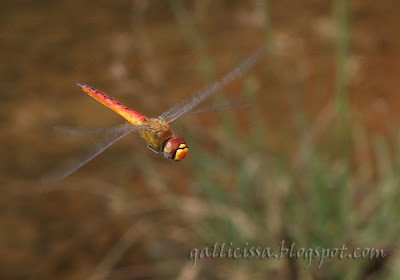
Wandering Glider
It was this world famous Wandering Glider aka. Globe Skimmer Pantala flavascens, which is a globe trotting species considered as the most widely distributed dragonfly in the world. It is a known temporary pool breeder and is almost always found flying—which was what pressed me to attempt the above shot.

My Canon 40 D and Canon 100 mm f2.8 Macro Lens stopped auto-focussing last week when I was shooting dragons at the aforementioned puddle. I took them to the repair centre of the local Canon dealer. It turned out that it wasn’t the lens. So they kept the camera body for further checking. After a week or so they called me to say that it is working okay. Apparently the auto-focussing problem has happened due to humidity. All what they had done was to clean to contacts of the camera body with a soft cloth. The bloke there told me to repeat it if it happens again, but before doing that, to make sure that I remove the battery to prevent short-circuiting.

I guided and facilitated a photo shoot of leaves in my garden, to be used for a desktop calendar for a local corporate. They were after leaves of 14 species of native/endemic flora to select from them, 12 to go with each month. I found them about 16 with various hues and textures to surpass their requirements. The two ladies who came got a few leeches too. Which was more than what they bargained for!

Now, I know I have admitted that I do not have leeches in my yard in a comment somewhere in this blog. Things have changed, folks. A small leech population has established probably after an accidental introduction caused by yours truly, when leech socks and boots were brought home straight from the rain forests without de-leeching them at the forest!

And let me tell you that some people that I know of are not too amused by this. So it is official that my home garden is a safe heaven for home-grown-terror. The first person to get a bleeding bite was my mom.

My friend Java Jones has tagged me for a blogging game called "I never".

Okay here goes my reply Mr. Jones. I’ve never.

1. thought that I would switch from Lion to Carlsberg in this lifetime. Seriously.

2. eaten a better tasting Chinese chop suay rice (mixed meat/sea food) than at the ‘late’ Garden restaurant that used to be near the Liberty Roundabout at Colpetty. Does anybody know whether it’s been relocated, please?

3. ad better arm-chair birding in Sri Lanka than from the balcony at Martin’s Simple Lodge, Sinharaja.

4. expected that a full body massage at La Passion, Battaramulla 90210., would be so awesome after a good day’s manual labour (at the pond).

5. think that anybody in this country could give a better earth-shattering head and shoulder massage as Ananda at Vajira Salon, Bamba.

6. thought that St Peter’s would thrash Royal 41-nil at Rugby as it happened magically in 2007 in our own den.

I end this masala post with this beauty that I photograged at my local wetland patch.
Image
It is an Oriental Scarlet aka Scarlet Skimmer Crocothemis servilia servilia. Apparently this is also found in outside the Orient despite the local common name; "Oriental Scarlet" suggested in the Sri Lankan dragonfly guide, which in my opinion ought to be revised. According to the “Dragonflies through Binoculars – A Field Guide to Dragonflies of North America”, it was “discovered in Miami in 1975, I has spread to Orlando by 1986….It now occurs in the FL Keys, Cuba, and Hawaii and in the Old World ranges from the Middle East to Japan and Australia.”

Monday, 17 November 2008

.42

My garden about which you have heard a lot is just .42 acres. In case you are new to this blog, it is quite well wooded as well. Most of the trees in it have been planted by me since I was 13 -- from the time I got hooked on nature as a schoolboy. Now that I am 30-something some of those trees stand to remind me how much I have aged as a naturalist. My garden borders to 9 other neighbouring home gardens, some of which are also quite well-wooded. So, by no means it is an island surrounded by lifeless sea of development. The natural riches that I get in my yard are also thanks to my neighbours who keep their gardens greener. This has helped to maintain a large enough area to harbour a decent enough diversity of natural history in what is actually a sprawling residential area.

Some of my neighbours are related to me and I have unfettered access to their gardens 24/7. I have even planted a few trees in them from time to time for habitat enrichment. Some of them are economically important trees. And I happen to derive indirect benifits from having them in the vicinity. So, it is a win-win partnership, as I see it. I have to observe here that none of my dear neighbours are as keen on natural history as I am. In fact they remain wilfully ignorant of the nature around them and lead lives of aloof ordinary citizens.

With that being the state of affairs, my cousin bro, next door decided to a clear what he termed as a 'grassy jungle' in his backyard, which in my world of reality translated into a good dragonfly and butterfly patch. Perhaps, he didn't know that it was a happy hunting ground of mine. Perhaps, I didn't dwell the importance of his backyard patch has to many critters that call it a home. All of a sudden he seemed to have got this preposterous notion of a 'cleaner environment' and turned a NIMBY!. He is not alone in this erratic thinking and quite a few neighbours seem to have their gardens with minimal low vegetation.

Careful diplomacy with my cousin to spare those patches fell on deaf ears. In our close-knit Asian social relationships, we depend on each other -- especially the neighbours for various kindnesses that are not valued in monetary terms. Having had no positive response to save this patch, I had to resort to more persuasive means of negotiations such as by threatening them of 'islolation' and categorising them into 'axis of evil'!Finally, this worked somewhat and I managed to save a few squares of 'grassy jungles' just as Tom Lovejoy saved those rectilineal squares of 1, 10, 100, 1000 sq.km of Amazonian rain forests from being clear-felled in the late 70s when they were being cleared by the Brazilian government to create among other things, cattle ranches to meet the demands of meat-eaters 'Up North'. Tom, I learnt had used less threatening negotiation tactics.

Due to thick overhead vegetation, my garden until recently had very few patches getting direct sunlight at the ground level, which is an important requirement for a good butterfly and dragonfly patch. This is why I decided to create a permanent patch for dragonflies and butterflies in my yard - one that I'd have full control of. After all, I cannot go on to use my bargaining tactics with my neighbours all the time!

For this end, I opened up a sun-lit patch in my backyard by selectively logging a few trees recently. More information of this new patch and a dragonfly pond that I am creating in it as we speak will be dealt in post later on. Until then, here's my .02 of the stuff I found in my .42 in the last few days. Enjoy!

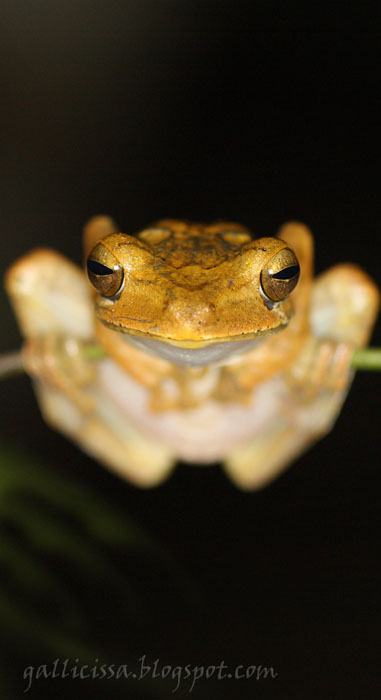
Common Hourglass Tree-frog Polypedates cruciger -- adult female. Endemic species.

Common Hourglass Tree-frog

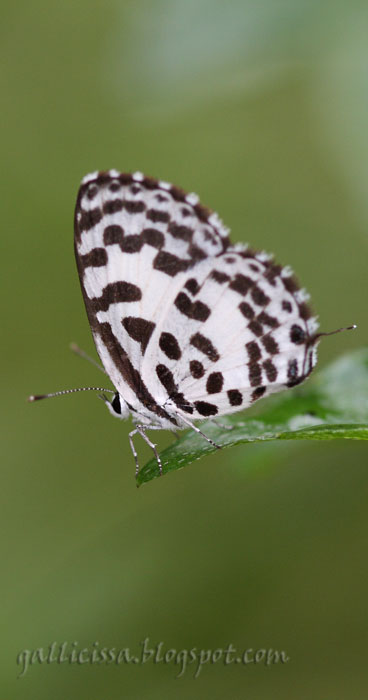
Common Pierrot Castalius rosimon

Common Pierrot

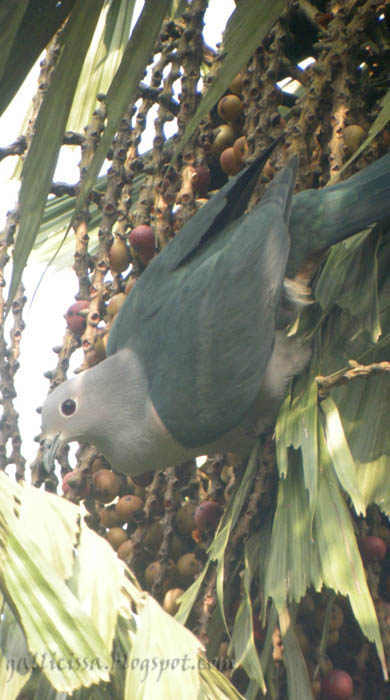
Green Imperiel Pigeon Ducula aenea - feeding on fruits of Fish-tailed Palm Caryota urens. This is a record shot. I have far better shots of this, which is the largest wild pigeon in Sri Lanka. I have 6 Fish-tail Palms in my yard.

Green Imperial Pigeon

Hump-nosed Viper Hypnale hypnale -- found inside a pile of coconut husks while clearing the land for the pond. Venomous but not deadly to humans.

Hump-nosed Viper

Tiny Grass Blue Zizula hylax -- wing span of the adult is about 1.5 cm -- the first butterfly photographed in the new patch.

Tiny Grass Blue

Pied Parasol Neurothemis tullia tuillia -- female

Pied Parasol - female Oh! I had yet another new bird in my yard in the form of a Bar-winged Flycatcher-shrike Hemipus picatus, which is also a new one to my local area. As in other recent new records, I heard it first. An Indian Pygmy Woodpecker and a Large Cuckooshrike were also seen well.

Thursday, 30 October 2008

Serendipity

Another garden post.

About 5 months ago, while photographing insects in a overgrown section of my yard—"designated" to lure in the Himalayn winter visitor Indian Pitta among other things—I had a brief encounter with a smallish terrestrial mammal. I couldn’t get a good look at it due to thick vegetation. It ran slowly in the under growth, froze for a moment, and moved out of my radar as I strained my eyes to catch a glimpse of it. My gut feeling suggested that it was a mouse deer aka. chevrotain (Me-minna)—a mammal that would not only be new to my yard but also to my local area!

And then, a local man who helps us with our gardening chores, Premadasa, recently mentioned to me a couple of days ago that he saw a Chevrotain in this very section of my yard about a month ago!

He is familiar with this animal as is apparently found in his area, which happens to be thickly wooded. Oh! And my mother too described features of a small mammal with yellow stripes that she saw in one late afternoon!

This is extremely good news, and I will be on the look out for this very special mammal.

After analyzing the skulls and skins of this mammal found in India and Sri Lanka, Groves and Meijaard in 2005, ‘split’ the population of the Mouse Deer found in the wet zone in Sri Lanka into an endemic species. Thus, it is now regarded as Yellow-striped Chevrotain Moschiola kathygre (Groves and Meijaard, 2005). Click here to download that paper published in the Raffles Bulletin of Zoology.

Below is a picture of an unfortunate Yellow-striped Chevrotain preyed a stray dog at the Sinharaja 'word heritage' rain forest. I reported this earlier in this post.

Image
Coming back to my garden's record, this is an extremely exciting news as my area is residential one and is not woody as it used to be.

The most exciting mammalian find in my yard before this, was in mid 2007, when a pair of Golden Jackals turned up at broad-daylight! I showed it to my mother and a few gasping neighbours who at once confessed that they would have easily overlooked them as two stray dogs! I belived them.

Here is a record shot of a pair Golden Jackals seen at Bundala National Park on a bird watching tour that I led with 11 British birders in 2006. Click here to read its full trip report.

Image
On the birding front, 2-days ago, I had a new bird getting added to my garden bird list in the form of Indian Pygmy Woodpecker (formerly, Brown-capped Pygmy Woodpecker). This species is found in my local area at a spot that is 1.5 km away from my residence, but this was the first occasion I had it turning up in my yard. It betrayed its presence by its distinct call, and moments later, I had a good sighting of it.

With this, I now have 4 species of Woodpeckers in my garden list. The other three species are the Black-rumped Flameback (the commonest Woodpecker in most home gardens), Lesser Yellownape (occasional visitor to my garden), and Rufous Woodpecker! The latter is the most exciting one out of this list. It was recorded in 1991—during a fine morning when I was getting ready go to school! It hung around for few days in my yard, betreying its presence by its signtature call. I had no sightings of this species in my garden since then.

A Large Cuckooshrike, which is an occasional visitor to my garden, was also heard a few days ago.

Moving on to invertebrates, I spotted this Long-horned Grasshopper species for the first time.

Image
Its identity was narrowed down by Dr. Priyantha Wijesinghe as follows.
Orthoptera: Tettigoniidae: Phaneropterinae: Mirolliini?

He commented “This is something of a mystery, but that is probably just my lack of familiarity with the species. By the way, it is illustrated on p. 103 of Henry's autobiography 'Pearls to Painting”

Image
I took my copy of G.M.Henry’s autobiography, and turned to page no.103, and—lo and behold—there it was in the form of an excellent work of art by Henry!

This was found low-down in an ornamental plant in the shade of a (Malaysian) Rambutan tree Nephelium lappaceum. As the Zumala that I found in Sinharaja rain forest, this looked rather bizarre with the posterior end of its tegmina looking somewhat like a headdress of an Egyptian Queen!

I was chasing a dragonfly when I ran into this Spiny orb-weaver Gasteracantha geminata (Fabricius, 1798) female (also identified by Dr. DPW). It was dealing with a termite prey. I took only this shot of it as I try not to get distracted with other life forms when I am chasing a particular target.

Image
Looking at the set of pictures that went into my Scrabble and Dragonfly tips post, I found this picture of a juvenile Elusive Adjutant that I had mysteriously overlooked!

Image
It is quite sharply focused in both the eyes than the similar looking picture that I used for that post. I did very little post processing with this as everything was just right. It was shot at natural light, hand-held.

By the way, his kinkiness the Painted Waxtail that I posted in this post was, as I suspected, suffers from a birth defect caused at the immergence from exuvia. This was confirmed by my dragonfly mentor Matjaz Bedjanic. He went on to say that the said individual “….is suffering from a emergence defect and his abdomen is has not been damaged during copula. Normally such specimens [with birth defects] don't survive long”.

That is all for now.

Edit: Dr. Priyantha Wijesinghe has sought opinion from Dr. Sigfrid Ingrisch, an expert on Orthoptera to narrow down the identification of the Long-horned Grasshopper above. And the question mark means it is unidentified.

Monday, 20 October 2008

Sticky matters.

Image

I led a 17-day "Christmas Bird watching Tour" in December, 2004, for a reputed British nature tour operator. Its ground handing was done by a local travel agency to which I freelanced at that time. This tour stays in my mind for a number reasons.

First, the unfortunate reasons:

1. Briefed and given in writing as a "mostly bird watching oriented tour," this tour had five English people that included:

i. A nature photographer with a keen interest in wild flowers.
ii. A walking enthusiast who just liked to keep on walking.
iii. A natural history enthusiast with a passion for photography and a passing interest in birds.
iv. A hardcore birder who was heavily into listing.
v. A person who didn’t fall into either of the above categories.

It was like a challenge that Donald Trump would have chosen for the final episode of the Apprentice. I did my best to juggle all the balls without dropping any. What can I say,  it was a good learning curve!

2. The Boxing Day Tsunami, which caused havoc killing over 40,000 people in Sri Lanka alone, happened during this tour. We were mopping up the montane endemics at the cloud forests of Horton Plains National Park—the tallest plateau in Sri Lanka some 2,100 m above sea level—when the killer tidal waves devastated the coastal lowlands. And we were to visit this area in two days’ time!

I had the tour rerouted thereafter to stay away from the affected lowlands. I also decided to spend more time in the unaffected endemic rich wet lowlands.

And now, the fortunate reasons:

1. More time in the wet lowlands didn’t harm our burgeoning bird list one bit. This was the first tour in which I showed the avian jewel Serendib Scops Owl Otus thilohoffmanni to an overseas bird watching audience, after its discovery in Jan, 2001. Needless to say, it was a momentous day for mankind!

2. I made a clean sweep all 33 endemic birds on this trip—for the first time having started my guiding career in January in the same year. As a budding bird guide, it was an important rite of passage.

3. An observation that I made at Sinharaja "world heritage" rain forest became the subject of my maiden paper to a peer-reviewed ornithological journal. It is—

Salgado, A. (2006). Some observations on the diet of Red-faced Malkoha Phaenicophaeus pyrrhocephalus in Sri Lanka. Sandy (UK): Forktail Journal of Oriental Bird Club. 22: 122-123.

Click here to download a PDF of it.

Anyway, what I am trying to get at like Sir. Humphrey Appleby is to correct an error that had slipped in the above article by me.

In it, I had a ‘giant stick insect’ preyed upon by a Red-faced Malkoha identified as Palophus sp (Order Phasmatodea) after comparing it with what I thought at that time to be a reliable source of reference.

On 14 October, 2008 its identity was corrected by a world authority on stick insects: Dr. Frank H. Hennemann from Germany, thanks to intervention by Dr. Priyantha Wijesinghe who is a Sri Lankan Entomologist/Systematic Biologist based in the USA.

Accordingly, it is an adult female of Phobaeticus hypharpax (Westwood, 1859).

The classification being:
Order: Phasmatodea. Suborder: Anareolatae. Family: Phasmatidae Subfamily: Phasmatinae Tribe: Pharnaciini.

A better view of the Giant stick insect. Note the rear left limb is a result of an optical illusion created by a limb like branch behind. The actual left rear limb was broken off by the time I took this shot as this was photographed after the above
Dr. Hennemann disclosed that the locality data for all but one of the specimens lodged in the world museums including the type specimen from which Westwood named this species bear nothing beyond "Ceylon."

Therefore, he, was quite happy to receive the locality data of my Phobaeticus hypharpax that eventually ended up in the gut of the above Red-faced Malkoha.

Very interestingly, on 15 October, a day after this e-mail communication, Dr. Hennemann had a revision of the very Tribe: Pharnaciini published in Zootaxa in the form of a 316 paged paper, which included, the above species.

The reference is:
Frank H. Hennemann & Oskar V. Conle (2008). Revision of Oriental Phasmatodea: The tribe Pharnaciini Günther, 1953, including the description of the world's longest insect, and a survey of the family Phasmatidae Gray, 1835 with keys to the subfamilies and tribes (Phasmatodea: "Anareolatae": Phasmatidae. Zootaxa 1906: 1-316 pp. Auckland, New Zealand: Magnolia Press.

According to the above, and as per a personal communication by Dr. Hennemann, in addition to the above species, Sri Lanka has one more species belonging to the tribe: Pharnaciini, which is Phobaeticus lobulatus (Carl, 1915). Its body length is 162.0 mm and is a very similar species to P. hypharpax, which has a body length of 185.0–236.0 mm. The former is only known from the female holotype with the locality data reading again as "Ceylon" only. So far, it has never been recorded since its original discovery in 1915 according to him.

By the way, the world’s longest insect, referred in the title of the aforementioned stick insect revision paper is (drumroll, please) Phobaeticus chani—Chan's megastick from Borneo—with a body length of 333.5–357.0 mm. Its overall length with the limbs stretched out is a whopping 567mm!

This is a completely new species described based on a specimen in the collection of a Malaysian naturalist and insect collector from Sabah Borneo, Chan Chew Lun, who had received it from a local collector. Dr. Philip Bragg named it in honour of Chan who had donated his world record holding megastick to the British Museum of Natural History.

If you are really into sizing up your megasticks, the former record holder for the world’s longest insect title based on body length was Phobaeticus kirbyi with 317.0mm., which is also found in Sabah, Borneo. So the newly described Chan's megastick is 40mm longer!

The former record holder for the overall length with the limbs stretched out was Phobaeticus serratipes distributed in Peninsula Malaysia, Singapore and Indonesia of which one has been measured at 555mm.

The new megastick on the block has beaten that record too by 12mm. However, this recorded would have been greater by 7–10 mm if the specimen of Phobaeticus chani donated by Chan Chew Lun had not been damaged according to Hennemann and Conle, 2008.

So no matter how you size up, the Malaysians get to retain the coveted world record title for the world’s longest insect by a long margin. I am sure Tabib, who is a regular visitor to my blog from Malaysia, will be proud about this.

I’d like to conclude this post by saying a big thank you to Dr. Hennemann for taking his valuable time to help with the identification of my megastick. Last but not least my profound gratitude is due to Dr. Priyantha Wijesinghe, for sending my images to Dr. Hennemann to seek his expert opinion and communicating to me the same and putting me in touch with such a world authority.

Tuesday, 14 October 2008

Lately in my garden

I was going to do a butterfly post, instead I changed my mind to do a garden post involving butterflies.

We are in the early stages of the North East monsoon now, which brings rain and migrant birds to the entire country. Speaking of migrants, the much talked about Himalayan avian jewel, Indian Pitta Pitta brachura has arrived and my mother reported hearing one early morning today.

It usually calls at around 6 a.m. and again at 6.00 p.m., which has earned its local Tamil name: Arumani Kuruvi meaning the Six O'clock-bird! I was fast asleep at the unearthly hour that my mother had heard it.

Well, now that I know it is here, I will make an exception and look for it. Soon.
I have been trying to capture a certain angle of it for the last 4 years to complete an article about its plumage. I hope I would be get it this season.

My first Brown-breasted Flycatcher aka. Layard's Flycatcher Muscicapa muttui for this migratory season was seen on 12 Oct (Sunday).

Brown-breasted FlycatcherI welcomed it by doing a customary migrant welcoming dance. For those who are not familiar with this obscure Sri Lankan birding ritual, it is very similar to the dance performed by some of the US birders when a life bird is seen, as demonstrated by Susan Williams, except that in this version, you do figure 8s from your hips 3 times before moving the hands in the air like you just don't care.

The species name of Brown-breasted Flycatcher: muttui is to honour one Mr. Muttu (pronounced muththu)– the Tamil cook who served its discover, Edgar Leopold Layard (1824-1900), who was a British civil servant (1839-1848) with a passion for birds and natural history. Layard came to Sri Lanka with just £17 in his pocket with his wife Barbara Anne Calthrope after whom the species name of the endemic Layard's Parakeet Psittacula calthropae was named.

I heard the unmistakable call of the regular migrant Bright Green Warbler Phylloscopus nitidus on 1 October, and saw one the following day. Two more migrants, Barn Swallow and Brown Shrike were also seen for the first time for this season a few days ago at my local patch.

Butterflies:
I have started to photograph 'blues' again, with renewed enthusiasm after getting my new camera. All these targets were acquired lying flat on the ground—commando-style—at early morning (defined as 7.30 a.m., thank you) when they weren't too active.


Indian Cupid Everes lacturnus

Indian Cupid
Their relative inactivity also allowed me to narrow down the shooting distance to less than a foot, which is required to get good close ups with my Canon 100mm Macro lens. In these pictures, you can see its conspicuous double orange spot on the tornus of the hind wing verso, which is a reliable diagnostic to tell this species.

Here's the same with in a more orthodox posture but with the light coming from a different angle.

Indian Cupid
Here is the same with the wings open showing why they are popularly referred as 'blues.'

Indian Cupid
Here's another shot of the same.

Indian Cupid
Most of the 'blues' are quite small and look identical, which explains why they pose ID challenges of the highest magnitudes. If you are not comfortable in capturing them to identify down to species level as deemed necessary by some experts, I think the next best way to identify them is to photograph them! And that is half the battle, of course.

I employ this second method, which works for me. Your mileage may vary.

Lime Blue Chilades lajus

Lime BlueHere’s one showing the recto of the same. Note how similar it is to the first one above.

Lime BlueA garden post without dragonflies?

No bloody way!

I had a brief but a good sighting of a male Pruinosed Bloodtail Lathrecista asiatica asiatica last Saturday, soon after waking up from a 3-hour power-nap at late afternoon. The last sighting of an adult male this uncommon dragonfly was on 6 Sep, 2004 when a male visited my home garden presenting my first views. Click here to see a young female of the same. An Amber-winged Glider Hydrobasileus croceus was seen today in flight, of which the first record was when I saw this individual on 17 Oct, 2004. This seem to be the time of the year when it visits my garden. This species is one of the two Libelluids that is not represented by a colour photograph in the 'photo guide to dragonflies of Sri Lanka,' as I blogged here I have now got both these species.

I conclude this post with this female Variegated Flutterer Rhyothemis variegata variegata, which is the Sri Lankan version of the Halloween Pennant found in North America seen in this post by Ecobirder.

Variegated Flutterer
Related Posts with Thumbnails