Merged
Conversation


And reword the blurb to include what was previously in the title.

This makes it easier to see that one has arrived to the right place:
beforehand, the only indication was through the link target for the
first edition; it was nowhere in the copy itself for most pages.
Unless it is the correct place to go, never link to the index of the
second edition as fallback. Point instead to different books, to the
reference, to the API documentation, etc.
To make it clearer where links are going, eliminate entirely the
language of "Related" or the long verbose book titles. Instead, simply
prefix with "In the first/second edition" as needed, and in similar
style for other resources like the reference or the Unsafe book.

Add the target's title, i.e. chapter number, name, and sometimes
subsection, directly to the link copy.
To improve immediate value and reduce discard-because-not-useful factor
upon arriving at a page which does not contain the content you were
expecting, add a small blurb taken/adapted from the newer source,
optionally accompanied by a code sample describing the feature.

However, due to the transitive nature of this resource, there must be no
content here that isn't available elsewhere.
Instead of placing the link to the recommended resource i.e. the second
edition in second place, push it up to the top of the list. In fact,
push the link to the first edition always at the bottom.

To emphasise even more that's where new visitors should go, bolden the
first link, and make the first-ed link smaller.

All this as well as a slight edit and simplification of the copy is
designed to make the new and recommended resources the primary path
readers take, without hiding the old resource completely.

steveklabnik
approved these changes
Dec 31, 2017
Contributor
 steveklabnik
left a comment
steveklabnik
left a comment
steveklabnik
left a comment
There was a problem hiding this comment.
this looks great to me. thanks a ton.


Member
|
Thank you for doing this! Also just a note that the book rides the release trains, so this won't hit doc.rust-lang.org/book for a while (beta backport to get it in sooner maybe, @steveklabnik ?) |

Contributor
|
I'm thinking of sending in a PR to the book shortly after the branch so that it does appear on nightly so we can get a feel for it. |
steveklabnik
added a commit
to steveklabnik/rust
that referenced
this pull request
Jan 30, 2018
Includes rust-lang/book#1088 and
rust-lang/book@62210e3
kennytm
added a commit
to kennytm/rust
that referenced
this pull request
Feb 3, 2018

…chton Update book This PR does two things: 1. update the book to include rust-lang/book#1088 2. update to mdbook 0.1 Both of these things are big changes, so I want to land them now, well before the next branch, so we can kick the tires. ------------------------------ Locally, I'm seeing some weirdness around the reference and this: 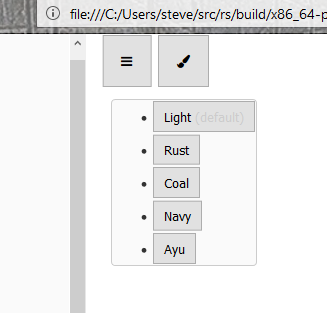 Putting this PR up so others can try and build and see if it reproduces for them.
kennytm
added a commit
to kennytm/rust
that referenced
this pull request
Feb 4, 2018
…chton Update book This PR does two things: 1. update the book to include rust-lang/book#1088 2. update to mdbook 0.1 Both of these things are big changes, so I want to land them now, well before the next branch, so we can kick the tires. ------------------------------ Locally, I'm seeing some weirdness around the reference and this:  Putting this PR up so others can try and build and see if it reproduces for them.
steveklabnik
added a commit
to steveklabnik/rust
that referenced
this pull request
Feb 4, 2018
Includes rust-lang/book#1088 and
rust-lang/book@62210e3
kennytm
added a commit
to kennytm/rust
that referenced
this pull request
Feb 5, 2018
…chton Update book This PR does two things: 1. update the book to include rust-lang/book#1088 2. update to mdbook 0.1 Both of these things are big changes, so I want to land them now, well before the next branch, so we can kick the tires. ------------------------------ Locally, I'm seeing some weirdness around the reference and this:  Putting this PR up so others can try and build and see if it reproduces for them.
This file contains hidden or bidirectional Unicode text that may be interpreted or compiled differently than what appears below. To review, open the file in an editor that reveals hidden Unicode characters.
Learn more about bidirectional Unicode characters
Sign up for free
to join this conversation on GitHub.
Already have an account?
Sign in to comment
3 participants


Add this suggestion to a batch that can be applied as a single commit.This suggestion is invalid because no changes were made to the code.Suggestions cannot be applied while the pull request is closed.Suggestions cannot be applied while viewing a subset of changes.Only one suggestion per line can be applied in a batch.Add this suggestion to a batch that can be applied as a single commit.Applying suggestions on deleted lines is not supported.You must change the existing code in this line in order to create a valid suggestion.Outdated suggestions cannot be applied.This suggestion has been applied or marked resolved.Suggestions cannot be applied from pending reviews.Suggestions cannot be applied on multi-line comments.Suggestions cannot be applied while the pull request is queued to merge.Suggestion cannot be applied right now. Please check back later.


(Following these tweets with @steveklabnik.)
The general idea / guiding thought is this: redirects are where many people land (right now), and we're trying to retain their attention while pointing them elsewhere. At the same time, eventually the redirects will all but disappear as links are updated.
I think the current design does this poorly.
The fact is, there is no 1:1 correspondence between 1st-ed and 2nd-ed chapters. There are a few N:1 (1st-ed to 2nd-ed), a large number of 1:N, and indeed some 1:nowhere. So it is impossible to automatically redirect people, which is the entire problem and why these redirects exist.
Hence, this Pull Request. I applied 5 incremental modifications to every redirect page:
Replace the generic title with the title of the chapter in 1st-ed
and reword the blurb to include what was previously in the title. This makes it easier to see that one has arrived to the right place.
Always go somewhere meaningful
Unless it is the correct place to go, never link to the index of the second edition as fallback. Point instead to different books, to the reference, to the API documentation, etc.
Include the title of the link's target into its text
To make it clearer where links are going, eliminate entirely the language of "Related" or the long verbose book titles. Instead, simply prefix with "In the first/second edition" as needed, and in similar style for other resources like the reference or the Unsafe book. Additionally, include the target's title, i.e. chapter number, name, and sometimes subsection, directly to the link copy.
Add a quick summary and code sample
To improve immediate value and reduce discard-because-not-useful factor upon arriving at a page which does not contain the content you were expecting, add a small blurb taken/adapted from the newer source (except in the case of pages that do not exist at all), optionally accompanied by a code sample describing the feature (or as relevant).
Keeping in mind that due to the transitive nature of the redirects, there must be no content there that isn't available elsewhere.
Highlight the recommended path and "lowlight" the old path
Instead of placing the link to the recommended resource i.e. the second edition in second place, push it up to the top of the list. In fact, push the link to the first edition always at the bottom. To emphasise even more that's where new visitors should go, bolden the first link, and make the first-ed link smaller.
This provides a clear recommendation of where to go, without completely hiding the old resource (which would be detrimental as there is value in the first-ed still).
Result
(Note that the code sample should actually be a yellow runnable syntax-highlighted Rust code block, but there is no script or means to build the redirects, so I had to do the preview by manually inserting rendered HTML into an existing page, which means it lacks the fanciness.)