Two Moods

There are two moods in this world.

One is born on the beach. Think Mediterranean, Southeast Asia, South America. The warm sun is crawling across the sky above you. The air is heavy, and time is moving so slowly it feels like you can see it. You’re chilling and want something chill to go with it — think freddo espresso or cold lager. Something cold that tells your soul to take a day off.

The second comes to you in the dark. Think Nordic countries, Russia, the British Isles. The sky is gloomy, it’s raining or snowing outside, and the day feels like it never fully woke up. You want the opposite — something warm to savor. A good cuppa or hot chocolate. Something hot that warms your hands before it reaches your soul.

To be happy is to let them take turns.

Bad Writing, Good Lessons

When you’re an aspiring writer, you try to justify everything you write and put into your book. Every little thing needs its own reason to exist in the text. You try to think of everything.

Let’s take the 100-word writing challenge I participated in, for example. I didn’t get through to the second round, sadly, but it was a fun experience, and I’ll be able to publish my little story later this month. Stay tuned.

The feedback from the judges is strict. They judge every word, and you need to be able to answer for each one you put in your submission.

Then you sit down to watch some TV with your wife, and one of the main protagonists of a well-known TV show, in its fifth and final season, suddenly becomes an IT technician who understands CCTV wiring and can loop cameras by simply switching a cable — all to get inside a military base slash laboratory. This trope is well-worn, yet it is so strange to watch.

But I guess you can see such lazy writing from two angles. On the one hand, it’s quite upsetting to see this in one of the most watched TV shows right now. On the other hand, if this kind of writing is good enough for the big guys who made it, it means you can do it too.

It’s inspiring, really — in its own bad-writing, oddly reassuring, impostor-syndrome-relieving kind of way.

A Case Against Chat Support

My Apple Watch has been acting up ever since I changed the region of my Apple Account. The Apple Watch app refuses to download any music to the watch, no matter what I do.

So, as a tech support person myself, I decide to contact Apple Support about it.

Here is how it went:

  • We start at 15:15.
  • I share detailed information about the issue and the troubleshooting steps I have already tried.
  • I can’t upload a screen recording of the problem because their interface doesn’t support the file format.
  • They ask me questions about things I have already explained.
  • I get disconnected from the first advisor.
  • I get reconnected to a second advisor.
  • They take some time to check the conversation history.
  • They ask me the same questions again about things I have already shared.
  • I am asked a few more questions, and I reply with more details.
  • The advisor finds out that I have a VPN app installed on my iPhone and suggests uninstalling it, even though there are no active tunnel profiles. It isn’t the VPN.
  • It is 16:00.
  • The second advisor says they have run out of troubleshooting steps they can provide and suggest escalating the issue to phone support.
  • I share my timezone, phone number, and current country.
  • They then find out that phone support isn’t available in Cyprus.
  • By this point, it is 16:15. I have just spent an hour talking to someone in a chat interface who is no help at all and hasn’t moved the issue forward even an inch.
  • Their final suggestion is that I call the Tier 1 support hotline myself to escalate the issue to a Senior Advisor.

An hour later, I am exactly where I started — except now I also have a phone number to call.

I have no idea about their support structure. And most importantly, I have no idea why they can’t just escalate my issue further and reply to me via email, which feels like the sanest thing to do next.

But just imagine how much easier it would be with normal email support. How much more time-, cost-, and mentally efficient email is.

The moral of the story: choose email. Always.

I can’t believe how bad controlling Apple Music on an Apple Watch still is.

How is it that I can load music onto an iPod, rediscover it in a drawer 15 years later, and all my music is still there - but when I download a playlist to my watch to listen offline, it just randomly disappears from time to time? It is honestly mind blowing.

This happened again this morning, so I had to run with no music at all. Like a barbarian.

Why, Apple, why.

Pragmata

You know the ongoing joke about “brain rot content” where the main video plays on the left, and Subway Surfers runs on the right (or Minecraft in the background) because the modern brain can’t focus on just one thing?

We all do that now. That’s why you need multiple monitors, duh.

Lately, I’ve been also trying to leave my phone in another room, or at least out of arm’s reach, so I stop checking it during the “boring” parts of whatever we're watching.

I think Pragmata weaponizes this beautifully, turning it into an engaging combat system where you’re hacking enemy AI (by solving a mini puzzle) while dodging their attacks at the same time. And it works!

It’s a compact single-player game with an engaging story, and I really enjoyed finishing it over the past week.

In a nutshell:

https://bsky.app/profile/iamgregb.io/post/3mk6bgcku3c2w

The Little Arc of Browser History

The first mainstream browser, Mosaic, was released 33 years ago. A little earlier, in 1990, Tim Berners-Lee created the very first browser, WorldWideWeb. And if you look at it, there’s surprisingly little separating those early interfaces from the way modern browsers still look today.

Indeed, the feature set of a traditional browser hasn’t changed all that much since its inception in 1990. You can argue otherwise, but most additions over the years have been incremental rather than transformative. In my view, there have only been two genuinely big ideas: tabs and extensions. Everything else, bookmarks, history, toolbar, and so on, is essentially boilerplate, with the same interface patterns carried from one browser to another without a second thought.

I don’t ask much from my browser, and I definitely don’t need any baked-in AI features. I’m pretty content with the current feature set. What’s surprising, though, is how little fresh, thought-provoking thinking there’s been around the browser interface, and how we interact with it.

I’m not talking about AI assistants in so-called “agentic” browsers like Comet, Atlas, or Dia, or the half-baked AI sidebars showing up in the latest versions of Chrome, Firefox, Edge, or Brave. I don’t want to chat with my tabs, and I definitely don’t need yet another chat bar in my browser. As Julian Lehr puts it in his post The Case Against Conversational Interfaces:

A natural language prompt like “Hey Google, what’s the weather in San Francisco today?” just takes 10x longer than simply tapping the weather app on your homescreen.

What I mean are bold moves that rethink how we actually work in a browser, and how the browser works for us.

Enter Arc.

A product of its time (2023), when TBCNY hadn’t yet gone all-in on AI and wasn’t shy about taking ambitious swings at Chrome. It was full of genuinely innovative ideas. Not all of them stuck, of course, and some were eventually discontinued, like Arc Notes. Still, most were compelling, and I miss them every day.

I’m sure I’m not the only one who fell in love with vertical tabs because of Arc. Now every browser seems to be racing to replicate the experience. Chrome finally got them this month, in April 2026, but not a single implementation feels or works quite as well.

Swiping between separate workspaces with different profiles (!) was seamless, and I’m still surprised that no other browser has managed to reproduce this behavior.

Peek was a great way to skim Twitter and open linked articles without losing context. Easels, even though I didn’t use them much, offered an interesting take on whiteboarding that lived right in the browser. And Arc Max wasn’t just another chat bar with an AI assistant, it was a genuinely thoughtful, complementary use of AI within a modern interface.

With all that in mind, Little Arc is the feature I loved, and miss, the most. Just like Peek, it was a brilliant way to preview and triage links without opening the main browser window. Orion has a similar feature called Link Previews, but it doesn’t quite hit the same mark for me.

I believe this is why Arc became so popular and earned its cult-like status among users. It packed so many gems into one product. A glass of ice water in hell. But in his Letter to Arc members 2025, Josh Miller, the CEO of TBCNY, calls it the "novelty tax" problem and frames it as Arc’s main downside:

After a couple of years of building and shipping Arc, we started running into something we called the “novelty tax” problem. A lot of people loved Arc — if you’re here you might just be one of them — and we’d benefitted from consistent, organic growth since basically Day One. But for most people, Arc was simply too different, with too many new things to learn, for too little reward.

And I get that. When you’re set in your ways, it’s hard to adapt to something new. But I still don’t think Arc’s downfall came from its novelty or the sheer number of features. It came from something else entirely: VC money.

Once you take VC money, you’re expected to demonstrate constant growth, or else. Or you pivot to AI and suddenly it becomes much easier to raise more.

The state of web browsers in 2026 looks different: while the big players and AI-companies are busy adding AI everywhere, a new crop of smaller browsers - Orion, Helium, Horse, Zen, Pola, and others - trying to emerge and, at times, mimic a fraction of Arc’s power.

I understand that browsers like Google Chrome, Mozilla Firefox, and Safari serve millions of users every day, and that at this scale it’s hard to experiment. I understand the power of defaults and all that. But still, it’s hard not to feel disappointed by how little real interface innovation there is.

Arc showed us that something fresh is still possible. Unfortunately, it also showed that we’re all chasing the wrong things.

On Being Left Out

A teaser this week, yet another CLI and headless agent access from a software company I follow, finally crystallized my theory about why "AI" is so controversial. I don't think the latest LLM technology is inherently evil, but the way it's being used and promoted feels way off.

The visceral reaction that everyone a lot of people seem to have against AI isn't coming from a place of hate (though I'll admit, it's not coming from a place of love either). It's simpler than that - people feel left out.

Look at what's happening around you.

Every software company is building the same thing, and it increasingly feels like they've switched from creating software for people to building software for AI agents.

Every LLM is being trained on the work of real humans without giving anything back, and then used as an excuse to lay off more and more of those same people.

LLMs are being used to automate everything and flood the internet, the very thing that people loved, with bots and generated text, making the dead internet theory a reality faster than anyone thought possible.

Would the reaction be the same if software companies actually took a minute to implement AI features thoughtfully, without forgetting about their actual users - flesh and blood?

Would people still react this way if the copyright questions were handled with care; authors and artists were compensated properly; and people's productivity increased without them losing their jobs?

Would the backlash be the same if the effect AI has on the internet and interpersonal communication were positive?

I don't know, but there's a real chance it wouldn't. Because right now we all feel like gamers raised on NVIDIA graphics cards. We grew up with the technology we love, only to find out that we're no longer the customer the company cares about.

The Cookie Banner Saga

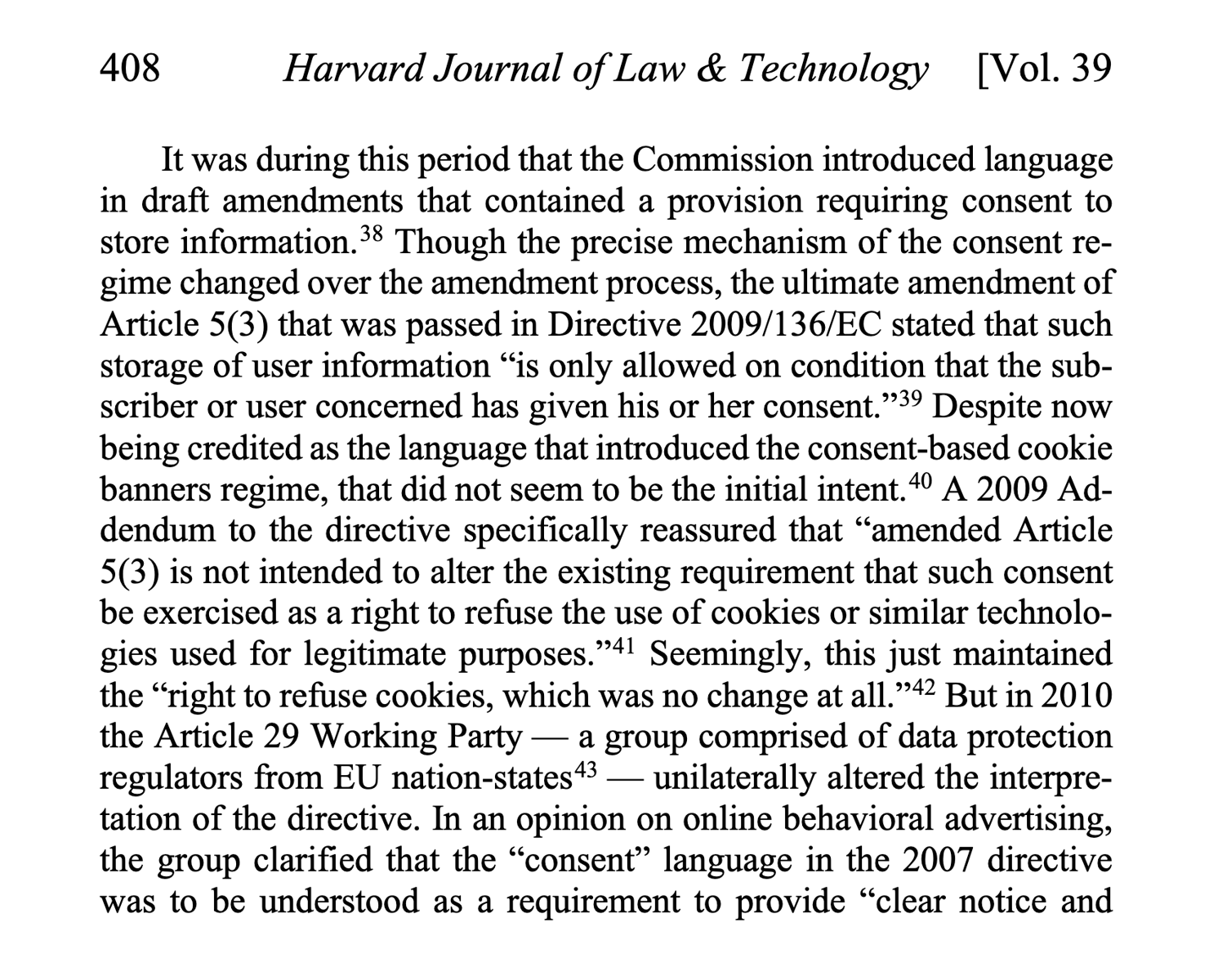
Back in November 2009, when I was a young 21-year-old studying linguistics at university - full of dreams and hopes about the upcoming winter exam period and the future, thinking about girls and stuff - the EU Parliament, Council, and Commission were busy introducing amendments to the ePrivacy Directive that would go on to ruin the internet forever:

Uploaded image
Journal page explaining how EU consent rules led to cookie banners

Can’t recommend this case study enough.

A great cri de coeur from Kate Klonick on abolishing cookie banners.

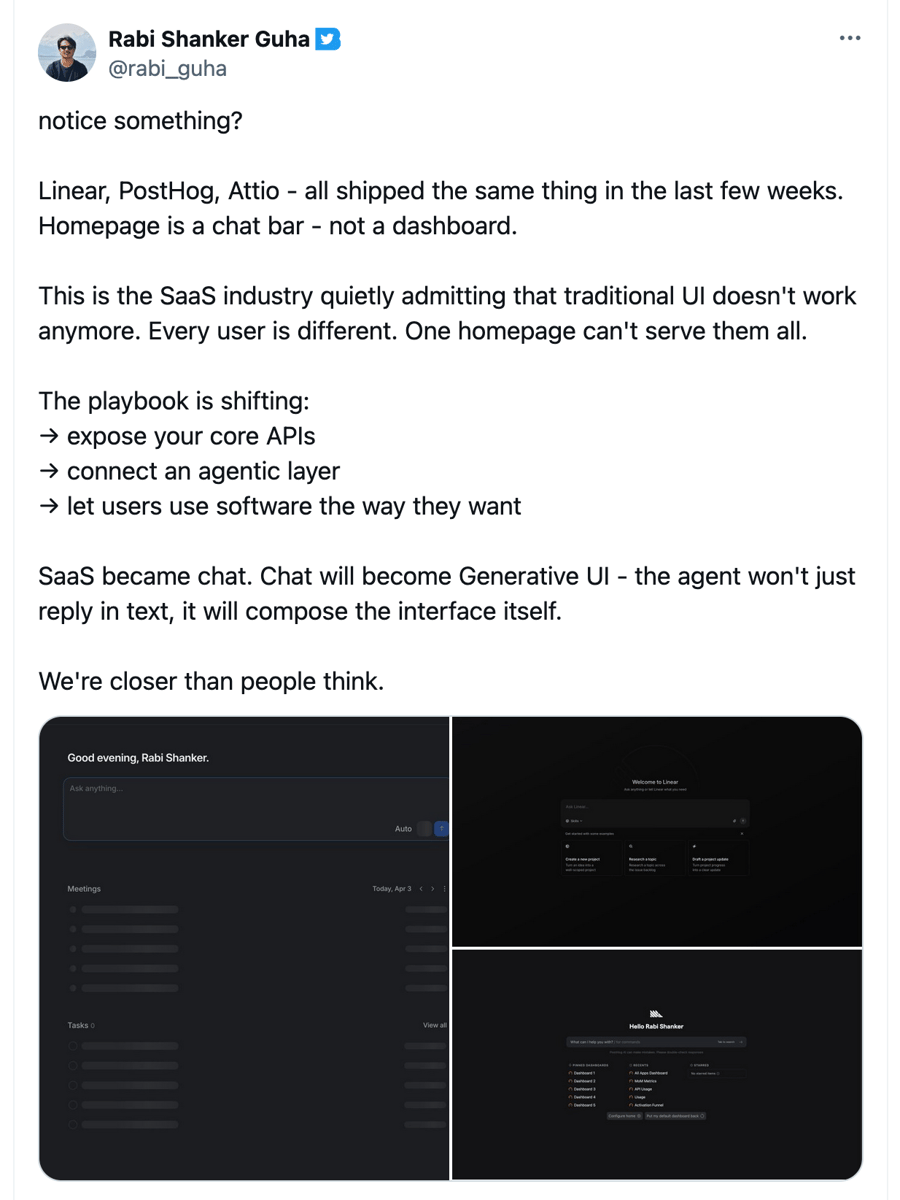
The Chat Bar Has Arrived

The moment I wrote about back in October 2024 has finally arrived.

Turns out, creativity wasn't required after all, so now everyone is just betting on the same thing - the chat bar:

Uploaded image
A screenshot of a tweet about the Chat Bar in Linear, PostHog, Attio

What a sad state of software, really. Instead of useful dashboards or UIs you've memorized and can navigate in a couple of clicks, you now get a dull chat bar where you have to ask a question first.

It's funny how the IT guys, the most introverted crowd, are building the most extroverted thing of all: something where you have to talk all day long.

Design Update

Revamped my blog design entirely.

The main page is now the feed of my posts. This way the site will feel more alive and dynamic, if I post regularly, though.

Added some custom CSS too, with little markers to distinguish #now and #fiction posts in the feed. I think it looks nice.

You're missing out if you're only reading this in RSS!

My mom is in the left picture, I am not. I am in the right picture, my mom is not.

Finished "The Idiot" last night, finally. It took me a while.

But in my defence I must say that 1) the book is quite long 2) I read two other books in the meantime.
now

Delve It Till You Make It

The industry of automation and cutting corners couldn't have produced anything else:

Delve achieves its claim of being the fastest platform by producing fake evidence, generating auditor conclusions on behalf of certification mills that rubber stamp reports, and skipping major framework requirements while telling clients they have achieved 100% compliance. Their “US-based auditors” are Indian certification mills operating through empty US shells and mailbox agents. Auditors breach independence rules by signing off anyway, leaving companies unknowingly exposed to criminal liability under HIPAA and hefty fines under GDPR.

https://deepdelver.substack.com/p/delve-fake-compliance-as-a-service

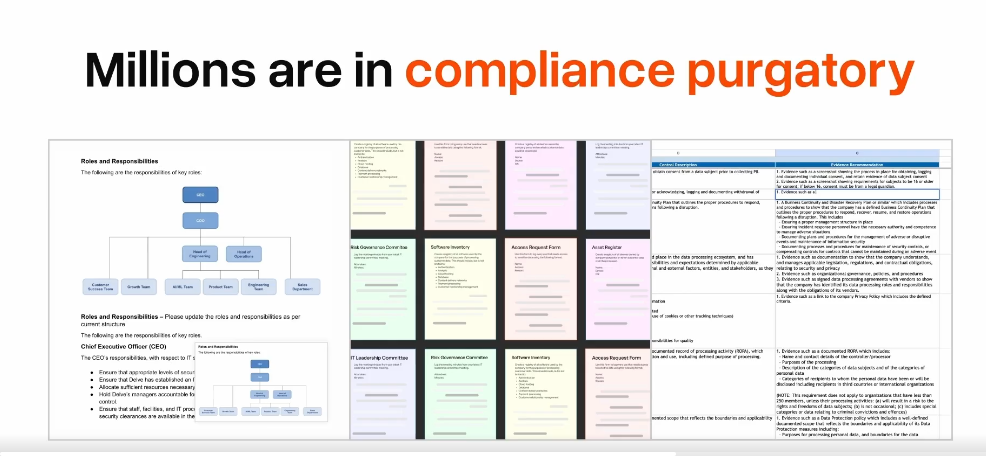
And I can see why it happened. We now have a whole generation of people who think privacy and compliance are just annoyances standing between them and their “real job.” They don’t take it seriously and treat it as just another checkbox to tick because the compliance team asked for it. It was only a matter of time before these people started founding startups.

Uploaded image
Slide from Delve video

That’s exactly the problem here. And it will persist as long as people see privacy and compliance as something separate from the work they’re actually paid to do.

Compliance isn’t a hurdle to clear so you can move on. It’s part of the work.