
1,208 startups launched 14,592 upvotes cast 73 submitted this week

Recently Listed

1,209 launches
Sort
ProHoster Featured

Infrastructure consolidation remains a persistent challenge for digital entrepreneurs. Developers and small businesses typically juggle multiple vendors for hosting, domain registration, security, and network services, each with separate interfaces and billing cycles. ProHoster addresses this fragmentation by bundling shared hosting, virtual private servers, dedicated infrastructure, and VPN services into a unified platform, paired with AI-assisted website building and SSL certification. The platform positions itself at cost-conscious operators through aggressive pricing. Shared hosting costs $2.50 monthly, VPS instances $2.60, and VPN access $2. Dedicated servers begin at $65. All packages include DDoS protection and SSL certificates, eliminating typical add-on costs. The company guarantees 99.98% uptime under its service level agreement and operates data centers across Europe and the USA to meet regional compliance requirements. The founding team's background as systems administrators shapes the technical decisions. The platform supports multiple virtualization options on VPS tiers (KVM and OpenVZ), accommodates various operating systems, and permits peer-to-peer traffic on higher plans. These choices reflect comfort with heterogeneous infrastructure rather than vendor lock-in. The included AI website builder targets the no-code segment, while free domain registration removes friction for first-time site owners. Support operates around the clock to serve a globally distributed customer base across 120 countries. The founder's stated values emphasize infrastructure independence and privacy. Cryptocurrency billing and VLESS obfuscation protocols indicate focus on users seeking anonymity and decentralized payments. The platform operates across 75 global locations with proprietary automation, demonstrating technical depth beyond typical reseller offerings. ProHoster's competitive position hinges on breadth and affordability. The bundled approach serves customers prioritizing operational simplicity and cost efficiency over niche specialization. Uptime guarantees and included security fundamentals function as table stakes rather than differentiators in today's hosting market. Performance capabilities remain unspecified in available materials. For startups and small businesses seeking cost-efficient infrastructure consolidation, ProHoster offers a straightforward option.


Web-hosting-services
P
ProHoster

Infrastructure consolidation remains a persistent challenge for digital entrepreneurs. Developers and small businesses typically juggle multiple vendors for hosting, domain registration, security, and network services, each with separate interfaces and billing cycles. ProHoster addresses this fragmentation by bundling shared hosting, virtual private servers, dedicated infrastructure, and VPN services into a unified platform, paired with AI-assisted website building and SSL certification. The platform positions itself at cost-conscious operators through aggressive pricing. Shared hosting costs $2.50 monthly, VPS instances $2.60, and VPN access $2. Dedicated servers begin at $65. All packages include DDoS protection and SSL certificates, eliminating typical add-on costs. The company guarantees 99.98% uptime under its service level agreement and operates data centers across Europe and the USA to meet regional compliance requirements. The founding team's background as systems administrators shapes the technical decisions. The platform supports multiple virtualization options on VPS tiers (KVM and OpenVZ), accommodates various operating systems, and permits peer-to-peer traffic on higher plans. These choices reflect comfort with heterogeneous infrastructure rather than vendor lock-in. The included AI website builder targets the no-code segment, while free domain registration removes friction for first-time site owners. Support operates around the clock to serve a globally distributed customer base across 120 countries. The founder's stated values emphasize infrastructure independence and privacy. Cryptocurrency billing and VLESS obfuscation protocols indicate focus on users seeking anonymity and decentralized payments. The platform operates across 75 global locations with proprietary automation, demonstrating technical depth beyond typical reseller offerings. ProHoster's competitive position hinges on breadth and affordability. The bundled approach serves customers prioritizing operational simplicity and cost efficiency over niche specialization. Uptime guarantees and included security fundamentals function as table stakes rather than differentiators in today's hosting market. Performance capabilities remain unspecified in available materials. For startups and small businesses seeking cost-efficient infrastructure consolidation, ProHoster offers a straightforward option.

ProHoster preview

Key features

  • Unified Platform: Consolidates shared hosting, VPS, dedicated servers, and VPN services into a single interface with one billing cycle.
  • Included Security: All packages include DDoS protection and SSL certificates at no additional cost.
See full listing
Tiny Desk AI

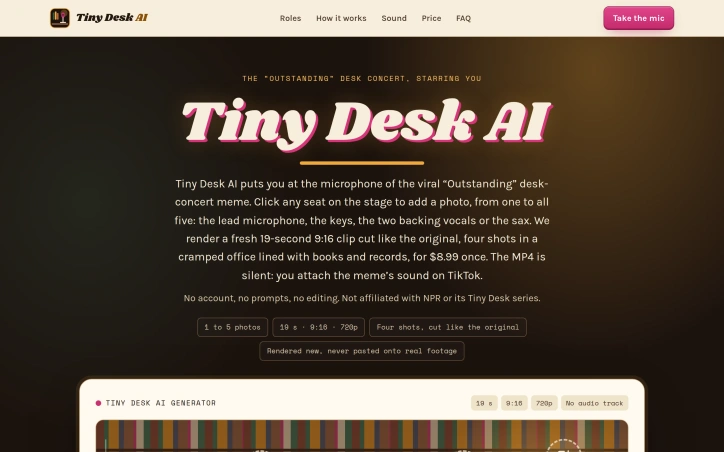
Meme culture thrives on participation and remixing, but most viral formats require technical editing skills or specialized tools. This new service strips away that friction by automating the core mechanics of one of TikTok's most durable audio trends: the "Outstanding" desk-concert parody inspired by NPR's Tiny Desk series. The product works with elegant simplicity. Users upload between one and five photographs—of themselves, friends, or anyone else willing to be part of a video—and the software places each face into a corresponding position within the meme template: lead vocalist, keyboardist, backing vocalists (two positions), or saxophonist. The system then renders a fresh 19-second vertical video in 720p, framed and edited to match the original's four-shot structure and cramped office setting. Crucially, the video ships without audio, requiring users to add the meme's iconic backing track directly on TikTok—a design choice that sidesteps licensing complexity while keeping the creation workflow focused. What distinguishes this approach is its commitment to reducing friction. There is no account creation, no AI prompt engineering, no layer of post-production editing. A user selects seats, uploads photos, pays $8.99 once, and receives a render. The experience is transactional and transparent: no recurring charges, no data harvesting beyond the immediate render cycle, and explicit commitments to delete uploaded photos within a day. Empty seats automatically populate with fictional musicians, so a user can generate a complete video with just a single photo. The pricing model mirrors the service's ethos. At $8.99 per video, the cost sits well below the friction threshold that would deter casual participation, while clearly establishing a commercial model rather than a free-tier trap. The one-time payment structure removes the psychological friction of ongoing subscriptions. This targets a specific but sizable audience: TikTok creators and meme enthusiasts who want to participate in established viral formats without learning new tools. It succeeds by doing one thing exceptionally well—turning a meme template into a personalization platform—rather than overextending into editing suites or AI-generated content sprawl. The product respects both the mechanics of meme culture and the constraints of its platform.

Ai-generative-media
L
lok lok

Meme culture thrives on participation and remixing, but most viral formats require technical editing skills or specialized tools. This new service strips away that friction by automating the core mechanics of one of TikTok's most durable audio trends: the "Outstanding" desk-concert parody inspired by NPR's Tiny Desk series. The product works with elegant simplicity. Users upload between one and five photographs—of themselves, friends, or anyone else willing to be part of a video—and the software places each face into a corresponding position within the meme template: lead vocalist, keyboardist, backing vocalists (two positions), or saxophonist. The system then renders a fresh 19-second vertical video in 720p, framed and edited to match the original's four-shot structure and cramped office setting. Crucially, the video ships without audio, requiring users to add the meme's iconic backing track directly on TikTok—a design choice that sidesteps licensing complexity while keeping the creation workflow focused. What distinguishes this approach is its commitment to reducing friction. There is no account creation, no AI prompt engineering, no layer of post-production editing. A user selects seats, uploads photos, pays $8.99 once, and receives a render. The experience is transactional and transparent: no recurring charges, no data harvesting beyond the immediate render cycle, and explicit commitments to delete uploaded photos within a day. Empty seats automatically populate with fictional musicians, so a user can generate a complete video with just a single photo. The pricing model mirrors the service's ethos. At $8.99 per video, the cost sits well below the friction threshold that would deter casual participation, while clearly establishing a commercial model rather than a free-tier trap. The one-time payment structure removes the psychological friction of ongoing subscriptions. This targets a specific but sizable audience: TikTok creators and meme enthusiasts who want to participate in established viral formats without learning new tools. It succeeds by doing one thing exceptionally well—turning a meme template into a personalization platform—rather than overextending into editing suites or AI-generated content sprawl. The product respects both the mechanics of meme culture and the constraints of its platform.

Rumpelstiltskin AI

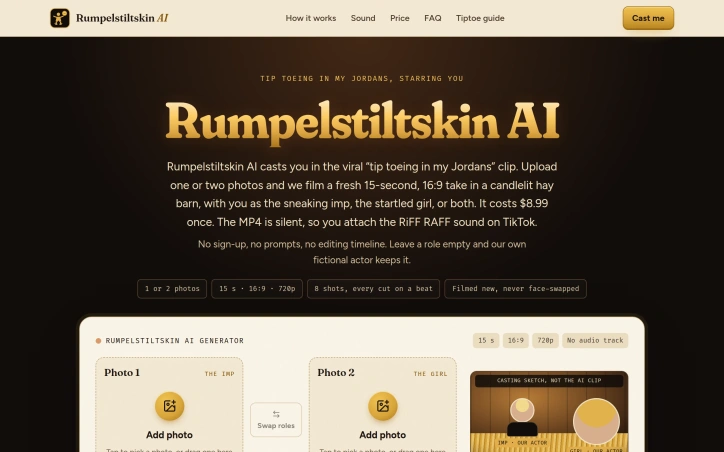
Viral meme replication typically demands either technical skill with video editing software or expensive creator services. Rumpelstiltskin AI solves this by reducing the barrier to near zero: upload a photo or two, pay $8.99, and receive a finished 15-second video ready to post. The product targets TikTok creators and social media users who want to participate in meme trends without learning editing timelines or committing to subscriptions. It operates on a template model, inserting user faces into a pre-shot sequence of the "tip toeing in my Jordans" meme. This is not face-swapping. The company films eight distinct shots with physical sets and actors, then composites the user's face into five to seven of those cuts depending on role selection. The remaining shots stay as original footage, typically showing hands, feet, or angles where face insertion would be unnecessary or uncanny. What distinguishes this product is its refusal of friction. There is no account creation, no prompt engineering, no timeline scrubbing. The user selects one or two photos, chooses a role (the imp, the girl, or both), clicks "cast," and the rendering begins. The company handles casting, filming, and compositing without asking for granular controls. The output is a silent MP4, intentionally design-limited so that users must attach audio on TikTok itself, which is where the meme lives. The pricing model reinforces this simplicity: $8.99 per video, no recurring charges, no cancellation mechanics. The company demonstrates transparency about its methods. The website explicitly states which shots are newly filmed and which are always pre-made footage, differentiating itself from services that promise total customization. Uploads are deleted 24 hours after rendering, and videos are private by default. The acceptable use policy requires confirmation that all people in uploaded photos are adults who consented and are not public figures, which attempts to preempt the most obvious legal and ethical misuses. The fixed edit structure is both a feature and a limitation. The 8-shot sequence never varies; cuts always land on the beat. This predictability means faster rendering and consistent output quality, but it also means zero creative deviation. Users cannot request different choreography, camera angles, or scene variations. At $8.99 for a one-time creation, the product is positioned as an impulse purchase rather than a production tool. It targets participants in trend cycles rather than professional creators, and it prices accordingly.

Ai-generative-media
L
lok lok

Viral meme replication typically demands either technical skill with video editing software or expensive creator services. Rumpelstiltskin AI solves this by reducing the barrier to near zero: upload a photo or two, pay $8.99, and receive a finished 15-second video ready to post. The product targets TikTok creators and social media users who want to participate in meme trends without learning editing timelines or committing to subscriptions. It operates on a template model, inserting user faces into a pre-shot sequence of the "tip toeing in my Jordans" meme. This is not face-swapping. The company films eight distinct shots with physical sets and actors, then composites the user's face into five to seven of those cuts depending on role selection. The remaining shots stay as original footage, typically showing hands, feet, or angles where face insertion would be unnecessary or uncanny. What distinguishes this product is its refusal of friction. There is no account creation, no prompt engineering, no timeline scrubbing. The user selects one or two photos, chooses a role (the imp, the girl, or both), clicks "cast," and the rendering begins. The company handles casting, filming, and compositing without asking for granular controls. The output is a silent MP4, intentionally design-limited so that users must attach audio on TikTok itself, which is where the meme lives. The pricing model reinforces this simplicity: $8.99 per video, no recurring charges, no cancellation mechanics. The company demonstrates transparency about its methods. The website explicitly states which shots are newly filmed and which are always pre-made footage, differentiating itself from services that promise total customization. Uploads are deleted 24 hours after rendering, and videos are private by default. The acceptable use policy requires confirmation that all people in uploaded photos are adults who consented and are not public figures, which attempts to preempt the most obvious legal and ethical misuses. The fixed edit structure is both a feature and a limitation. The 8-shot sequence never varies; cuts always land on the beat. This predictability means faster rendering and consistent output quality, but it also means zero creative deviation. Users cannot request different choreography, camera angles, or scene variations. At $8.99 for a one-time creation, the product is positioned as an impulse purchase rather than a production tool. It targets participants in trend cycles rather than professional creators, and it prices accordingly.

Rumpelstiltskin AI preview

Key features

  • Face Compositing: Inserts user faces into pre-filmed shots without face-swapping technology.
  • No Account Required: Users can create videos without signing up or creating an account.
See full listing
Zombie Couple Video

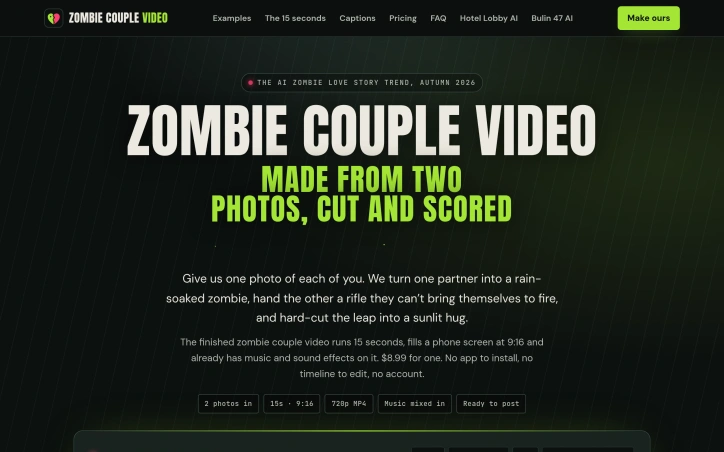
A trend tool for couples wanting participatory viral content, Zombie Couple Video generates fifteen-second vertical clips from two portraits for $8.99 per video. The creator positions this around the autumn 2026 zombie couple aesthetic—a scenario where one partner becomes undead in a rain-soaked standoff while the other, armed with a rifle, cannot bring themselves to shoot. The narrative resolves with a hard cut to a sunlit memory of the pair embracing. The product's strength lies in radical simplicity. There is no app to download, no account to create, no timeline to navigate. Users upload two images, confirm consent and age verification, and pay directly through Stripe. The entire process treats the output as a finished asset: the 720p MP4 arrives with music and sound effects already mixed in, formatted at 9:16 for mobile phone screens and ready to share immediately. The AI handles the substantive creative work. It transforms one photo into a zombie version, stages the survival scenario, choreographs the climactic jump, and cuts to the memory. The rendering happens server-side while users wait or step away. The examples shown—rendered from fictional test faces and presented unedited—suggest consistent visual coherence across the pipeline. Privacy and consent are explicit commitments. The founder emphasizes that all subjects must be adults, must consent to participation, and cannot be celebrities or public figures. Uploaded photos are deleted within 24 hours regardless of whether rendering succeeds. This directly addresses tensions around AI image generation and consent that plague many generative tools. The business model is transparent: each video costs eight dollars ninety-nine cents, charged once, with no recurring subscriptions or account balances. There are no credits to manage, no pressure to pre-purchase batches, no friction between the intention to create and the act of paying. What distinguishes this product is not the AI video generation capability itself but its ruthlessly focused application to a specific, trending scenario. The creator recognized a cultural moment and built exactly one thing to serve it well: an unburdened tool that removes friction between impulse and artifact. The stripped-down scope is deliberate. A user enters with two photos and a social media intention. They leave with a ready-to-post clip in under two minutes. The inherent risk is trend decay. The zombie couple aesthetic may fade as quickly as it rose. But the execution—the consent frameworks, the privacy commitments, the friction-free interface—establishes a working template that could theoretically adapt to other fleeting relationship video trends if cultural moments demand it.

Ai-generative-media
L
lok lok

A trend tool for couples wanting participatory viral content, Zombie Couple Video generates fifteen-second vertical clips from two portraits for $8.99 per video. The creator positions this around the autumn 2026 zombie couple aesthetic—a scenario where one partner becomes undead in a rain-soaked standoff while the other, armed with a rifle, cannot bring themselves to shoot. The narrative resolves with a hard cut to a sunlit memory of the pair embracing. The product's strength lies in radical simplicity. There is no app to download, no account to create, no timeline to navigate. Users upload two images, confirm consent and age verification, and pay directly through Stripe. The entire process treats the output as a finished asset: the 720p MP4 arrives with music and sound effects already mixed in, formatted at 9:16 for mobile phone screens and ready to share immediately. The AI handles the substantive creative work. It transforms one photo into a zombie version, stages the survival scenario, choreographs the climactic jump, and cuts to the memory. The rendering happens server-side while users wait or step away. The examples shown—rendered from fictional test faces and presented unedited—suggest consistent visual coherence across the pipeline. Privacy and consent are explicit commitments. The founder emphasizes that all subjects must be adults, must consent to participation, and cannot be celebrities or public figures. Uploaded photos are deleted within 24 hours regardless of whether rendering succeeds. This directly addresses tensions around AI image generation and consent that plague many generative tools. The business model is transparent: each video costs eight dollars ninety-nine cents, charged once, with no recurring subscriptions or account balances. There are no credits to manage, no pressure to pre-purchase batches, no friction between the intention to create and the act of paying. What distinguishes this product is not the AI video generation capability itself but its ruthlessly focused application to a specific, trending scenario. The creator recognized a cultural moment and built exactly one thing to serve it well: an unburdened tool that removes friction between impulse and artifact. The stripped-down scope is deliberate. A user enters with two photos and a social media intention. They leave with a ready-to-post clip in under two minutes. The inherent risk is trend decay. The zombie couple aesthetic may fade as quickly as it rose. But the execution—the consent frameworks, the privacy commitments, the friction-free interface—establishes a working template that could theoretically adapt to other fleeting relationship video trends if cultural moments demand it.

Zombie Couple Video preview

Key features

  • Two-Portrait Generation: Transforms two uploaded portraits into a 15-second zombie couple scenario video
  • No Account Required: Upload photos, verify consent and age, and pay—no app, login, or setup needed
See full listing
Bulin 47 AI

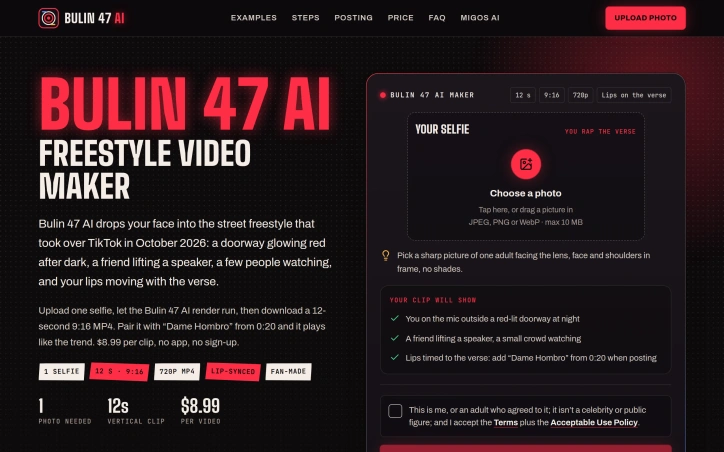
Capitalizing on a viral dembow moment that swept through Latin media in October 2026, this tool converts a single selfie into a 12-second vertical video of the user lip-synced to a freestyle verse that generated tens of millions of views across platforms. The service addresses a specific use case: enabling social media users to participate in a cultural trend without requiring video production skills, equipment, or account creation. The product's core strength is its radical simplicity. Users upload one clear facial photograph, verify they own the likeness, and pay $8.99 for a rendered MP4. No editing interface, no customization prompts, no strategic decisions beyond image selection. The output arrives as a mobile-ready vertical clip with lip-sync timing calibrated to the beat. The silent video design—users add audio when posting—keeps the production pipeline focused and the tool's scope deliberately narrow. Several design choices reveal intentional restraint. Uploaded images disappear within 24 hours, treating data minimization as a feature rather than a policy footnote. The service operates without accounts or subscriptions, eliminating authentication friction and the pressure to grow monthly active users. The creator frames this as an unofficial fan tool with no artist affiliation, setting clear expectations while sidestepping brand partnership complications. The one-time payment model at $8.99 per video signals the creators understand their own market constraints. This is a trend-capture product built for a moment, not a platform engineered for perpetual engagement. The business structure treats each video as a discrete transaction: pay once, receive an asset, the relationship ends. Users retain no profile, no library, no reason to return except to make another video during the trend's active window. The limiting factor is self-evident: viral moments in music have finite lifespans. The tool's entire value depends on sustained participation in the Bulin 47 trend. Should interest fade, so does relevance. The product makes no attempt to extend utility beyond the specific cultural moment it targets, which appears intentional rather than an oversight. This focus, while commercially risky long-term, makes the offering honest about what it is and what it actually does.

Ai-generative-media
L
lok lok

Capitalizing on a viral dembow moment that swept through Latin media in October 2026, this tool converts a single selfie into a 12-second vertical video of the user lip-synced to a freestyle verse that generated tens of millions of views across platforms. The service addresses a specific use case: enabling social media users to participate in a cultural trend without requiring video production skills, equipment, or account creation. The product's core strength is its radical simplicity. Users upload one clear facial photograph, verify they own the likeness, and pay $8.99 for a rendered MP4. No editing interface, no customization prompts, no strategic decisions beyond image selection. The output arrives as a mobile-ready vertical clip with lip-sync timing calibrated to the beat. The silent video design—users add audio when posting—keeps the production pipeline focused and the tool's scope deliberately narrow. Several design choices reveal intentional restraint. Uploaded images disappear within 24 hours, treating data minimization as a feature rather than a policy footnote. The service operates without accounts or subscriptions, eliminating authentication friction and the pressure to grow monthly active users. The creator frames this as an unofficial fan tool with no artist affiliation, setting clear expectations while sidestepping brand partnership complications. The one-time payment model at $8.99 per video signals the creators understand their own market constraints. This is a trend-capture product built for a moment, not a platform engineered for perpetual engagement. The business structure treats each video as a discrete transaction: pay once, receive an asset, the relationship ends. Users retain no profile, no library, no reason to return except to make another video during the trend's active window. The limiting factor is self-evident: viral moments in music have finite lifespans. The tool's entire value depends on sustained participation in the Bulin 47 trend. Should interest fade, so does relevance. The product makes no attempt to extend utility beyond the specific cultural moment it targets, which appears intentional rather than an oversight. This focus, while commercially risky long-term, makes the offering honest about what it is and what it actually does.

Bulin 47 AI preview

Key features

  • Selfie to Video: Converts a single photograph into a 12-second lip-synced vertical video.
  • Automatic Lip-Sync: Renders video with lip-sync timing calibrated to the beat.
See full listing
My Hotel Lobby AI

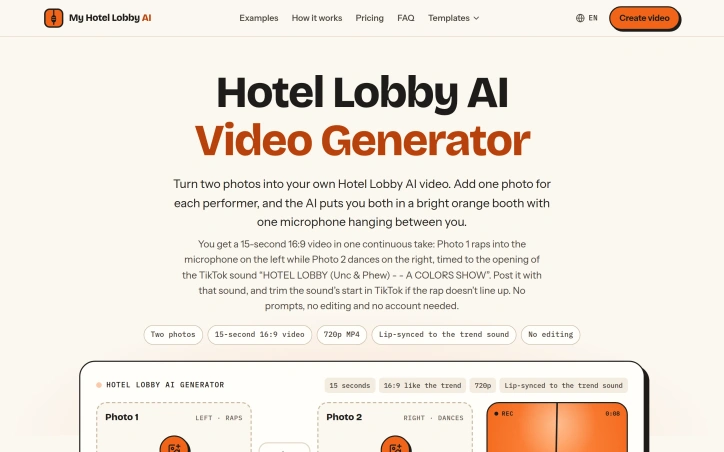
Creating viral social media content typically requires either significant technical skills or expensive tools. This AI video generator addresses that friction by packaging a single trending format into an extremely focused product that requires nothing more than two photos and $8.99. The core service transforms a pair of user-supplied images into 15-second TikTok videos matching the "Hotel Lobby" trend, where one photo raps into a hanging microphone while the other dances in an orange booth. The template is pre-configured, meaning users skip the usual AI video workflow of writing prompts, selecting models, or tweaking parameters. The service handles lip-syncing automatically to the established trend sound, and the output arrives pre-formatted in 720p MP4 at 16:9 aspect ratio—ready to post directly. What distinguishes this product is its deliberate simplicity. Most AI video tools force users to learn their systems, experiment with settings, and make creative decisions. This one does the opposite: it eliminates options. There is no account signup requirement, no creative customization, no editing phase. Users select two images, confirm they have permission to use them, and submit payment. The philosophy of constraint-driven design shows throughout. The product even includes a feature to swap performer positions before payment, eliminating a common source of regret with one-way transactions. Privacy receives explicit attention in the product design. The service deletes photos within 24 hours, whether the generation succeeds or fails. The terms explicitly address consent, prohibiting use of images containing minors, celebrities, or public figures—a meaningful guardrail against the misuse that plagues many generative tools. The pricing structure removes subscription friction entirely. At $8.99 per video with no recurring charges, the transaction is transparent and one-off. Failed generations automatically refund credits, eliminating the anxiety that often surrounds experimental features. The target user is clear: social media creators who want to participate in a specific trend without spending hours learning software or acquiring new skills. This narrowness is intentional. The product refuses the temptation to become a general AI video tool, instead excelling at a single outcome. That focus, combined with the frictionless workflow and transparent pricing, creates a compelling value proposition for anyone who sees the trend and wants in without the complexity.

Ai-generative-media
L
lok lok

Creating viral social media content typically requires either significant technical skills or expensive tools. This AI video generator addresses that friction by packaging a single trending format into an extremely focused product that requires nothing more than two photos and $8.99. The core service transforms a pair of user-supplied images into 15-second TikTok videos matching the "Hotel Lobby" trend, where one photo raps into a hanging microphone while the other dances in an orange booth. The template is pre-configured, meaning users skip the usual AI video workflow of writing prompts, selecting models, or tweaking parameters. The service handles lip-syncing automatically to the established trend sound, and the output arrives pre-formatted in 720p MP4 at 16:9 aspect ratio—ready to post directly. What distinguishes this product is its deliberate simplicity. Most AI video tools force users to learn their systems, experiment with settings, and make creative decisions. This one does the opposite: it eliminates options. There is no account signup requirement, no creative customization, no editing phase. Users select two images, confirm they have permission to use them, and submit payment. The philosophy of constraint-driven design shows throughout. The product even includes a feature to swap performer positions before payment, eliminating a common source of regret with one-way transactions. Privacy receives explicit attention in the product design. The service deletes photos within 24 hours, whether the generation succeeds or fails. The terms explicitly address consent, prohibiting use of images containing minors, celebrities, or public figures—a meaningful guardrail against the misuse that plagues many generative tools. The pricing structure removes subscription friction entirely. At $8.99 per video with no recurring charges, the transaction is transparent and one-off. Failed generations automatically refund credits, eliminating the anxiety that often surrounds experimental features. The target user is clear: social media creators who want to participate in a specific trend without spending hours learning software or acquiring new skills. This narrowness is intentional. The product refuses the temptation to become a general AI video tool, instead excelling at a single outcome. That focus, combined with the frictionless workflow and transparent pricing, creates a compelling value proposition for anyone who sees the trend and wants in without the complexity.

My Hotel Lobby AI preview

Key features

  • Two Photo Conversion: Transforms two user-supplied images into 15-second Hotel Lobby trend TikTok videos
  • Template-Based Workflow: Pre-configured template eliminates writing prompts, selecting models, or tweaking parameters
See full listing
RapZap

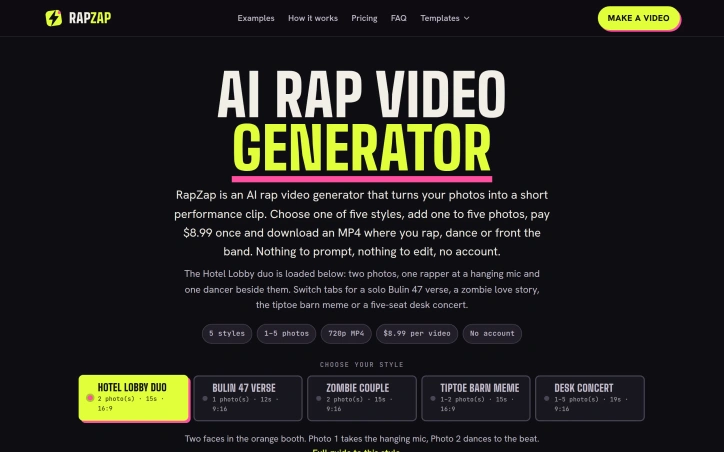
The appeal of meme culture and viral moments lies partly in their unpredictability—watching an unexpected person inserted into a familiar scene creates comedy through surprise and recognition. A social media creator seeking to tap into this trend faces a barrier: producing convincing video content requires either professional equipment and editing skills, or access to expensive AI tools that demand technical knowledge and ongoing subscriptions. RapZap addresses this friction by packaging AI video generation into a strictly bounded, template-based service. The product targets people who want to generate short performance clips for social sharing without building skills or maintaining an account. Users select from five predefined scenarios—a hotel lobby duet, a solo rap verse, a zombie love story, a barn dance meme recreation, and a desk concert—add between one and five face-forward photos, pay 8.99 dollars once, and receive a finished 720p MP4 ready for TikTok, Instagram Reels, or YouTube Shorts. The design emphasizes simplicity over customization. No prompting interface exists; no editing stage comes after rendering; no ongoing relationship with the platform is required. This constraint-based approach avoids the choice paralysis that plagues general-purpose AI tools while keeping friction minimal. Photos are deleted within 24 hours of processing, addressing privacy concerns without requiring lengthy data retention policies. The underlying technology stacks image-based face reconstruction with video generation to animate body movement and mouth synchronization. The quality depends heavily on input—the site explicitly recommends sharp, forward-facing shots with one person or animal per photo—but real examples from the live pipeline demonstrate output suitable for social sharing at the specified resolution and frame rates. Financially, the model is straightforward: 8.99 dollars per video with no recurring charges or hidden account requirements. This positions RapZap as an impulse purchase for casual creators rather than a platform requiring ongoing commitment. The one-time transaction removes decision friction for users curious enough to try but unwilling to subscribe. The service succeeds by acknowledging what it is not. It rejects the ambition of general AI video tools in favor of nailing a narrow use case: turning ordinary photos into recognizable meme variations that work at short-form video scale. That focused scope is its strength. For someone wanting to make their friend appear in a viral moment without learning video production, RapZap delivers exactly what is promised.

Ai-generative-media
L
lok lok

The appeal of meme culture and viral moments lies partly in their unpredictability—watching an unexpected person inserted into a familiar scene creates comedy through surprise and recognition. A social media creator seeking to tap into this trend faces a barrier: producing convincing video content requires either professional equipment and editing skills, or access to expensive AI tools that demand technical knowledge and ongoing subscriptions. RapZap addresses this friction by packaging AI video generation into a strictly bounded, template-based service. The product targets people who want to generate short performance clips for social sharing without building skills or maintaining an account. Users select from five predefined scenarios—a hotel lobby duet, a solo rap verse, a zombie love story, a barn dance meme recreation, and a desk concert—add between one and five face-forward photos, pay 8.99 dollars once, and receive a finished 720p MP4 ready for TikTok, Instagram Reels, or YouTube Shorts. The design emphasizes simplicity over customization. No prompting interface exists; no editing stage comes after rendering; no ongoing relationship with the platform is required. This constraint-based approach avoids the choice paralysis that plagues general-purpose AI tools while keeping friction minimal. Photos are deleted within 24 hours of processing, addressing privacy concerns without requiring lengthy data retention policies. The underlying technology stacks image-based face reconstruction with video generation to animate body movement and mouth synchronization. The quality depends heavily on input—the site explicitly recommends sharp, forward-facing shots with one person or animal per photo—but real examples from the live pipeline demonstrate output suitable for social sharing at the specified resolution and frame rates. Financially, the model is straightforward: 8.99 dollars per video with no recurring charges or hidden account requirements. This positions RapZap as an impulse purchase for casual creators rather than a platform requiring ongoing commitment. The one-time transaction removes decision friction for users curious enough to try but unwilling to subscribe. The service succeeds by acknowledging what it is not. It rejects the ambition of general AI video tools in favor of nailing a narrow use case: turning ordinary photos into recognizable meme variations that work at short-form video scale. That focused scope is its strength. For someone wanting to make their friend appear in a viral moment without learning video production, RapZap delivers exactly what is promised.

RapZap preview

Key features

  • Template-Based Generation: Choose from five predefined scenarios without customization options
  • One-Time Payment: $8.99 per video with no subscriptions or ongoing account requirements
See full listing
Meme Video Maker

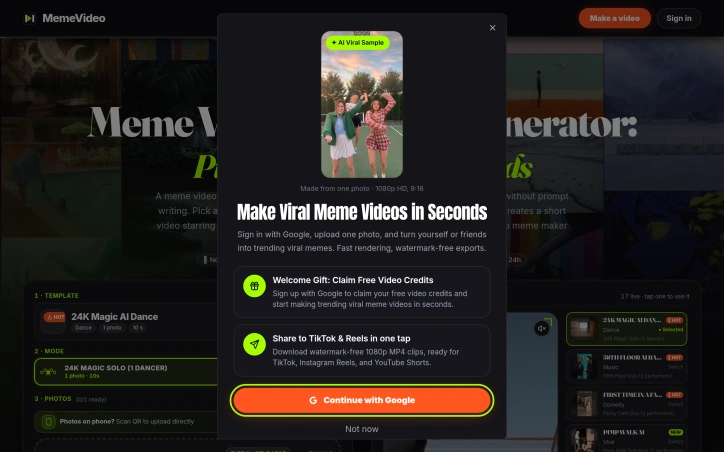
Viral short-form video creation has historically required either video editing skills or AI prompt fluency—two barriers that keep most people from participating in trending meme formats. This service eliminates both by packaging trending video templates with face-insertion AI, letting users simply upload photos and receive finished MP4s optimized for TikTok, Instagram Reels, and YouTube Shorts. The product targets social media users who want to capitalize on viral trends without learning Adobe Premiere or mastering AI prompting. The pitch is straightforward: pick a trending template, upload between one and five photos, and the system generates a 15-second video with the user's face composited into the choreography or scenario. Every video exports watermark-free in vertical 9:16 format. What distinguishes this offering from broader AI video generation tools is its template-first design. Rather than asking users to describe what they want, the service presents curated trending formats—currently 17 active templates spanning dance routines, music duets, comedy scenarios, sports moments, and cinematic sequences. This constraint is actually a strength; it trades unlimited creative freedom for reliability and speed. A template-based approach also naturally produces scroll-stopping content because the templates themselves are already proven viral hits. The execution details suggest thoughtful product design. Photo upload works via traditional browser selection or QR code scanning from mobile, acknowledging that users often have images on their phones. The service provides specific guidance on photo composition—front-facing, clear lighting, waist-up framing—to optimize AI face-insertion results. Render time is quoted at four minutes, competitive for real-time content creation. The privacy model deletes uploaded photos after 24 hours, addressing a legitimate concern about personal image data. The business model operates on a credit system, with a single video consuming 90 credits, though explicit pricing is not disclosed on the available text. The company emphasizes a refund guarantee, reducing perceived risk for first-time users evaluating the service. The main limitation is format rigidity. Users don't generate videos; they participate in predetermined templates. This works perfectly for trend-chasing and social proof but won't appeal to creators wanting original concepts. For the intended audience—people who want to be seen in trending formats without friction—the constraint is a feature, not a bug.

Ai-generative-media
Z
zeng arya

Viral short-form video creation has historically required either video editing skills or AI prompt fluency—two barriers that keep most people from participating in trending meme formats. This service eliminates both by packaging trending video templates with face-insertion AI, letting users simply upload photos and receive finished MP4s optimized for TikTok, Instagram Reels, and YouTube Shorts. The product targets social media users who want to capitalize on viral trends without learning Adobe Premiere or mastering AI prompting. The pitch is straightforward: pick a trending template, upload between one and five photos, and the system generates a 15-second video with the user's face composited into the choreography or scenario. Every video exports watermark-free in vertical 9:16 format. What distinguishes this offering from broader AI video generation tools is its template-first design. Rather than asking users to describe what they want, the service presents curated trending formats—currently 17 active templates spanning dance routines, music duets, comedy scenarios, sports moments, and cinematic sequences. This constraint is actually a strength; it trades unlimited creative freedom for reliability and speed. A template-based approach also naturally produces scroll-stopping content because the templates themselves are already proven viral hits. The execution details suggest thoughtful product design. Photo upload works via traditional browser selection or QR code scanning from mobile, acknowledging that users often have images on their phones. The service provides specific guidance on photo composition—front-facing, clear lighting, waist-up framing—to optimize AI face-insertion results. Render time is quoted at four minutes, competitive for real-time content creation. The privacy model deletes uploaded photos after 24 hours, addressing a legitimate concern about personal image data. The business model operates on a credit system, with a single video consuming 90 credits, though explicit pricing is not disclosed on the available text. The company emphasizes a refund guarantee, reducing perceived risk for first-time users evaluating the service. The main limitation is format rigidity. Users don't generate videos; they participate in predetermined templates. This works perfectly for trend-chasing and social proof but won't appeal to creators wanting original concepts. For the intended audience—people who want to be seen in trending formats without friction—the constraint is a feature, not a bug.

Meme Video Maker preview

Key features

  • Template-Based Creation: Choose from 17 trending video formats spanning dance routines, comedy, and cinematic sequences
  • Face Insertion AI: AI automatically composites user faces into choreography and scenarios within templates
See full listing
CryptKit

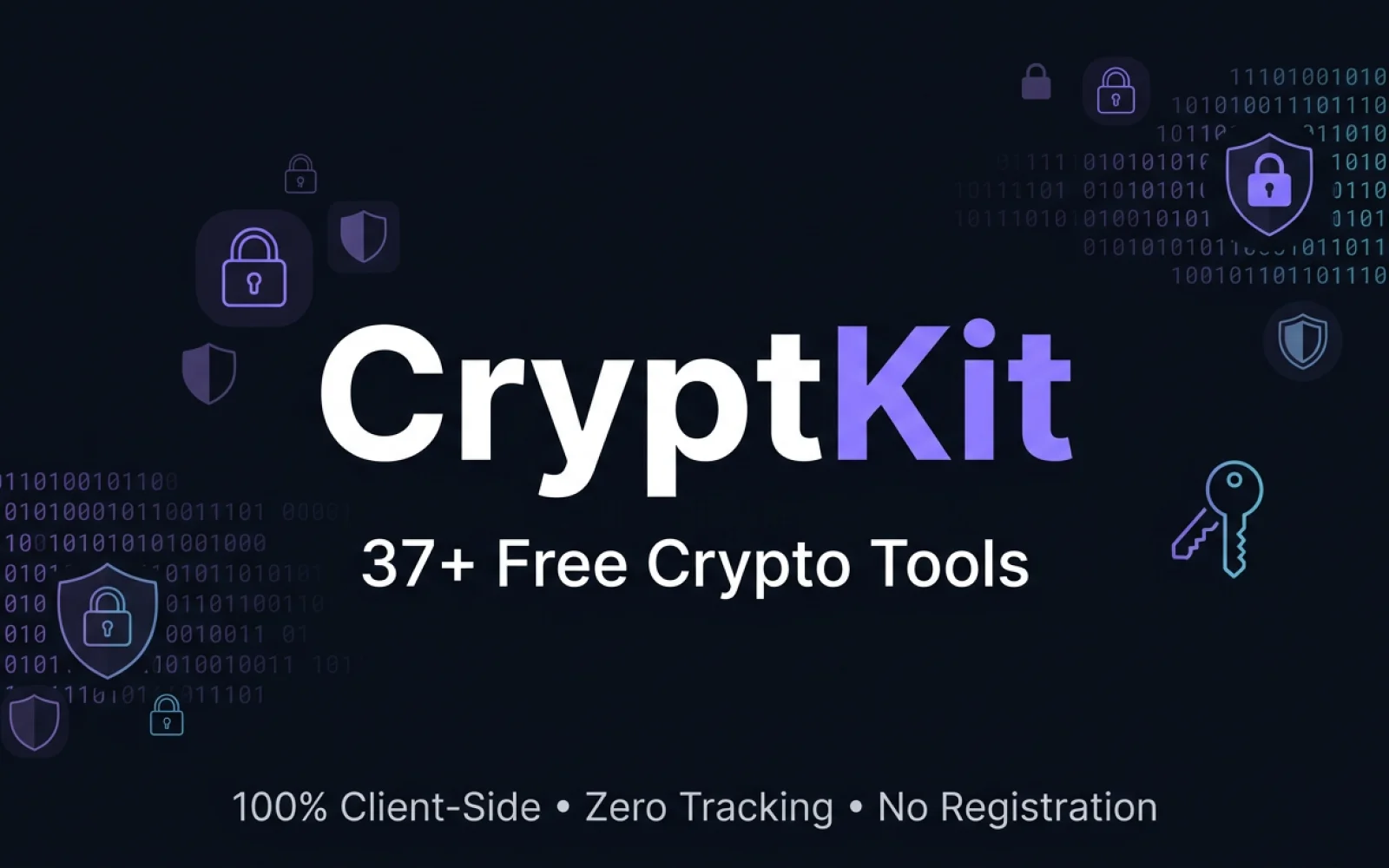
Developers who work with cryptographic operations frequently face a frustrating dilemma: either use specialized websites that send sensitive data to remote servers, or maintain bookmarks to dozens of single-purpose tools scattered across the internet. CryptKit addresses this friction point by consolidating 37 cryptography tools into a single, locally-executed platform that prioritizes privacy by design. The core appeal is straightforward but powerful. All processing happens client-side through the Web Crypto API, meaning encryption keys, passphrases, and test secrets never transmit to any server. For teams handling production credentials or developers working with sensitive configuration data, this distinction matters. The tool works entirely offline as a progressive web application, functions without user accounts or tracking, and carries no advertising. There is no friction to adoption and no privacy trade-off to negotiate. The feature set spans both conventional and modern cryptographic needs. Users can generate and test passwords, derive keys using algorithms like Argon2 and Scrypt with OWASP-recommended parameters, encrypt data via AES in multiple modes, work with asymmetric systems like RSA and ECC, manage digital signatures, handle JWT and JWE tokens, and split secrets using Shamir's Secret Sharing. The tool also includes support for post-quantum algorithms such as ML-KEM and ML-DSA, positioning it ahead of most competing utilities that ignore the near-term relevance of quantum-resistant cryptography. The execution shows careful design throughout. The password strength checker performs entropy analysis using zxcvbn-based pattern recognition. RSA and ECC key generators support multiple output formats—PEM, DER, JWK, SSH—for compatibility across different systems. The PGP tool handles encryption, decryption, signing, and verification with GnuPG compatibility. Blowfish, ChaCha20, DES, XOR, and other specialized ciphers are available for edge cases and compatibility testing. The business model removes common friction: CryptKit is completely free with no freemium tier, no paid features, and no upsell. For developers, security teams, and system administrators who regularly encrypt test data, verify tokens, hash configuration values, or generate keys, CryptKit collapses a tool-juggling workflow into a single, trustworthy destination. The absence of tracking combined with genuine offline capability makes it distinct in a space where many competitors ask users to place cryptographic material in the hands of remote services.

Security-software
�
李程林

Developers who work with cryptographic operations frequently face a frustrating dilemma: either use specialized websites that send sensitive data to remote servers, or maintain bookmarks to dozens of single-purpose tools scattered across the internet. CryptKit addresses this friction point by consolidating 37 cryptography tools into a single, locally-executed platform that prioritizes privacy by design. The core appeal is straightforward but powerful. All processing happens client-side through the Web Crypto API, meaning encryption keys, passphrases, and test secrets never transmit to any server. For teams handling production credentials or developers working with sensitive configuration data, this distinction matters. The tool works entirely offline as a progressive web application, functions without user accounts or tracking, and carries no advertising. There is no friction to adoption and no privacy trade-off to negotiate. The feature set spans both conventional and modern cryptographic needs. Users can generate and test passwords, derive keys using algorithms like Argon2 and Scrypt with OWASP-recommended parameters, encrypt data via AES in multiple modes, work with asymmetric systems like RSA and ECC, manage digital signatures, handle JWT and JWE tokens, and split secrets using Shamir's Secret Sharing. The tool also includes support for post-quantum algorithms such as ML-KEM and ML-DSA, positioning it ahead of most competing utilities that ignore the near-term relevance of quantum-resistant cryptography. The execution shows careful design throughout. The password strength checker performs entropy analysis using zxcvbn-based pattern recognition. RSA and ECC key generators support multiple output formats—PEM, DER, JWK, SSH—for compatibility across different systems. The PGP tool handles encryption, decryption, signing, and verification with GnuPG compatibility. Blowfish, ChaCha20, DES, XOR, and other specialized ciphers are available for edge cases and compatibility testing. The business model removes common friction: CryptKit is completely free with no freemium tier, no paid features, and no upsell. For developers, security teams, and system administrators who regularly encrypt test data, verify tokens, hash configuration values, or generate keys, CryptKit collapses a tool-juggling workflow into a single, trustworthy destination. The absence of tracking combined with genuine offline capability makes it distinct in a space where many competitors ask users to place cryptographic material in the hands of remote services.

CryptKit preview

Key features

  • Client-Side Processing: All cryptographic operations execute locally through the Web Crypto API, ensuring encryption keys and sensitive data never transmit to remote servers.
  • 37 Cryptography Tools: Consolidates password generation, key derivation, AES encryption, RSA, ECC, JWT/JWE tokens, Shamir's Secret Sharing, and more into a single platform.
See full listing
BothShot - Screenshot Recorder

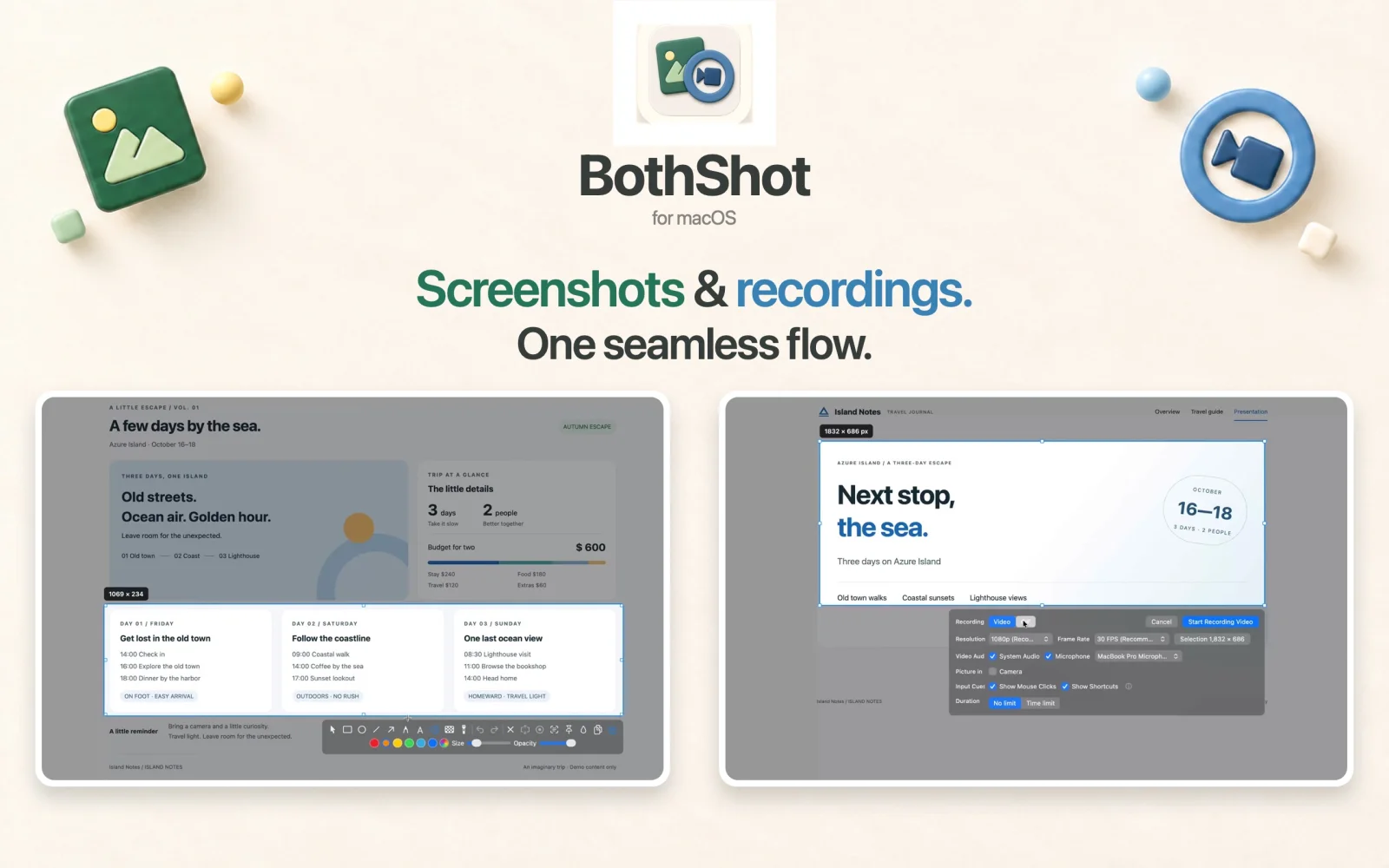
Mac users often cobble together multiple apps to handle screenshots, recordings, annotations, and desktop organization. BothShot consolidates these workflows into a single native application, targeting anyone who needs to document their screen—whether for tutorials, bug reports, demo videos, or general reference materials. The product distinguishes itself through comprehensive feature density packed into a free offering. At 38 total features, BothShot brings together capture capabilities (region, window, full screen, scrolling, and device-frame screenshots), annotation tools (nine inline drawing and text options plus mosaic and spotlight effects), video recording with live annotation, and a desktop pinning system for persistent reference images. The recording capabilities extend to 4K resolution at 60 frames per second, with system audio, microphone input, and camera picture-in-picture support. Users can annotate while recording, trim footage post-capture, extract individual frames, and export as MP4, MOV, or GIF formats. Beyond basic capture, BothShot includes productivity features that address real workflow pain points. Custom watermarking (text or logo, with separate defaults for images and video) streamlines branding across shares. On-device text recognition and translation reduce friction when working with multilingual or complex visual content. The desktop pin library creates a persistent workspace where users can keep reference images accessible above their other windows, adjustable for opacity and appearance. Desktop pinning also supports re-annotation of previously saved images. The technical implementation matters here: BothShot is written in native Swift, which on Apple Silicon and Intel Macs translates to responsive performance and seamless OS integration. It requires macOS 13 or later, with some features like on-device translation requiring macOS 15 and language resource installation. Pricing deserves explicit mention because it's the exception rather than the rule. The current version is entirely free, with all 38 features included. The developer has been transparent that future versions may shift to paid, but the present offering remains genuinely gratis. This positions BothShot as an aggressive free-tier competitor to established screenshot tools, though it deliberately avoids cloud sharing functionality to keep scope manageable. The main practical limitations are minor: video editing is restricted to trimming the start and end without frame-level removal, and there is no cloud file sharing. For users seeking a comprehensive local Mac tool without paid tiers, these trade-offs are reasonable.

Design-creative
J
junnan xing

Mac users often cobble together multiple apps to handle screenshots, recordings, annotations, and desktop organization. BothShot consolidates these workflows into a single native application, targeting anyone who needs to document their screen—whether for tutorials, bug reports, demo videos, or general reference materials. The product distinguishes itself through comprehensive feature density packed into a free offering. At 38 total features, BothShot brings together capture capabilities (region, window, full screen, scrolling, and device-frame screenshots), annotation tools (nine inline drawing and text options plus mosaic and spotlight effects), video recording with live annotation, and a desktop pinning system for persistent reference images. The recording capabilities extend to 4K resolution at 60 frames per second, with system audio, microphone input, and camera picture-in-picture support. Users can annotate while recording, trim footage post-capture, extract individual frames, and export as MP4, MOV, or GIF formats. Beyond basic capture, BothShot includes productivity features that address real workflow pain points. Custom watermarking (text or logo, with separate defaults for images and video) streamlines branding across shares. On-device text recognition and translation reduce friction when working with multilingual or complex visual content. The desktop pin library creates a persistent workspace where users can keep reference images accessible above their other windows, adjustable for opacity and appearance. Desktop pinning also supports re-annotation of previously saved images. The technical implementation matters here: BothShot is written in native Swift, which on Apple Silicon and Intel Macs translates to responsive performance and seamless OS integration. It requires macOS 13 or later, with some features like on-device translation requiring macOS 15 and language resource installation. Pricing deserves explicit mention because it's the exception rather than the rule. The current version is entirely free, with all 38 features included. The developer has been transparent that future versions may shift to paid, but the present offering remains genuinely gratis. This positions BothShot as an aggressive free-tier competitor to established screenshot tools, though it deliberately avoids cloud sharing functionality to keep scope manageable. The main practical limitations are minor: video editing is restricted to trimming the start and end without frame-level removal, and there is no cloud file sharing. For users seeking a comprehensive local Mac tool without paid tiers, these trade-offs are reasonable.

BothShot - Screenshot Recorder preview

Key features

  • Multiple Capture Modes: region, window, full screen, scrolling, and device-frame screenshots
  • Advanced Annotation Tools: nine drawing and text options plus mosaic and spotlight effects
See full listing
Natana Dance - The Intelligent dancing Software

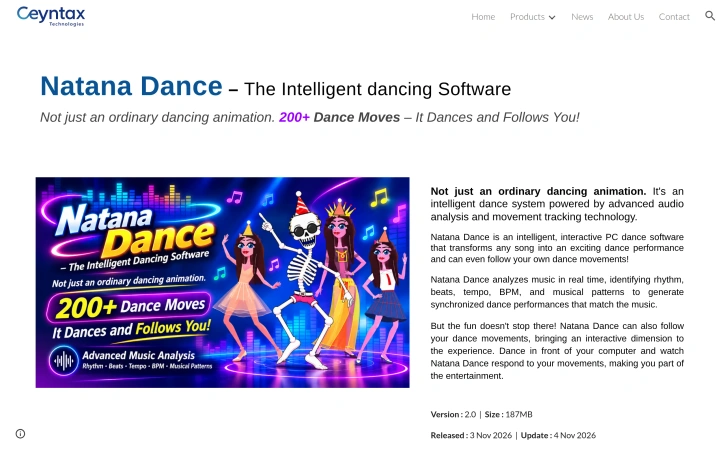
Interactive dance software combines real-time music analysis with movement tracking to create synchronized performances tailored to any song. Designed for entertainment enthusiasts seeking an engaging, hands-on way to interact with music, this PC application transforms audio input into choreographed dance sequences while simultaneously responding to the user's own movements in front of the camera. The core innovation lies in its dual-mode functionality. The automatic dance generation engine deconstructs incoming audio to identify critical musical elements—beat patterns, rhythmic structures, tempo variations, and frequency distributions—then synthesizes this analysis into coherent dance sequences from a library of over 200 distinct movements. This technical approach moves beyond simple animation triggering by creating performances genuinely synchronized to the music's structure. The application's second capability, movement tracking, adds an interactive layer by monitoring the user's physical gestures and responding dynamically, creating a participatory entertainment experience rather than a passive viewing one. The software launches with two operational modes in its free tier. Auto Dance Mode handles unattended music playback with automatically generated choreography, while Follow Dance Mode engages the movement tracking system. Both operate within a framework of core features including music detection and dance generation. The free version carries intentional constraints: users work exclusively with a default skeleton character model, and no character switching functionality exists. However, no time restrictions or usage limitations apply to the free experience. The paid tier, now available as version 2.0, removes these constraints by introducing character customization alongside a third hybrid mode that combines automatic choreography and movement tracking simultaneously. It also eliminates interface notifications that appear in the free version. This tiering strategy targets casual users seeking a risk-free trial against creators and enthusiasts willing to pay for expanded creative options. At 187 megabytes, the software maintains a modest installation footprint. The rapid update cycle—released November 3, 2026, with a patch on November 4—signals development momentum and responsiveness to initial user feedback. The positioning represents a genuine intersection of audio engineering and computer vision, executed as consumer entertainment rather than professional dance production software.

Music-generation
D
Dushshantha R.

Interactive dance software combines real-time music analysis with movement tracking to create synchronized performances tailored to any song. Designed for entertainment enthusiasts seeking an engaging, hands-on way to interact with music, this PC application transforms audio input into choreographed dance sequences while simultaneously responding to the user's own movements in front of the camera. The core innovation lies in its dual-mode functionality. The automatic dance generation engine deconstructs incoming audio to identify critical musical elements—beat patterns, rhythmic structures, tempo variations, and frequency distributions—then synthesizes this analysis into coherent dance sequences from a library of over 200 distinct movements. This technical approach moves beyond simple animation triggering by creating performances genuinely synchronized to the music's structure. The application's second capability, movement tracking, adds an interactive layer by monitoring the user's physical gestures and responding dynamically, creating a participatory entertainment experience rather than a passive viewing one. The software launches with two operational modes in its free tier. Auto Dance Mode handles unattended music playback with automatically generated choreography, while Follow Dance Mode engages the movement tracking system. Both operate within a framework of core features including music detection and dance generation. The free version carries intentional constraints: users work exclusively with a default skeleton character model, and no character switching functionality exists. However, no time restrictions or usage limitations apply to the free experience. The paid tier, now available as version 2.0, removes these constraints by introducing character customization alongside a third hybrid mode that combines automatic choreography and movement tracking simultaneously. It also eliminates interface notifications that appear in the free version. This tiering strategy targets casual users seeking a risk-free trial against creators and enthusiasts willing to pay for expanded creative options. At 187 megabytes, the software maintains a modest installation footprint. The rapid update cycle—released November 3, 2026, with a patch on November 4—signals development momentum and responsiveness to initial user feedback. The positioning represents a genuine intersection of audio engineering and computer vision, executed as consumer entertainment rather than professional dance production software.

Natana Dance - The Intelligent dancing Software preview

Key features

  • Real-Time Music Analysis: Deconstructs incoming audio to identify beat patterns, rhythmic structures, tempo variations, and frequency distributions.
  • Movement Tracking System: Monitors user gestures through the camera and responds dynamically to create interactive responses.
See full listing
ModGenie

Finding the perfect mod for a PC game typically requires knowing the right search terms—a frustrating barrier when you know exactly what you want but lack the vocabulary to locate it. ModGenie addresses this gap by letting players describe their desired modifications in natural language, then using AI to identify relevant mods and explain their functionality. The service targets PC gamers across a wide range of titles, from massive communities like Minecraft and Project Zomboid to more niche games like Valheim and Kenshi. The breadth is impressive: ModGenie catalogs tens of thousands of mods across dozens of games, reflecting genuine demand. Minecraft alone shows over 54,000 tracked mods with nearly 1.5 billion downloads recorded through the platform. What distinguishes ModGenie is its focus on search and discovery as the core problem. Rather than building a new mod hosting platform or competing with existing repositories, it acts as an intelligent intermediary that translates player intent into specific recommendations. The interface appears straightforward: describe the change you want—more inventory slots, ore through portals, a minimap with waypoints—and receive curated suggestions with clear explanations of what each mod does. The product launched in late October 2026 and has already indexed substantial catalogs across popular modding communities. Beyond search, ModGenie offers mod pack exports for supported games, bundling multiple mods into shareable configurations. This appeals to players who want to distribute entire mod collections rather than individual recommendations, adding practical value for group play or streaming scenarios. The founder's background as a full-stack developer who builds and operates complete products shows in the execution. The service identifies a real friction point in gaming without requiring players to navigate the quirks of individual mod sites or master esoteric search conventions. For casual players intimidated by mod installation or veterans optimizing their time, this translation layer delivers genuine value. The business model remains undisclosed, and the platform is too new to assess long-term sustainability. Still, ModGenie demonstrates sharp product thinking: it solves a specific, articulate problem for an engaged audience with measurable demand. Whether it evolves into a full gaming discovery platform or remains a focused utility, it represents the kind of targeted solution that emerges when developers build tools for their own pain points.
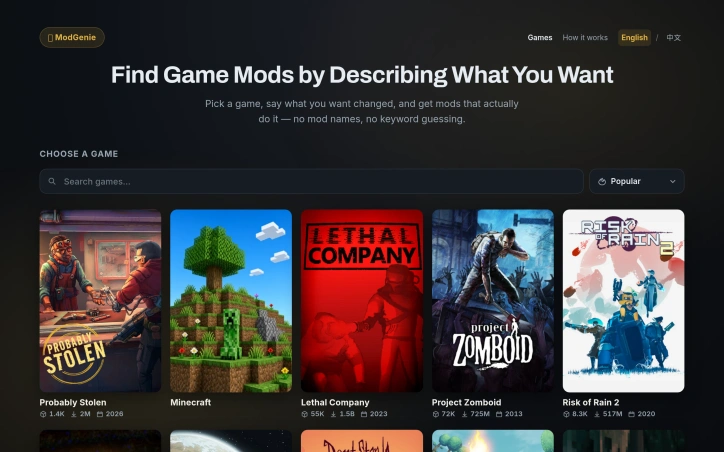

Finding the perfect mod for a PC game typically requires knowing the right search terms—a frustrating barrier when you know exactly what you want but lack the vocabulary to locate it. ModGenie addresses this gap by letting players describe their desired modifications in natural language, then using AI to identify relevant mods and explain their functionality. The service targets PC gamers across a wide range of titles, from massive communities like Minecraft and Project Zomboid to more niche games like Valheim and Kenshi. The breadth is impressive: ModGenie catalogs tens of thousands of mods across dozens of games, reflecting genuine demand. Minecraft alone shows over 54,000 tracked mods with nearly 1.5 billion downloads recorded through the platform. What distinguishes ModGenie is its focus on search and discovery as the core problem. Rather than building a new mod hosting platform or competing with existing repositories, it acts as an intelligent intermediary that translates player intent into specific recommendations. The interface appears straightforward: describe the change you want—more inventory slots, ore through portals, a minimap with waypoints—and receive curated suggestions with clear explanations of what each mod does. The product launched in late October 2026 and has already indexed substantial catalogs across popular modding communities. Beyond search, ModGenie offers mod pack exports for supported games, bundling multiple mods into shareable configurations. This appeals to players who want to distribute entire mod collections rather than individual recommendations, adding practical value for group play or streaming scenarios. The founder's background as a full-stack developer who builds and operates complete products shows in the execution. The service identifies a real friction point in gaming without requiring players to navigate the quirks of individual mod sites or master esoteric search conventions. For casual players intimidated by mod installation or veterans optimizing their time, this translation layer delivers genuine value. The business model remains undisclosed, and the platform is too new to assess long-term sustainability. Still, ModGenie demonstrates sharp product thinking: it solves a specific, articulate problem for an engaged audience with measurable demand. Whether it evolves into a full gaming discovery platform or remains a focused utility, it represents the kind of targeted solution that emerges when developers build tools for their own pain points.

ModGenie preview

Key features

  • Natural Language Search: Players describe desired modifications in everyday language instead of using specialized search terms.
  • AI-Powered Discovery: Artificial intelligence identifies relevant mods and explains their functionality based on player descriptions.
See full listing
Examscholars CBT Practice

Nigerian students preparing for high-stakes entrance exams face a familiar challenge: finding authentic practice materials that mimic real exam conditions without requiring constant internet access. Examscholars addresses this directly by bundling thousands of past questions, detailed explanations, and realistic CBT simulations into a single offline-capable application designed for students preparing for JAMB UTME, WAEC, BECE, NCEE, and Post-UTME examinations. The product's strongest differentiator is its offline functionality. In a market where connectivity remains unreliable for many users, the application works entirely without internet, removing a significant barrier to consistent test preparation. The interface deliberately mirrors JAMB's examination environment, using the organization's standardized eight-key navigation system to eliminate friction during the transition from practice to actual testing. The study modes offer flexibility that mirrors actual exam demands. A dedicated Study mode allows learners to work through questions with learning as the priority, while an Exam mode enforces time constraints and scoring that replicate authentic testing conditions. The result analysis system goes beyond simple pass-fail scoring, tracking metrics like time spent per question, attempted question counts, and relative speed, giving students granular data about their readiness in specific subject areas. Examscholars covers five major exam categories with curated past question banks and accompanying explanations. The platform has reached over 300,000 students, indicating meaningful market penetration within Nigeria's test-prep landscape. For schools, tutors, and education platforms, the product offers embedding capabilities that allow external websites to integrate the CBT builder without requiring API keys or backend integration, lowering technical barriers for institutional adoption. The business model combines a freemium approach with optional paid activation. While the core application provides functional test preparation at no cost, users can unlock additional features through a one-time payment of ₦3,000, a relatively modest price point positioned to maximize accessibility. This structure allows students to trial the product before committing financially while generating revenue from engaged users. The application targets both individual students and educational stakeholders. Parents guiding children through exam preparation can use it to monitor progress through the analytics dashboard, while educational institutions can embed it directly into their own platforms without additional overhead. The user-friendly design and focus on reducing technical complexity position it as a practical solution rather than a sophisticated but cumbersome tool.

Knowledge-base-software
I
Incofab Testing

Nigerian students preparing for high-stakes entrance exams face a familiar challenge: finding authentic practice materials that mimic real exam conditions without requiring constant internet access. Examscholars addresses this directly by bundling thousands of past questions, detailed explanations, and realistic CBT simulations into a single offline-capable application designed for students preparing for JAMB UTME, WAEC, BECE, NCEE, and Post-UTME examinations. The product's strongest differentiator is its offline functionality. In a market where connectivity remains unreliable for many users, the application works entirely without internet, removing a significant barrier to consistent test preparation. The interface deliberately mirrors JAMB's examination environment, using the organization's standardized eight-key navigation system to eliminate friction during the transition from practice to actual testing. The study modes offer flexibility that mirrors actual exam demands. A dedicated Study mode allows learners to work through questions with learning as the priority, while an Exam mode enforces time constraints and scoring that replicate authentic testing conditions. The result analysis system goes beyond simple pass-fail scoring, tracking metrics like time spent per question, attempted question counts, and relative speed, giving students granular data about their readiness in specific subject areas. Examscholars covers five major exam categories with curated past question banks and accompanying explanations. The platform has reached over 300,000 students, indicating meaningful market penetration within Nigeria's test-prep landscape. For schools, tutors, and education platforms, the product offers embedding capabilities that allow external websites to integrate the CBT builder without requiring API keys or backend integration, lowering technical barriers for institutional adoption. The business model combines a freemium approach with optional paid activation. While the core application provides functional test preparation at no cost, users can unlock additional features through a one-time payment of ₦3,000, a relatively modest price point positioned to maximize accessibility. This structure allows students to trial the product before committing financially while generating revenue from engaged users. The application targets both individual students and educational stakeholders. Parents guiding children through exam preparation can use it to monitor progress through the analytics dashboard, while educational institutions can embed it directly into their own platforms without additional overhead. The user-friendly design and focus on reducing technical complexity position it as a practical solution rather than a sophisticated but cumbersome tool.

Examscholars CBT Practice preview

Key features

  • Offline Functionality: Operates entirely without internet, enabling consistent test preparation regardless of connectivity.
  • Exam Simulation: Interface mirrors JAMB's examination environment using the standardized eight-key navigation system.
See full listing
L

Vendor selection remains a persistent challenge for organizations navigating crowded marketplaces filled with unvetted solutions. Listed Firm addresses this friction by functioning as a curated registry where businesses across B2B, B2C, SaaS, and agency sectors discover pre-screened partners and vendors. The platform's core differentiator is its vetting mechanism. Rather than operating as an open directory, every business undergoes audit and review before inclusion, reducing the due diligence burden on buyers. This screening layer targets organizations frustrated by unmeasured quality signals and unreliable referral networks. The breadth of category coverage spans over 60 verticals from accounting and fintech to web development and logistics, positioning Listed Firm as a horizontal search engine for business services. This approach establishes the platform as a unified reference point for multi-category vendor research across diverse industries. Listed Firm reinforces its verification credentials through ISO certification indexing and conducts thousands of daily audit lookups, demonstrating an ongoing commitment to maintaining listing standards beyond initial verification. This operational approach treats audit frequency as a core function rather than a one-time gate, signaling that standards enforcement remains active rather than perfunctory. The product serves two primary audiences with opposing incentives. On the buy side, procurement teams and business leaders gain centralized access to screened alternatives. On the supply side, vetted businesses access buyer attention without competing against unqualified vendors in commodity marketplaces. The founder's positioning centers on reducing buyer anxiety while enabling screened providers to reach customers more efficiently. This resonates with organizations maintaining structured vendor evaluation processes and sellers operating in competitive categories where differentiation is challenging. What remains unaddressed in public materials is how the vetting process handles category-specific expertise, whether verification carries time limits, what competitive intelligence the platform collects during screening, and whether pricing structures or listing tiers introduce misalignment in the review process. These details will determine whether Listed Firm functions as a neutral arbiter or devolves into a pay-to-play directory where verification becomes aspirational rather than definitive assurance. The foundation of a verification-based model is sound, but its execution depends heavily on mechanisms not yet transparent to potential users.


Marketplace-sites
P
Patel Yash

Vendor selection remains a persistent challenge for organizations navigating crowded marketplaces filled with unvetted solutions. Listed Firm addresses this friction by functioning as a curated registry where businesses across B2B, B2C, SaaS, and agency sectors discover pre-screened partners and vendors. The platform's core differentiator is its vetting mechanism. Rather than operating as an open directory, every business undergoes audit and review before inclusion, reducing the due diligence burden on buyers. This screening layer targets organizations frustrated by unmeasured quality signals and unreliable referral networks. The breadth of category coverage spans over 60 verticals from accounting and fintech to web development and logistics, positioning Listed Firm as a horizontal search engine for business services. This approach establishes the platform as a unified reference point for multi-category vendor research across diverse industries. Listed Firm reinforces its verification credentials through ISO certification indexing and conducts thousands of daily audit lookups, demonstrating an ongoing commitment to maintaining listing standards beyond initial verification. This operational approach treats audit frequency as a core function rather than a one-time gate, signaling that standards enforcement remains active rather than perfunctory. The product serves two primary audiences with opposing incentives. On the buy side, procurement teams and business leaders gain centralized access to screened alternatives. On the supply side, vetted businesses access buyer attention without competing against unqualified vendors in commodity marketplaces. The founder's positioning centers on reducing buyer anxiety while enabling screened providers to reach customers more efficiently. This resonates with organizations maintaining structured vendor evaluation processes and sellers operating in competitive categories where differentiation is challenging. What remains unaddressed in public materials is how the vetting process handles category-specific expertise, whether verification carries time limits, what competitive intelligence the platform collects during screening, and whether pricing structures or listing tiers introduce misalignment in the review process. These details will determine whether Listed Firm functions as a neutral arbiter or devolves into a pay-to-play directory where verification becomes aspirational rather than definitive assurance. The foundation of a verification-based model is sound, but its execution depends heavily on mechanisms not yet transparent to potential users.

Listed Firm preview
L

Key features

  • Curated Vendor Registry: A pre-screened directory where organizations discover vetted business partners across B2B, B2C, SaaS, and agency sectors
  • Vetting Mechanism: Every business undergoes audit and review before inclusion to reduce buyer due diligence burden
See full listing
CreatorCue - Teleprompter

Content creators know the struggle: delivering natural, conversational performance on camera while keeping scripts accessible without memorization. CreatorCue addresses this friction with a unified mobile app that combines a teleprompter, recording tool, and playback interface into a single workflow for iPhone and Android users. The standout feature is Voice Scroll, an AI-powered mechanism that advances the script in sync with the creator's speaking pace. As the user talks faster, the text moves faster; pausing holds the script in place. This eliminates the manual tapping or external control that breaks concentration. The technology adapts in real time, responding to natural speech variations without requiring special equipment or setup. CreatorCue couples this with Mirror Mode, designed for teleprompter rigs and front-facing camera shooting, flipping the text horizontally so it displays correctly through a beam splitter or similar optical setup. The built-in camera means creators can film without toggling between apps, keeping their workflow contained and reducing the friction of multiple retakes. For editing and publishing workflows, the Pro tier offers watermark-free recordings, a significant advantage for creators aiming for polished, publish-ready output. The interface prioritizes creator control through customization options: users adjust font, size, text color, and background to accommodate different lighting setups and filming environments. Script import supports DOCX, PDF, and TXT formats, and the app allows unlimited script storage at any length, removing practical constraints that plague simpler teleprompter solutions. CreatorCue operates on a freemium model. The free version includes the teleprompter, recording with watermark, basic customization, and storage of up to three scripts, making it accessible for experimentation. Upgrading to Pro unlocks Voice Scroll, Mirror Mode, watermark removal, file import, and unlimited scripts. The free tier is aggressive enough that creators can meaningfully evaluate the app's core value proposition before committing to a subscription. User sentiment reflected in app store reviews emphasizes the interface design and functionality. For creators producing content across TikTok, YouTube, Reels, and similar platforms where on-camera presence drives engagement, CreatorCue removes a significant cognitive and production barrier. The combination of voice-responsive scrolling and unified recording simplifies the path from script to polished take.
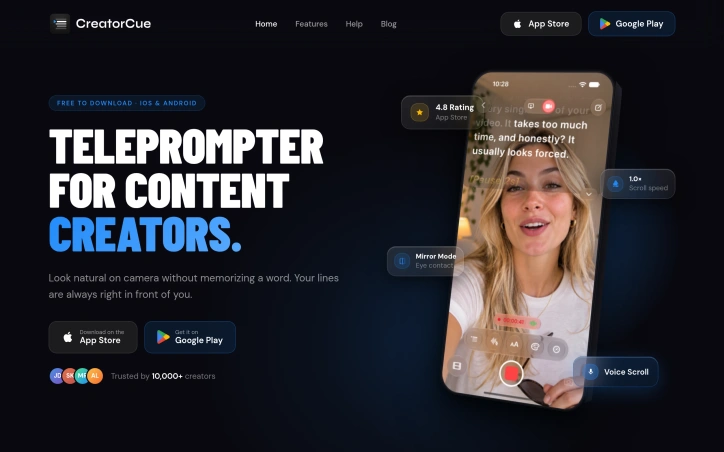

Content creators know the struggle: delivering natural, conversational performance on camera while keeping scripts accessible without memorization. CreatorCue addresses this friction with a unified mobile app that combines a teleprompter, recording tool, and playback interface into a single workflow for iPhone and Android users. The standout feature is Voice Scroll, an AI-powered mechanism that advances the script in sync with the creator's speaking pace. As the user talks faster, the text moves faster; pausing holds the script in place. This eliminates the manual tapping or external control that breaks concentration. The technology adapts in real time, responding to natural speech variations without requiring special equipment or setup. CreatorCue couples this with Mirror Mode, designed for teleprompter rigs and front-facing camera shooting, flipping the text horizontally so it displays correctly through a beam splitter or similar optical setup. The built-in camera means creators can film without toggling between apps, keeping their workflow contained and reducing the friction of multiple retakes. For editing and publishing workflows, the Pro tier offers watermark-free recordings, a significant advantage for creators aiming for polished, publish-ready output. The interface prioritizes creator control through customization options: users adjust font, size, text color, and background to accommodate different lighting setups and filming environments. Script import supports DOCX, PDF, and TXT formats, and the app allows unlimited script storage at any length, removing practical constraints that plague simpler teleprompter solutions. CreatorCue operates on a freemium model. The free version includes the teleprompter, recording with watermark, basic customization, and storage of up to three scripts, making it accessible for experimentation. Upgrading to Pro unlocks Voice Scroll, Mirror Mode, watermark removal, file import, and unlimited scripts. The free tier is aggressive enough that creators can meaningfully evaluate the app's core value proposition before committing to a subscription. User sentiment reflected in app store reviews emphasizes the interface design and functionality. For creators producing content across TikTok, YouTube, Reels, and similar platforms where on-camera presence drives engagement, CreatorCue removes a significant cognitive and production barrier. The combination of voice-responsive scrolling and unified recording simplifies the path from script to polished take.

CreatorCue - Teleprompter preview

Key features

  • Voice Scroll: AI-powered script advancement that syncs with the creator's speaking pace in real time.
  • Mirror Mode: Horizontally-flipped text display designed for teleprompter rigs and beam splitter setups.
See full listing
CRMLeaf

Service teams operating across multiple disconnected tools and spreadsheets have found their workflow solution. CrmLeaf addresses the fragmentation that plagues professional services firms—the constant switching between systems to manage proposals, project timelines, resource availability, and billing. By consolidating these functions into a single platform, the software eliminates the operational friction that typically consumes hours of administrative work each week. The product targets consulting firms, digital agencies, and service-oriented businesses that need to track everything from initial estimates through final invoices while maintaining visibility into project profitability and team capacity. The platform's architecture reflects this use case directly, embedding resource planning and project budgeting as core capabilities rather than afterthoughts. What distinguishes CrmLeaf is its modern integration approach. The MCP Server feature allows users to interact with their CRM directly from Claude, Cursor, or VS Code—68 tools available with write operations fully audited and deletions prohibited. This positions the software ahead of competitors still thinking in terms of traditional API integrations. The platform also includes built-in AI capabilities for inline writing assistance and blog generation, acknowledging the reality that modern PSA users expect AI-native workflows. The feature set reflects deep understanding of PSA needs. Time entries flow directly into invoices without manual re-entry. Milestone-based billing prevents double-charging while aggregating timelogs. Estimates convert to invoices automatically once accepted, and both proposals and contracts support electronic signatures. Resource planning provides real-time visibility into team capacity, skills, and availability. Budget tracking incorporates earned value management analytics alongside simpler burn-rate forecasting. The platform supports 5,000 app integrations through Zapier and connects directly to tools like Calendly and Fireflies.ai. Pricing begins at nine dollars per user per month, positioning the software competitively for teams seeking unified functionality without enterprise-grade costs. The company also open-sources its invoicing, purchase order, and payroll modules under MIT licensing, allowing teams to self-host components if needed. The combination of unified functionality, AI-first tooling, and affordable pricing positions CrmLeaf as a serious alternative to disconnected tool stacks that have dominated professional services operations. For teams tired of tool-switching and spreadsheet management, the platform delivers consolidation without complexity.

Crm-software
C
CRMLEAF Call

Service teams operating across multiple disconnected tools and spreadsheets have found their workflow solution. CrmLeaf addresses the fragmentation that plagues professional services firms—the constant switching between systems to manage proposals, project timelines, resource availability, and billing. By consolidating these functions into a single platform, the software eliminates the operational friction that typically consumes hours of administrative work each week. The product targets consulting firms, digital agencies, and service-oriented businesses that need to track everything from initial estimates through final invoices while maintaining visibility into project profitability and team capacity. The platform's architecture reflects this use case directly, embedding resource planning and project budgeting as core capabilities rather than afterthoughts. What distinguishes CrmLeaf is its modern integration approach. The MCP Server feature allows users to interact with their CRM directly from Claude, Cursor, or VS Code—68 tools available with write operations fully audited and deletions prohibited. This positions the software ahead of competitors still thinking in terms of traditional API integrations. The platform also includes built-in AI capabilities for inline writing assistance and blog generation, acknowledging the reality that modern PSA users expect AI-native workflows. The feature set reflects deep understanding of PSA needs. Time entries flow directly into invoices without manual re-entry. Milestone-based billing prevents double-charging while aggregating timelogs. Estimates convert to invoices automatically once accepted, and both proposals and contracts support electronic signatures. Resource planning provides real-time visibility into team capacity, skills, and availability. Budget tracking incorporates earned value management analytics alongside simpler burn-rate forecasting. The platform supports 5,000 app integrations through Zapier and connects directly to tools like Calendly and Fireflies.ai. Pricing begins at nine dollars per user per month, positioning the software competitively for teams seeking unified functionality without enterprise-grade costs. The company also open-sources its invoicing, purchase order, and payroll modules under MIT licensing, allowing teams to self-host components if needed. The combination of unified functionality, AI-first tooling, and affordable pricing positions CrmLeaf as a serious alternative to disconnected tool stacks that have dominated professional services operations. For teams tired of tool-switching and spreadsheet management, the platform delivers consolidation without complexity.

CRMLeaf preview

Key features

  • Unified Platform: Consolidates proposals, project timelines, resources, and billing into one system to eliminate tool-switching.
  • MCP Server Integration: Enables direct CRM interaction from Claude, Cursor, or VS Code with 68 available tools.
See full listing
Options Matrix Pro

Research fragmentation costs options traders their focus. Where a covered call analysis should take minutes, it stretches across an options chain, a yield calculator, a spreadsheet row, and a broker journal. Options Matrix Pro consolidates this workflow into a single web-based research platform, letting self-directed traders find high-probability setups without turning market research into a second job. The platform targets traders pursuing repeatable income strategies, particularly those focused on covered calls and cash-secured puts. For this audience, Options Matrix Pro eliminates the context switching between disconnected tools. Its central feature, the Options Matrix, displays every strike and expiration for a given stock as a color-coded heatmap. Traders rank contracts by monthly yield percentage, breakeven price, probability of profit and days to expiration in a single view, surfacing which short-dated position actually competes with longer-dated alternatives once time decay is factored in. Scanning capabilities extend beyond single stocks. The Short Options Scanner checks an entire watchlist against user-defined criteria, automatically surfacing cash-secured puts and covered calls that meet specified thresholds. An Advanced Strategy Scanner identifies multi-leg setups including spreads, iron condors and butterflies. Results flow directly into the Strategy Visualizer, where traders can model how positions respond to price and time movements, review Greeks and expected moves, and pressure-test assumptions against live market data pulled from ThetaData. What distinguishes the platform from standalone calculators is its trade-tracking component. A campaign journal aggregates thesis, entry fills, adjustments, rolls and final outcomes in a single record, eliminating the manual record-keeping that makes trade review and performance analysis tedious. Historical mode allows traders to rebuild past setups and analyze outcomes on earlier market dates. The platform offers AI-powered analysis features that integrate with ChatGPT or Claude for custom interpretation of scans, matrices and open positions. Free calculators for covered calls, cash-secured puts, expected move and probability of profit require no login, making core tools accessible before commitment. Pricing runs from ten dollars monthly for the Visualizer plan to fifty dollars for All Access, with a thirty-dollar Pro tier in between. Every subscription includes a seven-day trial of all features. The platform positions itself explicitly as research and decision support rather than trade recommendation, preserving trader autonomy while removing research friction.
Research fragmentation costs options traders their focus. Where a covered call analysis should take minutes, it stretches across an options chain, a yield calculator, a spreadsheet row, and a broker journal. Options Matrix Pro consolidates this workflow into a single web-based research platform, letting self-directed traders find high-probability setups without turning market research into a second job. The platform targets traders pursuing repeatable income strategies, particularly those focused on covered calls and cash-secured puts. For this audience, Options Matrix Pro eliminates the context switching between disconnected tools. Its central feature, the Options Matrix, displays every strike and expiration for a given stock as a color-coded heatmap. Traders rank contracts by monthly yield percentage, breakeven price, probability of profit and days to expiration in a single view, surfacing which short-dated position actually competes with longer-dated alternatives once time decay is factored in. Scanning capabilities extend beyond single stocks. The Short Options Scanner checks an entire watchlist against user-defined criteria, automatically surfacing cash-secured puts and covered calls that meet specified thresholds. An Advanced Strategy Scanner identifies multi-leg setups including spreads, iron condors and butterflies. Results flow directly into the Strategy Visualizer, where traders can model how positions respond to price and time movements, review Greeks and expected moves, and pressure-test assumptions against live market data pulled from ThetaData. What distinguishes the platform from standalone calculators is its trade-tracking component. A campaign journal aggregates thesis, entry fills, adjustments, rolls and final outcomes in a single record, eliminating the manual record-keeping that makes trade review and performance analysis tedious. Historical mode allows traders to rebuild past setups and analyze outcomes on earlier market dates. The platform offers AI-powered analysis features that integrate with ChatGPT or Claude for custom interpretation of scans, matrices and open positions. Free calculators for covered calls, cash-secured puts, expected move and probability of profit require no login, making core tools accessible before commitment. Pricing runs from ten dollars monthly for the Visualizer plan to fifty dollars for All Access, with a thirty-dollar Pro tier in between. Every subscription includes a seven-day trial of all features. The platform positions itself explicitly as research and decision support rather than trade recommendation, preserving trader autonomy while removing research friction.

Options Matrix Pro preview

Key features

  • Options Matrix: Displays all strikes and expirations as a color-coded heatmap ranked by monthly yield, breakeven price, probability of profit and days to expiration.
  • Short Options Scanner: Automatically scans entire watchlists for cash-secured puts and covered calls meeting user-defined criteria.
See full listing
Kryex Launch

Indie product launches frequently disappear into the noise of the internet, buried beneath established competitors and algorithmic recommendations. This directory addresses that core problem by offering indie founders a permanent, SEO-optimized listing designed specifically for discoverability across both traditional search and emerging AI search systems. The platform organizes over 1500 products across categories ranging from productivity and SaaS to AI tools, developer resources, and niche segments like robotics and no-code solutions. The catalog structure reveals the breadth of indie makers using the service, with a community of over 2155 founders actively participating. What differentiates this approach from generic product directories is its emphasis on search architecture. Each listing lands on a domain with a DR 71 rating and includes a dofollow backlink, positioning products for higher Google visibility rather than treating the directory as merely a vanity listing. Community features drive engagement beyond passive discovery. Products gain visibility through upvoting mechanisms, allowing founders to gauge and demonstrate traction. Editorial reviews complement community signals, creating a hybrid validation layer that appeals to both users browsing organically and algorithmic systems evaluating product quality. This dual-signal approach matters as AI search engines increasingly mine curated product directories for training data and user-facing results. The platform opts for accessibility with free permanent listings, acknowledging that indie founders often operate without marketing budgets. The business model introduces a paid tier at $15 to skip the launch queue and secure seven days of homepage featuring, along with periodic free queue slots. This freemium structure balances community inclusion with revenue generation, removing barriers to entry while monetizing creators with immediate visibility needs. The interface and categorization appear functional rather than particularly innovative, organized around product type rather than novel browsing experiences. The presentation emphasizes practical outcomes: appearing in front of both humans and AI systems that shape product discovery. For indie makers launching without existing distribution networks or brand recognition, the SEO fundamentals and community visibility represent genuine utility. The directory fills a specific gap between social-media-first launch strategies and enterprise app stores, positioning itself as the infrastructure for organic discoverability in an increasingly AI-mediated search landscape.

Startup-communities
B
Brian Lee

Indie product launches frequently disappear into the noise of the internet, buried beneath established competitors and algorithmic recommendations. This directory addresses that core problem by offering indie founders a permanent, SEO-optimized listing designed specifically for discoverability across both traditional search and emerging AI search systems. The platform organizes over 1500 products across categories ranging from productivity and SaaS to AI tools, developer resources, and niche segments like robotics and no-code solutions. The catalog structure reveals the breadth of indie makers using the service, with a community of over 2155 founders actively participating. What differentiates this approach from generic product directories is its emphasis on search architecture. Each listing lands on a domain with a DR 71 rating and includes a dofollow backlink, positioning products for higher Google visibility rather than treating the directory as merely a vanity listing. Community features drive engagement beyond passive discovery. Products gain visibility through upvoting mechanisms, allowing founders to gauge and demonstrate traction. Editorial reviews complement community signals, creating a hybrid validation layer that appeals to both users browsing organically and algorithmic systems evaluating product quality. This dual-signal approach matters as AI search engines increasingly mine curated product directories for training data and user-facing results. The platform opts for accessibility with free permanent listings, acknowledging that indie founders often operate without marketing budgets. The business model introduces a paid tier at $15 to skip the launch queue and secure seven days of homepage featuring, along with periodic free queue slots. This freemium structure balances community inclusion with revenue generation, removing barriers to entry while monetizing creators with immediate visibility needs. The interface and categorization appear functional rather than particularly innovative, organized around product type rather than novel browsing experiences. The presentation emphasizes practical outcomes: appearing in front of both humans and AI systems that shape product discovery. For indie makers launching without existing distribution networks or brand recognition, the SEO fundamentals and community visibility represent genuine utility. The directory fills a specific gap between social-media-first launch strategies and enterprise app stores, positioning itself as the infrastructure for organic discoverability in an increasingly AI-mediated search landscape.

Kryex Launch preview

Key features

  • SEO-Optimized Listings: High-authority domain placement with DR 71 rating and dofollow backlinks for Google visibility
  • Large Product Directory: Over 1500 indie products organized across categories from productivity and SaaS to AI tools and niche segments
See full listing
Medrecords AI

Legal and medical professionals drowning in paper handle a bottleneck that hasn't improved in decades: converting stacks of medical records into organized, usable documentation for litigation, insurance claims, and medical evaluation. Medrecords AI automates this workflow by processing medical files of any format—PDFs, scans, faxes, handwritten notes, voice recordings, and DICOM imaging—and transforming them into deduplicated, searchable chronologies and draft reports with source citations. The product targets a fragmented ecosystem of users. Personal injury law firms and defense counsel need comprehensive demand packages and rebuttal letters. Medical examiners, life care planners, and legal nurse consultants require specialized document formats like IME reports, life care foundations, and non-merit assessments. Insurance claims teams, workers compensation specialists, and utilization review nurses work with claims audits and MSA allocations. Veterans representatives handle appeal briefs. The software ships with templates for at least a dozen distinct output formats, acknowledging that different practitioners in the medicolegal space speak different languages. What distinguishes Medrecords AI is its approach to the economics of medical record processing. The company bills per deduplicated page rather than per case, and charges as little as five cents per page at volume. In a provided example, a 342-page file that contained 11 duplicate pages resulted in payment for 331 pages only. This pricing model directly penalizes waste and rewards efficiency rather than hiding costs in flat-fee per-case models that other document processing services use. The technical capabilities justify the pricing transparency. The platform reads handwritten and printed text, transcribes audio, processes medical imaging, flags missing records or co-mingled files, deduplicates at page-level granularity, builds searchable indices, generates event timelines, and extracts answers to record-specific questions. Each fact in a draft report is cited to its page or timestamp, creating an auditable trail from conclusion back to source material. Compliance features include HIPAA certification, SOC 2 compliance, US-only data hosting, and a Business Associate Agreement with every sub-processor. Draft documents are marked as attorney work product or confidential material depending on document type, addressing the legal protections practitioners need. The product doesn't claim to fully automate the medicolegal workflow. Reports emerge as drafts for human verification and final review, positioning Medrecords AI as an efficiency layer rather than a replacement for professional judgment. For practitioners accustomed to hiring contract reviewers or absorbing manual record organization work, the pricing and feature set offer concrete time and cost savings.
Legal-services
A
Ahmed Jemaa

Legal and medical professionals drowning in paper handle a bottleneck that hasn't improved in decades: converting stacks of medical records into organized, usable documentation for litigation, insurance claims, and medical evaluation. Medrecords AI automates this workflow by processing medical files of any format—PDFs, scans, faxes, handwritten notes, voice recordings, and DICOM imaging—and transforming them into deduplicated, searchable chronologies and draft reports with source citations. The product targets a fragmented ecosystem of users. Personal injury law firms and defense counsel need comprehensive demand packages and rebuttal letters. Medical examiners, life care planners, and legal nurse consultants require specialized document formats like IME reports, life care foundations, and non-merit assessments. Insurance claims teams, workers compensation specialists, and utilization review nurses work with claims audits and MSA allocations. Veterans representatives handle appeal briefs. The software ships with templates for at least a dozen distinct output formats, acknowledging that different practitioners in the medicolegal space speak different languages. What distinguishes Medrecords AI is its approach to the economics of medical record processing. The company bills per deduplicated page rather than per case, and charges as little as five cents per page at volume. In a provided example, a 342-page file that contained 11 duplicate pages resulted in payment for 331 pages only. This pricing model directly penalizes waste and rewards efficiency rather than hiding costs in flat-fee per-case models that other document processing services use. The technical capabilities justify the pricing transparency. The platform reads handwritten and printed text, transcribes audio, processes medical imaging, flags missing records or co-mingled files, deduplicates at page-level granularity, builds searchable indices, generates event timelines, and extracts answers to record-specific questions. Each fact in a draft report is cited to its page or timestamp, creating an auditable trail from conclusion back to source material. Compliance features include HIPAA certification, SOC 2 compliance, US-only data hosting, and a Business Associate Agreement with every sub-processor. Draft documents are marked as attorney work product or confidential material depending on document type, addressing the legal protections practitioners need. The product doesn't claim to fully automate the medicolegal workflow. Reports emerge as drafts for human verification and final review, positioning Medrecords AI as an efficiency layer rather than a replacement for professional judgment. For practitioners accustomed to hiring contract reviewers or absorbing manual record organization work, the pricing and feature set offer concrete time and cost savings.

Medrecords AI preview

Key features

  • Multi-Format Processing: Accepts PDFs, scans, faxes, handwritten notes, voice recordings, and DICOM medical imaging
  • Intelligent Deduplication: Automatically identifies and removes duplicate pages to reduce billable page count
See full listing
S

Integrating fragrance knowledge into AI assistants requires access to a reliable, comprehensive database of perfumes and their characteristics. Scento Perfume API addresses this gap by offering developers a free, key-free connector that brings over 1,600 designer and niche fragrances into applications like Claude, ChatGPT, and Cursor. The service distinguishes itself through radical simplicity. No authentication, no account creation, and no API keys stand in the way of integration. Developers paste a single URL into their MCP client or assistant settings and instantly gain access to twelve read-only tools for querying fragrance data. This friction-free approach makes adoption trivial even for teams unfamiliar with API integrations. The capability set addresses real use cases. Users can search fragrances by name, house, notes, or mood. A dedicated "perfume portrait" tool retrieves the full sensory profile of a fragrance including its note pyramid, family classification, perfumer, release year, and concentration level. The API also enables smell-alike recommendations through scent neighbors, side-by-side fragrance comparisons, and the ability to discover perfumes built from specific raw materials. An additional tool handles occasion-based fragrance edits and recommendations. Every answer returned by the API includes a lede suitable for direct quotation, supporting detail, and a link back to scento.com for readers wanting deeper information. This citation architecture ensures that AI assistants can provide authoritative responses while directing traffic back to Scento's own fragrance database. The service supports output in ten languages, broadening its utility across international developer communities. The underlying data reflects significant curation work. Scento maintains its own fragrance family taxonomy across more than 400 raw materials, distinguishing itself from services that merely aggregate third-party fragrance reviews or notes. The business model removes economic barriers entirely. Free access, no key management, and no account signup mean developers can evaluate the connector without friction and begin using it immediately in production applications. This approach trades direct monetization for network effects and embedded reach within developer tools and AI assistant ecosystems.
Unified-api
S
Scento Team

Integrating fragrance knowledge into AI assistants requires access to a reliable, comprehensive database of perfumes and their characteristics. Scento Perfume API addresses this gap by offering developers a free, key-free connector that brings over 1,600 designer and niche fragrances into applications like Claude, ChatGPT, and Cursor. The service distinguishes itself through radical simplicity. No authentication, no account creation, and no API keys stand in the way of integration. Developers paste a single URL into their MCP client or assistant settings and instantly gain access to twelve read-only tools for querying fragrance data. This friction-free approach makes adoption trivial even for teams unfamiliar with API integrations. The capability set addresses real use cases. Users can search fragrances by name, house, notes, or mood. A dedicated "perfume portrait" tool retrieves the full sensory profile of a fragrance including its note pyramid, family classification, perfumer, release year, and concentration level. The API also enables smell-alike recommendations through scent neighbors, side-by-side fragrance comparisons, and the ability to discover perfumes built from specific raw materials. An additional tool handles occasion-based fragrance edits and recommendations. Every answer returned by the API includes a lede suitable for direct quotation, supporting detail, and a link back to scento.com for readers wanting deeper information. This citation architecture ensures that AI assistants can provide authoritative responses while directing traffic back to Scento's own fragrance database. The service supports output in ten languages, broadening its utility across international developer communities. The underlying data reflects significant curation work. Scento maintains its own fragrance family taxonomy across more than 400 raw materials, distinguishing itself from services that merely aggregate third-party fragrance reviews or notes. The business model removes economic barriers entirely. Free access, no key management, and no account signup mean developers can evaluate the connector without friction and begin using it immediately in production applications. This approach trades direct monetization for network effects and embedded reach within developer tools and AI assistant ecosystems.

Scento Perfume API preview
S

Key features

  • No-Auth Integration: Zero API keys, authentication, or account creation required for immediate access
  • 1,600+ Fragrances: Comprehensive database of designer and niche perfumes with detailed characteristics
See full listing