Wind of Change
Can a song change the world? Can a new social networking platform? Doc McGhee has reasons to believe it can.
The world that produced “Wind of Change” was before my time. I have no memory of watching the Berlin Wall open, or of wondering whether the Cold War might finally end. I encounter that moment through recordings, photographs, and the hopes people attached to them.
The Scorpions’ song offers a way into that feeling: the possibility that people raised to fear one another might share a future.
Its origins make that hope especially compelling. In August 1989, the West German band played the Moscow Music Peace Festival in the Soviet Union. Singer Klaus Meine later recalled the Red Army soldiers posted in the stadium to control the crowd turning to face the stage and throwing their caps in the air. Within days of that trip, he had the bulk of “Wind of Change” written, months before the Berlin Wall opened in November. The song captured a possibility still taking shape, according to the band’s oral history in Rolling Stone.
It appeared on Crazy World in November 1990 and became an international hit in 1991. By then, listeners could hear it as the soundtrack to changes already underway. Its enduring association with the Berlin Wall blurs that sequence: the song’s inspiration came before the Wall opened; its commercial success came after.
The distinction matters. Meine was responding to an encounter between people whose governments had spent decades confronting one another. Music made their common humanity visible.
The manager behind the meeting
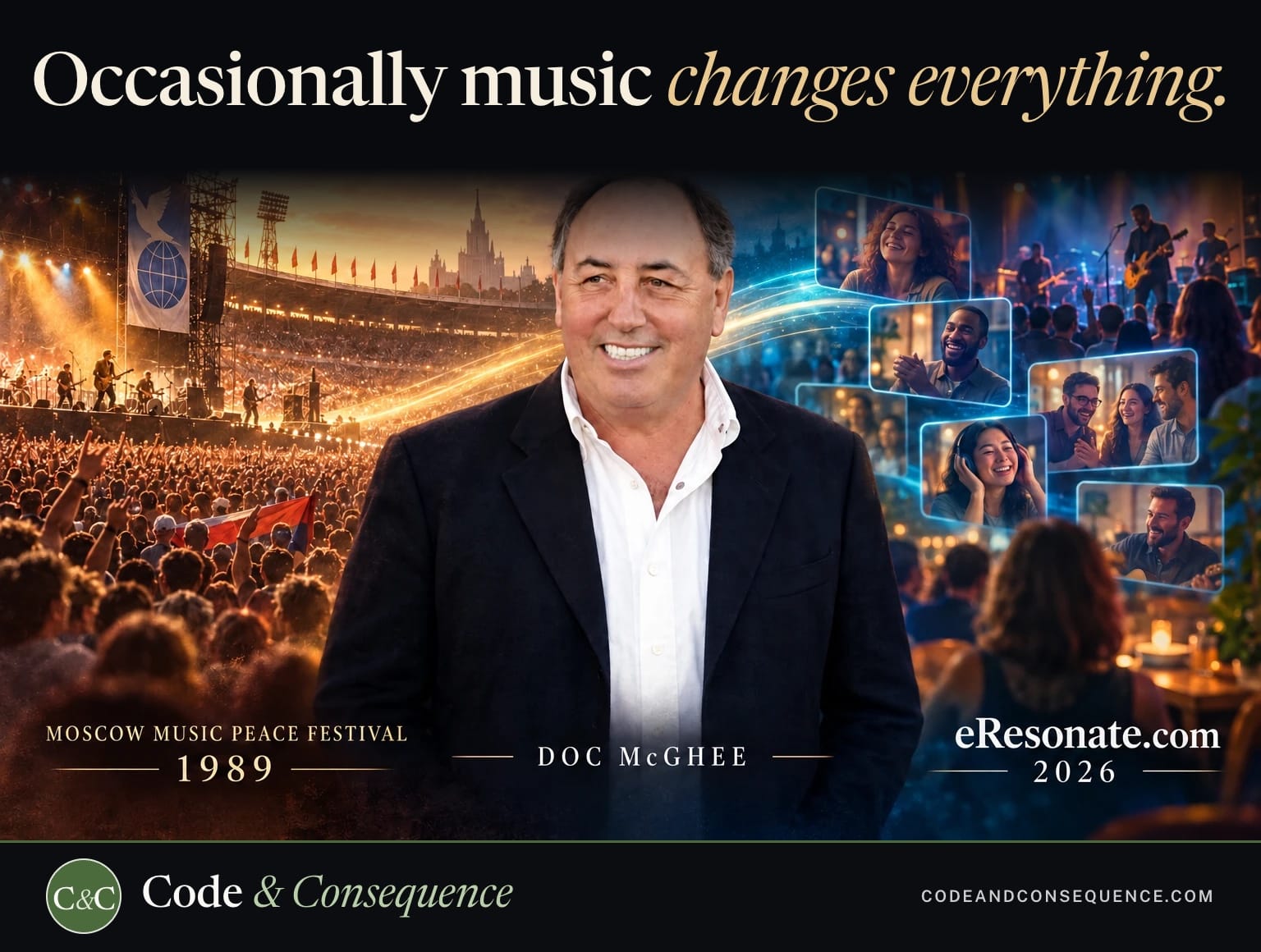
Behind that encounter stood Doc McGhee, the Scorpions’ American manager, who had already turned Mötley Crüe and Bon Jovi into arena headliners. With the Russian musician and organizer Stas Namin, McGhee organized the festival that brought the band to Moscow. His contribution began before the song existed: he helped make possible the experience that inspired Meine to write it.
McGhee also helped protect the recording’s most recognizable feature. When record-company staff wanted the whistling cut, he told them they were crazy, and the band kept it. That small decision mattered. The whistle gave the song a melody listeners could carry with them, whatever language they spoke.
Its worldwide reach grew through the combined efforts of the band, management, record companies, and radio programmers. Guitarist Rudolf Schenker recalled that France released the single first, and that its popularity spread from one country to the next. In America, adult-contemporary radio played it first, and it crossed over from there to pop and rock.
Britain held out longest. In October 1991, the trade weekly Music & Media reported that the song had topped the European singles chart that June without making any impact in the UK. Dave Thorn, a former Phonogram UK executive then representing McGhee Entertainment in Europe, explained that the single’s top-five success in the US finally gave British radio a reason to listen, and the record company pushed it again.
That practical work belongs in the song’s history alongside its inspiration. Meine gave the moment words and music; McGhee helped create the opportunity, defended the recording, and sustained the organization through which it reached the world. A shared hope needed people willing to arrange the meeting, protect the melody, and get it heard.
Around them, the political landscape was shifting. Across Eastern Europe, communist governments faced movements demanding change. The opening of the Berlin Wall became the defining image of a division that had once seemed permanent beginning to dissolve.
There is even a disputed intelligence story woven into the song’s history. Patrick Radden Keefe’s 2020 podcast Wind of Change investigated a rumor that the CIA had helped create it. The allegation remains unproven, and Meine denied it. The story adds intrigue, and it shows how much political power people are willing to attribute to a song.
The distance from here
Listening today, the distance between that hopeful moment and our own feels immense.
Russia’s war against Ukraine has brought destruction to the region the song once imagined drawing closer together. The Iran war has added another source of international danger. On October 26, delegations from Saudi Arabia, Pakistan, and Turkey met in Tehran seeking to prevent renewed fighting. Peace again appears precarious, dependent on decisions whose consequences reach far beyond the battlefield.
The fear extends to whether these conflicts could become parts of something larger. In his August column “Has World War III Already Started?”, Bret Stephens compares today’s wars with the regional crises that accumulated before the Second World War. He argues that the conflicts are increasingly connected, while divisions among democracies compound the danger. That is a warning built on a historical analogy; whether these wars will converge remains an open question.
The contrast with “Wind of Change” is unsettling. The song imagined encounters across borders opening a peaceful future. Today, connections between conflicts raise fears that violence in one region will deepen insecurity in another.
Within countries, there is division too. Gallup reported in July that Americans’ confidence in institutions remains near its all-time low, with trust shifting according to which party holds power. International IDEA’s Global State of Democracy 2026 report found that 2025 was the 11th consecutive year in which more countries declined democratically than improved. These findings give substance to the feeling that cooperation itself has become harder to sustain.
Nationalism can make cooperation harder still when belonging depends on treating outsiders as threats. The song asks listeners to imagine a broader community, one that reaches beyond the boundaries they inherited.
Its own performance history shows how difficult that aspiration has become. After Russia’s full-scale invasion of Ukraine in 2022, Meine rewrote the opening lines in live performances to express support for Ukraine. He told Loudwire that singing the familiar references to Moscow felt like romanticizing Russia during the war. The song had to respond to history again.
Where the hope goes now
For someone whose perspective comes after its emergence, the song’s value reaches beyond nostalgia. It preserves evidence that people can experience a change they once struggled to imagine.
McGhee’s own story did not end in Moscow. The festival was one chapter in one of the most successful careers in rock management. He signed Mötley Crüe in 1982 after seeing them play in Santa Monica, and he guided them through Shout at the Devil and Dr. Feelgood. He managed Bon Jovi through Slippery When Wet, the album that turned them into a worldwide stadium act. In 1995 he took on KISS and brought the original lineup back together, makeup and all. Their reunion tour made KISS the top-grossing concert act of 1996. His roster has also included Skid Row, Hootie & the Blowfish and Darius Rucker. His peers have inducted him into the Personal Managers Hall of Fame, and the Metal Hall of Fame added him in 2021.
That career now reaches into the present. McGhee is an adviser to eResonate, a social network built around live music and shared experiences. The company announced his appointment to its advisory board in November 2023 and still lists him among its advisers.
eResonate’s stated ambition is to help bridge the divides separating people from one another and from a sense of community. Its approach begins with music: bringing artists, venues, and fans together through live performances, then giving those relationships somewhere to continue after the show. Against isolation, political division, and fragmented social life, it aims to create opportunities for belonging through shared interests and experiences. The platform is fully built, on the web and as a native iPhone app coming soon to the App Store, and is live now in an invite-only preview, ready for its public launch.
There is a thread connecting that ambition to the Moscow festival of 1989. McGhee helped make possible an encounter that inspired a song about people discovering how much they shared. His involvement with eResonate brings that history into a new setting, where the work of connection takes place across digital spaces as well as physical borders.
The hope running through “Wind of Change” still has somewhere to go. It lives in the effort to create another meeting, another shared experience, another reason for people to see a future together.
That possibility carries a responsibility. A better future requires diplomacy, protection for those facing aggression, institutions that deserve public trust, and the patience to recognize humanity across bitter divisions. Hope gives those efforts a purpose even when success feels distant.
“Wind of Change” belongs to a particular moment. Its longing belongs to every generation.
We inherit that longing alongside the unfinished work of making peace possible.
