Image

What’s new for Gephi? Echoes from Gephi Week 2025

Nantes 2025

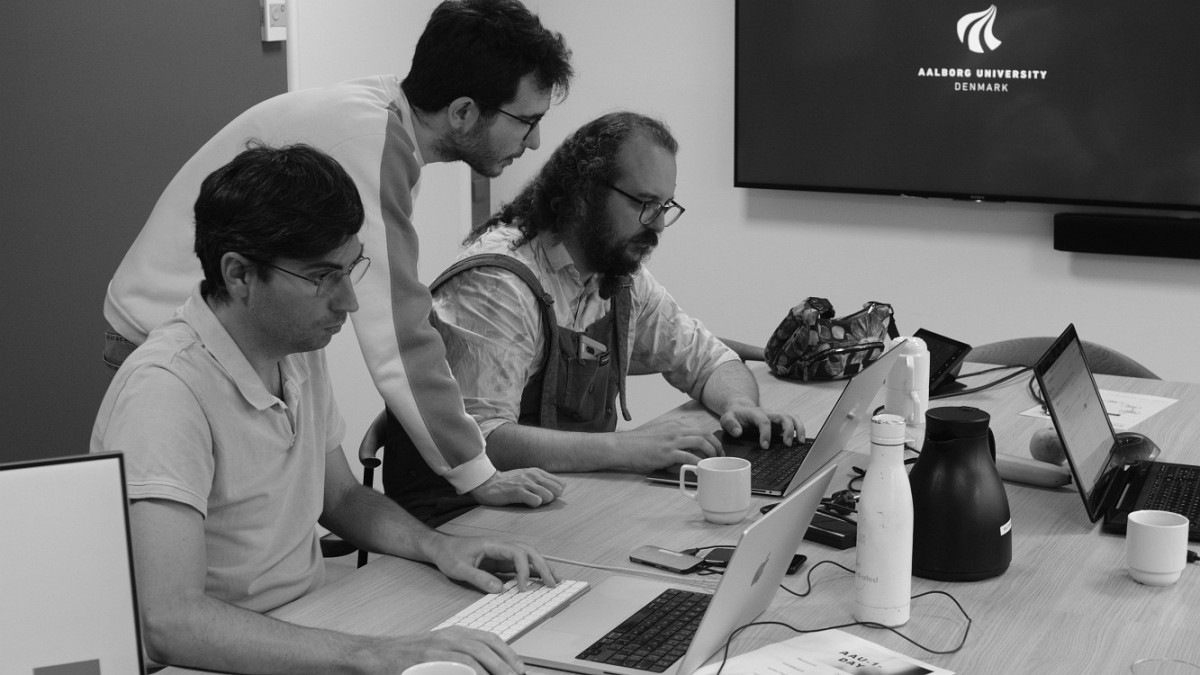
The Gephi Week aspires to be a yearly event where the team and some community members gather to work on the project. The first iteration was in 2021 in Copenhagen (see debrief), and it has happened every year since except in 2023. This year’s edition was hosted by OuestWare in Nantes, France (OuestWare is the team developing Gephi Lite, but it is also a company that does a lot of other projects). The working space was sponsored by the Nantes company UmanIT.

Here is a debrief of what we have done during this edition!


1. Gephi ecosystem

New Gephi Lite 1.0

Gephi Lite has been out and running for a while now, and it is now time for a complete UX overhaul! The team (Alexis Jacomy, Paul Girard and Benoit Simard)  worked with Arthur Desaintjan a (UX design intern) for a semester to rethink the entire user interface, taking into account the feedback of many users. From this process came out a brand new visual language and layout for the tool, that we are very excited to release very soon. Learn more about this design process in this blog post.

Because we think Gephi Lite will be complete enough, it will move into “1.0” territory. Gephi Desktop was overtaken! More on Gephi Lite 1.0 in a separate post.

Headless Gephi with Python : Gephipy

A recurrent demand by members of the community is to have an automated pipeline for Gephi-based analysis. During Gephi Week, this concern was reiterated by our colleagues at Agoratlas, Mathis Hammel, Florent Lefebvre, and Clément Hammel.

We do think that Gephi is, by essence, always about visual and interactive user interface. Nevertheless, it’s an interesting and recurring discussion that we had with users. The current official solution would be to use the Gephi toolkit, a headless (= no ui) version of Gephi that allows you to use all Gephi features in your own java application. It’s convenient for Java developers, but most Gephi users are more used to Python using Jupyter Notebook. 

So Benoît Simard, with the help of Matthieu Totet, had a quick look on the state of art of interfacing Python and Java and found JPype.  This library allows you to load a java library into a Python environment and use it as a normal python library.

It does work nicely out of the box, but then it has been noticed the way to use the toolbox isn’t quite straight forward and it could be simplified so that there would be a more Pythonic way to use the library.

The result of this is a library : Gephipy. This library is available on Pypi and is a wrapper around the Gephi java toolkit that allows you to use Gephi functionality in a Python script or in a Jupyter Notebook.

Keep in mind it’s just an experiment that we make it available and open source so people have a starting point if they need to develop with the headless use case in mind. There is definitely still a lot to do and continue to have a proper python wrapper, but if you are courageous enough, it’s technically possible to use Gephi as a Python library !

At this occasion, we also started the creation of a Gephi organization in PyPI (pending for approval).

New Viz engine integration

For many years, our lead dev Eduardo Ramos Ibanez has been working on a new visualization engine for Gephi (desktop). This was already an important point of the first Gephi Week in 2021.

Maintenance and performance are at stake. The current engine’s technology dating back to 2008, we had decided to rewrite it from scratch. That way, we could leverage modern OpenGL versions and unlock greater performance. Rewriting a core Gephi module is never easy but we have done it before and doing so also unlocks future improvements and enhanced maintainability. The new engine had been worked in a separate repository, to iterate faster. Prior to the Gephi Week, we had decided that it was now time to finish the integration work and clean-up all of the old engine’s code.

Mathieu Bastian, Matthieu Totet and Eduardo Ramos Ibanez have made a lot of progress in the integration work. The last big missing piece is to render text, and hope to tackle that soon.

Preparing for Gephi 0.11

Integrating the new visualization engine and enhancing its reliability and performance is the main goal for the next Gephi release. We hope to be able to release the 0.11 version by the end of this year.

We also performed maintenance tasks and small improvements, to ensure the software remains up-to-date. Notably, we migrated to the latest version of the Netbeans Platform.

Gephi Web Viewer

We discussed the opportunity to create a new Gephi tool. Sharing a network from Gephi on the web for reading has been a thing from the very beginning (Girard et al. 2024). Recently we added a plugin in Gephi desktop to export a graph on the web using Retina, so we discussed the opportunity to transform Retina into an official Gephi web viewer that could be used from Gephi or Gephi Lite.

Change the icons in Gephi Desktop

Gephi had been using pixel-based icons like in the 90s. It was pretty ugly, even though some may find it charming. That will be gone: we replaced all the icons with a homogeneous design language, following the suggestions of Côme Brocas in 2021.

These new icons will be compatible with the dark mode, and will make the UI more calm, allowing you to better focus on your network.


2. Communication and community

Revamping the website

We had not changed the Gephi website in a very long while!

The main screenshot was outdated by a decade or so… But most importantly, we wanted to make it clear that Gephi Lite was there, and we wanted to make room for it. Our main goal was to have a clear path to Gephi Lite from the landing page.And of course many things ensued, such as redefining the structure of the website etc. We tried to reduce the amount of pages to ease maintenance while making sure all important information is there. We used Astro as an infrastructure to build the new version.

Writing new tutorials

Even if the interface and user experience are well designed, a tool as complex as Gephi must be documented with tutorials. But the Gephi team already has a lot on its plate and the more pages and resources we create, the more things we have to maintain, so we have always been grateful for the community to have written multiple series of great tutorials. We encourage all users to produce their own tutorials, because what novice users need is not always technical documentation but a walkthrough of the main features, in an order and using teaching methods that may be specific to different areas of application.

However, we do think that it is also important to new users that they can find the most basic tutorials on the website directly. It’s important to note that we are about to have new user interface choices for both Gephi Lite (major rework) and Gephi Desktop (minor changes but still significant). This called for making an up to date version of the basic tutorials.

That’s why we decided to create a short introduction to Gephi, as simple and universal as possible. This was taken in charge by a few prolific tutorial makers in the community, namely Martin Grandjean, Veronica Espinoza, and Tommaso Venturini. We decided to go for parallel tutorials between the Desktop and Lite versions of Gephi to help users knowing one going to the other.

New FAQ

You probably know about the strength of weak ties, Granovetter’s famous argument. In short, in your relational network, people less close to you (weak ties) can reach resources you don’t otherwise have access to (they are strong).

We had the chance to have Veronica Espinoza with us. In case you don’t know her, she has been writing a lot on various network analysis tools for PhD students and social science and humanities scholars. And she’s based in Mexico. Precisely because she is confronted to a public that we don’t usually have access to, she had a set of very fruitful comments on Gephi as a tool and as a project. A good illustration of Granovetter’s principle!

We have used her feedback as the basis for a FAQ section in the new website, about using Gephi, but also about a range of other things related to the project or the community.

Documentation

In 2022, during the Gephi Week in Paris, we had set up a new online platform to host the documentation. But we had not used it much yet. Progress in the project created that need again, and we decided to definitively move in this new infrastructure.

We decommissioned the old Gephi Wiki, which we froze into an accessible archive.

We will release the new documentation portal with the minimum viable information, and we will gradually go through the wiki to fill the new documentation with relevant and updated content.


3. Project life

Governance

During a Gephi Week, there is always the need to discuss and improve the project’s life. This year’s focus was on governance.

We had the help of Celya Gruson-Daniel to accompany us in the process of formalizing how we function as a collective, and become better at onboarding new members.

Part of this process will be to integrate the project’s life more firmly into the Open Collective platform, and facilitate donations through the platform. This will make the project more transparent and easier to manage.

Documenting the project in video

Like the Paris 2022 edition, we had the chance to have Nicolas “Datalgo” Bouchaib with us. We were able to have live streams every day to talk about data science and network analysis in French and English, and provide insights into the project in video.


Acknowledgements

Thank you to our sponsors UmanIT who welcomed us very generously in their own open space. It was a blast having such a nice place to work in.

Thanks also to OuestWare for sponsoring the food and some of the accomodation.

Additional pictures of the event

Image

Gephi week 2024 – peek from the inside!

This new edition of the Gephi week takes place in Copenhagen, organized by Mathieu Jacomy who lives there and works as a professor at Aalborg University. It was a closed meeting, contrary to the Gephi week 2 years ago in Paris, because of the complexity to organize a public event. This one was smaller and streamlined: 11 participants in one meeting room booked for 5 days. So, what’s happening? I’ll give some personal impressions, interspersed with pictures I took of the event.

Image

The event is pretty important because while Gephi is a passion for all of us, and needs lots of work to develop, the reality is that the actors most involved in the development of Gephi are all super busy with the rest of their lives. The week offers a place and a short window in time where these individuals can work and interact in a highly focused state – that’s 100% Gephi for a couple of days.

One highlight is the participation of Mathieu Bastian (Gephi architect) and Eduardo Ramos (Gephi lead dev), who could spend a few days together and work on the upgrading of Gephi’s viz engine. This is a long term project, started years ago and that perfectly illustrates the difficulty to move on complex subjects with constrained resources.

Image

The promise is to get a new version of the viz engine that will easily accomodate graphs of the size of hundreds of thousands of nodes. Spoiler alert: their project is sufficiently advanced that they could show a demo running within Gephi, and yes gigantic networks can be opened and manipulated just like you’d handle a tiny one today. Looks quite magical. Don’t expect it to be released soon though, as lot of work remains so that the engine works for all platforms and edge cases – that’s many tiny paper cuts to fix.

Image

Another big component of the week is the team of Ouestware working on Gephi lite, which is the web version of Gephi. Lighter than Gephi as the name implies, in the sense that it is not meant to include every feature of Gephi, but evokes a similar experience in terms of graph viz and exploration. It has a much easier learning curve, and it opens Gephi to the features that web technologies afford (modern UI, interfacing with other web services, etc.)

The Ouestware team was joined by Mathieu’s colleagues: Anders Kristian Munk, Johan Irving Søltoft and Lasse Uhrskov Kristensen who provided extensive user reports and insights on Gephi lite (the app being so young, there is still a long road to improve the user experience).

By the way, the development of Gephi lite opens interesting issues: are we witnessing the birth of a kind of “Gephi family” of tools and products? If so, how can it be reflected? Should “Gephi” be called “Gephi desktop” to distinguish it from Gephi lite? What about the visual identity of Gephi? Discussions were exploratory, and in practice the first concrete steps have been taken to redesign the Gephi website to explain better the different assets and use cases for Gephi.

Image

On Mathieu Jacomy’s side, there was interesting work (actually still ongoing, the week is not finished!) on implementing the “connected closeness” algorithm, that he designed and published about (link to the paper, link to the very detailed Observable notebook). What does it do?

It is very simple and powerful: when you layout a network, this algorithm provides a measure of how “good” the layout is. What is “good” then, that’s the big question! A good algorithm is one that brings connected nodes closer to another. Hence the name of the algorithm. Can’t wait to try it!

Image

Another ongoing contribution is by Emilien Schultz, research engineer at ENSAE, who acted both as a participant and an observer: he is interested in Gephi as a topic in sociology of science so he gathered information on the project, all while coding a project that would trace the network of contributors on Github who interacted with Gephi in some capacity. A network that would then be easily explored… in Gephi 🙂

On my side, I spent the week trying to increase the speed of the Force Atlas 2 algorithm, which is this high quality layout developed by Mathieu Jacomy and al., which makes the networks so intelligible. When the graphs are super big (thousands of nodes and dozens of thousands of edges), there are so many computations to be done to lay it out that it is very slow. After 3 days of work, I could double the speed, which is both great but also sligthly disappointing, as I had higher hopes. Besides this result, I learned a lot about the algorithm itself, which has many different parts. It will keep me thinking.

Image

To finish: the atmosphere!

The atmosphere is one of intense focus: participants who made room for a few days to spend time on Gephi and so not wasting a minute. As the pictures show, the meeting room was often silent, just with the noise of keyboard typing. Many or most participants being French, some interruptions came to comment on the political turmoil in France. No tourism on my side except for great culinary experiences in the evening. Copenhagen has great food!

Next steps?

Check out the Gephi website as I’d expect its new version to be published in the not distant future. Then, push me to publish the “speed” version of Force Atlas 2, which is not included in the main Gephi code base yet. And try out Gephi lite, while waiting for the major update to Gephi’s visualization engine! ✨

Talk on community management at Inria fOSSa 2012

The Gephi Consoritium will participate to the fourth edition of the fOSSa Conference taking place from December 4 to 6, 2012 in Lille (France).

The aim of the fOSSa (Free Open Source Academia Conference) is to reaffirm the underlying values of Open Source software: innovation & research in software development.

While the first edition aimed at providing valuable information on the Open Source model at large, the second edition focused specific key-aspects of FOSS such as tech innovation,upcoming issues & challenges in the open development context and how open activities, collaboration and knowledge sharing is beneficial to academia, education & industry. The third edition look at the future of Open Source (Eco system, Trends, new territories, etc).

The fourth edition will address in an open-minded style about:
Digital Geographic Strategies & the Native Generation,
– FLOSS History with the movie: “Revolution OS” followed by a debate,
Open Art, collaboration between art & science,
Licenses in the real life: no lawyers speeches, only facts & return experience,
– Workshops to learn how to develop code for debian, gnome, apache, robotics ROS …
And, of course the usual fOSSa topics (Education & Community management).

At this occasion, Sébastien Heymann will make a presentation about Motivations in Free Software communities, 6th Dec at 2pm in the Community Management track.

“What marks the difference between fOSSa and other events is the air that you breath there. An event organized by passionate people, with passionate attendees as well … and great speakers. Every year you can get some presentations of greater international events in advance (I remember the year of Arduino, to give you an example).” — Gabriele Ruffatti — SpagoWorld Blog 2012.

fOSSa days are open to everyone and registration is free!
more information @ http://fossa.inria.fr

EDIT: slides of the presentation
http://fr.slideshare.net/slideshow/embed_code/15531802

Gephi meet-up #4 in Berlin

user-group_smallInformation Epidemics with Gephi by Dmitry Paranyushkin / Nodus Labs

Large groups of people can drastically change their opinion, adopt a completely unexpected trend, come out to protest on a square, adopt a certain ideology, have an amazing time at a party, or start using a certain product on mass scale. While all these social phenomena are diverse, one thing in common is that they involve information dissemination that happens in a synchronized way, evoking a certain response from the population at once.

In this workshop I will demonstrate how epidemic theories from network science can be used to study information contagion and trend/rumor propagation (so-called information cascades). We will use real examples from Facebook and Twitter, as well as Gephi software to visualise the sample data.

You will learn what groups to target when planning effective marketing campaigns, how promote your news to the top of the feed on Facebook, generate and seed trends in social networks. You will also find out how information becomes viral and what one can do in order to increase the message’s contagious potential.

The workshop will be held in English and German.

To sign up: workshopinformationepidemics-eorg.eventbrite.com

Date: 16th of February, from 6:00 PM to 8:00 PM
Place: betahaus, 19-20 Prinzessinnenstr (U8: Moritzplatz), 4th floor Arena hall

Gephi meet-up #3 in Berlin

user-group_smallText Network Analysis with Gephi by Dmitry Paranyushkin / Nodus Labs

In this workshop we will demonstrate a novel method for text network analysis using Gephi graph visualization software. Unlike other topic modelling methods (latent semantic network analysis, LDA) our approach takes into account the structural properties of text network in order to identify the clusters for meaning circulation and the most influential concepts within the text. You will learn how to create graph network representations of texts and perform their comparative quantitive and qualitative analysis. The method can be especially useful for quick text summarization and group sentiment profiling.

What It Can Be Used For:

– Identifying the most influential concepts and topics within a text.
– Comparing different texts together, especially what strategy a text uses to “push” a certain agenda.
– Group sentiment analysis: find the terms that unite any group together
– Quick text summary and overview (can be especially useful for studying or law text)

If you’d like to participate you can send us a short text (200 to 300 words) to info at noduslabs dot com describing your interests and current occupations. We will create text graphs both for participants and the whole group and see how they relate to one another (see the image attached). This may also be useful for you to meet other like-minded individuals at betahaus or find the people who could complement your cognitive map with their knowledge.

To sign up: workshopnoduslabs1.eventbrite.com

Date: 7th of December, Wednesday, 18.00 to 20.00
Place: betahaus, 19-20 Prinzessinnenstr (U8: Moritzplatz), 4th floor Arena hall

We highly recommend you to bring your laptop with you and pre-install Gephi graph visualization software on your computer (works on Mac, PC, Linux).

First Gephi Plugin Developers Workshop on October, 6

gephi workshop

This is an announcement for the first Gephi Plugins Developers Workshop October 6, 2011 in Mountain View, California. Come and learn how to write your first Gephi plugin and ask questions. The workshop is organized by Mathieu Bastian, Gephi Architect and will be gratefully hosted by IMVU.

Gephi is a modular software and can be extended with plug-ins. Plug-ins can add new features like layout, filters, metrics, data sources, etc. or modify existing features. Gephi is written in Java so anything that can be used in Java can be packaged as a Gephi plug-in! Visit the Plugins Portal on the wiki and follow the tutorials to get started.

The workshop will start with a presentation of Gephi’s architecture and the different types of plugins that can be written with examples. Details about Gephi’s APIs, code examples and best practices will be presented in an interactive “live coding” way. The Gephi Toolkit will also be covered in details. The second part of the workshop will be dedicated to help individuals with their projects and answer questions.

Some of the best projects using or extending Gephi are developed in the Silicon Valley and we are looking forward helping the developer community. Please don’t hesitate to send us your ideas to maximize efficiency.

ImageRSVP here

Gephi meet-up #2 in Berlin

user-group_smallPeople in Beta is a festival about startup culture, diy and co-working hosted on the 1st of October at betahaus in Berlin.

As a part of this festival Nodus Labs will do a workshop on social network analysis starting at 13.30, finishing at 14.30 (reserve your space on people in beta festival website).

Also, betahaus cafe will be a space where everyone can host their own session, so right after the workshop, at 14.30, we’ll host the second Gephi meetup in Berlin downstairs at one of the open tables. Together with the other guests we’ll talk about the different ways we use Gephi and Dmitry from Nodus Labs will show some practical applications of Gephi for text network analysis and social network analysis.

You are welcome to come and join in!

You can read a report on the previous meet-up on the blog of Nodus Labs.
Image


dmitry

Dmitry Paranyushkin is a professional amateur who’s had numerous affairs in the fields of arts, music, intersubjective relations, network research and internet business. He’s the founder of ThisIsLike.Com – an online mnenomic network and Nodus Labs – an exploratorium of ideas in the fields of network analysis. Having fled Russia for undefined reasons in 1976 he’s found a temporary refuge in Berlin where he lives in a castle on Spree river and occasionally visits betahaus to steal rocket-fast broadband frequencies.

First Gephi drink in Paris

user-group_smallThis is an announcement for the first Gephi User Group drink in Paris! The area has many active Gephi users and supporters and we are looking forward making regular meetups, to create connections and discuss features and projects. The group is also open to students interested in open-source or data visualization.

date2 The first event is planned for Wednesday September 28, 20.00 to 22.00 (free access) in Aux 2 Academies, 15 Rue Bonaparte, Paris Au Père Tranquille, 16 rue Pierre Lescot, Paris (map).

Gephi can be used in many domains and with different types of data. Whether you are a scientist, a student, an artist, a developer or a simple enthusiast, you are welcome to join the community and show up at our meetup. It’s a great opportunity to ask questions, discuss data, plugins, code, metrics or visualization.

seb

The meetup will be organized by Sébastien Heymann, Gephi co-founder. To register, sign-in on meetup.com and RSVP for the event.

First Gephi meet-up in Berlin

user-group_smallThis is an announcement for the first Gephi User Group meet-up in Berlin! The area has many active Gephi users and supporters and we are looking forward making regular meetups, to create connections and discuss features and projects. The group is also open to students interested in open-source or data visualization.

date2 The first event is planned for Thursday September 8, 17.30 to 19.30 (free access) in betahaus, 4th floor (Arena), Prinzessinnenstr 19-20, 10999, Berlin (map).

In this workshop conducted by Dmitry Paranyushkin from Nodus Labs hosted at Berlin’s most important co-working hub betahaus, we will demonstrate how one can visualize and analyze a social network or a community (using an example from Facebook selected by the participants). We will find out how to identify the most influential nodes within a network, various subgroups within a community, and the most efficient communication strategies to spread information within a group.

We will also discuss what behavior within the network fosters stronger ties between the members and a more sustainable community.

This event will also be first event of the Gephi Meetup Group in Berlin and we can move to betahaus cafe after to discuss further questions after the workshop.


dmitry

Dmitry Paranyushkin is a professional amateur who’s had numerous affairs in the fields of arts, music, intersubjective relations, network research and internet business. He’s the founder of ThisIsLike.Com – an online mnenomic network and Nodus Labs – an exploratorium of ideas in the fields of network analysis. Having fled Russia for undefined reasons in 1976 he’s found a temporary refuge in Berlin where he lives in a castle on Spree river and occasionally visits betahaus to steal rocket-fast broadband frequencies.