Tooter Claxton is no stranger to these pages. This Dutch, punk-rocking, avatar-making, Second Life Hobo is an articulate and informed, somewhat mad/ingenious graphic designer and art director in Real Life, and a favorite personality of mine.
In my dealings with him, I have come to recognize another quality in Tooter that I so admire: integrity. Tooter shoots straight and he's true to himself. And he's funny while he's doing it. Can't say that about too many people. 
I didn't thoughtfully consider this unique combination of attributes before I invited him to participate in the "Visions of Global Justice" group art exhibition in Second Life. I just knew it in a flash. Ah, what a good kind of flash that turned out to be! The even better news is that he accepted, and his installation joined those of over a dozen artists who came together for the opening of the International Justice Center.
Tooter's piece is called "Free world - the fenced edition." Walk up to it (teleport directly from here), wait a few seconds... and you are in for a surprise. 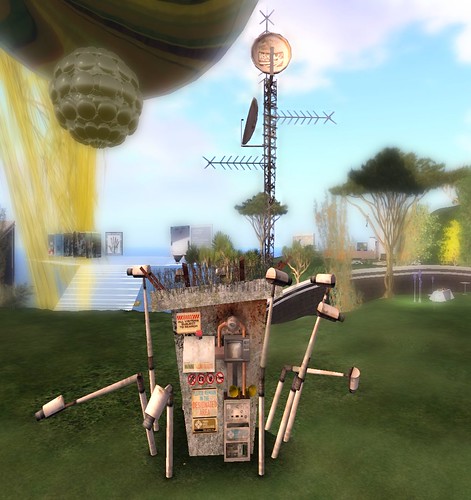
Tooter explains it this way:
Tooter Claxton: Justice and law are based on agreements between people of what is right and what is wrong. Sometimes the difference between right and wrong is evident to everyone, but it isn't always that clear (that's why we need to write the agreements down in books of law, treaties and such) and the line between them can get fuzzy or even disappear. The two sides can even flip, depending on the perspective or interpretation of the viewer. When is someone a freedom fighter? A patriot? A terrorist or an enemy of the state? 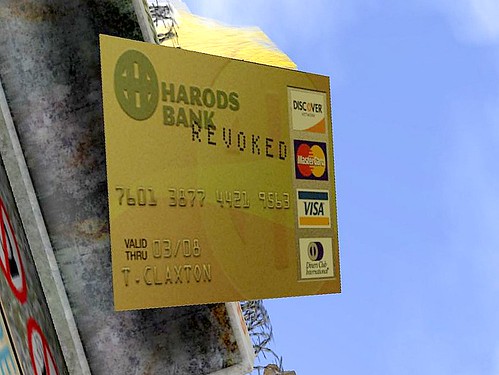
A small, high walled structure, fenced off thoroughly with barbed wire and thick walls. Inside is some grass and flowers on the ground and a door with a lock and a key. The outside walls are textured with 'jail graffiti' and surrounded by a forest of cctv camera's moving around like meerkats, eyeing the visitor.
There are scanners, lights, lots of beeping and humming and scripted checks of the visitor. Security is over the top. Way over the top. Even their trash is sifted through.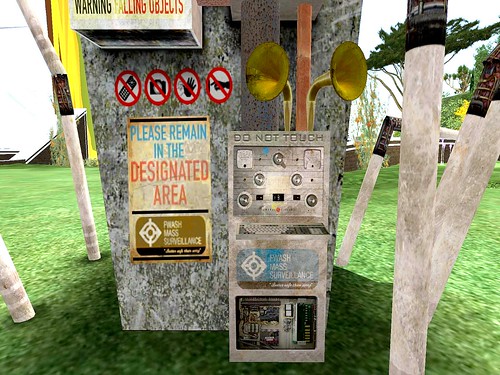
Tooter Claxton: In other words: we punish criminals by putting them in confined spaces, so we can watch and control everything they do. The criminals obviously experience this control and lack of freedom and privacy as punishment. But we, who have committed no crimes, have not been convicted of anything, are increasingly being watched and controlled in the same way: our emails and Internet history can be stored and read, our phone calls are being scanned by the NSA a.s., we get bio-metric passports, all your trips and purchases can be traced through air miles and credit cards, and the cities are full of cctv's watching our every move... Is there still a free world? Are we still innocent until proven guilty? 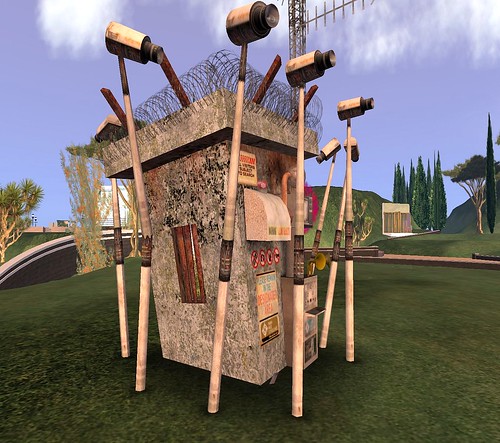
WARNING: SPOILER! READ NO FURTHER IF YOU THINK YOU'D LIKE TO EXPERIENCE THIS PIECE - BUT GO NOW... EXHIBIT WILL END IN ONE DAY! Impressively scripted by Paladin Pinion, text by Tooter Claxton
I walked up to the structure, and a few seconds later, it started talking to me:
[22:26] ::: Initializing. Please remain stationary, Bettina Tizzy
[22:26] ::: Please stand in the designated area. You have received your location 2008-03-20. Check your inventory Bettina Tizzy.
[22:26] ::: Free World Access Scanner Hub (FWASH) activated, please wait.
[22:27] ::: ::: :::
[22:27] ::: We are strongly committed to your right to privacy, Bettina Tizzy. Please read the privacy disclaimer provided by FWASH, available to all Free Citizens.
[22:27] ::: FWASH error: unable to deliver privacy disclaimer. Free World group membership detection not available at this time.
[22:27] ::: Please enable scan and temporary deactivation of Data Protection Act by typing 'I agree' in chat within the set time.
[22:27] ::: Please note that except as otherwise expressly provided, whenever in this Act an amendment or repeal is expressed
[22:27] ::: in terms of a section or other provision of the Data Protection Act of 1984 (47 U.S.C. 151 et seq.), Section 3 (47 U.S.C. 153) is amended: in section 332(d), by striking `section 3(n)' each place it appears and inserting `section 3'.
[22:27] ::: ::: :::
[22:27] ::: ::: :::
[22:27] ::: No response from agent Bettina Tizzy detected within set time. Scanner status: suspicion of possible concealment of identity by agent. Agent status set to 4-B: suspect. Initializing full scan. Please wait.
[22:27] ::: ::: :::
[22:27] ::: FWASH identity confirmed: Bettina Tizzy. Retrieving data. Please wait.
[22:27] ::: ::: :::
[22:27] ::: Your Universally Unique Identifier: cb84ba5a-70bb-4ba7-85c7-a29992d42382 Status unverified.
[22:28] ::: UUID Confirmed suspicion rate 4.7. Restrictive violence acceptable. Subsequent action classified to agent.
[22:28] ::: Facial recognition unit initializing... FRU ready.
[22:28] ::: User Bettina Tizzy born: 2007-01-26. No history of active membership of Free World group detected.
[22:28] ::: Possible membership of non governmental organizations detected.
[22:28] ::: Your Payment info on file: Status: 3-PAYMENT INFO ON FILE Scanning for other payment methods and potential fraudulent transactions.
[22:28] ::: Repetitive purchase of foreign comestibles tracked on loyalty cards: Pizza.
[22:28] ::: Repetitive purchase of foreign comestibles tracked on credit cards: Pizza.
[22:28] ::: Domestic comestibles purchase rate: 5 – average. Probable polynationalism or lack of patriotism detected. Xenoscan Tracking permanently enabled on Bettina Tizzy.
[22:28] ::: FRU scan result: Undetermined moisture detected, probability cold sweat: 87.472%, probability wallpaper adhesive: 12.528%.
[22:28] ::: Retrieving your energy invoices and air miles statistics to determine Fuel Consumption Level for Bettina Tizzy with mass 1.822263. Ratio of mass to energy utilization is not within projected economic stability range.
[22:29] ::: FWASH FCL 3.2 Category Treehugger
[22:29] ::: Avatar clothing changes: over 256 since 2007-01-26. Possible ID concealment. Avatar clothing changes: less than 512 since 2007-01-26. Possible use of alternative accounts.
[22:29] ::: Liquidity in Linden Dollars per day: < 565. You are extremely poor. Enabling financial tranquilizer for Bettina Tizzy.
[22:29] ::: ::: ::: ::: :::
[22:29] ::: Financial Tranquilizer: -start message- Welcome Bettina Tizzy. Money isn't everything. Keep in mind that over 3.8 billion people have less than 565 Linden dollars a day to spend. In the real world. Count your blessings.
[22:29] ::: Financial tranquilizer: Poverty is a choice, Bettina Tizzy. Obey and prosper. -end message-
[22:29] ::: Financial Tranquilizer is offline.
[22:29] ::: ::: :::
[22:29] ::: ::: :::
[22:29] ::: Engaging Waste Analyzer
[22:29] ::: ::: :::
[22:30] ::: Waste Analyzer engaged. Connecting to Department of Sanitation.
[22:30] ::: ::: :::
[22:30] ::: Connected. Scanning garbage bag 00567 through 02441 - Bettina Tizzy. Please wait.
[22:30] ::: Thank you for your patience.
[22:30] ::: ::: :::
[22:30] ::: Traces of addictive substances found. Coffee. Possible tofu. Notifying Drug Abuse Prevention Task Force.
[22:30] ::: Scan finished. Please wait for results.
[22:30] ::: ::: ::: ::: ::: ::: :::
[22:30] ::: No criminal record for user Bettina Tizzy. Suspicion level 7. Estimated loyalty rating index at 2.1
[22:30] ::: Preemptive safety measures will be taken. Please wait.
[22:31] ::: Bettina Tizzy taken into custody by FWASH on suspicion of planning potentially subversive acts.
[22:31] ::: Bettina Tizzy will remain detained.
[22:31] ::: Entrance to Free World denied.
[22:31] ::: Thank you for you for keeping the Free World safe, Bettina Tizzy. Have a nice day.
~*~
This just in and direct from Tooter when I asked him for the authorized bio:
"I don't get bored easily. I am a graphic designer/ art director by profession but I have done, and still do a lot more. I have been singing and/or playing guitar in bands since 1976; punk rock, bluegrass, country, traditional dutch music, german schlagers and even just plain old rock 'n' roll. I've also hosted a variety of shows, quizzes and contests. I design and illustrate books, magazines, and occasionally write for them too. I draw comics and make animations. I've made hundreds of posters, flyers and record sleeves for the local and international 'underground' music scene. I've spent many holidays making and playing theater shows, I have worked with poets, sculptors and painters, making installations in musea, illustrations, short films, prints, performances. And then there's computers...
I've been working with computers since shortly after I left art school in the early eighties. First I tried programming in Basic, making simple games, but I soon used them to design typefaces and animations. After that computers have become an integral part of my work and life.
For the past year and a half I have also been active in Second Life. I spend most of my time in sandboxes, playing and building. I particularly enjoy the absurd side of Second Life, and I see it as an eclectic artwork made by all it's inhabitants. I learned (and still learn) building from other more skilled builders (mostly from the hobo group) and try to add pieces to the dadaist collage that is already there. I 'make a living' in Second Life selling somewhat 'off' avatars, which makes me enough to pay for rent, tier and a premium account. The more I make, the more land I buy to build my own projects on: usually silly, more than often useless. I try to make as many freebies as I can, and as I am selling more and more avatars, I've been giving away more of my builds free. I've also done -and cooperated in- artworks in SL. Most were themed around (dis-) communication, one of the most interesting parts of Second -and real- Life i.m.o."
Many thanks to the MacArthur Foundation, Global Kids and the Justice Commons for hosting this event, together with the USC Network Culture project. Special thanks, too, to In Kenzo, for giving me the opportunity to serve under her as co-curator, thereby allowing me to learn much about how to curate an art event in virtual worlds. In addition to Tooter Claxton and Pavig Lok, whom I featured in my last blog post, the following artists created original art works for this show: Tuna Oddfellow, AM Radio, Tooter Claxton, Juria Yoshikawa, Dancoyote Antonelli, Filthy Fluno, elros Tuominen, Chance Abattoir, Adam Ramona, Josina Burgess, Velazquez Bonetto, Junivers Stockholm.
Saturday, March 22, 2008
Tooter Claxton sounds off on justice with his "Free world - the fenced edition"

Friday, March 21, 2008
Pavig Lok's "Intellectual Property Garden"
Despite the smallish size of Pavig Lok's avatar, this well-honed and witty character packs a powerful punch: great intelligence, a breadth of knowledge that spans many fields, and uncompromising sincerity. 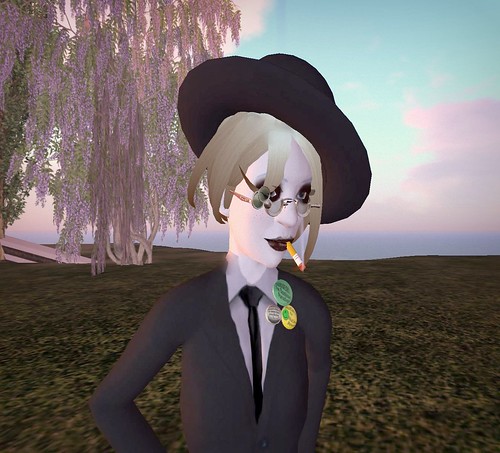
It was my recent pleasure to co-curate, together with In Kenzo (aka Evonne Heyning), and Delia Lake, a group art exhibition in Second Life featuring the works of over a dozen artists. The occasion was the opening of the International Justice Center, a “virtual clearinghouse for information and action in support of global justice and the International Criminal Court,” and the theme: Visions of Global Justice. While Pavig is best known as the lead-creator of Greenies Home Rezzable, and for being an active participant in the Second Life Hobo community, there is another side to this person that I admire, so given the opportunity to invite four artists, I was very pleased when Pavig agreed to participate.
Tasked with conceiving and creating an original and themed art installation with less than 100 prims, Pavig weighed in with a concept and an 18 prim 3D sculpture that shatters the notion that virtual worlds are useful solely as mindless sources of entertainment: the "Intellectual Property Garden," (teleport directly from here). 
Pavig describes the piece as follows:
"A child is seen in a field blowing a dandelion. The flower and seeds are composed of copyright symbols, which can also be seen growing wild in the field. To the child the dandelion represents making a wish. To the adult it is a garden pest which stifles the growth of preferred plants. Every adult knows this when they teach a child to blow dandelion seeds, yet they encourage the child to spread the pest throughout their garden. Is this responsible stewardship?"
Now, I have always found Pavig to be deliberately succinct and someone who generally uses the fewest number of words possible to convey a message, so imagine my amazement when the notecard that accompanies this piece goes on to say the following:
What has intellectual property got to do with justice?
The practical application of justice is law. Law, we know, primarily concerns itself with property and ownership. Crime and punishment is a much simpler domain than that of property, where establishment of rights is by definition far more abstract – less universal. Property exists nowhere in the world, only in contract, agreement, or the award of possession through lawful interpretation of a chain of events.(1)
History, however, provides endless examples of the application of law in ways which may offend our natural sense of justice. One need only look to the distribution of ownership by kingdoms, states, politics and corporations in one's lifetime for many examples.
With ideas now increasingly falling under the umbrella of property law, the abstract idea of ownership becomes increasingly ephemeral. Whilst initially conceived as a protection for the individual, copyright is now increasingly owned by corporation – the modern kingdom. Those who wish to trade with us must agree to be annexed into this kingdom – to practice our conception of justice and ownership over ideas. They become subject to our proprietary rights.
There is some protection in justice as applied by law, but can we be sure natural justice is served. Copyright, patent law, access to technologies, educational materials, information in general; the bread and butter of intellectual property is not distributed evenly.(2)
Just as property law divides the map of our land into rectangles representing right of passage or tresspass, intellectual property segments our intellectual environment into no-go zones based on the provenance of thoughts and ideas. Our children grow and are educated in this environment; our business and nation building, and thus the day to day struggles of our people, are practiced within it.
When corporations in far countries can own; the tools and stories we use to educate our children(3), our own genome and thus our ancestry and makeup(4), the genome of the diseases that kill us and the formula for their cures(5), the living structure of the plants we sow and breeds of the animals we harvest(6), the design of the tools of our industry and anything which we invent ourselves which resembles or replaces them(7); then can we be sure natural justice is being served.
_________________________
Footnotes:
1 We know that property law deals with abstracts in that it's primary unit of exchange, money, is itself ephemeral. The value of these tokens is simply one of agreed consensus within the market – a consensus which shifts to and fro on a daily basis, and thus is removed from any intrinsic value that the Dollar, Euro or Yen may represent. This has arguably been the case since the abolition of the gold standard.
2 Access to a system of law does not imply a balanced justice system. Intellectual Property law, such as copyright and patent law, requires a large and highly developed infrastructure to establish provenance. When new players enter an IP regulated market – such as is the case through recent “free trade” agreements, where right to trade is contingent on adoption, adherence and acknowlegement of existing intellectual properties and systems of law – we should expect the new entrant to start at a severe disadvantage. A smaller nation trading with the USA is a fine example. In the United States almost anything patentable has been patented. This includes, for example, a button on a website that says “buy” - something which should seem obvious and un-patentable as a pre-requisite for patent is novelty. It is unreasonable to expect a smaller nation to compete with the established body of patent claims which exists on such a granular level in developed nations. For the significant social costs of implementing a patent system on developing nations see: Samuel Oddi, The International Patent System and Third World Development: Reality or Myth?, 1987 Duke Law Journal 831 (1987).
3 Educational use of existing materials covered by copyright comes under either a licensing or fair use provision in law. As the rights under copyright are extended, fair use provisions come under pressure. Now the mere threat of litigation presents an economic burden on educational institutions, who must now practice citation and study of copyrighted works defensively. These increased costs alone, and the restrictions on use of works for education to avoid them, are changing the practice of education even in affluent nations. In jurisdictions where the development of IP law has outpaced complimentary fair use provisions, this burden is correspondingly increased.
4 Since sequencing of the human genome, various parts of it have been subject to ownership under intellectual property law. Particularly famous cases of this pertain to genetic sequencing of indigenous populations, who may have a body of native law concerning ancestry, and thus their genetic heritage. Unwittingly transferring property rights to the unique sequence of their DNA brings native law and intellectual property law into conflict. Can a corporation own what makes one ones-self without informed consent? How are the benefits of ownership of this property distributed? Distribution of advantage can be worth considerable sums in cases where natural immunity to diseases within a genome confer towards a commercial treatment for disease – a situation where western property law is often poorly structured to remunerate donor groups. For further research on ethical and other concerns, the “human genome diversity project,” and “the genographic project,” and controversies surrounding them, are a good starting point.
5 Contention may arise in the patenting of gene sequences of disease. The first company to genetically sequence the SARS virus now owns it – though our natural sense of ownership would say it is owned perhaps by nature or humanity, if the concept of ownership is even an appropriate. This right of ownership under intellectual property law however, allows the company to contest a right to part ownership or interest in any cure which may be developed. It is not hard to see how such a system could be abused. Biological patents are nothing new, and neither is controversy regarding their use as a barrier to legitimate research. Compliance with a system of biological patent precludes nations with weaker economies from engaging in research on equal terms by eating up research budgets in order to comply with legal licensing against a stronger unit of currency. With over half a million gene patents filed in the last few years, biological patenting has entered a new era, and controversy will continue as law continues to adapt to this new area of intellectual property.
6 For evidence where IP affects crops, one need look no further than the “terminator seeds” controversy. In order to protect the biological intellectual property of it's own nation, the US Department of Agriculture developed a genetic method to turn second generation seeds sterile – a so called GURT or Genetic Use Restriction Technology. Of course, the outcome, should this technology hit the market, is that smaller nations, indigenous and rural farmers, would become dependent on the agricultural industry for seed on a seasonal basis. This undermines the 12,000 year old practice of saving the best seed from each crop for sowing the following season. Similar issues can be found in biological patent and “usage rights” on animals for breeding purposes. Overlap between patent rights to plant materials and long established law such as plant breeders' rights is another source of contention.
7 The use of patent law to stifle technological development is well documented. Arguments of this sort cite a “negative right” the patent holder gains, allowing them to exclude competitors from exploiting a similar invention they may develop independently. The legal burden of producing prior art in such cases can preclude the competition from proving their case even when they may have developed the invention first. When this is the case and a patent is contested, the competitor may be forced to cease development of the invention, or pay a licensing fee for use of the others' IP.
_________________________
During an "artist talk," at the gala opening of the show, Pavig went on to explain:
"I came here tonight ready to engage in a complex diatribe about art – about art being too complex to be specific. The irony was not lost on my closest friends, who put me right. For that I am truly thankful.
My rant was full of the exact hubris I was arguing against. That we, as artists, “hide our statements within a cryptic mishmash of semiotics.” So I set out to hoist myself with my own petard, by overcomplicating discourse on overcomplicated art about a complicated subject; justice.
I realized that everything I wanted to say about art had been said before, much more eloquently and concisely, by Charles Bukowski. It's a quote I've written at the front of all my journals to remind myself not to talk around things but to them – hoping to become more of a poet really, than a rather well read intellectual boor.
He said;" An intellectual is someone who says a simple thing in a difficult way. An artist is someone who says a difficult thing in a simple way." This is precisely the message I hoped to impart.
The theme of justice can be discussed endlessly – it is complex, multifaceted, confusing, just too darn hard to address. As a friend said to me: “the world's biggest economic / political problems are not hidden from the public in any way, there just to complex for the public to comprehend.” Yet we all have a sense of justice which we are sure we know intimately – this is natural justice.
We all know natural justice from our basic moral stance. This is something bodies such as the United Nations seek to codify, in their statements of basic human rights. We should not allow folk to be subject to violence. We should not allow folk to starve so that others can become obscenely rich. We should not displace folk from their land. We should implement systems to minimize the possiblility that these offenses to basic human dignity happen.
The principles of justice are simple – it is in the implementation of justice, our laws, systems and so on, that they become complex. Law is the formalization of justice – the justice system – and in being so complex it is sure to have it's faults and loopholes.
My piece is about Intellectual Property as it relates to justice. Though I deliberately haven't talked about this before – I'm, sure you all know, I.P. Law is a subject of concern to those in virtual worlds. My piece implies that I.P. Law is part of our environment. For folk who spend their time on the web and in SL all property is virual, intellectual property. Our sense of basic justice often touches on intellectual property issues due to this. I'm not here to preach to the converted.
Intellectual property however is part of all of our environments, and impacts real world concerns as well. As the notecard in my piece illustrates, it is of profound significance to issues we may not expect. It has implications for justice which are complex, multifaceted, not at all cut and dry. It has justice implications outside what we may percieve as it's narrow domain. It is a complicated matter.
So I tried to make my piece say some very simple things about the concept of intellectual property:
It is part of our envirnoment, like a weed or a flower.
IP and justice are related. It is in the justice commons – the subject is relevant to the context.
Our view of intellectual property is naive and obscured, and personal. It is a childs view. We see the shadow of it (a flat view like the shadows on the walls of Plato's cave) but not the whole. Every viewer sees it slightly differently (as the exact shape is dependant on viewing angle).
IP may have a dark side – though it's an idylic scene, it's black after all. (More detail on this aspect is revealed in a notecard in the work onclick.)
And Intellectual property is like the dandelion. Kid's may call them “fairies” but gardeners call them weeds. If we spread it throughout our environment without concern for the implications, eventually we'll have to weed it out where it becomes a pest.
Hopefuly my piece acts as an invitation for people to discuss the complex issues surrounding intellectual property. As law it is one of the tools of our formal justice system. We must watch IP law closely as it develops to ensure justice is the outcome."
Many thanks to the MacArthur Foundation, Global Kids and the Justice Commons for hosting this event, together with the USC Network Culture project. Special thanks, too, to In Kenzo, for giving me the opportunity to serve under her as co-curator, thereby allowing me to learn much about how to curate an art event in virtual worlds. In addition to Pavig Lok, the following artists created original art works for this show: Tuna Oddfellow, AM Radio, Tooter Claxton, Juria Yoshikawa, Dancoyote Antonelli, Filthy Fluno, elros Tuominen, Chance Abattoir, Adam Ramona, Josina Burgess, Velazquez Bonetto, Junivers Stockholm.