Showing posts with label Tennessee. Show all posts

Sunday, 22 August 2021

Seventeen confirmed deaths and forty two still missing as flash floods hit Tennessee.

Seventeen people, including several young children, have now been confirmed dead, and another forty two are missing following a series of floods in Humphreys County, Tennessee. Slightly over 43 cm of rain fell in the area around the town of Waverly within 24 hours over the weekend of 21-22 August 2021, exceeding previous rainfall records by more than 8 cm, and causing a series of flood events that swept away many homes and businesses in the area.

Image 
Flooding around the town of Waverly in Humphreys County, Tennessee. Nashville Fire Department.

The rainfall was caused by a combination of a high pressure system over Texas and a low pressure system over the Mid Atlantic, which pushed waves of humidity laden air to be pushed northwards from the Gulf of Mexico. Low pressure systems are caused by solar energy heating the air above the oceans, which causes the air to rise leading to an inrush of air. Meteorologists have warned that such storms are likely to become much more common with rising global temperatures. Storms of this magnitude were formerly expected roughly once every hundred years in the Tennessee, but this is the second such event this year, following a storm to the south of Nashville in March.

See also...

Image
Image


Image
Image


Image
Image


Follow Sciency Thoughts on Facebook.

Follow Sciency Thoughts on Twitter


Thursday, 4 June 2020

Hyoliths from the Early Cambrian Murray Shale of Chilhowee Mountain, Tennessee.

The Hyoliths are an enigmatic group of shelled invertebrates known from the Earliest Cambrian until the End Permian Extinction. They had conical shells with opercula (lids), and sometimes a pair of curved horns called 'helens'. The exact nature of Hyoliths was for a long time considered a mystery, with most palaeontologists considering them to be either a form of Mollusc or an extinct phylum of animals of unknown affinities. However, recent studies of Hyoliths with preserved soft tissues and shell microstrucure has led to the conclusion that they were lophophorate animals closely related to Brachiopods.

In a paper published in the Journal of Paleontology on 2 April 2020, John Peel and Sebastian Willman of the Department of Earth Sciences at Uppsala University and Steven Hageman of the Department of Geological and Environmental Sciences at Appalachian State University, describe a series of Hyloliths from the Early Cambrian Murray Shale of Chilhowee Mountain, Tennessee.

Outcrops of Laurentian Early Cambrian (Cambrian Series 2; roughly 521 to 509 million years ago) strata extend from Alabama and Tennessee to North-East Greenland along the Eastern Seaboard of North America. Traditionally, their age has been determined by occurrences of trilobites indicative of the Dyeran Stage of North American usage (Cambrian Stage 4; roughly 514 to 509 millio years ago), with widespread records of Olenellus and related Trilobites in the literature. By contrast, extensive faunas of older Cambrian Trilobite faunas indicative of the Montezuman Stage (Cambrian Stage 3; roughly 521 to 514 million years ago) are well known from the opposite side of Laurentia, in the western United States. However, fossiliferous Avalonian successions in Rhode Island and Massachusetts, New Brunswick, Nova Scotia, and eastern Newfoundland comprising the Terreneuvian (Cambrian Series 1; roughly 541 to 521 million years ago) and Cambrian Series 2 to Lower Ordovician, are juxtaposed against the Laurentian of the Eastern Seaboard of present-day North America.

Image
Localities and stratigraphy. (1) Peary Land region of North Greenland showing outcrops of the Buen Formation (black) and localities with Montezuman Stage fossil assemblages; (2) Eastern Seaboard of North America with Greenland displaced southward to its approximate position in the Cambrian. NEG indicates Dyeran occurrences in North-East Greenland. (M), (NB + CBI), and (N) locate Avalonian successions in Massachusetts, New Brunswick and Cape Breton Island, and eastern Newfoundland, respectively; (3) early Cambrian stratigraphy in southern Peary Land showing derivation of fossil assemblages with the Buen Formation; (4) early Cambrian stratigraphy at Chilhowee Mountain, Tennessee, indicating location of fossiliferous samples (F) in the Murray Shale (Montezuman Stage) and the established Dyeran Stage faunas of the Shady Dolomite in Virginia. Peel et al. (2020).

The recent description of the Nevadioid Trilobite Buenellus from the upper Murray Shale of Chilhowee Mountain, eastern Tennessee, is significant in providing evidence of the Montezuman Stage in the Laurentian terrane of the eastern United States. Buenellus is otherwise known only from its type locality in the Sirius Passet Lagerstätte of Peary Land, North Greenland.

The Sirius Passet Lagerstätte is the oldest known fossil assemblage within a succession of Montezuman–early Dyeran (Cambrian Stages 3–4) age assigned to the Buen Formation. The Lagerstätte is known only from a single locality, but the siliciclastic sediments of the Buen Formation are otherwise widely distributed in eastern North Greenland. The Buen Formation lies within the transarctic Innuitian Orogen, facing the Arctic Ocean. By contrast, the Murray Shale at Chilhowee Mountain, and other Laurentian outcrops along the Eastern Seaboard between Alabama and North-East Greenland accumulated along the shore of the former Iapetus Ocean. In Cambrian times, however, Laurentia occupied a tropical position, and this Iapetan margin faced to the south.

About 35 Hyolithid specimens preserved in pale buff weathering shale were examined from locality CM3 on Chilhowee Mountain where they occur together with Buenellus chilhoweensis in the upper Murray Shale. The specimens are crushed, but not completely flattened, and some are preserved as external and internal molds. Conchs dominate but most are broken. Opercula occur as isolated fossils, and in rare partially articulated associations with conchs Rare broken fragments of the paired appendages (helens) have been observed as isolated fossils.

The specimens recovered were sorted into four species, one of which was tentatively placed in the genus Burithes, the other three being of uncertain affinities and are instead numbered. None of the material is considered well enough preserved to name a species from.

The species placed in the genus Burithes has a conch with incremental angle 20°–25° and ligula about one-sixth of total length, with a slight longitudinal curvature such that the ventral surface may have been shallowly convex. The width of the ligula is about half its length, but the length increases proportionately with growth Shallow lateral sinuses for the likely passage of helens lie on the dorsal side of the angular transition from the convex dorsal surface to the almost flat ventral surface. The dorsal surface is seemingly uniformly shallowly convex, but the degree of inflation uncertain due to crushing. Ornamentation on the ventral surface consists of fine comarginal growth lines with occasional growth halts that may appear periodic. Ornamentation on the dorsal surface is poorly known, seemingly almost orthocline. Operculum and helens not certainly known, but associated isolated opercula are wider than long, supporting the interpretation that the dorsal surface of the conch was not strongly inflated.

Image
Burithes? sp. Hyolith conchs from the Murray Shale, Chilhowee Mountain, Tennessee. (1) PMU 35718, ventral surface; (2) PMU 35719, ventral surface; (3) PMU 35720, obliquely crushed ventral surface; (4) PMU 35721, central surface, above, with external mold of dorsal surface, below; (6) PMU 35722, crushed, with dorsal surface overlying internal surface of ventral surface with ligula; (7) PMU 35723, ventral surface with characteristic fractures; (8) PMU 35724, ventral surface. Peel et al. (2020).

All specimens are compressed, although a degree of separation between the dorsal and ventral surfaces may be maintained. Crushing has often produced Y–shaped cracks that extend from the ligual margin down the median line as a raised, irregular ridge or angulation to near the apex. The median fracture is commonly expressed as a ridge on the ventral surface, but this is a preservational artifact. However, a broad, rounded ridge in some specimens likely represents compaction around a solid object within the conch interior, possibly an early mineralized burrow or sediment-infilled section of gut.

In terms of its overall shape, the Murray Shale conchs are similar to Burithes erum from the Tommotian of the Anabar Massif of Siberia. Nevadotheca whitei from the Pioche Shale (Cambrian Series 2) of Nevada, the type species of Nevadotheca, differs in having a high, inflated dorsum and narrowly rounded lateral margins. This is also the case in Nevadotheca boerglumensis and Kalaallitia myliuserichseni, described from the early Olenellus Biozone (Dyeran, Cambrian Stage 4) of the Buen Formation of southern Peary Land, North Greenland, but Kalaallitia is distinguished by its fine longitudinal lirae and longer ligula. Opercula referred to these Peary Land species are proportionately longer than Murray Shale specimens, suggesting that the dorsal surface of their conchs was more strongly inflated than in Burithes? sp.

Some researchers have noted some similarity between specimens from the Dyeran of North-East Greenland and Burithes, but the acute dorsum of their material suggested assignment to Grantitheca. In contrast to material from the Murray Shale and Buen Formation, hyoliths from North-East Greenland are preserved mainly as internal molds in limestone or as phosphatic residues from limestones.

The first numbered species 'Hyolithid sp. 1' is known from the illustrated specimens and two additional fragments, is characterized by two or three prominent transverse folds or corrugations on the adapertural part of the shallowly convex ventral surface of the conch and ligula. The incremental angle is about 30°, and the length of the ligula is slightly more than half its width. Lateral sinuses are present at the transition from the shallowly convex ventral surface to the dorsal surface, but the degree of inflation of the latter is not known. Ornamentation consists of fine comarginal growth lines, although these are more strongly developed at the preserved aperture.

Image
Hyolithid sp. 1, PMU 35725: (5) external and (9) internal molds showing prominent corrugation. Peel et al. (2020).

Corrugation of the latest growth stage of the ventral surface and ligula is common in hyolithids, but not with the high degree of emphasis seen in the Murray Shale specimen. Examples have been illustrated in specimens from Siberia referred to Trapezovitus sinscus and Burithes cuneatus, in Nitoricornus wushiensis from the lower Cambrian of Xinjiang, China, and in specimens from New Brunswick.

The second unnamed species, 'Hyolithid sp. 2' is described from three overlapping incomplete specimens in ventral aspect, which Peel et al. suggest may form part of a gut fill or coprolite. One of the specimens preserves the operculum in place. The incremental angle is about 20°, and the ligula is short. The ventral surface is shallowly convex, but the lateral edges are rounded and delimited on their axial edge by a shallow longitudinal furrow. The dorsal surface is not known, but lateral sinuses seem to be well developed The impression of the dorsal exterior of the operculum shows comarginal growth lines and a suggestion of a radial furrow. While similar in shape to other opercula from the Murray Shale, it is too poorly preserved for closer comparison.

Image
Hyolithid sp. 2; (11), (12) PMU 35727 with three fragmentary specimens in ventral aspect, probably within a gut fill, coprolite, or burrow; arrow in (12) locates external mold of operculum shown in detail in (11); (13) PMU 35728, external mold of ventral surface. Scale bars 2 mm.

The third unnamed species, 'Hyolithid sp. 3', is described from a single poorly preserved specimen which has an incremental angle of 15° and appears to have an oxygonal aperture. Adaperturally, shallowly convex comarginal growth lines on the ventral surface are cord-like and laterally discontinuous, resembling the pattern seen in Nitoricornus danianum and ?Crestjahitus danianus from New Brunswick, Canada, whereas the dorsal surface is ornamented with barely discernible fine growth lines.

Image
Hyolithid sp. 3, PMU 35726, dorsal view. Peel et al. (2020).

Three poorly preserved specimens of partially articulated Hyolithid skeletons occur, but several isolated opercula are known. The length of the best-preserved specimen is about four-fifths of its width. Its conical shield is hemispherical in plan view, and the summit lies at about one-quarter of the distance from the adapical margin to the adapertural margin. The folds separating the conical and cardinal surfaces delimit an angle of about 130° in plan view In lateral perspective, the cardinal shield rises high above the summit of the operculum, with the inclination of its adapical margin suggesting that the conch had an amblyogonal margin. The cardinal area is ornamented with radial ridges transverse to the comarginal growth lines present over the entire conch. The latter are most conspicuous on the conical shield where radial ornamentation consists of fine lines.

Image
Hyolithid opercula from the Murray Shale, Chilhowee Mountain, Tennessee. (1)–(3) PMU 35729: (1) oblique apertural, (2) dorso-lateral, and (3) dorsal views. (4) PMU 37730 external mold with arrow indicating lateral sinus for passage of helen; (5)–(7) PMU 35731: (5) dorsal, (6) dorso-lateral, and (7) lateral views. (1)–(3) Scale bars 1 mm; (4)–(7) scale bars 2 mm. Peel et al. (2020).

A second specimen, preserved as an external mold, has a well-defined convex adapical border with prominent coarse ridges between the summit and the adapical margin. A broad shallow sinus in the margin marks the exit point for the helen. A third specimen has a more elliptical shape than the other two specimens and develops a series of short comarginal rugae located medially on the conical shield.

The cardinal surface is proportionately longer in opercula of Nevadotheca boerglumensis and Kalaallitia myliuserichseni from the early Olenellus Biozone at Brillesø, southern Peary Land, and the folds separating the conical and cardinal surfaces delimit an angle of about 90°, much smaller than in the specimens from the Murray Shale. In this respect, the opercula from the Murray Shale more closely resemble the opercula associated with articulated specimens from the Sirius Passet Lagerstätte, but these are too poorly preserved for close comparison. A similar wide angle is seen in Nitoricornus danianum illustrated from New Brunswick.

Image
Articulated Hyolithids from the Sirius Passet Lagerstätte, Buen Formation, Peary Land, North Greenland. (1) MGUH 29260; (2), (4) MGUH 29691: (2) ventral surface with operculum displaced and inverted to show conical surface; (4) enlarged view. (3) MGUH 29258, ventral surface. (1)–(3) Scale bars 2 mm; (4) scale bar 1 mm. Peel et al. (2020)

The Murray Shale Hyolithids are the oldest Hyoliths known from present–day eastern Laurentia but not from eastern North America. Hyoliths considered to be of Terreneuvian and younger age have been reported from Avalonian terranes, although some researchers have referred some of this material to the Montezuman, citing the occurrence of Aimitus and Notabilitus.

Previous work has described Hyolithids and Orthothecids from the Sirius Passet Lagertstätte occurring together with Buenellus higginsi. Orthothecids have not been recognized from the Murray Shale. Although several Hyolithid specimens from the Sirius Passet Lagerstätte preserve the operculum and paired helens together with the conch, their poor state of preservation precludes more precise identification. However, opercula from the Murray Shale are similar in shape to a Sirius Passet operculum and unlike those occurring in the Dyeran Buen Assemblage 2 from southern Peary Land. Variation in the incremental angle of the conch suggests that several taxa may be present in the Sirius Passet articulated material. Some Sirius Passet specimens have an angular dorsum not seen in Murray Shale material and thereby resemble Grantitheca. The articulated specimens are associated with longitudinally ribbed conchs assigned to Trapezovitus and an Orthothecid, but specimens similar to these have not been observed from the Murray Shale.

The Bradoriid Arthropod Indota, represented by Indota tennesseensis in the Murray Shale, has not been described from the Sirius Passet Lagerstätte. Poorly preserved specimens from the upper Buen Formation (Dyeran Stage) have been tentatively referred to the genus, but the assignment has been questioned. Isoxys chilhoweanus from the Murray Shale is similar to Isoxys volucris, which is the most abundant fossil in the Sirius Passet Lagerstätte. 

Two crushed hyolithids from Buen Assemblage 1 at Brillesø, southern Peary Land have been illustrated in association with the Nevadioid Trilibite Limniphacos perspicullum, of presumed Montezuman age. The rugose growth ornamentation of one of these is reminiscent of Hyolithid sp. 1 from the Murray Shale but is much less strongly expressed. Strata within the Buen Formation of probable Montezuman age occur in Hans Egede Land, eastern Peary Land; they are not well known, but unidentifiable hyolith fragments are associated with poorly preserved Trilobites.

See also...

https://sciencythoughts.blogspot.com/2019/09/joania-cordata-argyrotheca-cuneata.htmlhttps://sciencythoughts.blogspot.com/2019/01/alfaites-romeo-new-species-of-hyolith.html
https://sciencythoughts.blogspot.com/2018/12/cellaria-oraneae-new-species-of.htmlhttps://sciencythoughts.blogspot.com/2018/11/beania-serrata-beania-mediterranea-two.html
https://sciencythoughts.blogspot.com/2017/11/bryozoas-from-seamounts-islands-and.htmlhttps://sciencythoughts.blogspot.com/2017/08/a-hydrocarbon-seep-from-late-triassic.html
Follow Sciency Thoughts on Facebook.

Wednesday, 4 March 2020

Tornado outbreak kills at least 25 in Tennessee.

An outbreak of Tornadoes on Tuesday 3 March 2020 has killed at least 25 people in Tennessee. The outbreak occurred slightly after midnight, when most of the population was sleeping, so many people did not make it to storm shelters on time. The majority of the fatalities happened in Putnam County, to the east of Nashville, where nineteen people are known to have died, with three recorded deaths so far in Wilson County, two in Davidson and one in Benton. In addition to the known fatalities a number of people are still missing, and around 150 people are being treated in hospital for injuries sustained during the outbreak. It is though likely that the number of victims will rise as emergency teams search through the wreckage left by the storm. As well as the damage to private homes the area has suffered damage to infrastructure, with Nashville Electric reporting four substations closed down due to tornado damage, leaving around 44 000 people without electricity, and severe damage to buildings at John C Tune International Airport.

Image
Damage to a restaurant in Nashville, Tennessee, following a tornado outbreak on 3 March 2020. AP.

Tornadoes are formed by winds within large thunder storms called super cells. Supercells are large masses of warm water-laden air formed by hot weather over the sea, when they encounter winds at high altitudes the air within them begins to rotate. The air pressure will drop within these zones of rotation, causing the air within them so rise, sucking the air beneath them up into the storm, this creates a zone of rotating rising air that appears to extend downwards as it grows; when it hits the ground it is called a tornado. 

Image
Damage to retail outlets in Nashville, Tennessee, following a tornado outbreak on 3 March 2020. Jason Kempin/Getty Images.

Tornadoes can occur anywhere in the world, but are most common, and most severe, in the area of the American mid-west known as 'Tornado Ally', running from Texas to Minnisota, which is fuelled by moist air currents from over the warm enclosed waters of the Gulf of Mexico interacting with cool fast moving jet stream winds from the Rocky Mountains. Many climatologists are concerned that rising temperatures over the Gulf of Mexico will lead to more frequent and more severe tornado events.
 
Image
Simplified diagram of the air currents that contribute to tornado formation in Tornado Alley. Dan Craggs/Wikimedia Commons/NOAA.
 
See also...
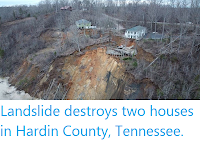
 
https://sciencythoughts.blogspot.com/2020/02/landslide-destroys-two-houses-in-hardin.htmlhttps://sciencythoughts.blogspot.com/2018/12/magnitude-44-earthquake-in-meigs-county.html
 
https://sciencythoughts.blogspot.com/2015/12/stroms-and-floods-kill-at-least-43.htmlhttps://sciencythoughts.blogspot.com/2013/04/earthquake-in-southeast-missouri.html
https://sciencythoughts.blogspot.com/2012/06/protest-group-appalachia-rising-occupy.html
Follow Sciency Thoughts on Facebook.

Monday, 17 February 2020

Landslide destroys two houses in Hardin County, Tennessee.

Two houses have been destroyed in a landslide above the Tennessee River in Hardin County, Tennessee, on Saturday 15 and Sunday 16 February 2020. The incident happened in the evening in the Chalk Bluff area acording to the Hardin County Fire Department. Only one of the houses was occupied, and that was evacuated earlier in the day, when it became clear the location had become extremely unstable. The landslip appears to have been caused by high floodwaters on the river below, which appear to have washed away sediments at the base of the hillslope, undermining the layers above.

Image
Drone picture of the landslide on Chalk Bluff on the Tennessee River, taken at about 5.30pm, local time. The house on the left collapsed about an hour later, the house on the right the following day. Hardin County Fire Department/Facebook.

Flood-related incidents are not unusual in Tennessee at this time of year, although this winter has seen more than usual. This is probably related to the El Niño system currently present over the Pacific Ocean, which can bring warmer, wetter air to the southerb US than is typical for the time of year.

The El Niño is the warm phase of a long-term climatic oscillation affecting the southern Pacific, which can influence the climate around the world. The onset of El Niño conditions is marked by a sharp rise in temperature and pressure over the southern Indian Ocean, which then moves eastward over the southern Pacific. This pulls rainfall with it, leading to higher rainfall over the Pacific and lower rainfall over South Asia. This reduced rainfall during the already hot and dry summer leads to soaring temperatures in southern Asia, followed by a rise in rainfall that often causes flooding in the Americas and sometimes Africa. Worryingly climatic predictions for the next century suggest that global warming could lead to more frequent and severe El Niño conditions, extreme weather conditions a common occurrence.

Image
 Predicted changes to North American weather patterns during an El Niño event. NWS/NCEP Climate Prediction Center/NOAA.
 
See also...
https://sciencythoughts.blogspot.com/2020/01/worker-killed-by-ammonia-spill-in-north.htmlhttps://sciencythoughts.blogspot.com/2019/12/three-killed-in-tornado-outbreak-in.html
https://sciencythoughts.blogspot.com/2019/10/channa-argus-northern-snakehead.htmlhttps://sciencythoughts.blogspot.com/2019/10/legionnaires-disease-outbreak-in-north.html
https://sciencythoughts.blogspot.com/2019/09/hurricane-dorian-confirmed-to-have.htmlhttps://sciencythoughts.blogspot.com/2019/06/teenager-injured-by-shark-in-north.html
Follow Sciency Thoughts on Facebook.

Thursday, 13 December 2018

Magnitude 4.4 Earthquake in Meigs County, Tennessee.

The United States Geological Survey recorded a Magnitude 4.4 Earthquake at a depth of 11 km, roughly 11 k to the northeast of the town of Decatur in Meigs County, Tennessee, slightly before 4.15 am local time (slightly before 9.15 am GMT) on Wednesday 12 December 2018. These are no reports of any damage or injuries associated with this event, but people have reported feeling it in Tennessee, Missouri, Kentucky, Illinois, Indiana, Ohio, West Virginia, Virginia, North Carolina, South Carolina and Alabama.

Image
The approximate location of the 12 December 2018 Meigs Earthquake. Google Maps.
 
Tennessee lies within an area known as the New Madrid Fault Zone, an seismically active area which lies over the deeply buried Reelfoot Rift, an area of tectonic expansion associated with the breakup of the ancient supercontinent of Rodinia about 750 million years ago. This is no longer an active rift, but it is an area of weakness within the North American Plate which is more prone to movement in response to other tectonic stresses, such as the compression of the plate by expansion beneath the Atlantic and Pacific Oceans.
 
The Reelfoot Rift is overlain by a deep layer of poorly consolidated tertiary sediments. These sediments are prone to liquefaction during tremors. When this occurs the sediments behave as a liquid, rather than a solid, with often devastating consequences for man made structures such as buildings and roads on the surface.
 
Image
 The structures underlying the New Madrid Fault Zone. Geological Survey of Alabama.
 
The New Madrid Fault Zone gets its name from the New Madrid Earthquakes of 1811-12, which were felt over much of the central United States, entirely destroying the city of New Madrid, Missouri, and causing damage to buildings as far away as St Louis, Missouri and Memphis Tennessee as well as diverting the course of the Mississippi River.
 
Witness reports can help Geologists understand Earthquake events and the underlying structures that cause them. If you felt this quake (or if you were in the area but did not, which is also useful information) you can report it to the United States Geological Survey here.

See also...

https://sciencythoughts.blogspot.com/2018/09/hurricane-florence-kills-four-in-north.htmlhttps://sciencythoughts.blogspot.com/2018/09/tropical-storm-gordon-makes-landfall-on.html
https://sciencythoughts.blogspot.com/2018/08/sternula-antillarum-hundreds-of-least.htmlhttps://sciencythoughts.blogspot.com/2018/08/evacuations-as-city-of-lynchburg.html
https://sciencythoughts.blogspot.com/2018/07/seventeen-dead-after-pleasure-boat.htmlhttps://sciencythoughts.blogspot.com/2018/06/arkansas-kayaker-killed-when-sinkhole.html
Follow Scieny Thoughts on Facebook.

Friday, 7 December 2018

Buenellus chilhoweensis: An Olenelline Trilobite from the Early Cambrian Murray Shale of Tennessee.

The Chilhowee Group outcrops in the Appalachian Mountains from Alabama to Pennsylvania, and comprises a series of sedimentary units of Late Ediacaran to Early Cambrian sedimentary deposits laid on the southern margin of the continent of Laurentia, along the shores of the newly opened Iapetus Ocean. Due to the time period covered by these rocks, they are of great interest to geologists and palaeontologists, but unfortunately they produce very few fossils, making the deposits hard to date and of little value in understanding the biotic changes of this period. Trilobites were first recorded from the Chilhowee Group by Charles Doolittle Walcott in a series of papers between 1890 and 1910. Walcott found Trilobites at two levels within the Chilhowee Group, the Murray Shale on Chilhowee Mountain, Blount County, Tennessee, and the somewhat younger Antietam Formation at several locations in Virginia, Maryland, and Pennsylvania. Unfortunately Walcott referred to all of his specimens as members of the genus Olenellus, which was used for almost all early Trilobites at the time, and his recording of locations and horizons was somewhat vague, making it hard to understand the nature and origin of his specimens.

In a paper published in the Journal of Paleontology on 26 March 2018, Mark Webster of the Department of the Geophysical Sciences at the University of Chicago, and Steven Hageman of the Department of Geology at Appalachian State University describe the rediscovery of the Trilobite-bearing horizon of the Murray Shale on Chilhowee Mountain, and describe the Trilobites found there as a new species.

The new species is placed in the genus Buenellus, and given the specific name chilhoweensis, meaning ‘from Chilhowee’. The species is described from a cephalon (head section) at least 18.8 mm in length, and a series of similar specimens preserved as internal and external moulds. Given the known age range for the genus, Webster and Hageman suggest that the horizon that produced the fossils must be between 518 and 515.5 million years old.

Image
Buenellus chilhoweensis from the Murray Shale, Chilhowee Mountain, Blount County, Tennessee, U.S.A. (1) Internal mould of cephalon; (2) internal mould of cephalon; (3), (4) internal and external mould, respectively, of cephalon from; (5), (6) internal and external mould, respectively, of cephalon; (7) external mould of cephalon; (8) latex peel of external mould of incomplete cephalon found by Walcott in 1889, dorsal view. (1)–(7) from upper part of Murray Shale; (8) from Little River Gap area. Scale bars are 5 mm. Webster & Hageman (2018).

See also...

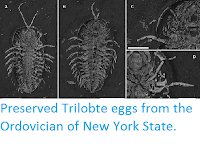
https://sciencythoughts.blogspot.com/2018/10/dipleura-dekayi-north-american.htmlhttps://sciencythoughts.blogspot.com/2017/01/preserved-trilobte-eggs-from-ordovician.html
https://sciencythoughts.blogspot.com/2015/02/five-new-species-of-proetoid-trilobites.htmlhttps://sciencythoughts.blogspot.com/2012/03/preserved-trilobite-digestive-tracts.html
Follow Sciency Thoughts on Facebook.

Tuesday, 29 December 2015

Storms and floods kill at least 43 people in the US over Christmas period.

AT least 43 people have died across the southern and midwest United States over the past week as the country has been hit by a series of severe floods and storm events. Multiple deaths have been recorded in Texas, Missouri, Mississippi, Tennessee and Illinois, and severe storm and flood damage in New Mexico, Louisiana, Arkansas, Oklahoma and Alabama.

Image
The remains of a home destroyed by storms in Roundaway, Mississippi, on 23 December 2015. Troy Catchings/The Press Register/AP.

The highest death toll has been recorded in Texas where a series of nine tornadoes touched down to the northeast of Dallas on Saturday 26 December, damaging or destroying around 140 homes, as well as toppling trees and power lines and killing at least eleven people. The worst affected area was the community of Garland in Dallas County, where around 600 homes have been destroyed, at least eight people have died, three of them in vehicles thrown from in interstate highway, and at least fiftenn more have been injured. Twenty three people have been reported in the town of Rowlett, also in Dallas County. Three further deaths have been reported in Collin County. In addition heavy snowfall has been reported across much of the north of the state, with snow in excess of 50 cm deep closing many roads and cutting off smaller communities.

Image
Homes destroyed by a tornado in Garland, Texas on 26 December 2015. NBC.

In Missouri six people have died in two separate incidents involving vehicles on flooded roads in the southern art of the state, four soldiers from another country stationed at Fort Leonard Wood for training who died in Pulaski County and two other people in Green County. Two other deaths have been reported from the state, and several more people are missing, though details of these are not yet clear, and many people have been evacuated from homes in low-lying areas.

Image
Flooding in Kendricktown Missouri on Sunday 27 December 2015. AP.

In Mississippi ten people including a seven-year-old boy died in a series of tornadoes that swept across the northern part of the state on Wednesday 23 December. In the worst event a single tornado stayed on the ground for over 200 km, leaving a trail of destruction across six counties, and killing four people in the small community of Holly Springs in Marshall County.

Image
A tornado that touched down near Clarksdale, Mississippi, on 23 December 2015. Mike Prendergast/TV Weatheroom.

In Tenassee at least six people died in storms on Wednesday 23 December including three teenagers found dead in a car submerged in a creek Maurey County. Further deaths have been reported in Perry County, where an elderly couple were blown off a road in their car and in Rhea County where a 22-year-old man died when his car was caught in a flash flood. This has been followed by a drop in temperature that has brought ice storms, sleet, snow and freezing rain to areas where many people have lost their homes and many more have damaged homes and/or have lost electricity supplies.

Image
Storm damage near Linden, Tennessee, following the 23 December storms. Mark Humphrey/AP.

Illinois was hit by a series of blizzards and flash floods on Saturday 26 December, and five people including two children are reported to have died when their car was caught in a flash flood in Marrion County. Flood warnings remain in place across much of the south of the state, particularly close to the Mississippi River, with evacuations being carried out in some low-lying areas.

Image
Flooding in the LaRue Pine Hills in southern Illinois. Nathan Speagle/The Southern Illinoisan.

Eastern New Mexico has been hot by severe winter storms with more than 50 cm of snow falling in places and drifts in excess of 3 m. At least one person has died of hypothermia in Albuquerque and around 10 000 homes have been left without electricity due to downed power lines. A large number of vehicle accidents have been reported as drivers struggle to cope with unfamiliar conditions.

Image
A road traffic accident to the south of Albuquerque in New Mexico on Saturday 26 December 2015. Roberto Rosales/The Albuquerque Journal/AP.

In Louisiana high winds and tornadoes have damaged and destroyed homes across large areas of the state, as well as toppling many trees, which have blocked roads and brought down power lines; about 19 000 homes were without power on the morning of Monday 28 December. The state is on high alert from expected flooding, with a number of levees already reported to be under strain.

Image
Damage caused by a tornado in Rapides Parish, Louisiana on Monday 28 December 2015. KALB.

In Arkansas a woman was killed when a tree was blown onto her house on Wednesday 23 December and a man has died in a flooding in Pope County on Monday 28 December, after his car was washed off a road in a flash flood, and several other people have been reported missing. Flooding has been reported across much of the northeast of the state, while tornadoes have been reported in Ouachita, Calhoun and Lee counties.

Image
Storm damage caused by high winds in Sharp County, Arkansas, on 23 December 2015. Brenda Harris/TVH11.

In Oklahoma two people are known to have died in flooding on Monday 28 December, and at least one more is missing; a third death in the state is being attributed to hypothermia. About 50 people have been admitted to hospitals with storm-related injuries. High winds, heavy rainfall and snow have brought disruption to much of the state, with About 200 000 people being left without electricity, and several cases of carbon monoxide poisoning have been reported as people without electricity have tried to warm their homes with little-used fireplaces, only to find that ventilation has been blocked. 

Image
Flooding in Tulsa, Oklahoma, on 28 December 2015. Mike Simons/Tulsa World/AP.

In Alabama heavy rain began to fall on Christmas Day bringing flooding to the Birmingham area, and has continued for much of the following week, leading to flooding across much of the state. Three people are known to have died, two in Coffee County and one in New Hope. Flooding has forced many people from their homes, and a series of tornadoes has caused further problems in the Birmingham area.

Image
Flooding at Harvest in Madison County, Alabama. Penny Bright/AL.com.

The storms and flooding has been widely linked to the El Niño weather system currently affecting the Pacific Ocean, a phenomenon that typically brings high levels of rainfall to the southwest United States, starting around the beginning of December, although this year the area has been suffering floods since the middle of October. 

Image
 Predicted changes to North American weather patterns during an El Niño event. NWS/NCEP Climate Prediction Center/NOAA.

The El Niño is the warm phase of a long-term climatic oscillation affecting the southern Pacific, which can influence the climate around the world. The onset of El Niño conditions is marked by a sharp rise in temperature and pressure over the southern Indian Ocean, which then moves eastward over the southern Pacific. This pulls rainfall with it, leading to higher rainfall over the Pacific and lower rainfall over South Asia. This reduced rainfall during the already hot and dry summer leads to soaring temperatures in southern Asia, followed by a rise in rainfall that often causes flooding in the Americas and sometimes Africa. Worryingly climatic predictions for the next century suggest that global warming could lead to more frequent and severe El Niño conditions, extreme weather conditions a common occurrence.

See also...

http://sciencythoughts.blogspot.co.uk/2015/11/flooding-and-winter-storms-thought-to.htmlFlooding and winter storms thought to have killed at least fouteen in Texas, Oklahoma and Kansas.                                                    At least fourteen people are thought to have died as flooding and...
http://sciencythoughts.blogspot.co.uk/2015/10/flash-flooding-brings-chaos-to-south.htmlFlash flooding brings chaos to South California.                                                   Many areas of southern California are recovering after a series of thunderstorms caused flash flooding across parts of Los Angeles, San Luis Obispo, Santa...
http://sciencythoughts.blogspot.co.uk/2015/06/severe-damage-to-homes-and-businesses.htmlSevere damage to homes and businesses after tornado hits Hawthorne, Nevada.          Six homes and five businesses have reportedly suffered severe damage after a tornado touched down in the town of Hawthorne in Mineral County, Nevada, at about 3.15 pm local time on Friday 5 June 2015.  The storm created a trail of damage through the town about...
Follow Sciency Thoughts on Facebook.