


-
Book Overview & Buying
-
Table Of Contents

Mastering NLP From Foundations to Agents - Second Edition
By :


Mastering NLP From Foundations to Agents
By:
Overview of this book
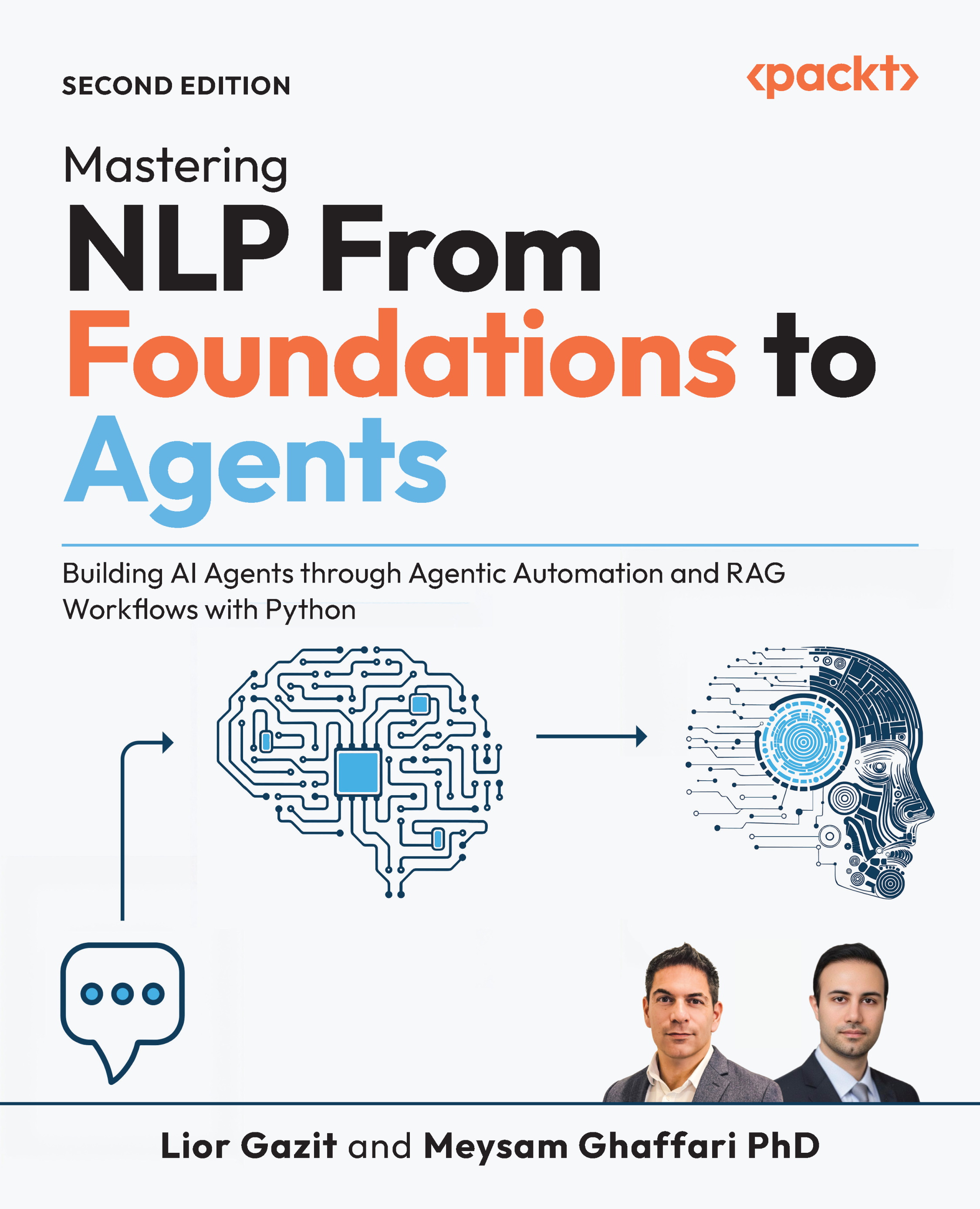
Natural Language Processing has evolved beyond rule-based systems and classical machine learning (ML). This second edition guides you through that transformation from mathematical and ML foundations to large language models, retrieval pipelines, agentic automation, and AI-native system design. It strengthens core NLP concepts while expanding into modern architectures such as transformers, parameter-efficient fine-tuning (LoRA and QLoRA), and alignment methods like RLHF and DPO.
You’ll begin with essential linear algebra, probability, and ML principles before moving into text preprocessing, feature engineering, classification pipelines, and deep learning architectures. From there, the focus shifts to system design: building Retrieval-Augmented Generation (RAG) pipelines, implementing model routing strategies that balance cost and performance, and orchestrating structured multi-agent workflows. You'll also introduce structured interoperability patterns, including the Model Context Protocol (MCP). Governance and safety will be treated as architectural concerns, demonstrating how policy and compliance can be integrated directly into AI systems. By the end, you will have the tools to implement NLP techniques and be equipped to design, govern, and deploy intelligent systems built on them.
*Email sign-up and proof of purchase required
Table of Contents (19 chapters)
Preface


 Free Chapter
An Introduction to the NLP Landscape
Mathematical Foundations for Machine Learning in NLP
Unleashing Machine Learning Potential in NLP
Streamlining Text Preprocessing Techniques for NLP
Text Classification Using Traditional ML Techniques
Text Classification Part 2 – Using Deep Learning Language Models
Demystifying LLM Theory, Design, and Implementation
Parameter-Efficient Fine-Tuning and Reasoning in LLMs
Advanced Setup and Integration with RAG and MCP
Advanced LLM Practices Using RAG and LangChain
Multi-Agent Solutions and Advanced Agent Frameworks

Technical Guardrails of AI Safety and Responsible Implementation
Designing and Managing AI-Native Products
Index
Other Books You May Enjoy
Appendix C


