
Summary: in this tutorial, you’ll learn how to use the SQL UPPER function to return a new string with all characters converted to uppercase.
Introduction to the SQL UPPER function #
The UPPER function accepts a string and returns a new string with all characters converted to uppercase.
Here’s the syntax of the UPPER function:
UPPER(string)The UPPER function returns a new string with all characters of the string converted to uppercase. If the string is NULL, the UPPER function returns NULL.
Basic SQL UPPER function example #
The following statement uses the UPPER function to convert the string sql upper to uppercase:
SELECT
UPPER('sql upper') result;Output:
result
-----------
SQL UPPERThe following query uses the UPPER function with NULL:
SELECT
UPPER(NULL) result;Output:
result
--------
NULLTransforming data to uppercase #
We’ll use the employees table from the sample database.
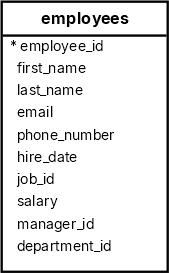
The following query uses the UPPER function to retrieve data from the last_name column and convert it to uppercase:
SELECT
UPPER(last_name) formatted_last_name
FROM
employees
ORDER BY
formatted_last_name;Output:
formatted_last_name
---------------------
AUSTIN
BAER
BAIDA
BELL
CHEN
...In this example, we retrieve data from the last_name column of the employees table and convert them to uppercase on the fly. The data in the last_name column of the employees remains intact.
Filtering data case-insensitively #
When filtering data using the WHERE clause, database systems match character strings case-sensitively. For example, the literal string Bruce is different from bruce.
To match text string case-insensitively, you use the UPPER function in the WHERE clause like this:
SELECT
employee_id,
first_name
FROM
employees
WHERE
UPPER(first_name) = 'BRUCE';Notice that this query scans the whole table to find the matching row. In case the table is big, it will be slow.
To address this, some database systems provide a function-based index that allows you to define an index based on a function of one or more columns, which results in better query performance.
Summary #
- Use the
UPPERfunction to return a new string with all characters converted to uppercase from a string.
Databases #
- PostgreSQL UPPER Function
- MySQL UPPER Function
- SQLite UPPER Function
- Db2 UPPER Function
- Oracle UPPER Function
- SQL Server UPPER Function
Thank you for your feedback!
