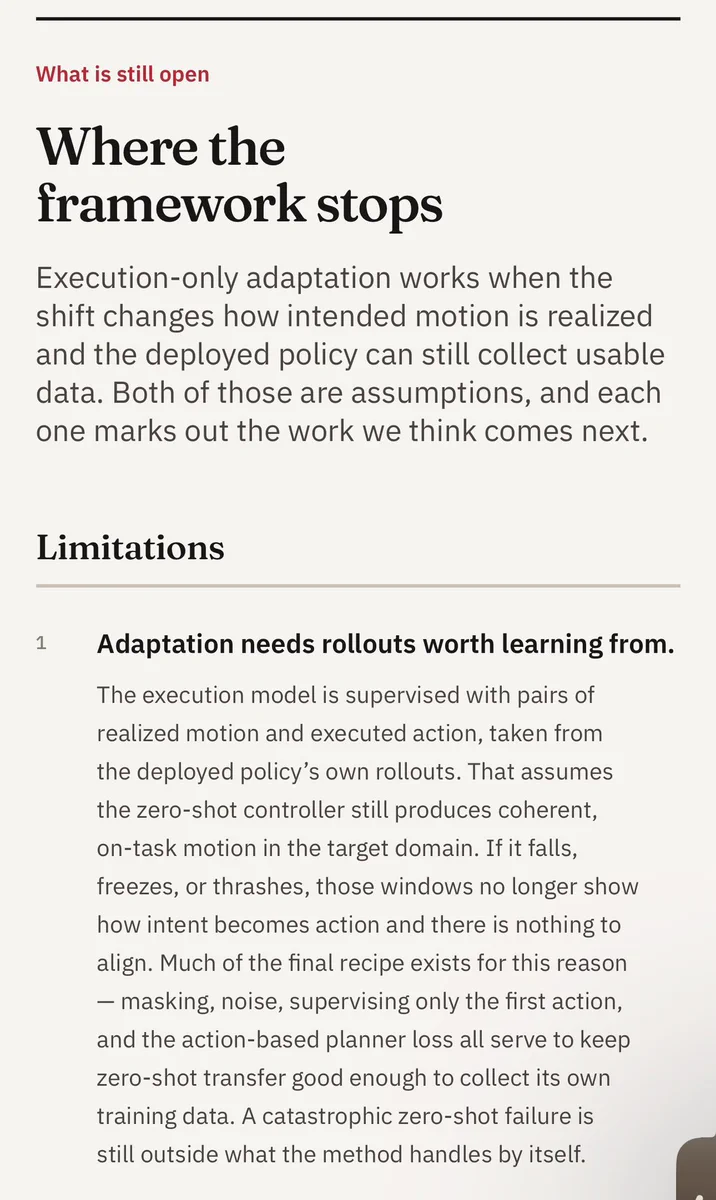
I decided to review and explicitly post about the limitations of all my previous papers because I believe this is the fundamental driving force behind research, especially in this era of PRs and bubbles.
We are releasing a dataset with human motions together with terrain reference collected both indoors and outdoors.
Now, contact signals can be extracted to help with learning terrain interactions.
Presenting in Nov 2026 @corl_conf!
Try out EgoHTR now!
🔗 egohtr.github.io
We are releasing EgoHTR, a dataset with both human motions and terrain references, accepted @corl_conf.
📖 Paper: lnkd.in/eeepUefs
🌐 Project Page: egohtr.github.io
• 55 scene-aligned sequences • 150k+ frames • rough-terrain environments • multi-modal 3D scene
Introducing OM-1, our first robot foundation model, zero-shot generalizing to any robot: table-top arms, industrial arms and humanoids.
- learned directly from human manipulation data
- no teleop/robot data
- close to human-level dexterity and efficiency
- multi-robot collab
It’s great to see more people openly discussing the true limitations of their own work.
No one understands the strengths and weaknesses of your method better than you do. That puts you in the best position to contribute to principled research—and to help others build on it.
🧵
🎉 FADA is now accepted to CoRL 2026!
Along with the code, we’re releasing something a little different: a timeline of the research journey behind FADA — the ideas we tried, what failed, the choices we made, and the lessons we learned along the way.
lecar-lab.github.io/FADA-humanoid/…
Was amazing to learn how much has been achieved already at @nomagicAI with @m_wulfmeier! Really enjoyed the time catching up with old and new folks at the workshop!
Deeply enjoyed talking about mastery-first physical AI at the IWIALS workshop! Old friends and many new ones - looking forward to how this group will continue to shape European AI.
On mastery: we've made strides on generality and now need to demonstrate real-world more than ever