Five Words from … Dress Codes: How the Laws of Fashion Made History

Cover of Dress CodesWelcome to the latest installment of “Five Words From …” our series which highlights interesting words from interesting books! In this installment, semifinalist in Esquire magazine’s Best Dressed Real Man in America contest and Stanford law professor Richard Thompson Ford presents in Dress Codes a history of the laws (and customs so strong they might as well be laws) of fashion, from the middle ages to today.

abacost

“Mobutu also banned European attire, imposing a sort of national uniform, a Mao-style tunic called an abacost—short for a bas le costume, or “down with the suit”—inspired by a visit to the People’s Republic of China in 1973.”

Although the abacost is intended to be worn without a tie, it can be worn with a cravat.

bifurcation

“Indeed, the taboo against clothing that revealed or even suggested a woman’s legs was so complete that women wearing loose-fitting trousers became a popular sexual fetish, known in the trade as “bifurcation.””

The word ‘bifurcation’ comes from Latin roots meaning ‘two’ and ‘forked’.

cornette

“For instance, the iconic habit of the Sisters of Charity was distinguished by a wimple or cornette—a large starched headdress, with upturned corners.”

In the U.S., the Daughters of Charity wore the cornette until after the Second Vatican Council in 1964. (The most famous representation of the cornette is popular culture is probably the 1960s TV show The Flying Nun.)

pachuca

“It was also a sisterhood: young women who wore a feminine zoot suit ensemble were labeled pachucas, “Zoot suit gangsterettes,” and “zooterinas.””

The origin of the word pachuca (feminine of pachuco) is unclear. It may come from the name of Pachuca, a city in Mexico, or from a Spanish word meaning ‘yokel’.

sprezzatura

“Sprezzatura—the ancient art of seemingly effortless style—is both a status symbol and a way of turning a uniform into a mode of personal expression.”

The word ‘sprezzatura’ was coined in 1528 by Baldassare Castiglione, author of the influential The Book of the Courtier, which addresses the question of what constitutes the courtier, or “ideal gentleman”.

Five Words from … The Notebook: A History of Thinking on Paper

Cover of The NotebookWelcome to the latest installment of “Five Words From …” our series which highlights interesting words from interesting books! In this installment, Roland Allen’s The Notebook: A History of Thinking on Paper provides a wide-ranging history of how the humble notebook became an indispensable tool for thinking.

affordance

“Conventional models of perceptual psychology didn’t accurately account for what he saw, so once peace had returned Gibson set to work on a new theory of perception, which included the concept of affordance: that aspect of an object which makes the object useful to a human interacting with it.”

Affordances depend not just on the qualities of the object, but the abilities of the human interacting with it.

egodocument

“‘Egodocument’, a neologism first coined by the historian Jacques Presser in the 1950s, is now a widely used umbrella term for diaries and journals, and the first academic journal devoted to ‘life writing’ appeared in 2012.”

Egodocuments include diaries, journals, travelogues, correspondence, memoirs, and wills.

polyptych

“Operating on the same principle as a wipe-clean table-book or wax tablet, the polyptych consisted of twelve fine ivory sheets, pinned together at one end so that they could fan open for temporary note-taking.”

The word polyptych comes from a Greek word meaning ‘having many folds’. The polyptych described here is Thomas Jefferson’s.

schifanoia

“The only surviving draft was dedicated, as a schifanoia or ‘boredom buster’, to Isabella d’Este, Countess of Mantua and one of the Renaissance’s most important patrons.”

The word schifanoia comes from an Italian phrase meaning “to escape from boredom”. The Este family also had a palazzo, the Palazzo Schifanoia in Ferrara, now a museum.

woodfree

“Confusingly, ‘woodfree’ paper is made of wood: the term refers to the pulp having been bleached to remove the tint of wood sap.”

Woodfree paper is also called ‘tree-free’ or ‘fine’ paper. The chemical process used to create it removes lignin, which is the source of paper yellowing.

Five words from … Braiding Sweetgrass

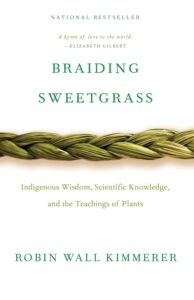
cover of Braiding SweetgrassWelcome to the latest installment of “Five words from …” our series which highlights interesting words from interesting books! In this installment, we learn from botanist and member of the Citizen Potawatomi Nation Robin Wall Kimmerer the gifts and lessons of living beings—asters and goldenrod, strawberries and squash, salamanders, algae, and sweetgrass—whose voices she lifts up.

circumnutation

In this teenage phase, hormones set the shoot tip to wandering, inscribing a circle in the air, a process known as circumnutation.

The word circumnutation comes from Latin roots meaning ‘around’ and ‘nodding’.

biocultural

It is an exemplar of a new holistic approach, called biocultural or reciprocal restoration.

Biocultural methodologies start with local cultural perspectives, taking into account those communities’ values, knowledge, and needs, and build upon them, recognizing feedback cycles between ecosystems and the health and development of people.

summerwood

These densely packed cells are called late wood or summerwood.

Summerwood is also known as latewood. Wood in a growth ring of a tree that is produced early in the growing season is known as earlywood or springwood.

aerenchyma

These white cells, called aerenchyma, are big enough to be seen with the naked eye and make a buoyant, cushiony layer at the base of each leaf.

Aerenchyma is a “spongy tissue that creates spaces or air channels in the leaves, stems and roots of some plants, which allows exchange of gases between the shoot and the root.” [Wikipedia]

phytochrome

There are photosensors by the hundreds in every single bud, packed with light-absorbing pigments called phytochromes.

“Phytochromes control many aspects of plant development. They regulate the germination of seeds (photoblasty), the synthesis of chlorophyll, the elongation of seedlings, the size, shape and number and movement of leaves and the timing of flowering in adult plants.” [Wikipedia]

Five Words From … Otter Country

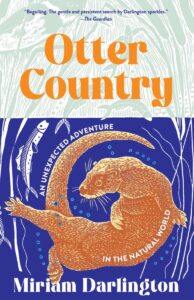
cover of Otter Country Welcome to the latest installment of “Five words from …” our series which highlights interesting words from interesting books! In this installment, we follow nature writer Miriam Darlington from her home in Devon, England, through the wilds of Scotland, Wales, the Lake District, and the countryside of Cornwall as she pursues a deeper understanding of the enchanting, elusive, and fascinating otter.
holt

The wild otter I saw would no doubt be out of the water and making tracks to its own musky holt, to curl belly-upward in a home of roots, peat and rocks.

Otters’ resting-places are also sometimes called lodges or couches.

leat

Lower down, the path joins an old leat, a stone waterway engineered a hundred years ago to carry water to feed the reservoirs and tin mines.

The word ‘leat’ is more commonly found in the south and west of England, and in Wales; the word goit is more common in northern England.

spraint

There may be spraint, the otter’s droppings, nearby, and these signs can sometimes form great mounds.

Otter excrement is also sometimes called coke, because it has a black, ashy appearance. For other terms for animal droppings, check out the Wordnik list “Specific Excrement“.

stickle

In the twentieth century, sometimes a hunted otter would be trapped in the water by a line of people forming a barrier with poles. This was called a “stickle” and if caught like this the otter was less likely to escape.

In the dramatic conclusion of Tarka the Otter (an inspiration for Darlington’s own otter search), Tarka escapes from between two stickles, killing a hunting hound before swimming free.

vibrissae

From this sniff-level position I get a flash of the bristling vibrissae, the otter’s extravagant whiskers, and in a split second he catches my scent.

The word vibrissa (vibrissae is the plural) comes from a Latin word meaning ‘vibrate’.

Got a book you’d like to see given the “five words from” treatment? Nominate it through this form, or email us!

Five Words From … AI Snake Oil: What Artificial Intelligence Can Do, What It Can’t, and How to Tell the Difference

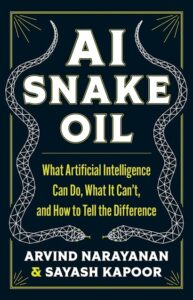
cover of AI Snake OilWelcome to the latest installment of “Five words from …” our series which highlights interesting words from interesting books! In this book, Arvind Narayanan and Sayash Kapoor, two of TIME’s 100 Most Influential People in AI 2023, explain how AI works (and why it often doesn’t), explore AI’s limits and risks, and outline where AI is a useful tool and where it’s not just empty hype but actually harmful.

algospeak

“To appreciate how common it is for regular users to try to evade content moderation, consider algospeak: words or phrases that are widely understood and adopted by social media users as a way to avoid being mistakenly penalized by fickle content moderation algorithms.”

Neologism researcher Brianne Hughes has created a Wordnik list of “Algorithm Avoidant Inventions” to collect algospeak examples.

cliodynamics

“One ambitious effort is the theory of cliodynamics by Peter Turchin, which applies mathematical models to populations.”

The ‘clio-‘ of ‘cliodynamics’ comes the name of the muse of history in Greek mythology.

criti-hype

“Researcher Lee Vinsel called this phenomenon criti-hype—criticism that tends up portraying technology as all powerful instead of calling out its limitations.”

Vinsel created the word ‘criti-hype’ in a 2021 Medium post titled “You’re Doing It Wrong: Notes on Criticism and Technology Hype“.

deep learning

“In 2011, Alex Krizhevsky, Ilya Sutskever, and Geoffrey Hinton decided to take a crack at the ImageNet competition using neural networks, which by then had been branded “deep learning” because of the key insight that having more layers (depth) improves accuracy.”

Neural networks, despite the name, are not intended to realistically model the behavior of actual neurons.

shadowbanning

“Instead of removal, the post can be slapped with a warning, or, if it is a “borderline” policy violation, it might be silently shown to fewer users than it otherwise would. This is a notable development in the last few years known as downranking or demotion, or, colloquially, shadowbanning.”

Rich Kyanka, the creator of Something Awful, claims that the term ‘shadow ban’ was created on that forum. A 2018 explainer from Vice, “Where Did the Concept of ‘Shadow Banning’ Come From?” highlights similar practices, including ‘twit bit’, ‘bozo filter’, and ‘toading’.

Five Words From … How Infrastructure Works: Inside the Systems That Shape Our World by Deb Chachra

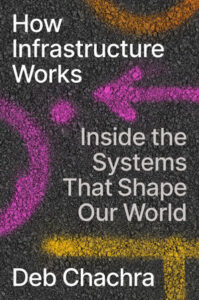
cover of How Infrastructure WorksWelcome to the latest installment of “Five words from …” our series which highlights interesting words from interesting books! In this book, Deb Chachra, Professor of Engineering at Olin College of Engineering, helps us explore the hidden beauty and complexity of the infrastructure we take for granted, and outlines how we can transform and rebuild it to be not just functional but also equitable, resilient, and sustainable.

bioswale

“It also likely means unbuilding structures, whether that’s relocating buildings away from shorelines facing sea-level rise and higher storm surges, or taking up the concrete around urban river and replacing it with bioswales, vegetated channels that absorb stormwater, preventing floods while removing pollutants.”

The Portland Nursery offers a PDF listing plants you can use to create bioswales (or rain gardens) in your own yard.

exogenous

“A graph of the total exogenous energy usage of humanity (that is, energy from all sources outside our own bodies) over time is flat until about 1800, after which it becomes roughly exponential, starting slowly and then rising more and more steeply.”

The word ‘exogenous’ comes ultimately from Greek roots meaning ‘born’ and ‘outside’.

externality

“Externalities, to economists, are values or costs that aren’t accounted for by the market, because they accrue to someone who isn’t part of the transaction and therefore often has no choice in whether it happens or not.”

This sense of the word ‘externality’ was first used by Alfred Marshall, a British economist, in Principles of Economics, published in 1890.

ultrastructure

“While talking through what we had seen over the course of that weekend, Charlie and I landed on the term “ultrastructure” to describe this web of social structures, all of the cultural, political, regulatory, and other systems that shape and govern infrastructure.”

Chachra talks in more depth about the idea of ‘ultrastructure’ in this interview in the excellent Scope of Work newsletter.

veneriforming

“If terraforming is taking an uninhabitable planet like Mars and changing the atmosphere to make an ecosystem capable of supporting life, we are instead taking our perfectly habitable planet and veneriforming it, transforming our terrestrial home into our other planetary next-door neighbor, suffocatingly hot Venus.”

The word ‘veneriform‘ exists in another Venus-related sense: having the shape of the shell of the Venus clam.

Five Words From … Limitarianism: The Case Against Extreme Wealth by Ingrid Robeyns

cover of Limitarianism, showing a distortedly large pink piggybank Welcome to the latest installment of “Five words from …” our series which highlights interesting words from interesting books! In this book, Ingrid Robeyns, the Chair in Ethics of Institutions at the Ethics Institute of Utrecht University, outlines the principle she calls limitarianism—the need to limit extreme wealth.

stagflation

The story that most economics professors will tell is that, in the early 1970s, Keynesian economics lost ground when the world’s developed economies experienced stagflation—a combination of high unemployment, slow economic growth (stagnation), and rising prices (inflation).

kleptocracy

“Kleptocracy literally means “rule by thieves” (from the Greek kleptes, ‘thief’, and kratia, ‘power’ or ‘rule’)—we’re talking here about heads of state and political leaders who loot their own countries.”

chumocracy

“Putin’s Russia and Berluconi’s Italy are two particularly memorable examples, but we would be prudent not to assume that widespread state corruption only happens somewhere else—just think of the UK’s ‘chumocracy’ scandal in 2020 or of Donald Trump’s attempt to rig the 202 presidential election in the US.”

degrowth

“Still other proposals for a new economic system argue that we should start by replacing our obsession with GDP growth with an ambition for sustainable prosperity, sometimes known as ‘degrowth’.”

affluenza

“As the granddaughter of a former president of General Motors, [Jessie] O’Neill is herself from the third generation of a wealthy family, and has also worked as a therapist. She coined the term ‘affluenza’ to denote the harmful psychological effects of extreme wealth, especially on children.”