-
-
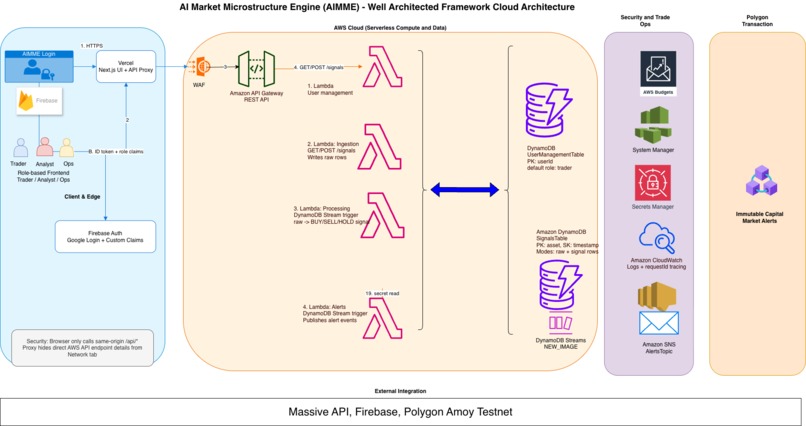
Hybrid Architecture
-
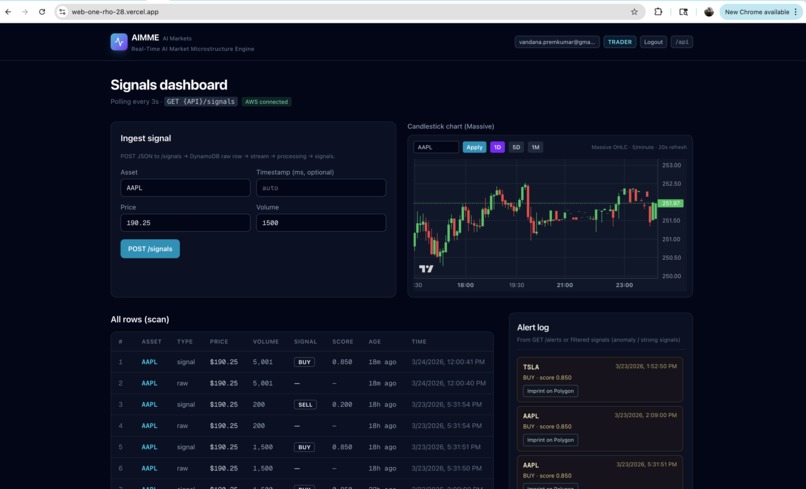
Trader Dashboard
-
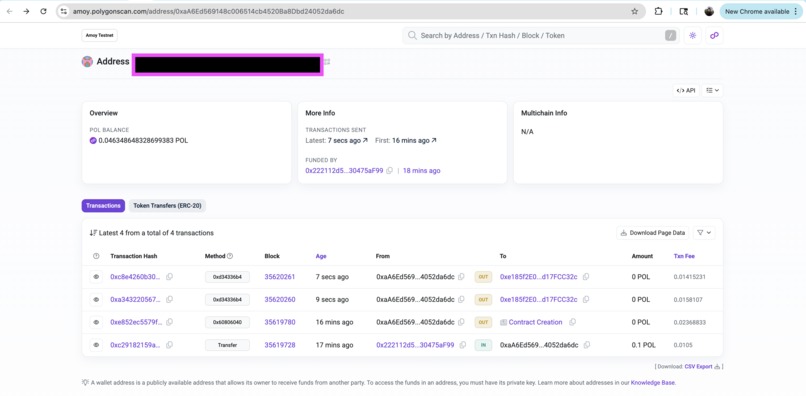
Polygon Amoy Testnet Transaction of Immutable Alerts
-
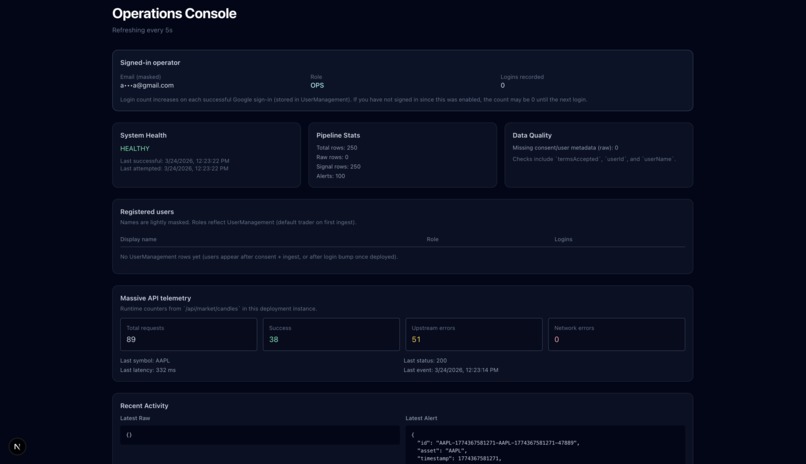
Trade and Sys Ops Dashboard
-
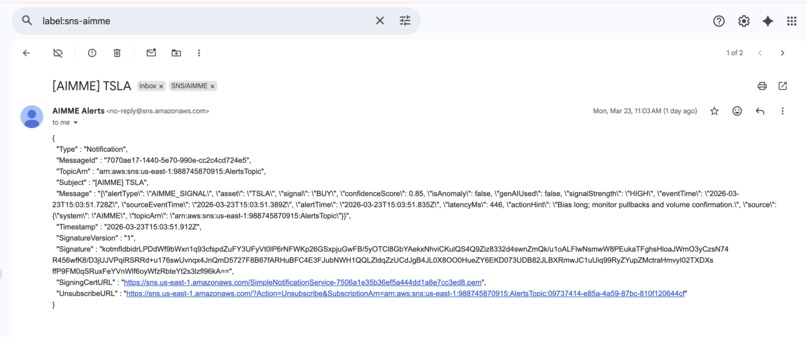
AWS_SNS_Email_Alert


Inspiration
Modern financial markets generate an overwhelming volume of micro-events, yet early warning signs of risk remain fragmented and delayed. Critical hazards such as liquidity shocks, sentiment divergence, and event-driven volatility often go undetected until it’s too late.
AIMME transforms real-time events into hazard alerts and anchors them on-chain via Polygon Technology, creating a transparent and verifiable layer for market risk detection.
What it does
AIMME is an AI-powered market hazard detection platform that:
Ingests real-time market data and event probabilities
- Detects anomalies and emerging risks
- Generates hazard alerts with severity levels
- Provides AI-driven explanations for each risk
- Exposes signals via APIs and a live dashboard
Hazard Types Detected
- Flash crash risk (price + volume anomalies)
- Sentiment divergence (market vs prediction markets)
- Event-driven volatility (macro triggers)
- Liquidity risk (bid/ask imbalance)
On-chain attestations
- Immutable hazard writes on Polygon via
contracts/HazardRegistry.soland web API routes
How we built it
We built AIMME as a dual-mode architecture for both local development and cloud deployment:
Data Layer
- Real time Market data via https://massive.com/
- Immutable audit trail of market risks using smart contract on Polygon
Polygon PoS & tooling
- Solidity ^0.8.20
- Hardhat
- ethers.js v6
- Polygonscan / Amoy Polygonscan
Cloud Architecture
- Serverless backend on Amazon Web Services
- API Gateway
- AWS Lambda
DynamoDB (with streams)
- AI Layer
- Ultra-fast inference powered by Groq
Generates:
- Risk classification
- Confidence score
- Natural language explanations
Frontend
- Next.js dashboard deployed on Vercel
- Real-time hazard alerts + visualization
Authentication
- Google SSO via Firebase
- Role-based access (Trader / Analyst / Ops )
Testing/tooling:
- Postman collections
- curl-based verification
- playwrite end2end
- cloudwatch monitoring
Challenges we ran into
- Cloud deployment edge cases (resource creation and handler behavior)
- Free Massive API for market data has limits
- Bumping into Insufficient POL funds during testing
- DynamoDB type constraints (float vs Decimal with boto3)
- API route differences (/alert vs /alerts) causing confusing gateway errors
Accomplishments that we're proud of
- Delivered a working end-to-end pipeline: ingest -> process -> signal -> alert -> UI -> on-chain Immutable record
- Deployed a live production UI on Vercel integrated with AWS backend
- Added compatibility/fallback logic across backend variants
- Implemented secure proxy routing so browser calls stay same-origin
- Improved observability and UX with request IDs, connection status, and time-series table behavior
What we learned
- Maintaining consistent event contracts and data structures is essential in distributed pipelines.
- Even small observability features like logging, metrics, and alerts can drastically reduce debugging time.
- Server-side proxying enhances security and operational control for frontend apps.
- Designing for both local and cloud environments early prevents costly integration rewrites.
- Achieving product readiness requires balancing speed, reliability, and extensibility.
- Early adoption of immutable logging improves traceability and auditability for AI-driven systems.
What's next for AI Market Microstructure Engine (AIMME)
- Enhance analytics and explainability, including historical trend analysis for signals and alerts.
- Monetization roadmap:
- SaaS subscription tiers for professional users
- API usage billing for programmatic access
- Enterprise/private deployment packages with dedicated support
- SaaS subscription tiers for professional users
Built With
- amazon-web-services
- cdk
- cloudwatch
- docker
- dynamodb
- dynamodb-streams
- fast-api
- lambda
- nextjs
- postman
- python3.11
- redis
- restapi
- sns
- sqs


Log in or sign up for Devpost to join the conversation.