A couple of approaches form past presentations:
- FOSS4G 2010: This is the original OSGeo-Live talk - with a 90 minute time slot. That was enough time to introduce the OSGeo live project, explore its history as a LISAsoft project gradually opening up to be community driven. Go through different "GIS" software categories - even in an expert crowd such as FOSS4G not everyone will be familiar with disaster relief, or navigation as a software category. Wrapping up with exploring how to use the OSGeo-Live project for education and advocacy.
- OSGeo Live Presentation: Cameron Shorter cut down the above presentation with a stronger focus strictly on project overviews, and provided a talking script for others to run the presentation at their own events.
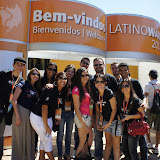
OSGeo-Live at Latinoware 2012
Here are the slides, read below to learn why they are really not the point of the presentation.
OSGeo Live from Jody Garnett
I was really happy with the pacing, an hour was just enough time to run this presentation. I tend to run my presentations at two levels (as advocated by Martin Fowler). The general approach is to have two streams of communication, what you are saying and a separate visual stream that supports what you are talking about.
The OSGeo slides are basically a solid wall of text, so you may wonder what on earth I would talk about? I am certainly not mean enough just to read slides.
And the answer depends on what the target audience wants to hear. For Latinoware 2012 I was faced with a developer heavy crowd (I asked them before the talk started) who did not have a background in GIS. As such most of the project details, feature lists and so on would be a meaningless snooze fest.

In introducing OSGeo-Live it is important to establish the size (massive) and scope (international) of the project. So while there is no way to read the individual contributors they can lend weight (of numbers) to the introduction.
Of course I did need to answer the obvious technical questions at a Linux heavy conference (yes it uses XUnbuntu) the important point is what the project is useful for, backed up with a successful history of releases and events.

In this context I needed to introduce what mapping and GIS was all about. As such I leaned heavily on the software categories used to organise the OSGeo-Live project. While my bullet points were mostly useless, they gave me something to show when setting expectations for the available software.

With the sheer number of OSGeo-Live projects (50!) and only an hour to present I was left with some tough choices. The individual projects still provide value to the presentation, if only by weight of numbers, but I would not be able to communicate a meaningful difference in the available time. I decided to use the OSGeo nature of this presentation to my advantage, and only provide a discussion on the much smaller number of official OSGeo projects. This gave me a chance to explore some projects in more detail and give a flavour of what the particular software category was all about.

For each of the OSGeo projects I was often able to tell a story, reflecting back on the Foundation, the project community or both:
- For deegree I was able to talk about the importance of standards, and their involvement with INSPIRE
- Perhaps the nicest story was for QuantumGIS where I was able to point out the OSGeo Chapters acting as project sponsors to fund specific features. This is an excellent engagement model for the Foundation and shows an amazing community
- Speaking of engagement models, for OpenLayers I was able to talk about the recent OpenLayers 3 funding push
- For Geomajas I was able to describe the migration from javascript to GWT (even just for technical interest).
- For GEOS I was able to talk about what a Geometry is and what developers need to get going in this area
- I did take some time out to talk about our criss management category, especially given the recent floods in the area.
Note this is just the approach I used for a developer focused, non GIS conference. As illustrated by FOSS4G 2010 and Cameron's presentation this material can be thrown around for an experienced GIS crowd as well.
OSGeo-Live for Advocacy and Marketing
In terms of Advocacy we need to reach back, before the OGC standards, and introduce basic GIS concepts. A point I specifically had to make to the developer heavy crowd at FOSS4G was that maps are fun and important.
In order to play in this area developers need to select both a representation of geometry, and a technique for referencing that geometry onto a real-world location. While I was able to use the GEOS project to tell this story, I keenly felt the lack of JTS as a talking point.
Suggestions: Include JTS on the OSGeo-Live project overview. I was able to write up a jts_overview page on the airplane back, and this mornings OSGeo-Live meeting is looking to schedule including the visual test-runner program pictured below.

Suggestion: The project category slides from the above presentation are a nice minimum that could be added to the OSGeo-Live documentation. Beyond that it would be nice connect with an education sponsor and arrange a couple of "intro to GIS" tracks that can be run directly out of OSGeo Live. This would be a similar collaboration to how OGC standards are described, however a strong education partner is needed to gather the basic explanation angle that projects continually fail to deliver.
On a project by project basis there are a couple important aspects that are missing from the OSGeo live story.
- Love: Tell me about the volunteers that are behind a project. In a large part the community is what your are buying into when choosing a project. There is a vast difference between a popular project like QuantumGIS (most downloads from OSGeo servers) and specific tools as the TEAM Engine (which just joined incubation).
- Money Tell me who is paying. It is both polite to thank sponsors for their contribution, and am important information for those considering a project. Even if a project does not meet your feature checklist out of the gates, if the project is popular in your industry it may be a good fit (as its future direction should align with your long term needs).
We also need to keep in mind that the OSGeo Foundation (and thus OSGeo-Live) needs to remain vendor and project neutral. OSGeo-Live is a tool to promoting the grand adventure that is open source spatial software.
Suggestion: List the the PSC members, followed by organisation. This is done for Eclipse Foundation projects and provides a good indication of who is involved, and who is paying their way.
Suggestion: Not quite sure how to thank sponsors tastefully in the context of OSGeo Live. The State of GeoServer talk also does an excellent job of connecting sponsor logos next to the feature they contributed to (thanks to Justin and Andrea for this classy move). This is an important story to tell and one OSGeo-Live needs help with. Idea: Ask each project overview to include a "sponsors" link much like is done for "support".
Thanks
Thanks to Brian Hamlin for reviewing the slides prior to wider internet distribution. A consequence of gathering material from previous presentations was working with an out of date contributors and sponsors list.
Thanks to Latinoware 2012 for having me, and to Rafael Soto for facilitating (and being such as champion for OSGeo in Latin America).
 |
| From Latinoware 2012 |
 |
| From Latinoware 2012 |