
Tokenization
Transform any instrument of value into its digital counterpart.

What is Tokenization?
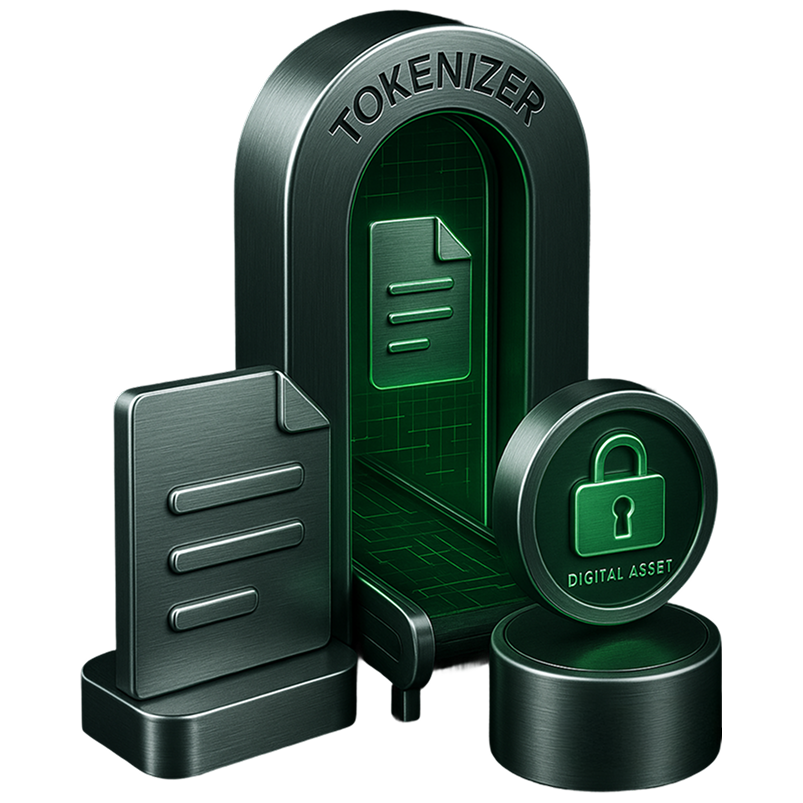
- Heralded as the frontier of economic evolution, tokenization is the process of creating (issuing) digital assets to represent any arbitrary instrument of value.
- Acting like digital unit of account on a distributed/decentralized ledger, tokens have become vehicles facilitating ownership and alternative transactional capabilities in the digital economy.
- Effectively, the considerations around tokenization fall into two processes; tangibility and fungibility. What kind of object will it represent, for (intangible) digitally native objects or (tangible) physical objects. What are the characteristic traits that the asset must posses in terms of its uniqueness.
- Capturing the minds of enterprise, entrepreneurs, financers, and institutions around the world, tokenization has become a key diver of the digital economy.
Benefits of Tokenization

24/7 Market Operations
Operating in a dynamic, asynchronous, distributed environment, Crypto never sleeps.

Fractionalization
Fragmenting objects into multiple pieces. Splitting ownership into smaller denominators to unlock access to a larger pool of participants with different capital requirements.

Increase Accessibility
Tokenized objects living on blockchains’ inherit the open, borderless, censorship resistant, geographic neutrality of the technology and allow for the participation of a global audience.

Decrease Transactional Friction
Remove the bottlenecks prevalent in current technological infrastructure, arbitrate out the 3rd parties, minimize settlement times, and automate bookkeeping.

Liquidity Extension
Create more transactional capacity. Streamline trade activities, tap into wider pools of capital, diversify the reserve profile.
Token Class Categories
Tokens or coins that have no tangible counterpart or underlying material system from which to derive and inherit value beyond the value imbued by its particular use case. These digitally native objects have their entire provenance sourced exclusively as data.
Examples:
Utility/Access tokens, Gas, Memes, Currencies, Tickets, DAO Memberships, LP tokens, etc.
A clever portmanteau of “Physical” and “Digital”, phygital object are an interesting sector at the intersection of collectibles. These are consumer goods objects that range from apparel and novelty items to aging caskets of liquor and luxury watches.
Ultimately, this category boils down to some something relating to the metaverse or the ability to redeem and underlying object.
Heavily explored by corporates over the last few years, companies including Adidas, Starbucks, Louis Vuitton, Nike, Gucci, Dolce & Gabbana, and other, NFTs have unlocked a new touchpoints to build brand loyaltyExamples:
Equity, bonds, real estate, insurance obligations, currencies, Contracts, Intellectual Property, Music Processes, Art, among a variety of other objects and other institutional grade instruments existing firmly in the framework of regulations around the world
Fungiblity
Fungible object are those can be seamlessly be traded between one-another due to the likeness of innate characteristics and inherent value.
The most commonly understood examples are currencies such as the US dollar or a crypto like Bitcoin.
One dollar is always equal to one dollar. Regardless of the serial number, issuance date, whether it is in a cash register, bank vault, person’s wallet, the creases of a couch, or on the floor. Even if the dollar is physically distorted (creased, crumpled, lightly torn) it possess the same exact purchasing power a merchant; thus allowing for fluidity in transactions.
Something that is Non-fungible means that it possess inherently unique attributes, that cannot universally evaluated, making for more friction whenever attempted to exchanged for something else.
Broadly speaking, this applies to primarily illiquid (or low liquid) objects.
Real Estate being a prime example, where two houses on the same street, built in the same year, but inhabited by different people carries different costs. The interior build, the quality of care, renovations, flooding and other damages, all contribute to variations in value (not to mention personal sentiment, immediacy for capital demands, and macro-economic factors).
Token Standards
ERC-20 is the most mature, widely adopted standard for issuing tokens. Originating from a use case of payments, ERC-20’s cover all basic functionality (sending, owning, etc.) and is not formally recognized by legacy institutions.
Examples: LINK, AAVE, UNI, COMP, USDT
Used by the majority of leading Web3 projects, ERC-721 is the most common standard for issuing non-fungible tokens. This class of standards creates batches of assets that are related but not like.
Examples: BAYC, Crypto Kitties, Pudgy Penguins
An adaptation of ERC-20, the ERC-777 standard introduced operator classifications, effectively extending the capabilities of ERC-20’s with the added function of nominating control rights. The killer feature of ERC-777 is the receiver hooks, that protect against token mismanagement through a feedback loop
Examples: Pool Together, Augur
Ideal for the gaming sector, ERC-1155 merges the most desirable properties of ERC-20 and ERC-721 to create an asset profile with modularity in it’s fungibility. Synthesizing the two, allows for “batch approvals” that enhanced operations through cost reduction
Examples: Parallel, Sandbox, Decentraland
ERC-1400 As a means to comply with regulation, ERC-1400 is an amalgamation of four (4) underlying ERCs equipped with off-chain documentation mapping, forced token transfers, and a unique hybrid solution for partitioning an issuance set for managing roles (preferred, common stock)
Examples: Please refer to Polymath
ERC-3643, previously known as “T-REX” is a standard originally developed by Tokeny and is widely considered to be the most compliant token design. Baked into its functionality are primitives relating to permissions, transaction controls, KYC/AML, documentation, and the such
Examples: Please refer to Tokeny
What can be Tokenized?

Real Estate

Loyalty Points

Memberships

Contracts

Tickets

Art

IP

Files

Collectible Cards

Yield

Currency

Certificates
Have Any Questions?
The Process
Legal Prep
Preemptive review of the regulatory landscape to understand how to behave regarding laws in different jurisdictions
Asset Audit
Conduct formal diligence processes in the form of an evaluation to establish a fair market value
Define Archetype
Understanding what tokenization standard will best suit your specific case; ERC-20, ERC-721, ERC-1155, ERC-1400, ERC-3643, et al
Define Specs
Configure the economic properties applicable to your asset; supply, supply policy, issuance model, redemptions, emissions', et al
Develop Smart Contract
Prepare the software code that will be deployed on-chain
Distribution
Bring the tokens into circulation through a mint, airdrop, auction, or any other mechanism
Management
Regardless of the asset issued, it is important to facilitate all post issuance analytics. Providing ancillary attestations, controlling capital flows, and the such
