1. X
  2. Sergey Levine
Log inSign up
Sergey Levine
2,622 posts
user avatar

Sergey Levine

@svlevine
Associate Professor at UC Berkeley Co-founder, Physical Intelligence
Berkeley, CA
rail.eecs.berkeley.edu
Joined April 2018
144
Following
135.2K
Followers
RepliesRepliesMediaMedia

Log in or sign up for X

See what’s happening and join the conversation

Continue with phone
or
Log in with username or email
Terms·Privacy·Cookies·Accessibility·Ads Info·© 2026 X Corp.
  • user avatar
    Sergey Levine
    @svlevine
    Aug 15
    Latest Deep RL class lectures are now online! youtube.com/playlist?list=… Thanks to @seohong_park, we now have CS185/285 for spring 2026 available to everyone to watch. Course website here: rail.eecs.berkeley.edu/deeprlcourse/ Apologies for a few recording glitches (it's not a perfect system).
    Image
    youtube.com
    CS 185/285: Deep Reinforcement Learning (Spring 2026)
    Recordings of CS185/285: Deep Reinforcement UC Berkeley Spring 2026 See course website: https://rail.eecs.berkeley.edu/deeprlcourse/
  • user avatar
    Sergey Levine
    @svlevine
    Aug 14
    Chelsea doing another rock star presentation. Robots can indeed fold laundry and make espresso!
    user avatar
    Y Combinator
    @ycombinator
    Aug 12
    Robots can already fold laundry, make espresso, clean kitchens, and assemble things. The harder problem is getting them to do those tasks reliably, for long periods of time, without a human babysitting them. At Startup School 2026, @physical_int cofounder @chelseabfinn explains
    Image
    00:00
  • user avatar
    Sergey Levine
    @svlevine
    Aug 7
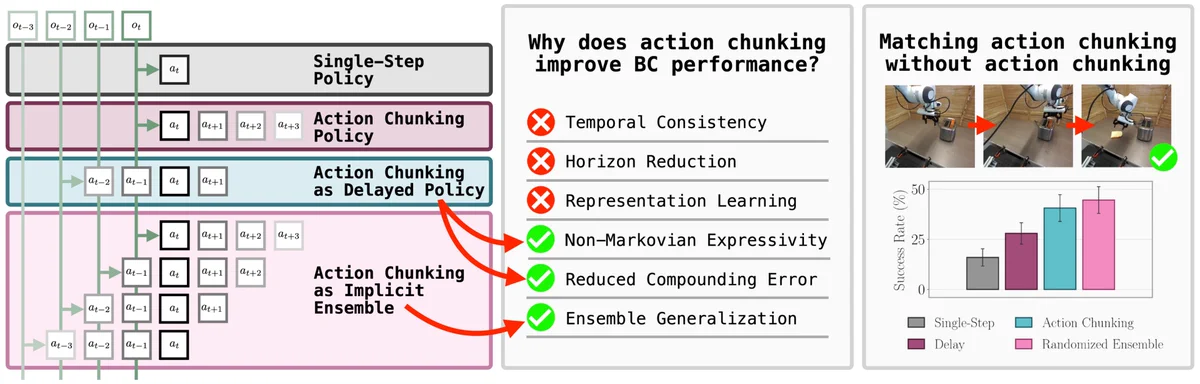
    Action chunking is a mysteriously effective method. Modern large-scale imitation learning basically doesn't work without it. But why does it actually help? In our new paper, we try to break down the reasons. As the saying goes, what happened next might surprise you...
    user avatar
    Andrew Wagenmaker
    @ajwagenmaker
    Aug 7
    Action chunking is a critical component in virtually all modern approaches to imitation learning for robotics. But why is it so critical, and do we really need action chunking? Check out our latest work to find out! (1/n) action-chunking.github.io
    Image
  • user avatar
    Sergey Levine
    @svlevine
    Jul 31
    Learning from suboptimal data is important, because robots make suboptimal data on their own, and the more robots there are, the more data they make. If you want to contribute to building a public, open dataset of suboptimal data, check this out!
    user avatar
    Paul Zhou
    @zhiyuan_zhou_
    Jul 30
    This is a robot failing to grasp a ball. Almost every robot lab produces clips like this daily… and almost all of them get thrown away. This is the most abundant but underused resource in robot learning. We’re collecting all of it now as ✨OopsieData✨, please join us!
    Image
    00:00
  • user avatar
    Sergey Levine
    @svlevine
    Jul 31
    While we share a lot about our research work at @physical_int, we don't talk much about what it's actually like to work here. Here is a very nice blog post from @Stone_Tao about how working at Pi works, and a little bit about sim at Pi!
    user avatar
    Stone Tao
    @Stone_Tao
    Jul 31
    Just over a month later, I have now joined @physical_int full time! Wrote a bit about why I'm excited to research simulation at Pi stoneztao.substack.com/joining-physic…
Advertisement
Advertisement