Image

Repairing A Polaroid 630 SL Lightmixer Instant Camera

Before the advent of digital cameras, if you wanted to take a few photos without having to get a whole roll of film developed, you’d use some form of instant camera. The Polaroid 630 SL Lightmixer that [Odd Tinkering] is looking at in a recent video is a good example of a late-80s, early-90s instant camera. As a mass-market product he got it slightly broken for $10, figuring it’d make for an interesting repair and restoration project.
Image

Unlike the 1970s instant cameras that still used plenty of metal and such for the housing and mechanisms, this 600-series camera is pretty much an all-plastic affair. Produced much like the practically identical Lightmixer 630 between 1986 and 1992 it’s clearly designed for easy assembly, with plastic clips holding the whole affair together.

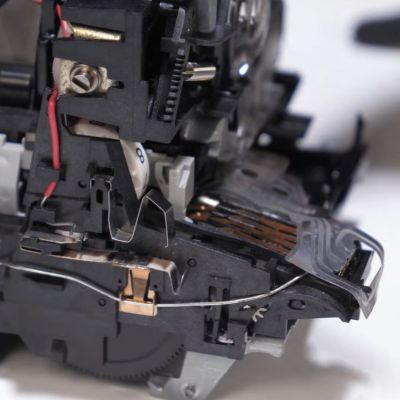
The symptoms for this sold-as-broken machine mostly pertained to issues with the trigger button and it taking shots by itself. This issue along with the flash not working turned out to be just due to corrosion on some connectors, but just getting to these parts required many hours of frustrating prying and trying not to break plastic. Somewhere along in all that violence the internal switch – consisting of a piece of bent copper strip – for the flash also ended up being broken.

With said broken strip patched and brazed back together, the corrosion cleaned and the outer shell’s paint having received a touch up, it works and looks pretty much as it would have back around 1990. You can even still get 600-series film for it today, as the retro-nostalgia factor seems to keep drawing people back to these machines, with newer models still being produced in various guises.

Continue reading “Repairing A Polaroid 630 SL Lightmixer Instant Camera” →
Image

Active Antenna Runs On A Single Lithium-Ion Cell

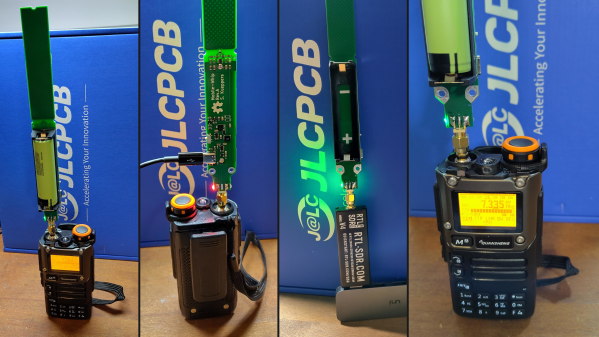
[skuep]’s Mobile-Whip is a compact, active receive-only antenna that is optimized for operation from a single lithium-ion battery or USB power. This makes it very handy for use on portable equipment, as shown in the images here.

What’s an active antenna do? Its main purpose is to provide useful reception with an antenna size much smaller than would normally be called for. It’s pretty handy to be able to have one that’s completely self-contained, and able to easily fit on a mobile radio or scanner.

The Mobile-Whip is based on the Mini-Whip active antenna by [PA0RDT], but with some important changes. One is that it has a narrower frequency range, but it’s also one piece, much smaller, can be powered by a single lithium-ion cell, and it integrates a charger.

It’s still in early development (and there’s no enclosure designed yet), but if you’d like to try it out for yourself the schematics and KiCad files are available. There are also instructions for ordering everything from a PCB manufacturer, which is about as easy as it gets.

[skuep] seems to have a knack for designing PCBs that attach directly to portable equipment, like the Ham Radio All-in-one cable (AIOC) which makes interfacing to a computer ridiculously easy.

Image

The Hidden Microcontroller Inside A LoRa Chip

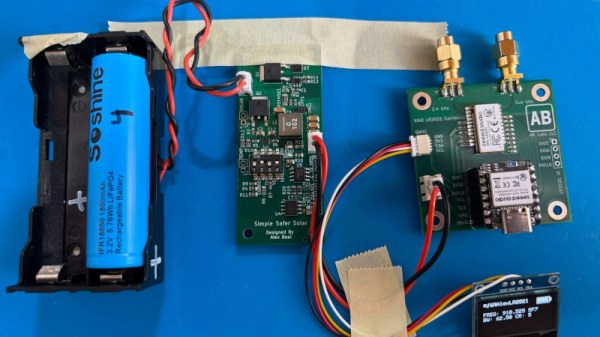
If you’ve ever done anything with LoRa, the chances are you’ve used a LoRa chip or module as a peripheral for a microcontroller, and left it at that. But that’s not always the case. Rather than being a pre-programmed ASIC under the hood, the Semtech LR2021 has its own on-board microcontroller whose firmware can be updated. [Alex Beale] has managed to unlock its secrets.

The use of LLMs can elicit strong opinions at times, but in this case we agree with him that the task of reverse engineering this hidden microcontoller would have been a near-impossible task without their help. Having done so though,he can write custom firmwares, which he’s able to demonstrate. Running the required FFTs for a waterfall display on-chip for example is now possible, as is running your mesh network node on the chip itself.

This work continues a streak of recent discoveries unlocking software-defined radio functionality inside dedicated radio chips, with both WiFi and LoRa chips falling prey to reverse engineering. It’s an interesting time, if SDR is your thing.

Thanks [Notbasa] for the tip.

Image

A Bike-Friendly, DIY Action Cam Stereo Microphone

[DJJules] had two problems. Being an avid biker, recording audio on a bike-mounted action camera was less than ideal due to wind. In addition, the built-in microphone on action cameras is also just not as good as a dedicated stereo microphone setup. His solution: The Bike Mike.

Image
The furry ends contain one mic each, mounted with foam.

The Bike Mike solves both problems at once by providing a windproof stereo microphone for [DJJules]’s bike-mounted action camera. It consists of a 3D printed frame and mount for two electret microphones. The mics each get a foam cover, and are surrounded by a cage upon which furry mic covers are applied.

The microphones are wired up to a 3.5 mm audio connector, which is a pretty straightforward soldering job. To make it compatible with the action camera, [DJJules] uses a super slim USB microphone adapter that accepts the 3.5 mm connector on one end, and provides a USB-C plug on the other. One can insert that directly into the camera and have it recognized as an external mic.

If this looks a bit familiar, it’s similar to his earlier design for a DIY external stereo mic for things like DSLR cameras. This one’s adapted for action cameras, integrating a USB adapter for a wider compatibility.

Embedded is a build video followed by sample footage, so give it a watch and listen for yourself.

Continue reading “A Bike-Friendly, DIY Action Cam Stereo Microphone” →

Image

Automate That Halloween Treating

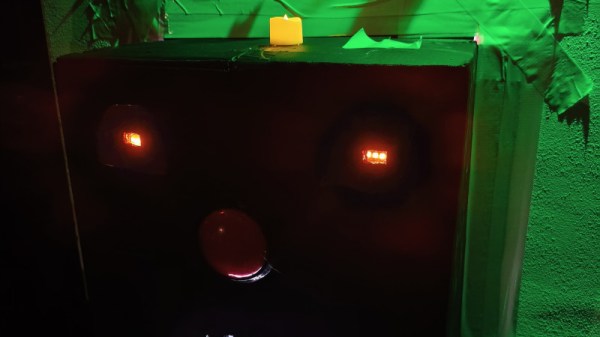
We live a Jetsons future of ubiquitous automation, in which the most trivial of human tasks has a machine to take the work out of it. Take doling out Halloween candy for example, why the effort of doing it by hand when a machine can take the  strain? [Christian] is here to show us the way with the Halloween Candy Mosnter. It’s a cardboard monster ehad that delivers candy when you press its nose, but there’s a bit more to it than that.

Behind the scenes there’s an ESP32 running the show, with the candy dispensed by a stepper motor with a finger wheel. An IR break beam detects candy dispensing, and an array of flashing lights and sounds complete the celebration. It’s a bit of fun, but with more substance than at first meets the eye. Everything sits in a GitHub repository should you wish to take a peek.

Halloween comes but once a year, and thus we only have a few days in which to show off these hacks. Oddly this one isn’t the first dispenser of candy we have brought you.

Image

DIY Rooftop Tent Sets Up In A Jiffy

[CraftAndu] shares his DIY car rooftop tent design that looks like a pretty accessible build. It allowed him to test drive the concept to his satisfaction while spending a fraction of what a commercial unit would cost.

The rooftop tent consists of a folding platform of sturdy plywood bolted to the roof rack. The tent is attached, with the support rods cleverly anchored to the hinges so folding the platform stows the tent and mattress, and unfolding deploys it. Doing this in a way that also leaves suitable clearance between the sections when folded requires a special hinge design, but it’s mechanically straightforward. According to [CraftAndu], it’s also plenty strong and he never had any worries about stability. The final touch is a rain cover made from durable waterproof fabric that buckles around the whole thing.

ImageThere are a few nifty design elements we particularly like. The integrated aluminum ladder is a nice touch, as is the little folding table on the inside of the ladder. Also, since the platform folds out to the side, one can have a small roof overhead while sitting below. Hanging a tarp around the perimeter also creates a what he jokingly refers to as “the livingroom”.

[CraftAndu] also shares his thoughts after using it for a two-week trip. Chief among them is that while it worked very well and shows no signs of wear, it’s still just a tent. It’s a bit cramped, cold, and like any tent it needs to be dried out in the morning due to condensation even if there’s no rain. On the plus side, it’s ridiculously convenient and easy to set up. Check it out in the video, embedded just below.

If you want to see some other DIY vehicle-camper projects, don’t miss this DIY pop-up truck camper, the Toyota Corolla that sleeps two, and for a little something different here’s a van converted to off-grid camper-slash-remote office.

Continue reading “DIY Rooftop Tent Sets Up In A Jiffy” →

Image

It’s Alpine Linux, On A Kindle Paperwhite 3

As computing power becomes cheaper and microprocessors become more capable, a steady trend over recent decades has been to see more everyday devices hiding Linux under the hood somewhere. Sadly in most cases that’s where it stays, but some such machines have a level of hackability. One such is the 7th generation Kindle PaperWhite 3, for which [pragyaangaur] has produced a distro that gives it the Alpine Linux userspace and a few other tricks.

As you might expect, the Kindle must be jailbroken, and is limited to the rather ancient Amazon kernel. The distro comes with a few extras for the custom front end. There’s a selection of games, a browser, an ArXiv search client, an ePub reader, and Quill, a local chatbot running SmolLM2 over llama.cpp on the Kindle’s own processor. At 1.7 words per second it may not be the fastest, but the important thing is that everything stays on the device. Best of all, it’s easy enough to return your Kindle to stock should you tire of the distro.

A quick look at everyone’s favourite auction site finds these readers available for well under $100, so should you wish to join the fun it at least shouldn’t cost an arm and a leg. Meanwhile, Kindle hacking is somewhere we’ve taken you before.