1,188 startups launched 14,483 upvotes cast 64 submitted this week

Recently Listed

1,188 launches
Sort
Panam Dekho - See Your Money, Control Your Spending

Financial management across multiple investment platforms has become a frustrating necessity for modern investors. Panam Dekho addresses this fragmentation by consolidating investment tracking into a single interface where users can monitor their holdings, performance, and overall financial picture without switching between different services. The platform targets individuals navigating the growing complexity of diversified investing. As more people explore mutual funds, index funds, ETFs, and other investment vehicles, the cognitive overhead of tracking these across separate platforms grows alongside. Panam Dekho eliminates this friction by bringing financial data together in one place, allowing investors to understand where their money lives and how it performs. What distinguishes Panam Dekho from other aggregation tools is its foundation in genuine user need rather than generic problem-solving. The founder built this after experiencing the pain of scattered financial information firsthand while managing his own investments. This hands-on perspective shapes the product's core premise: financial awareness requires visibility, and visibility requires consolidation. The platform enables users to track investments across multiple services without constant platform-switching. By centralizing investment data, it simplifies the mental model required to understand personal finances. This approach particularly resonates with investors managing multiple asset types simultaneously, where fragmentation becomes both a practical inconvenience and a psychological barrier to engagement. The product philosophy extends beyond mere convenience. The name itself encodes the mission—Panam Dekho translates to "Look at your money," positioning financial attention and literacy as central to the user experience. Rather than optimizing for transaction speed or automated trading features, the platform emphasizes understanding and control, giving users both the visibility and confidence to make informed decisions about their investments. No pricing model is currently disclosed on the available materials, leaving questions about the product's monetization strategy unanswered. The platform demonstrates clear market intuition and solves a recognized problem for a meaningful user segment, though its success will depend on execution quality, data accuracy, and whether aggregation alone sustains engagement or if expanded features become necessary for retention.


Financial management across multiple investment platforms has become a frustrating necessity for modern investors. Panam Dekho addresses this fragmentation by consolidating investment tracking into a single interface where users can monitor their holdings, performance, and overall financial picture without switching between different services. The platform targets individuals navigating the growing complexity of diversified investing. As more people explore mutual funds, index funds, ETFs, and other investment vehicles, the cognitive overhead of tracking these across separate platforms grows alongside. Panam Dekho eliminates this friction by bringing financial data together in one place, allowing investors to understand where their money lives and how it performs. What distinguishes Panam Dekho from other aggregation tools is its foundation in genuine user need rather than generic problem-solving. The founder built this after experiencing the pain of scattered financial information firsthand while managing his own investments. This hands-on perspective shapes the product's core premise: financial awareness requires visibility, and visibility requires consolidation. The platform enables users to track investments across multiple services without constant platform-switching. By centralizing investment data, it simplifies the mental model required to understand personal finances. This approach particularly resonates with investors managing multiple asset types simultaneously, where fragmentation becomes both a practical inconvenience and a psychological barrier to engagement. The product philosophy extends beyond mere convenience. The name itself encodes the mission—Panam Dekho translates to "Look at your money," positioning financial attention and literacy as central to the user experience. Rather than optimizing for transaction speed or automated trading features, the platform emphasizes understanding and control, giving users both the visibility and confidence to make informed decisions about their investments. No pricing model is currently disclosed on the available materials, leaving questions about the product's monetization strategy unanswered. The platform demonstrates clear market intuition and solves a recognized problem for a meaningful user segment, though its success will depend on execution quality, data accuracy, and whether aggregation alone sustains engagement or if expanded features become necessary for retention.

Panam Dekho - See Your Money, Control Your Spending preview

Key features

  • Multi-Platform Consolidation: Consolidates investment tracking from different platforms into a single interface.
  • Holdings Tracker: Allows users to monitor their holdings across multiple investment services.
See full listing
ValarchiX

Financial literacy in India faces a common obstacle: information overload without actionable guidance. ValarchiX tackles this by building a library of 56+ financial calculators and planning engines designed to teach users how to make decisions rather than dictating which investments they should choose. The product targets individuals seeking to optimize wealth accumulation, retirement planning, and daily financial management while maintaining complete control over their data. The platform distinguishes itself through several technical and philosophical choices. Client-side zero-knowledge encryption ensures that financial data never leaves the user's device, addressing privacy concerns that often deter people from using digital financial tools. Rather than presenting a cluttered toolkit, ValarchiX organizes its capabilities into logical categories—wealth and compounding, budgeting and cash flow, retirement planning, and tax analysis—making navigation intuitive for users at different financial stages. The feature set covers the practical needs of wealth-building in the Indian market. Interactive simulators let users experiment with systematic investment plans, compare fixed deposits to equity mutual funds accounting for inflation, and calculate compound interest across different time horizons. Specialized engines like the XIRR calculator and cost-of-delay simulator serve users tracking irregular cash flows or reconsidering procrastination's financial impact. The platform also integrates educational elements, with AI-assisted guidance available through its Vaathi AI component. A particularly noteworthy aspect is the platform's deterministic approach to financial planning. Rather than relying on black-box algorithms or opaque advice, ValarchiX emphasizes transparent mathematical foundations through what it calls objective scoring based on financial DNA assessment. This appeals to users who want to understand the reasoning behind financial recommendations and build confidence in their own decision-making. The product positions itself as addressing the gap between financial ignorance and expensive advisory services. By combining accessible calculators with an educational framework and absolute privacy protections, ValarchiX enables self-directed financial management without the friction of conventional wealth-management tools or advisory platforms. No pricing information appears in the available content, though the emphasis on privacy and zero-knowledge architecture suggests the platform likely operates on a freemium model or monetizes through premium analysis features rather than data licensing.


Financial-planning
P
Pranavesh Nandakumar

Financial literacy in India faces a common obstacle: information overload without actionable guidance. ValarchiX tackles this by building a library of 56+ financial calculators and planning engines designed to teach users how to make decisions rather than dictating which investments they should choose. The product targets individuals seeking to optimize wealth accumulation, retirement planning, and daily financial management while maintaining complete control over their data. The platform distinguishes itself through several technical and philosophical choices. Client-side zero-knowledge encryption ensures that financial data never leaves the user's device, addressing privacy concerns that often deter people from using digital financial tools. Rather than presenting a cluttered toolkit, ValarchiX organizes its capabilities into logical categories—wealth and compounding, budgeting and cash flow, retirement planning, and tax analysis—making navigation intuitive for users at different financial stages. The feature set covers the practical needs of wealth-building in the Indian market. Interactive simulators let users experiment with systematic investment plans, compare fixed deposits to equity mutual funds accounting for inflation, and calculate compound interest across different time horizons. Specialized engines like the XIRR calculator and cost-of-delay simulator serve users tracking irregular cash flows or reconsidering procrastination's financial impact. The platform also integrates educational elements, with AI-assisted guidance available through its Vaathi AI component. A particularly noteworthy aspect is the platform's deterministic approach to financial planning. Rather than relying on black-box algorithms or opaque advice, ValarchiX emphasizes transparent mathematical foundations through what it calls objective scoring based on financial DNA assessment. This appeals to users who want to understand the reasoning behind financial recommendations and build confidence in their own decision-making. The product positions itself as addressing the gap between financial ignorance and expensive advisory services. By combining accessible calculators with an educational framework and absolute privacy protections, ValarchiX enables self-directed financial management without the friction of conventional wealth-management tools or advisory platforms. No pricing information appears in the available content, though the emphasis on privacy and zero-knowledge architecture suggests the platform likely operates on a freemium model or monetizes through premium analysis features rather than data licensing.

ValarchiX preview

Key features

  • Financial Calculators: A library of 56+ planning engines covering wealth, budgeting, retirement, and tax analysis.
  • Zero-Knowledge Encryption: Client-side encryption ensures financial data never leaves the user's device.
See full listing
Sikkanam

Travel planning for budget-conscious visitors to Tamil Nadu typically requires juggling multiple websites, booking platforms, and fragmented information sources. Sikkanam streamlines this experience by consolidating transportation booking, accommodation search, and itinerary planning into a single AI-powered platform. The service targets budget travelers heading to Tamil Nadu who want to minimize planning time while maximizing trip quality. Rather than piecing together information from separate bus booking, railway reservation, and hotel comparison sites, users receive curated itineraries powered by artificial intelligence across more than 100 destinations throughout the region. What distinguishes Sikkanam in the crowded travel planning space is its integration of real-time booking directly into the planning workflow. The platform connects to TNSTC bus services and IRCTC train reservations, allowing users to move seamlessly from itinerary discovery to booking without leaving the application. This addresses a significant friction point in travel planning where good suggestions lose value if execution requires external context switching. The inclusion of curated budget hotel options reinforces the platform's commitment to the affordability-focused traveler rather than the luxury segment. The AI component reduces the cognitive load of travel planning. Rather than manually searching through hundreds of possible destinations and route combinations, users receive instant itineraries tailored to budget constraints. This approach recognizes that many travelers lack the time or expertise to optimize their own multi-destination trips across a region as geographically and culturally diverse as Tamil Nadu. By combining AI-driven discovery with direct access to major transportation operators and accommodation providers, Sikkanam positions itself as a purpose-built alternative to generic travel planning tools. Its specificity to Tamil Nadu and budget travel suggests a focused market strategy rather than an attempt to serve all travelers equally. This narrower scope allows deeper integrations and more relevant recommendations than generalist competitors might offer. The platform represents a practical application of AI to a concrete travel planning problem, prioritizing user convenience and affordability over comprehensive feature sprawl. For its target audience, this focused approach to accessibility and speed may prove more valuable than more complex alternatives.


Travel-planning
P
Pranavesh Nandakumar

Travel planning for budget-conscious visitors to Tamil Nadu typically requires juggling multiple websites, booking platforms, and fragmented information sources. Sikkanam streamlines this experience by consolidating transportation booking, accommodation search, and itinerary planning into a single AI-powered platform. The service targets budget travelers heading to Tamil Nadu who want to minimize planning time while maximizing trip quality. Rather than piecing together information from separate bus booking, railway reservation, and hotel comparison sites, users receive curated itineraries powered by artificial intelligence across more than 100 destinations throughout the region. What distinguishes Sikkanam in the crowded travel planning space is its integration of real-time booking directly into the planning workflow. The platform connects to TNSTC bus services and IRCTC train reservations, allowing users to move seamlessly from itinerary discovery to booking without leaving the application. This addresses a significant friction point in travel planning where good suggestions lose value if execution requires external context switching. The inclusion of curated budget hotel options reinforces the platform's commitment to the affordability-focused traveler rather than the luxury segment. The AI component reduces the cognitive load of travel planning. Rather than manually searching through hundreds of possible destinations and route combinations, users receive instant itineraries tailored to budget constraints. This approach recognizes that many travelers lack the time or expertise to optimize their own multi-destination trips across a region as geographically and culturally diverse as Tamil Nadu. By combining AI-driven discovery with direct access to major transportation operators and accommodation providers, Sikkanam positions itself as a purpose-built alternative to generic travel planning tools. Its specificity to Tamil Nadu and budget travel suggests a focused market strategy rather than an attempt to serve all travelers equally. This narrower scope allows deeper integrations and more relevant recommendations than generalist competitors might offer. The platform represents a practical application of AI to a concrete travel planning problem, prioritizing user convenience and affordability over comprehensive feature sprawl. For its target audience, this focused approach to accessibility and speed may prove more valuable than more complex alternatives.

Sikkanam preview

Key features

  • AI-Powered Itineraries: The platform generates curated itineraries powered by artificial intelligence across more than 100 destinations throughout Tamil Nadu.
  • Real-Time Booking Integration: Direct connections to TNSTC bus services and IRCTC train reservations enable seamless booking without leaving the application.
See full listing
Marakadhey

Capturing opportunities before they disappear is a constant friction point for researchers, students, and professionals juggling multiple sources of information. Marakadhey addresses this directly: a privacy-centric browser extension and Android app that converts webpage saving into a one-click operation paired with intelligent reminders and calendar synchronization. The product positions itself against information loss through simplicity. Rather than requiring account setup or login, Marakadhey operates on local storage, storing everything on the user's device without external cloud dependencies. This privacy-first architecture eliminates concerns about data brokers while maintaining cross-platform functionality between Chrome, Microsoft Edge, and Android. What distinguishes Marakadhey from generic bookmarking tools is its reminder-centric design. Users don't simply save a link; they capture context alongside automatic page title detection, set deadline reminders with preset shortcuts (Tomorrow, 3 Days, 1 Week), assign priority levels, and integrate directly with calendar systems. The mobile app complements desktop capture with push notifications and offline archive access, allowing users to stay alert during commutes or downtime. The architecture splits responsibilities logically. The browser extension lives in the toolbar for rapid capture during research sessions, displaying a badge counter for pending deadlines. The standalone Android APK integrates with the system share sheet, enabling saves directly from Chrome Mobile or LinkedIn without opening a separate application. Calendar synchronization pushes alerts across devices, ensuring no opportunity slips through notification cracks. Implementation choices reflect thoughtful product design. The one-click capture pattern eliminates friction that typically causes users to defer saving for later, a moment that rarely comes. Auto-detection of page titles removes manual data entry. Quick preset reminders reduce decision fatigue compared to manual date picking. Push notifications with contextual summaries provide gentle, actionable alerts rather than generic notifications. Marakadhey operates entirely free with no subscription fees or locked premium features, a notable stance when most competing services employ freemium models or require accounts. This accessibility extends to the Android APK, which remains directly downloadable without app store gatekeeping. The product appeals directly to individuals who benefit from external memory systems: researchers tracking calls for papers, professionals monitoring job boards, students managing application deadlines, or anyone consuming content at scale. By eliminating account friction and cloud intermediaries, Marakadhey trades sophistication for accessibility and trust, positioning itself as a lightweight alternative to heavier task management systems.


Social-bookmarking
P
Pranavesh Nandakumar

Capturing opportunities before they disappear is a constant friction point for researchers, students, and professionals juggling multiple sources of information. Marakadhey addresses this directly: a privacy-centric browser extension and Android app that converts webpage saving into a one-click operation paired with intelligent reminders and calendar synchronization. The product positions itself against information loss through simplicity. Rather than requiring account setup or login, Marakadhey operates on local storage, storing everything on the user's device without external cloud dependencies. This privacy-first architecture eliminates concerns about data brokers while maintaining cross-platform functionality between Chrome, Microsoft Edge, and Android. What distinguishes Marakadhey from generic bookmarking tools is its reminder-centric design. Users don't simply save a link; they capture context alongside automatic page title detection, set deadline reminders with preset shortcuts (Tomorrow, 3 Days, 1 Week), assign priority levels, and integrate directly with calendar systems. The mobile app complements desktop capture with push notifications and offline archive access, allowing users to stay alert during commutes or downtime. The architecture splits responsibilities logically. The browser extension lives in the toolbar for rapid capture during research sessions, displaying a badge counter for pending deadlines. The standalone Android APK integrates with the system share sheet, enabling saves directly from Chrome Mobile or LinkedIn without opening a separate application. Calendar synchronization pushes alerts across devices, ensuring no opportunity slips through notification cracks. Implementation choices reflect thoughtful product design. The one-click capture pattern eliminates friction that typically causes users to defer saving for later, a moment that rarely comes. Auto-detection of page titles removes manual data entry. Quick preset reminders reduce decision fatigue compared to manual date picking. Push notifications with contextual summaries provide gentle, actionable alerts rather than generic notifications. Marakadhey operates entirely free with no subscription fees or locked premium features, a notable stance when most competing services employ freemium models or require accounts. This accessibility extends to the Android APK, which remains directly downloadable without app store gatekeeping. The product appeals directly to individuals who benefit from external memory systems: researchers tracking calls for papers, professionals monitoring job boards, students managing application deadlines, or anyone consuming content at scale. By eliminating account friction and cloud intermediaries, Marakadhey trades sophistication for accessibility and trust, positioning itself as a lightweight alternative to heavier task management systems.

Marakadhey preview

Key features

  • One-Click Saving: Converts webpage saving into a single-click operation without requiring account setup
  • Intelligent Reminders: Users set deadline reminders with preset shortcuts like Tomorrow, 3 Days, or 1 Week
See full listing
AI Rap Forge

Creating shareable videos typically demands expensive equipment, production expertise, or lengthy editing workflows. AI Rap Forge cuts through these barriers by automating the conversion of personal photos into short-form rap videos optimized for social platforms. The service targets content creators, social media enthusiasts, and musicians seeking production-quality clips without the traditional time or financial investment. The platform operates through three distinct creation pathways. Topic Rap transforms a theme—a birthday message, shared memory, or personalized concept—into a rap video with AI-generated lyrics customized to the input. Hot Templates provide pre-designed scenes like the "Hotel Lobby" and "Migos AI" concepts where users upload photos to slot themselves into trending video formats. Custom mode grants creative control for users who want to describe their own mood, setting, and visual direction. This tiered approach balances accessibility for casual creators with flexibility for those with specific artistic visions. What distinguishes AI Rap Forge is its focus on vertical video formats. Videos render in 9:16 aspect ratio, ready for TikTok and Instagram Reels without reformatting. This specificity matters—most video AI tools treat vertical content as an afterthought, while this service has clearly designed around social distribution from the ground up. The integration of Seedance 2.0, described as an advanced AI video model, suggests the company is leveraging current-generation capabilities for character and scene generation. The technical workflow is streamlined. Users select a stage, upload photos, optionally add a personalized theme, specify output settings (resolution, duration), and submit. The platform uses a credit system where credits deduct upon submission and refund automatically if generation fails—a reasonable mechanism that protects against failed transactions. Video durations range from 5 to 15 seconds, aligned with social media consumption patterns. The platform's positioning bridges a genuine gap. Professional rappers and content creators can generate artist promotion materials or teasers. People without production skills can participate in viral trends. The friction elimination is notable—transforming a multi-hour production task into a minutes-long interaction removes a meaningful barrier to video content creation. No explicit pricing appears in the available materials, suggesting a freemium or credit-purchase model requiring account creation to discover specifics. The credit-based approach indicates usage-based pricing rather than subscriptions, which could favor occasional creators or encourage experimentation.

Ai-generative-media
Y
yuhan yang

Creating shareable videos typically demands expensive equipment, production expertise, or lengthy editing workflows. AI Rap Forge cuts through these barriers by automating the conversion of personal photos into short-form rap videos optimized for social platforms. The service targets content creators, social media enthusiasts, and musicians seeking production-quality clips without the traditional time or financial investment. The platform operates through three distinct creation pathways. Topic Rap transforms a theme—a birthday message, shared memory, or personalized concept—into a rap video with AI-generated lyrics customized to the input. Hot Templates provide pre-designed scenes like the "Hotel Lobby" and "Migos AI" concepts where users upload photos to slot themselves into trending video formats. Custom mode grants creative control for users who want to describe their own mood, setting, and visual direction. This tiered approach balances accessibility for casual creators with flexibility for those with specific artistic visions. What distinguishes AI Rap Forge is its focus on vertical video formats. Videos render in 9:16 aspect ratio, ready for TikTok and Instagram Reels without reformatting. This specificity matters—most video AI tools treat vertical content as an afterthought, while this service has clearly designed around social distribution from the ground up. The integration of Seedance 2.0, described as an advanced AI video model, suggests the company is leveraging current-generation capabilities for character and scene generation. The technical workflow is streamlined. Users select a stage, upload photos, optionally add a personalized theme, specify output settings (resolution, duration), and submit. The platform uses a credit system where credits deduct upon submission and refund automatically if generation fails—a reasonable mechanism that protects against failed transactions. Video durations range from 5 to 15 seconds, aligned with social media consumption patterns. The platform's positioning bridges a genuine gap. Professional rappers and content creators can generate artist promotion materials or teasers. People without production skills can participate in viral trends. The friction elimination is notable—transforming a multi-hour production task into a minutes-long interaction removes a meaningful barrier to video content creation. No explicit pricing appears in the available materials, suggesting a freemium or credit-purchase model requiring account creation to discover specifics. The credit-based approach indicates usage-based pricing rather than subscriptions, which could favor occasional creators or encourage experimentation.

AI Rap Forge preview

Key features

  • Topic Rap: Converts themes into rap videos with AI-generated lyrics customized to user input
  • Hot Templates: Pre-designed scenes where users upload photos to slot into trending video formats
See full listing
Deleted Tweet Finder

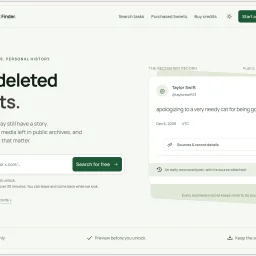
We built Deleted Tweet Finder because important tweets disappear every day, but public archives preserve them. We wanted to make it easy for anyone to search these archives and recover deleted tweets—finding the text and media that matters before it's lost forever. Our tool proves that deleted doesn't have to mean gone.


Twitter-apps
T
Tommy

We built Deleted Tweet Finder because important tweets disappear every day, but public archives preserve them. We wanted to make it easy for anyone to search these archives and recover deleted tweets—finding the text and media that matters before it's lost forever. Our tool proves that deleted doesn't have to mean gone.

LyricFast

Creating professional lyric videos has traditionally required either expensive video editing software or hiring services, both impractical for independent musicians managing tight release schedules. LyricFast addresses this friction by automating the most tedious part of the workflow: synchronizing lyrics to audio at word-level precision. The platform targets musicians preparing releases for YouTube and TikTok, with particular appeal to independent artists and those using AI music generation tools like Suno. Rather than building another general-purpose video editor, the founders designed specifically around the release-to-social workflow musicians actually follow. The core mechanic is straightforward but well-executed. Users upload a track in common formats (MP3, WAV, M4A, OGG, or FLAC, up to 10 minutes), and AI generates a timed lyric draft. The service lets creators listen to the full song with synchronized lyrics before committing to export, eliminating the surprise of discovering timing errors after rendering video. Users can manually adjust any misaligned words and paste original lyrics upfront if the AI transcription needs anchoring. What distinguishes LyricFast from simpler tools is the depth of the preview. The UI uses the same rendering engine for preview and final export, so creators see precisely what they'll get on YouTube or TikTok. The platform exports in three aspect ratios (16:9, 9:16, and 1:1), addressing the different distribution channels musicians care about. Template selection spans visual philosophies. Film Lyrics pairs quiet typography with moving backgrounds, prioritizing the music itself. Lyrics Animation adds kinetic text and word highlighting for more dynamic presentations. These aren't generic presets but deliberately chosen styles reflecting different release strategies. The interface design carries weight too. The founders deliberately omit the complex timeline editing typical of video software, signaling that this tool solves a specific problem rather than pretending to be Premiere Pro. The product handles AI lyric transcription but also accepts manually entered lyrics, giving control back to artists who need exact wording preserved. The service integrates directly with Suno AI, reducing friction for musicians generating music synthetically. This positioning in the AI music creator ecosystem signals how the founders see their market. The business model involves a free full-song preview tier and project unlocking for export, though specific pricing wasn't disclosed in the available materials. For independent artists and hobbyists, the free preview alone provides meaningful value, allowing experimentation before commitment.

Video-editing
C
Cody

Creating professional lyric videos has traditionally required either expensive video editing software or hiring services, both impractical for independent musicians managing tight release schedules. LyricFast addresses this friction by automating the most tedious part of the workflow: synchronizing lyrics to audio at word-level precision. The platform targets musicians preparing releases for YouTube and TikTok, with particular appeal to independent artists and those using AI music generation tools like Suno. Rather than building another general-purpose video editor, the founders designed specifically around the release-to-social workflow musicians actually follow. The core mechanic is straightforward but well-executed. Users upload a track in common formats (MP3, WAV, M4A, OGG, or FLAC, up to 10 minutes), and AI generates a timed lyric draft. The service lets creators listen to the full song with synchronized lyrics before committing to export, eliminating the surprise of discovering timing errors after rendering video. Users can manually adjust any misaligned words and paste original lyrics upfront if the AI transcription needs anchoring. What distinguishes LyricFast from simpler tools is the depth of the preview. The UI uses the same rendering engine for preview and final export, so creators see precisely what they'll get on YouTube or TikTok. The platform exports in three aspect ratios (16:9, 9:16, and 1:1), addressing the different distribution channels musicians care about. Template selection spans visual philosophies. Film Lyrics pairs quiet typography with moving backgrounds, prioritizing the music itself. Lyrics Animation adds kinetic text and word highlighting for more dynamic presentations. These aren't generic presets but deliberately chosen styles reflecting different release strategies. The interface design carries weight too. The founders deliberately omit the complex timeline editing typical of video software, signaling that this tool solves a specific problem rather than pretending to be Premiere Pro. The product handles AI lyric transcription but also accepts manually entered lyrics, giving control back to artists who need exact wording preserved. The service integrates directly with Suno AI, reducing friction for musicians generating music synthetically. This positioning in the AI music creator ecosystem signals how the founders see their market. The business model involves a free full-song preview tier and project unlocking for export, though specific pricing wasn't disclosed in the available materials. For independent artists and hobbyists, the free preview alone provides meaningful value, allowing experimentation before commitment.

LyricFast preview

Key features

  • AI Lyric Synchronization: Automatically synchronizes lyrics to audio at word-level precision
  • Multi-Format Upload: Accepts MP3, WAV, M4A, OGG, and FLAC files up to 10 minutes
See full listing
D

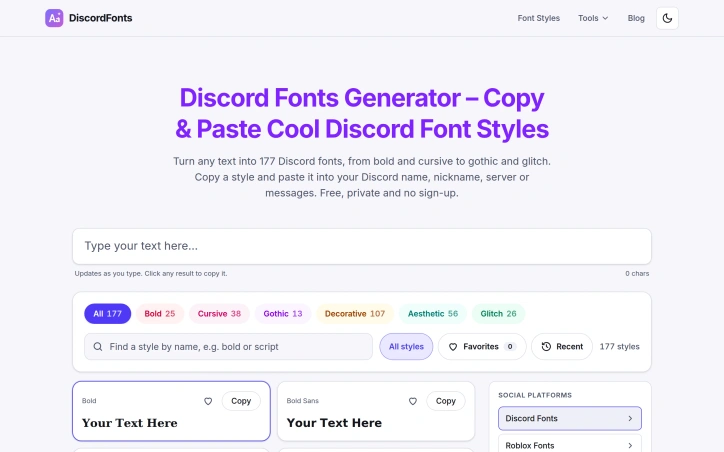
Looking to add personality to Discord profiles and messages, users find a straightforward solution in this text-styling application. It addresses a genuine demand from Discord's creative users who want distinctive visual presentation without technical complexity or account registration overhead. The service transforms input text into 177 different typographic variations, spanning categories from classical styles like bold and italic to more expressive options such as gothic fraktur, vaporwave, and glitch aesthetics. This breadth of choice gives users substantial creative freedom rather than a limited preset menu. The interface delivers immediate visual feedback, updating the display as users type, which makes exploring style options fluid and intuitive. What distinguishes this offering is its operational simplicity. The tool requires no sign-up, downloads, or authentication. Users type or paste content and immediately see all 177 variations rendered below, with individual copy buttons for each style. This frictionless workflow addresses a real pain point: Discord's native styling options are limited to markdown formatting like bold, italics, and strikethrough. The application expands expressive possibilities dramatically by leveraging Unicode character sets to create genuinely distinct visual representations. The feature set extends beyond simple font transformation. A random generator creates mixed-style text where each letter receives a different treatment, producing surreal combinations suitable for users seeking unconventional aesthetics. The interface also tracks recently used styles and allows favoriting, reducing repetition when users gravitate toward specific looks. Additionally, the service includes a reference guide for Discord's built-in markdown syntax alongside the Unicode transformations, providing value even to users primarily seeking formatting reminders. The platform operates as a free service without subscription tiers or paywalls. This economic model removes barriers to adoption and keeps the value proposition transparent: no hidden costs or data collection presented as trade-offs. The application's straightforward design focuses entirely on functionality. Users seeking visual differentiation in Discord communities or personal profiles will find practical utility here. Whether for gaming servers, online communities, or social presence building, the tool delivers on its core promise with minimal friction.

Design-resources
I
Ishfaq Ahmed

Looking to add personality to Discord profiles and messages, users find a straightforward solution in this text-styling application. It addresses a genuine demand from Discord's creative users who want distinctive visual presentation without technical complexity or account registration overhead. The service transforms input text into 177 different typographic variations, spanning categories from classical styles like bold and italic to more expressive options such as gothic fraktur, vaporwave, and glitch aesthetics. This breadth of choice gives users substantial creative freedom rather than a limited preset menu. The interface delivers immediate visual feedback, updating the display as users type, which makes exploring style options fluid and intuitive. What distinguishes this offering is its operational simplicity. The tool requires no sign-up, downloads, or authentication. Users type or paste content and immediately see all 177 variations rendered below, with individual copy buttons for each style. This frictionless workflow addresses a real pain point: Discord's native styling options are limited to markdown formatting like bold, italics, and strikethrough. The application expands expressive possibilities dramatically by leveraging Unicode character sets to create genuinely distinct visual representations. The feature set extends beyond simple font transformation. A random generator creates mixed-style text where each letter receives a different treatment, producing surreal combinations suitable for users seeking unconventional aesthetics. The interface also tracks recently used styles and allows favoriting, reducing repetition when users gravitate toward specific looks. Additionally, the service includes a reference guide for Discord's built-in markdown syntax alongside the Unicode transformations, providing value even to users primarily seeking formatting reminders. The platform operates as a free service without subscription tiers or paywalls. This economic model removes barriers to adoption and keeps the value proposition transparent: no hidden costs or data collection presented as trade-offs. The application's straightforward design focuses entirely on functionality. Users seeking visual differentiation in Discord communities or personal profiles will find practical utility here. Whether for gaming servers, online communities, or social presence building, the tool delivers on its core promise with minimal friction.

Discord Fonts preview
D

Key features

  • Font Variations: Transforms text into 177 different typographic styles spanning classical styles like bold and italic to expressive options like gothic fraktur, vaporwave, and glitch aesthetics
  • Live Preview: Updates the display in real-time as users type, providing immediate visual feedback of all available style options
See full listing
Thrive

Traders operating at scale struggle to determine whether their profits stem from sound methodology or fortunate circumstances. Thrive separates these by documenting each trade alongside the market conditions present at execution—funding rates, liquidation levels, volume, and open interest—making it possible to evaluate which decisions hold up under scrutiny. The product targets serious futures traders on Binance, Bybit, and OKX who work with meaningful position sizes and want systematic proof of their edge. It explicitly rejects the alert-and-trade workflow, positioning itself instead for traders willing to review their own decisions and extract lessons from losses. The mechanics center on marrying trade data to market context. Every entry and exit records against conditions that existed at that moment. This prevents retrospective justification of outlier trades or false correlation between size and skill. Traders input data manually, upload CSVs, or optionally connect an exchange account via read-only API—a deliberate constraint that bars the platform from accessing withdrawal permissions. Analysis layers include performance breakdowns across timeframes, win rates, profit factors, average win-to-loss ratios, and equity curves that reveal patterns in consistency over time. Users export results as CSV or JSON, eliminating platform lock-in. The terms make clear that downloaded data remains theirs even after cancellation. Revenue comes through a credits system tied to trade reviews. Pro accounts bundle 2,000 monthly credits, though specific pricing remains unstated. The mechanics are straightforward: use credits for analysis, monitor usage in settings. Thrive's philosophy diverges sharply from most trading software. It does not tell traders what to buy, when to enter, or when to exit. The data feed offers context; the trader decides. The journal then shows whether those decisions reflect repeatable process or noise. Traders encounter a hard mirror: keep the tool if it reinforces discipline, discard it if it merely validates choices already made. This approach acknowledges that some traders will self-select out—those seeking comfort or automation rather than accountability. That clarity, paired with read-only architecture and unrestricted data export, serves the trader serious about auditing their own competence.


Finance
T
Thrive

Traders operating at scale struggle to determine whether their profits stem from sound methodology or fortunate circumstances. Thrive separates these by documenting each trade alongside the market conditions present at execution—funding rates, liquidation levels, volume, and open interest—making it possible to evaluate which decisions hold up under scrutiny. The product targets serious futures traders on Binance, Bybit, and OKX who work with meaningful position sizes and want systematic proof of their edge. It explicitly rejects the alert-and-trade workflow, positioning itself instead for traders willing to review their own decisions and extract lessons from losses. The mechanics center on marrying trade data to market context. Every entry and exit records against conditions that existed at that moment. This prevents retrospective justification of outlier trades or false correlation between size and skill. Traders input data manually, upload CSVs, or optionally connect an exchange account via read-only API—a deliberate constraint that bars the platform from accessing withdrawal permissions. Analysis layers include performance breakdowns across timeframes, win rates, profit factors, average win-to-loss ratios, and equity curves that reveal patterns in consistency over time. Users export results as CSV or JSON, eliminating platform lock-in. The terms make clear that downloaded data remains theirs even after cancellation. Revenue comes through a credits system tied to trade reviews. Pro accounts bundle 2,000 monthly credits, though specific pricing remains unstated. The mechanics are straightforward: use credits for analysis, monitor usage in settings. Thrive's philosophy diverges sharply from most trading software. It does not tell traders what to buy, when to enter, or when to exit. The data feed offers context; the trader decides. The journal then shows whether those decisions reflect repeatable process or noise. Traders encounter a hard mirror: keep the tool if it reinforces discipline, discard it if it merely validates choices already made. This approach acknowledges that some traders will self-select out—those seeking comfort or automation rather than accountability. That clarity, paired with read-only architecture and unrestricted data export, serves the trader serious about auditing their own competence.

Thrive preview

Key features

  • Trade Context Documentation: Records each trade with concurrent market conditions including funding rates, liquidation levels, volume, and open interest.
  • Performance Analytics: Provides breakdowns by timeframe, win rates, profit factors, average win-to-loss ratios, and equity curves.
See full listing
IndieLaunch

A free launch platform addressing a real friction point for independent makers: the gap between building something and getting it discovered. IndieLaunch aggregates new SaaS applications, AI tools, and side projects in one searchable directory, connecting creators with early adopters and offering something many solo builders crave—meaningful feedback and community validation. The platform serves indie makers at the critical moment when they're ready to go public with their work. The directory spans software categories from developer tools to marketing solutions, with recent launches arriving constantly. The interface prioritizes browsing and discovery through categorical organization, allowing potential users to find products aligned with their interests rather than scrolling chronologically. What distinguishes IndieLaunch from broader product directories is its focus on the independent creator ecosystem rather than venture-backed startups. The founder positioned it explicitly as a space where makers can both launch and discover, creating reciprocal value. The emphasis on dofollow backlinks also signals awareness of what indie creators actually need—not just visibility, but SEO value that compounds over time. The platform operates on a freemium model. Submitting and discovering products is free, but premium "launch" tiers are available for featured visibility. The site displays advertising inventory, with spots available to sponsors seeking to reach this maker-focused audience. This dual model aligns incentives cleanly: the platform thrives when more makers submit products, and advertisers see a growing audience worth paying to reach. The current directory shows over 440 launches, suggesting meaningful adoption among independent creators. Recent submissions span legitimate product categories: photo security applications, comparison games, AI video generation tools, file compression utilities, and e-commerce automation. This range suggests real products rather than a dumping ground for low-effort projects. IndieLaunch occupies a specific niche well. For indie makers tired of launching into the void, it offers a concentrated audience of early adopters and fellow creators. For those searching for new tools, it beats algorithmic feeds or mega-platforms where discovery of small products gets buried. The implementation remains functional and straightforward rather than flashy, prioritizing utility over polish—fitting for a platform built by makers, for makers.

Startup-communities
R
Rupamjit Ghosh

A free launch platform addressing a real friction point for independent makers: the gap between building something and getting it discovered. IndieLaunch aggregates new SaaS applications, AI tools, and side projects in one searchable directory, connecting creators with early adopters and offering something many solo builders crave—meaningful feedback and community validation. The platform serves indie makers at the critical moment when they're ready to go public with their work. The directory spans software categories from developer tools to marketing solutions, with recent launches arriving constantly. The interface prioritizes browsing and discovery through categorical organization, allowing potential users to find products aligned with their interests rather than scrolling chronologically. What distinguishes IndieLaunch from broader product directories is its focus on the independent creator ecosystem rather than venture-backed startups. The founder positioned it explicitly as a space where makers can both launch and discover, creating reciprocal value. The emphasis on dofollow backlinks also signals awareness of what indie creators actually need—not just visibility, but SEO value that compounds over time. The platform operates on a freemium model. Submitting and discovering products is free, but premium "launch" tiers are available for featured visibility. The site displays advertising inventory, with spots available to sponsors seeking to reach this maker-focused audience. This dual model aligns incentives cleanly: the platform thrives when more makers submit products, and advertisers see a growing audience worth paying to reach. The current directory shows over 440 launches, suggesting meaningful adoption among independent creators. Recent submissions span legitimate product categories: photo security applications, comparison games, AI video generation tools, file compression utilities, and e-commerce automation. This range suggests real products rather than a dumping ground for low-effort projects. IndieLaunch occupies a specific niche well. For indie makers tired of launching into the void, it offers a concentrated audience of early adopters and fellow creators. For those searching for new tools, it beats algorithmic feeds or mega-platforms where discovery of small products gets buried. The implementation remains functional and straightforward rather than flashy, prioritizing utility over polish—fitting for a platform built by makers, for makers.

IndieLaunch preview

Key features

  • Searchable Directory: Aggregates new SaaS applications, AI tools, and side projects in one searchable location.
  • Categorical Organization: Organizes products by category enabling discovery by interest rather than chronological browsing.
See full listing
H

Protecting sensitive personal photos has become an increasingly common concern as smartphones store more intimate memories while facing mounting privacy threats. Hide Photos addresses this need by providing a dedicated vault system designed entirely around device-based encryption rather than relying on external servers or cloud infrastructure dependent on third parties. The application targets users who want to maintain control over their most private content without sacrificing convenience or creating friction in their daily workflow. This includes individuals concerned about physical device theft, casual snooping by family members, or accidental exposure through standard sharing mechanisms. What distinguishes this approach is the implementation of decoy vaults, a feature that creates multiple distinct collections with separate access credentials. Someone forcing access through an incorrect PIN encounters a different set of content entirely, creating genuine uncertainty about what the vault actually contains without requiring the user to memorize multiple separate applications or devices. Complementing this security-first design are practical features for actual photo management. Users can organize content into albums and folders, take photos directly within the vault without touching the main camera roll, and set the app to automatically lock and obscure itself during app switching to prevent accidental disclosure. The encryption relies on AES-GCM algorithms applied directly on the device, with no backend servers involved in the encryption process. Users can export encrypted backups they control directly rather than depending on a developer-operated service for recovery. An optional Pro tier adds encrypted synchronization across Apple devices via the user's own iCloud account, with the critical distinction that data is encrypted locally before any upload. Additional security features include tracking failed unlock attempts as an intruder alert system and the ability to swap the app icon to something inconspicuous for users who want an extra layer of obscurity. The application is free to download with core functionality immediately accessible. Premium features unlock additional capacity and synchronization capabilities through in-app purchases. The combination of decoy vault technology, genuine on-device encryption without server dependency, and minimal friction for legitimate use creates a compelling alternative to relying on basic PIN protection or standard photo library visibility settings.


Security-software
G
gao xiao

Protecting sensitive personal photos has become an increasingly common concern as smartphones store more intimate memories while facing mounting privacy threats. Hide Photos addresses this need by providing a dedicated vault system designed entirely around device-based encryption rather than relying on external servers or cloud infrastructure dependent on third parties. The application targets users who want to maintain control over their most private content without sacrificing convenience or creating friction in their daily workflow. This includes individuals concerned about physical device theft, casual snooping by family members, or accidental exposure through standard sharing mechanisms. What distinguishes this approach is the implementation of decoy vaults, a feature that creates multiple distinct collections with separate access credentials. Someone forcing access through an incorrect PIN encounters a different set of content entirely, creating genuine uncertainty about what the vault actually contains without requiring the user to memorize multiple separate applications or devices. Complementing this security-first design are practical features for actual photo management. Users can organize content into albums and folders, take photos directly within the vault without touching the main camera roll, and set the app to automatically lock and obscure itself during app switching to prevent accidental disclosure. The encryption relies on AES-GCM algorithms applied directly on the device, with no backend servers involved in the encryption process. Users can export encrypted backups they control directly rather than depending on a developer-operated service for recovery. An optional Pro tier adds encrypted synchronization across Apple devices via the user's own iCloud account, with the critical distinction that data is encrypted locally before any upload. Additional security features include tracking failed unlock attempts as an intruder alert system and the ability to swap the app icon to something inconspicuous for users who want an extra layer of obscurity. The application is free to download with core functionality immediately accessible. Premium features unlock additional capacity and synchronization capabilities through in-app purchases. The combination of decoy vault technology, genuine on-device encryption without server dependency, and minimal friction for legitimate use creates a compelling alternative to relying on basic PIN protection or standard photo library visibility settings.

Hide Photos: Secret Album preview
H

Key features

  • Decoy Vaults: creates multiple distinct collections with separate credentials that display different content when accessed with an incorrect PIN
  • Device-Based Encryption: uses AES-GCM algorithms applied on-device with zero backend server involvement in encryption
See full listing
BlueVetaUpright

Product photo rotation is a persistent headache in e-commerce and media management. Platforms receive images sideways, upside-down, or tilted at awkward angles, yet detecting and correcting these issues has proven surprisingly difficult at scale. Existing computer vision approaches either miss subtle diagonal tilts or flag false positives that waste manual review time. BlueVetaUpright targets this specific problem with an API built exclusively for rotation detection. Rather than applying generic vision models to a specialized task, the service handles quadrant rotations (0, 90, 180, 270 degrees) alongside fine-tilt detection, reporting not just the correction angle but a calibrated confidence score. The API returns results in real time from a single call and accepts images in multiple formats: JPEG, PNG, WebP, or HEIC. The reported accuracy matters here. On clean 90-degree turns, the service claims above 95% accuracy. When additional tilt layers in (up to roughly 30 degrees), accuracy stays above 90%. Even in the hardest cases—severe tilts between 30 and 45 degrees—it remains above 80%. These numbers exclude ambiguous images like flat-lays or hand-held shots with no single correct orientation, and the service notes lower accuracy on AI-generated or stock-style images. The company measured these figures against hand-reviewed photos rather than synthetic test sets, which carries more weight. What distinguishes Upright beyond raw accuracy is its honest reporting. When confidence drops or when embedded camera metadata contradicts detected rotation, the API says so plainly instead of guessing. This transparency avoids the false confidence that generic vision APIs often project. Customers can request the corrected image alongside the detection result for an added fee. The pricing model supports low-friction adoption. There is no subscription; users buy credits at tiered rates. A single API call costs 3 cents at the lowest tier, with discounts scaling to 1.5 cents per call for bulk purchases. A three-dollar minimum on first purchase lowers the barrier for experimentation, and credits never expire. A 10,000-credit bundle costs $150, suitable for medium-scale operations. The service is explicitly designed for product photography but works on any image. For companies managing large inventories of user-uploaded or legacy product photos, or for platforms where rotation errors slip through, this represents a focused solution that sidesteps the complexity of training or tuning broader AI models.


Product photo rotation is a persistent headache in e-commerce and media management. Platforms receive images sideways, upside-down, or tilted at awkward angles, yet detecting and correcting these issues has proven surprisingly difficult at scale. Existing computer vision approaches either miss subtle diagonal tilts or flag false positives that waste manual review time. BlueVetaUpright targets this specific problem with an API built exclusively for rotation detection. Rather than applying generic vision models to a specialized task, the service handles quadrant rotations (0, 90, 180, 270 degrees) alongside fine-tilt detection, reporting not just the correction angle but a calibrated confidence score. The API returns results in real time from a single call and accepts images in multiple formats: JPEG, PNG, WebP, or HEIC. The reported accuracy matters here. On clean 90-degree turns, the service claims above 95% accuracy. When additional tilt layers in (up to roughly 30 degrees), accuracy stays above 90%. Even in the hardest cases—severe tilts between 30 and 45 degrees—it remains above 80%. These numbers exclude ambiguous images like flat-lays or hand-held shots with no single correct orientation, and the service notes lower accuracy on AI-generated or stock-style images. The company measured these figures against hand-reviewed photos rather than synthetic test sets, which carries more weight. What distinguishes Upright beyond raw accuracy is its honest reporting. When confidence drops or when embedded camera metadata contradicts detected rotation, the API says so plainly instead of guessing. This transparency avoids the false confidence that generic vision APIs often project. Customers can request the corrected image alongside the detection result for an added fee. The pricing model supports low-friction adoption. There is no subscription; users buy credits at tiered rates. A single API call costs 3 cents at the lowest tier, with discounts scaling to 1.5 cents per call for bulk purchases. A three-dollar minimum on first purchase lowers the barrier for experimentation, and credits never expire. A 10,000-credit bundle costs $150, suitable for medium-scale operations. The service is explicitly designed for product photography but works on any image. For companies managing large inventories of user-uploaded or legacy product photos, or for platforms where rotation errors slip through, this represents a focused solution that sidesteps the complexity of training or tuning broader AI models.

BlueVetaUpright preview

Key features

  • Rotation Detection API: Detects and corrects quadrant rotations (0, 90, 180, 270 degrees) plus fine-tilt detection up to 45 degrees.
  • Confidence Scoring: Reports calibrated confidence scores alongside correction angles to indicate detection reliability.
See full listing
NexusAi

Starting a business with AI tools today means wading through thousands of options scattered across the internet. NexusAi consolidates this fragmented landscape into a single discovery platform designed for founders, developers, and teams evaluating AI software. The core problem is real: the AI tool market has exploded faster than any traditional directory can keep pace. Rather than bouncing between review sites, product hunt, and scattered vendor websites, users can now explore curated categories, compare offerings side by side, and access a library of ready-to-use prompts and workflows. The platform currently indexes over 700 AI tools across more than 1000 categories, with daily updates to keep pace with new launches. What distinguishes NexusAi is the workflow-first approach embedded in its design. The service goes beyond simple product listings by bundling in expert-crafted prompts and practical workflows that show users how to actually apply these tools to real problems. Someone searching for content creation solutions doesn't just see tool options—they also find validated workflows and prompt templates that reduce the setup friction. The directory segments tools by use case and industry vertical: productivity, development, marketing, content, data, automation, and operations. A trending section highlights the month's fastest-growing AI applications with engagement metrics. This removes the guesswork from which tools are actually gaining traction versus which ones peaked in a Reddit thread. The platform maintains a 50,000 monthly visitor base and offers free-tier discovery access. Revenue comes from sponsored listings and premium partnerships, with companies like CodeRabbit and getimg.ai featured as paid placements within the directory. The main limitation is scale. NexusAi claims daily curation, but as the AI tool market doubles every few months, human-curated directories inevitably lag behind the pace of launches. The 1000-plus category structure, while comprehensive, risks becoming unwieldy for users trying to navigate to their specific need rather than browse discovery mode. For teams managing AI tool sprawl across an organization, or founders evaluating the landscape before committing engineering resources to integration, NexusAi cuts meaningful time off the research phase. It trades the chaos of unlimited searching for the constraints of a curated subset—a worthwhile exchange for those who value speed over exhaustiveness.


Starting a business with AI tools today means wading through thousands of options scattered across the internet. NexusAi consolidates this fragmented landscape into a single discovery platform designed for founders, developers, and teams evaluating AI software. The core problem is real: the AI tool market has exploded faster than any traditional directory can keep pace. Rather than bouncing between review sites, product hunt, and scattered vendor websites, users can now explore curated categories, compare offerings side by side, and access a library of ready-to-use prompts and workflows. The platform currently indexes over 700 AI tools across more than 1000 categories, with daily updates to keep pace with new launches. What distinguishes NexusAi is the workflow-first approach embedded in its design. The service goes beyond simple product listings by bundling in expert-crafted prompts and practical workflows that show users how to actually apply these tools to real problems. Someone searching for content creation solutions doesn't just see tool options—they also find validated workflows and prompt templates that reduce the setup friction. The directory segments tools by use case and industry vertical: productivity, development, marketing, content, data, automation, and operations. A trending section highlights the month's fastest-growing AI applications with engagement metrics. This removes the guesswork from which tools are actually gaining traction versus which ones peaked in a Reddit thread. The platform maintains a 50,000 monthly visitor base and offers free-tier discovery access. Revenue comes from sponsored listings and premium partnerships, with companies like CodeRabbit and getimg.ai featured as paid placements within the directory. The main limitation is scale. NexusAi claims daily curation, but as the AI tool market doubles every few months, human-curated directories inevitably lag behind the pace of launches. The 1000-plus category structure, while comprehensive, risks becoming unwieldy for users trying to navigate to their specific need rather than browse discovery mode. For teams managing AI tool sprawl across an organization, or founders evaluating the landscape before committing engineering resources to integration, NexusAi cuts meaningful time off the research phase. It trades the chaos of unlimited searching for the constraints of a curated subset—a worthwhile exchange for those who value speed over exhaustiveness.

NexusAi preview

Key features

  • AI Tool Directory: Indexes over 700 AI tools across 1000+ categories with daily updates
  • Workflow Integration: Bundles expert-crafted prompts and workflows showing practical applications to real problems
See full listing
Saudi Riyal Rate - Compare Saudi Riyal Transfer Rates

Expatriates in Saudi Arabia lose money every time they send earnings home through remittance services that slice margins and fees off the top. RiyalRate.com solves this by centralizing user-reported exchange rates from dozens of providers across six remittance corridors: India, Pakistan, Bangladesh, Nepal, Sri Lanka, and the Philippines. The site fills a genuine gap in remittance shopping. While the Saudi riyal is pegged to the US dollar, each provider adds its own margin, creating rate spreads wide enough to matter. Over a year of monthly transfers, seemingly small gaps compound into substantial amounts left on the table. Most expats check rates by opening multiple apps individually—a time sink that RiyalRate.com eliminates by stacking providers side by side for direct comparison. The product aggregates rates from 23 providers, including major names like Western Union, Fawri, and Emirates NBD alongside smaller services. Each rate includes a timestamp showing when users reported it, which matters because rates shift constantly. The platform prioritizes recent data by showing the best rate from the last ten days; if nothing recent exists, it displays the highest older rate to prevent stale information from dominating the list. A built-in calculator lets users estimate what their family receives for any amount, translating abstract exchange rates into concrete arrival figures. The site supports ten languages, reflecting its target audience of multilingual expatriates, and presents information through an intentionally uncluttered interface. Users select a destination country, scan the ranked table, cross-check with a calculator, then verify with their chosen provider before executing the actual transfer. RiyalRate.com makes a deliberate transparency choice: rates are clearly marked as user-reported and unverified, with disclaimers emphasizing confirmation before sending. This approach builds credibility by avoiding false certainty while still providing enough signal for shopping decisions. The product focuses narrowly on rate comparison rather than offering transfers directly, which keeps it neutral and prevents conflicts of interest. The business model remains unstated in available materials, though the service is free to users. Distribution appears primarily organic, but wider adoption would benefit anyone in this remittance corridor who currently scatters rate checks across a dozen apps or resorts to guesswork about which provider offers the best terms.


Money-transfer
R
RiyalRate Ahad

Expatriates in Saudi Arabia lose money every time they send earnings home through remittance services that slice margins and fees off the top. RiyalRate.com solves this by centralizing user-reported exchange rates from dozens of providers across six remittance corridors: India, Pakistan, Bangladesh, Nepal, Sri Lanka, and the Philippines. The site fills a genuine gap in remittance shopping. While the Saudi riyal is pegged to the US dollar, each provider adds its own margin, creating rate spreads wide enough to matter. Over a year of monthly transfers, seemingly small gaps compound into substantial amounts left on the table. Most expats check rates by opening multiple apps individually—a time sink that RiyalRate.com eliminates by stacking providers side by side for direct comparison. The product aggregates rates from 23 providers, including major names like Western Union, Fawri, and Emirates NBD alongside smaller services. Each rate includes a timestamp showing when users reported it, which matters because rates shift constantly. The platform prioritizes recent data by showing the best rate from the last ten days; if nothing recent exists, it displays the highest older rate to prevent stale information from dominating the list. A built-in calculator lets users estimate what their family receives for any amount, translating abstract exchange rates into concrete arrival figures. The site supports ten languages, reflecting its target audience of multilingual expatriates, and presents information through an intentionally uncluttered interface. Users select a destination country, scan the ranked table, cross-check with a calculator, then verify with their chosen provider before executing the actual transfer. RiyalRate.com makes a deliberate transparency choice: rates are clearly marked as user-reported and unverified, with disclaimers emphasizing confirmation before sending. This approach builds credibility by avoiding false certainty while still providing enough signal for shopping decisions. The product focuses narrowly on rate comparison rather than offering transfers directly, which keeps it neutral and prevents conflicts of interest. The business model remains unstated in available materials, though the service is free to users. Distribution appears primarily organic, but wider adoption would benefit anyone in this remittance corridor who currently scatters rate checks across a dozen apps or resorts to guesswork about which provider offers the best terms.

Saudi Riyal Rate - Compare Saudi Riyal Transfer Rates preview

Key features

  • Provider Aggregation: Centralizes exchange rates from 23 providers across six remittance corridors for direct comparison.
  • Rate Comparison Tool: Displays providers side-by-side with ranked rates to eliminate checking multiple apps individually.
See full listing
SameMuse

Virtual try-on technology has long promised to solve a central friction in online shopping: the gap between how a garment looks on a model and how it will look on you. SameMuse tackles this problem with a deliberately narrow focus that emphasizes practical decision-making over flashy AI results. The service pairs a personal photo with a clothing product image to generate a preview showing how that specific garment would appear on the user's body. Rather than attempting full outfit reconstruction or body-swapping effects, it anchors the preview to the person's actual pose, face, and proportions while rendering only the clothing itself. This constraint is presented as a feature, not a limitation. The interface explicitly warns that results indicate silhouette and styling but should not be used for precise measurements or sizing guarantees. What distinguishes this approach is its acceptance of real-world shopping inputs. Rather than requiring pristine catalog photography, the tool works with shopping screenshots, product links, and even worn garment references. This practicality extends to the use cases themselves. The product specifically addresses three scenarios: comparing exact items from a product tab rather than relying on memory of store models, previewing menswear pieces before committing to a purchase, and testing single garment changes against existing photos. The workflow intentionally strips away editing options to keep users focused on the core comparison: does this styling work for me. The product's handling of privacy and data appears straightforward. User photos and generated previews are deleted automatically after seven days and explicitly not used for model training. The company provides clear guidance on what the tool is not: it does not measure bodies or guarantee exact garment details, and users should continue consulting size charts and fit information from retailers. The business model follows a freemium structure. Users can generate one Standard-quality preview at no cost, with paid credit packs available for additional try-ons. A higher-fidelity HD option is mentioned but not detailed. The processing typically completes within a minute. The positioning here is refreshingly honest about limitations. Rather than overselling AI capabilities, SameMuse frames itself as a tool for making shopping decisions faster with slightly more information. For online retailers and frequent shoppers frustrated by fit uncertainty, that focused promise may prove more useful than more ambitious virtual try-on systems.


Photo-editing
C
Cody

Virtual try-on technology has long promised to solve a central friction in online shopping: the gap between how a garment looks on a model and how it will look on you. SameMuse tackles this problem with a deliberately narrow focus that emphasizes practical decision-making over flashy AI results. The service pairs a personal photo with a clothing product image to generate a preview showing how that specific garment would appear on the user's body. Rather than attempting full outfit reconstruction or body-swapping effects, it anchors the preview to the person's actual pose, face, and proportions while rendering only the clothing itself. This constraint is presented as a feature, not a limitation. The interface explicitly warns that results indicate silhouette and styling but should not be used for precise measurements or sizing guarantees. What distinguishes this approach is its acceptance of real-world shopping inputs. Rather than requiring pristine catalog photography, the tool works with shopping screenshots, product links, and even worn garment references. This practicality extends to the use cases themselves. The product specifically addresses three scenarios: comparing exact items from a product tab rather than relying on memory of store models, previewing menswear pieces before committing to a purchase, and testing single garment changes against existing photos. The workflow intentionally strips away editing options to keep users focused on the core comparison: does this styling work for me. The product's handling of privacy and data appears straightforward. User photos and generated previews are deleted automatically after seven days and explicitly not used for model training. The company provides clear guidance on what the tool is not: it does not measure bodies or guarantee exact garment details, and users should continue consulting size charts and fit information from retailers. The business model follows a freemium structure. Users can generate one Standard-quality preview at no cost, with paid credit packs available for additional try-ons. A higher-fidelity HD option is mentioned but not detailed. The processing typically completes within a minute. The positioning here is refreshingly honest about limitations. Rather than overselling AI capabilities, SameMuse frames itself as a tool for making shopping decisions faster with slightly more information. For online retailers and frequent shoppers frustrated by fit uncertainty, that focused promise may prove more useful than more ambitious virtual try-on systems.

SameMuse preview

Key features

  • Personal Photo Matching: Generates previews showing how garments appear on your specific body and pose
  • Real-World Input Compatibility: Works with shopping screenshots, product links, and even worn garment references
See full listing
ModelSnap

Fashion e-commerce faces a persistent friction point: independent sellers need on-model product photography but lack the resources to hire photographers or book studio sessions. ModelSnap addresses this gap by converting existing product photos into AI-generated on-model imagery, eliminating the logistical and financial overhead of traditional photoshoots. The service targets sellers of all scales—from independent brands to online boutiques to marketplace vendors—who already have flat lay, mannequin, or clean product photos but need to show garments on models. Rather than asking sellers to source new reference images, ModelSnap works backward from what they already own, generating variations that simulate how clothing looks when worn. The workflow is straightforward: upload your existing product photo, select from available AI models and scenes, generate variations, and review the results against the original garment before publication. The platform emphasizes a comparison-first approach, encouraging users to verify colors, patterns, buttons, pockets, and other details before downloading. This reflects a practical understanding of the trust required in AI-generated fashion imagery—the product itself remains the authoritative reference. What distinguishes ModelSnap from broader AI image generators is its specificity to this workflow. Rather than trying to be everything, it concentrates on a single valuable operation: product photo multiplication. The ability to save setups and reuse them for subsequent products adds operational efficiency, particularly for sellers with consistent brand aesthetics and shooting styles. A seller with an established lighting setup and model preference can treat their first product as a template and apply it to new arrivals. The pricing model employs a freemium approach with a one-time trial offering shared credits good for up to three product photos, followed by paid plans for continued use. No credit card is required to start, which lowers the barrier to experimentation. The transparency about what AI cannot guarantee—detailed garment accuracy, physical fit reproduction, universal appearance across customer body types—suggests realistic positioning rather than hype. The platform's primary strength lies in its focused scope and acknowledgment of its limitations. Rather than claiming to replicate professional photography, it positions AI as a productivity multiplier for sellers working within modest budgets. For the independent clothing merchant, this represents a meaningful alternative to choosing between no on-model photos and expensive studio overhead.

Photo-editing
C
Cody

Fashion e-commerce faces a persistent friction point: independent sellers need on-model product photography but lack the resources to hire photographers or book studio sessions. ModelSnap addresses this gap by converting existing product photos into AI-generated on-model imagery, eliminating the logistical and financial overhead of traditional photoshoots. The service targets sellers of all scales—from independent brands to online boutiques to marketplace vendors—who already have flat lay, mannequin, or clean product photos but need to show garments on models. Rather than asking sellers to source new reference images, ModelSnap works backward from what they already own, generating variations that simulate how clothing looks when worn. The workflow is straightforward: upload your existing product photo, select from available AI models and scenes, generate variations, and review the results against the original garment before publication. The platform emphasizes a comparison-first approach, encouraging users to verify colors, patterns, buttons, pockets, and other details before downloading. This reflects a practical understanding of the trust required in AI-generated fashion imagery—the product itself remains the authoritative reference. What distinguishes ModelSnap from broader AI image generators is its specificity to this workflow. Rather than trying to be everything, it concentrates on a single valuable operation: product photo multiplication. The ability to save setups and reuse them for subsequent products adds operational efficiency, particularly for sellers with consistent brand aesthetics and shooting styles. A seller with an established lighting setup and model preference can treat their first product as a template and apply it to new arrivals. The pricing model employs a freemium approach with a one-time trial offering shared credits good for up to three product photos, followed by paid plans for continued use. No credit card is required to start, which lowers the barrier to experimentation. The transparency about what AI cannot guarantee—detailed garment accuracy, physical fit reproduction, universal appearance across customer body types—suggests realistic positioning rather than hype. The platform's primary strength lies in its focused scope and acknowledgment of its limitations. Rather than claiming to replicate professional photography, it positions AI as a productivity multiplier for sellers working within modest budgets. For the independent clothing merchant, this represents a meaningful alternative to choosing between no on-model photos and expensive studio overhead.

ModelSnap preview

Key features

  • AI Photo Conversion: Transforms existing product photos into on-model AI-generated imagery without requiring new photoshoots or studio sessions.
  • Model and Scene Selection: Choose from available AI models and scenes to customize the appearance and context of generated images.
See full listing
A

Content verification has become a pressing concern as AI generation tools become more accessible. This platform addresses that need by offering writers, editors, and creators a way to analyze text and images for signs of artificial generation. Rather than claiming to provide definitive proof of authorship, the service positions itself as an analytical tool that contributes one signal to a broader evaluation process. The product's philosophy centers on measured skepticism. Instead of a binary yes-or-no result, AI Checker delivers detection signals paired with explanatory context. Users upload writing between 600 and 10,000 characters, or submit JPG, PNG, or WebP images, and receive analysis that identifies potential AI markers in passages and includes metadata examination. The company acknowledges that inconclusive results hold value, and that human judgment must ultimately interpret what the data reveals. Reports are retained in user accounts for reference. The text analysis function accepts pasted content or imported .txt files and generates live reports with passage-level breakdown. The image checker evaluates photographs and examines associated metadata, while noting that missing metadata or compression artifacts do not conclusively prove AI authorship. Video analysis is in development. What distinguishes this offering from simpler detection tools is its transparency about limitations. The platform explicitly states that detection cannot serve as plagiarism checking or definitive proof of content origin. The emphasis on signal interpretation rather than absolute verdicts reflects a more sophisticated understanding of what AI detection can responsibly deliver. This approach may appeal particularly to professionals in editorial, academic, or publishing contexts where nuance and defensibility matter. The business model uses a credit system. New accounts receive 20 free credits, with credits consumed by both text and image analysis. Monthly and yearly subscription options distribute credits across content types. This structure encourages regular use while allowing users to understand their costs. The service enters a competitive space where detection tools have faced well-documented accuracy challenges. AI Checker's framing prioritizes context and human judgment over algorithmic confidence, positioning itself less as an oracle and more as a diagnostic aid. Whether that positioning translates into practical value for users depends on detection quality and the clarity of signals in practice, neither of which can be evaluated from the marketing materials alone.


Ai-content-detection
�
郭朕

Content verification has become a pressing concern as AI generation tools become more accessible. This platform addresses that need by offering writers, editors, and creators a way to analyze text and images for signs of artificial generation. Rather than claiming to provide definitive proof of authorship, the service positions itself as an analytical tool that contributes one signal to a broader evaluation process. The product's philosophy centers on measured skepticism. Instead of a binary yes-or-no result, AI Checker delivers detection signals paired with explanatory context. Users upload writing between 600 and 10,000 characters, or submit JPG, PNG, or WebP images, and receive analysis that identifies potential AI markers in passages and includes metadata examination. The company acknowledges that inconclusive results hold value, and that human judgment must ultimately interpret what the data reveals. Reports are retained in user accounts for reference. The text analysis function accepts pasted content or imported .txt files and generates live reports with passage-level breakdown. The image checker evaluates photographs and examines associated metadata, while noting that missing metadata or compression artifacts do not conclusively prove AI authorship. Video analysis is in development. What distinguishes this offering from simpler detection tools is its transparency about limitations. The platform explicitly states that detection cannot serve as plagiarism checking or definitive proof of content origin. The emphasis on signal interpretation rather than absolute verdicts reflects a more sophisticated understanding of what AI detection can responsibly deliver. This approach may appeal particularly to professionals in editorial, academic, or publishing contexts where nuance and defensibility matter. The business model uses a credit system. New accounts receive 20 free credits, with credits consumed by both text and image analysis. Monthly and yearly subscription options distribute credits across content types. This structure encourages regular use while allowing users to understand their costs. The service enters a competitive space where detection tools have faced well-documented accuracy challenges. AI Checker's framing prioritizes context and human judgment over algorithmic confidence, positioning itself less as an oracle and more as a diagnostic aid. Whether that positioning translates into practical value for users depends on detection quality and the clarity of signals in practice, neither of which can be evaluated from the marketing materials alone.

AI Checker preview
A

Key features

  • Text Analysis: Accepts pasted content or imported .txt files with live report generation showing passage-level breakdown.
  • Image Checking: Evaluates photographs and associated metadata to identify potential AI generation indicators.
See full listing
Edit Image Text

Designers and content creators often face a frustrating constraint: an image is nearly perfect, but the text needs updating. Whether refreshing a menu's prices, fixing a typo on product photography, or adjusting copy on an event poster, the usual solution demands rebuilding the entire design from scratch. Edit Image Text solves this by letting users modify text within existing images without starting over. The product targets creators working with static visual assets who lack design expertise or want to avoid the time investment of full redesigns. The workflow is straightforward: upload an image in PNG, JPG, or WebP format, let the system scan for text, select what needs changing, and edit the words or fonts. The AI component handles the technical lift, automatically detecting text blocks and preparing them for editing while attempting to match the original font style. What distinguishes this offering is its focus on preservation. Rather than forcing users into regeneration, it works within constraints. The interface shows original and edited versions side by side, giving users confidence that their design vision remains intact. The ability to add new text alongside editing existing text expands utility beyond simple replacements. Font matching, while noted as approximate, addresses a key pain point: manually hunting down typefaces after making text changes. The credit system reflects realistic resource consumption. Scanning an image costs one credit, while automatic text preparation runs between twenty and seventy credits depending on complexity. The distinction matters: editing prepared text is free, encouraging iteration without penalty. This aligns incentives with user behavior—experimentation is encouraged once initial work is complete. Pricing operates through free trial credits, monthly subscriptions, and à la carte credit packs, though specific pricing details remain unstated. Free downloads include a watermark; paid plans remove it. This monetization model works for both casual users testing the service and power users committing regular spending. The product positions itself for practical, immediate use rather than artistic exploration. A poster refresh, a screenshot correction, a menu update—these are quick wins. The absence of claims about replacing professional designers suggests realistic positioning. For creators managing existing visual assets and needing rapid edits without rebuilding, this fills a genuine gap in available tools.

Photo-editing
�
郭朕

Designers and content creators often face a frustrating constraint: an image is nearly perfect, but the text needs updating. Whether refreshing a menu's prices, fixing a typo on product photography, or adjusting copy on an event poster, the usual solution demands rebuilding the entire design from scratch. Edit Image Text solves this by letting users modify text within existing images without starting over. The product targets creators working with static visual assets who lack design expertise or want to avoid the time investment of full redesigns. The workflow is straightforward: upload an image in PNG, JPG, or WebP format, let the system scan for text, select what needs changing, and edit the words or fonts. The AI component handles the technical lift, automatically detecting text blocks and preparing them for editing while attempting to match the original font style. What distinguishes this offering is its focus on preservation. Rather than forcing users into regeneration, it works within constraints. The interface shows original and edited versions side by side, giving users confidence that their design vision remains intact. The ability to add new text alongside editing existing text expands utility beyond simple replacements. Font matching, while noted as approximate, addresses a key pain point: manually hunting down typefaces after making text changes. The credit system reflects realistic resource consumption. Scanning an image costs one credit, while automatic text preparation runs between twenty and seventy credits depending on complexity. The distinction matters: editing prepared text is free, encouraging iteration without penalty. This aligns incentives with user behavior—experimentation is encouraged once initial work is complete. Pricing operates through free trial credits, monthly subscriptions, and à la carte credit packs, though specific pricing details remain unstated. Free downloads include a watermark; paid plans remove it. This monetization model works for both casual users testing the service and power users committing regular spending. The product positions itself for practical, immediate use rather than artistic exploration. A poster refresh, a screenshot correction, a menu update—these are quick wins. The absence of claims about replacing professional designers suggests realistic positioning. For creators managing existing visual assets and needing rapid edits without rebuilding, this fills a genuine gap in available tools.

Edit Image Text preview

Key features

  • AI Text Detection: Automatically scan images to identify and locate text blocks for editing
  • Side-by-Side Preview: Compare original and edited versions simultaneously to verify design consistency
See full listing
K

Turning memes into video requires the convergence of timing, luck, technical skill, and an intimate knowledge of internet culture. KickClap collapses that friction by packaging trending meme formats into a browser-based tool that converts uploaded photos into ready-made short videos. The platform targets internet culture enthusiasts and social media users who want to participate in viral trends without the learning curve of video production. The product works by offering template-based meme formats drawn from actual viral moments. Users select a template like "Hotel Lobby" or "Boombox Rap / Slide," upload their own photos, and the AI generates a 10-second video that mirrors the structure and style of the original trend. The approach democratizes what would otherwise require serious video editing knowledge or creative intuition. What separates KickClap from a straightforward video generator is its cultural literacy layer. Alongside the maker tool, the platform catalogs the meme references themselves, offering explanations of trends and links back to source material. This educational component serves dual purposes: helping newcomers understand why a template matters and giving context to why the output will resonate. The website displays examples anchored to genuine internet moments, from Nicole Kidman going viral as a song title to K-pop costume trends that dominated Halloween 2026. That specificity grounds the tool in real culture rather than hypothetical scenarios. The business model is straightforward. Video generation is paid per output, which aligns incentives cleanly: the platform benefits when users create more content. The founder emphasizes that both template format options and photo uploads require consent, suggesting a deliberate stance on rights and appropriateness, though the practical enforcement mechanisms remain unclear from the materials provided. The weakness is scope. The platform currently offers a handful of templates, which means the catalog will either need constant expansion to stay relevant or will quickly feel dated as internet trends move on. Meme culture accelerates rapidly, and a static library of formats risks becoming stale. The 10-second video length also caps creative expression compared to longer-form meme content. Still, the execution is focused and specific. KickClap identifies a real gap between wanting to participate in internet trends and having the skills to do so, then addresses it directly without unnecessary complexity.
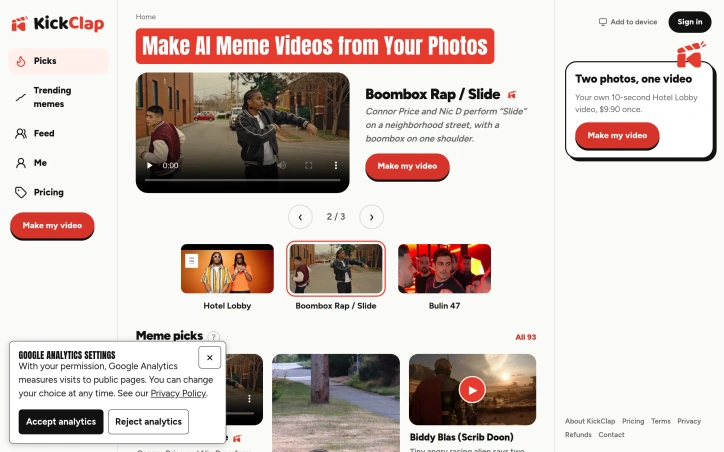

Turning memes into video requires the convergence of timing, luck, technical skill, and an intimate knowledge of internet culture. KickClap collapses that friction by packaging trending meme formats into a browser-based tool that converts uploaded photos into ready-made short videos. The platform targets internet culture enthusiasts and social media users who want to participate in viral trends without the learning curve of video production. The product works by offering template-based meme formats drawn from actual viral moments. Users select a template like "Hotel Lobby" or "Boombox Rap / Slide," upload their own photos, and the AI generates a 10-second video that mirrors the structure and style of the original trend. The approach democratizes what would otherwise require serious video editing knowledge or creative intuition. What separates KickClap from a straightforward video generator is its cultural literacy layer. Alongside the maker tool, the platform catalogs the meme references themselves, offering explanations of trends and links back to source material. This educational component serves dual purposes: helping newcomers understand why a template matters and giving context to why the output will resonate. The website displays examples anchored to genuine internet moments, from Nicole Kidman going viral as a song title to K-pop costume trends that dominated Halloween 2026. That specificity grounds the tool in real culture rather than hypothetical scenarios. The business model is straightforward. Video generation is paid per output, which aligns incentives cleanly: the platform benefits when users create more content. The founder emphasizes that both template format options and photo uploads require consent, suggesting a deliberate stance on rights and appropriateness, though the practical enforcement mechanisms remain unclear from the materials provided. The weakness is scope. The platform currently offers a handful of templates, which means the catalog will either need constant expansion to stay relevant or will quickly feel dated as internet trends move on. Meme culture accelerates rapidly, and a static library of formats risks becoming stale. The 10-second video length also caps creative expression compared to longer-form meme content. Still, the execution is focused and specific. KickClap identifies a real gap between wanting to participate in internet trends and having the skills to do so, then addresses it directly without unnecessary complexity.

KickClap preview
K

Key features

  • Template-Based Meme Formats: Users select from trending templates like 'Hotel Lobby' or 'Boombox Rap / Slide' drawn from actual viral moments
  • Photo to Video Conversion: Upload photos that are converted into AI-generated 10-second videos mirroring the structure of original trends
See full listing
Zipic

Professionals managing visual content face a persistent friction point: compressing images to save storage and bandwidth while maintaining acceptable quality, often across multiple formats and thousands of files. Zipic addresses this squarely with a native desktop application for macOS and Windows, built around the principle that image processing belongs on the user's device rather than uploaded to cloud servers. The product's core value proposition is straightforward but well-executed. It handles compression, format conversion, and resizing across a broad range of formats including JPEG, PNG, WebP, HEIC, AVIF, JPEG XL, TIFF, GIF, PDF, and SVG, plus platform-specific formats like ICNS on macOS and ICO on Windows. The compression claims near-lossless quality, demonstrated through a slider comparison showing a 403KB image reduced to 108KB without visible degradation. This matters for content creators, web developers, and designers working under storage or bandwidth constraints. What distinguishes Zipic from simpler competitors is its commitment to workflow integration. Beyond a straightforward graphical interface, it offers folder monitoring with custom rules, clipboard auto-compression, a command-line interface that returns structured JSON output and exit codes, Apple Shortcuts support on macOS, a Raycast extension, and an installable skill for Claude Code and other AI agents. The presence of these integration points suggests the product is targeting power users and professionals building automated pipelines, not casual users compressing a photo here and there. The native application approach carries real benefits. Zipic processes everything locally without requiring uploads or account creation, eliminating privacy concerns and latency. The desktop apps adapt to system themes and support drag-and-drop operation alongside hotkey access and menu bar integration. Custom presets allow users to switch between different compression profiles instantly, useful for workflows with varying quality and size requirements. The pricing model is straightforward: a free tier allowing 25 images daily with basic features, or a one-time Pro purchase that includes lifetime updates. This structure avoids recurring subscriptions and removes the friction of account management for local processing, though the 25-image daily limit on the free tier may frustrate heavy users quickly. The founder notes that metadata preservation and customizable notifications are available for Pro users, along with CLI access. These details suggest the product has matured beyond basics to support professional workflows. The compressed feature set and focus on reliability over feature sprawl indicate disciplined product design. Zipic occupies a specific but valuable niche: professionals who need reliable, fast, local image processing with minimal friction and automation-friendly APIs. It solves a real problem without unnecessary complexity.
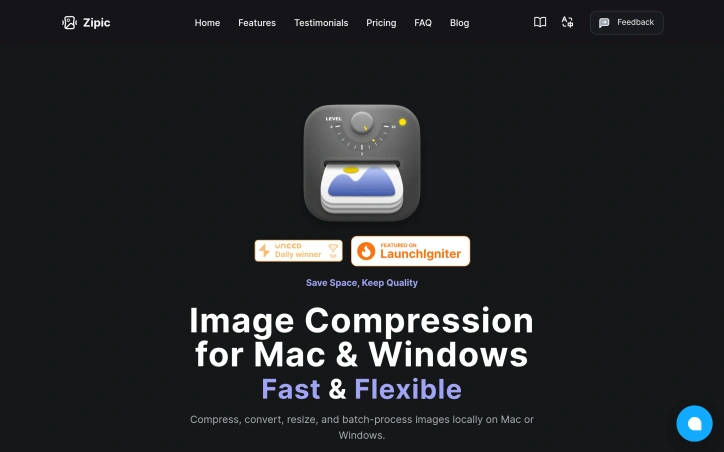
Photo-editing
Y
Ye Tian

Professionals managing visual content face a persistent friction point: compressing images to save storage and bandwidth while maintaining acceptable quality, often across multiple formats and thousands of files. Zipic addresses this squarely with a native desktop application for macOS and Windows, built around the principle that image processing belongs on the user's device rather than uploaded to cloud servers. The product's core value proposition is straightforward but well-executed. It handles compression, format conversion, and resizing across a broad range of formats including JPEG, PNG, WebP, HEIC, AVIF, JPEG XL, TIFF, GIF, PDF, and SVG, plus platform-specific formats like ICNS on macOS and ICO on Windows. The compression claims near-lossless quality, demonstrated through a slider comparison showing a 403KB image reduced to 108KB without visible degradation. This matters for content creators, web developers, and designers working under storage or bandwidth constraints. What distinguishes Zipic from simpler competitors is its commitment to workflow integration. Beyond a straightforward graphical interface, it offers folder monitoring with custom rules, clipboard auto-compression, a command-line interface that returns structured JSON output and exit codes, Apple Shortcuts support on macOS, a Raycast extension, and an installable skill for Claude Code and other AI agents. The presence of these integration points suggests the product is targeting power users and professionals building automated pipelines, not casual users compressing a photo here and there. The native application approach carries real benefits. Zipic processes everything locally without requiring uploads or account creation, eliminating privacy concerns and latency. The desktop apps adapt to system themes and support drag-and-drop operation alongside hotkey access and menu bar integration. Custom presets allow users to switch between different compression profiles instantly, useful for workflows with varying quality and size requirements. The pricing model is straightforward: a free tier allowing 25 images daily with basic features, or a one-time Pro purchase that includes lifetime updates. This structure avoids recurring subscriptions and removes the friction of account management for local processing, though the 25-image daily limit on the free tier may frustrate heavy users quickly. The founder notes that metadata preservation and customizable notifications are available for Pro users, along with CLI access. These details suggest the product has matured beyond basics to support professional workflows. The compressed feature set and focus on reliability over feature sprawl indicate disciplined product design. Zipic occupies a specific but valuable niche: professionals who need reliable, fast, local image processing with minimal friction and automation-friendly APIs. It solves a real problem without unnecessary complexity.

Zipic preview

Key features

  • Multi-Format Compression: Handles JPEG, PNG, WebP, HEIC, AVIF, JPEG XL, TIFF, GIF, PDF, SVG, ICNS, and ICO with near-lossless quality.
  • Local Processing: Processes all images on your device without uploads or account creation.
See full listing