
Microsoft Foundry Blog
Your source for learning and building with our models, agents, and tools.
Featured posts

What’s new in Microsoft Foundry | Ignite 2026

Microsoft Foundry Ignite 2026 updates for agents, developer tools, models, training, enterprise context, and governance, with continuous improvement.

What’s new in Foundry Agent Service at Ignite 2026

Your customers don't judge agents by how well they demo. They judge them by whether the work gets done: the case resolved, the report delivered, the follow-up s...
Latest posts

Hosted agents in your own virtual network: five checks when the Agents page times out

The five questions teams ask most when they run hosted agents in their own virtual network: which subnet is the agent subnet, why listing agents times out, why a TLS-inspecting firewall still breaks after you add your CA, how peered VNets and DNS fit, and why a subnet stays in use after you delete an account.

Serve open models in production with Foundry Managed Compute

Managed Compute serves open models on dedicated GPUs in Microsoft Foundry, with Global and US or EU Data Zone deployments.
Build trusted autonomous agents for your team with Microsoft Foundry

Enterprises are all-in on AI agents, but the ROI hasn’t followed. What’s holding those agents back isn’t capability. Today’s agents can do remarkable work on their own. They can solve math problems that stumped mathematicians for decades, build functional operating systems from scratch, and teach themselves a new skill by watching you do a task once. Bringing agents this powerful into the enterprise takes two things: they have to integrate with enterprise workflows, and they have to meet enterprise governance, security, and compliance requirements. Most fall short on both, and you see it as soon as you ask one t...

Hosted agents in Foundry Agent Service at Ignite 2026: from pilot to production inside your enterprise boundaries

What is new for hosted agents in Foundry Agent Service at Ignite 2026: shared subnet IPs, private CA trust, network egress controls, deployment to your own AKS clusters, resilient execution and memory snapshots.

Browser Automation Tool in Microsoft Foundry : Ignite’26 Announcements


Enterprise-ready cloud browsers for every Foundry agent: MCP action batching, Live View and Take control, session recording, VNet injection, browser proxy, profile reuse, secret management, and CAPTCHA handling.
The Foundry Dev Pack is here: build Foundry agents your way

Your next agent can start wherever you like to build: in your editor, at the terminal, or with your favorite coding agent. At Microsoft Ignite, we're making that first step easier: the Foundry Dev Pack (aka.ms/foundrydevpack) is now generally available, bringing the Microsoft Foundry developer tools to your machine in a single install. Move from setup to building, debugging, evaluating, and deploying agents in the environment you already know. The Dev Pack combines the Foundry CLI () and Microsoft Foundry Skill, and installs the Foundry Toolkit for VS Code and Foundry plugin for the GitHub Copilot app wh...

Build once, reuse across your agent fleet: Tools and Toolboxes in Foundry

Connecting one tool to one agent is not hard. The challenge is managing a useful set of tools and agentic capabilities across a fleet of production agents at scale. Every new agent shouldn't require you to build the same integrations, copy the same instructions, and troubleshoot the same dependencies. And adding a useful capability shouldn't require a separate rollout in every agent application. Toolboxes in Microsoft Foundry turn tools, skills, and agents into shared capabilities. Curate and version them in Foundry, expose them through one MCP endpoint, and reuse them across Foundry agents and other MCP-compa...

Content Understanding adds GPT-6.1, 6, and 5.6: Choose the right model for your workload

Azure Content Understanding now supports the GPT-5.6, GPT-6, and GPT-6.1 model families, giving you more choices for document, text, speech, and video workflows. This adds to the existing set of supported models like the GPT-5 series. To help customers understand how to use this expanded set of options, we're updating our model recommendations and sharing the evaluation data behind them. In our GPT-5 model-selection guide, we described model selection as a mixing board: adjust quality and cost for each workload. The new models add range to those controls. Not every workload needs to be set to maximum, so w...
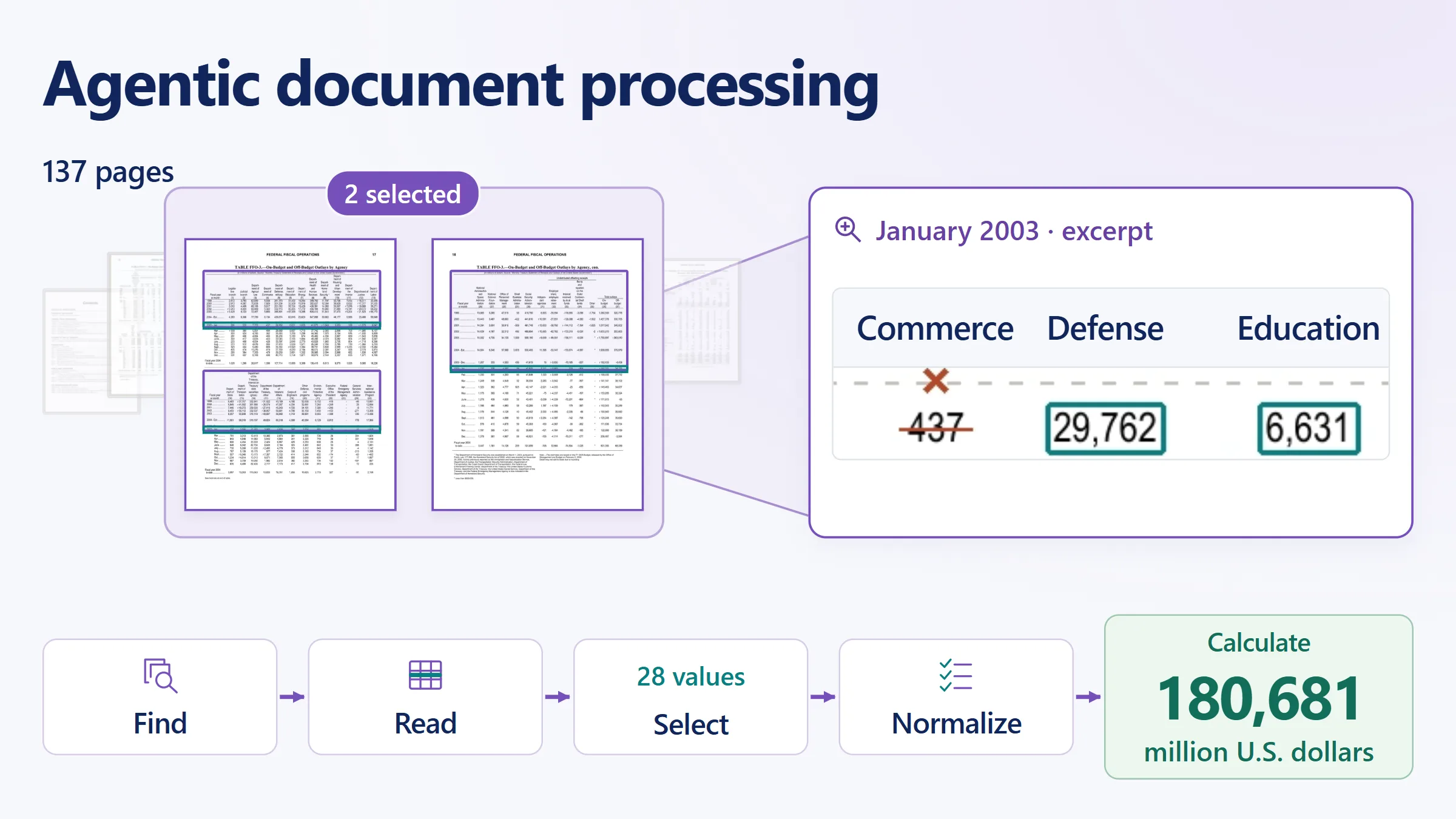
When one pass isn’t enough: agentic mode in Azure Content Understanding
Most document analysis takes one efficient pass. Learn how agentic mode gives AI a document-native harness for the hardest tasks, and when to choose it over standard mode. “Some books are to be tasted, others to be swallowed, and some few to be chewed and digested.” Francis Bacon, “Of Studies”, 1625 A.D. Francis Bacon once observed that an intelligent reader doesn’t consume every book the same way: some are swallowed whole, while a few must be chewed and digested. As we build specialized agents to process documents, we’re learning that lesson again. When we started building Azure Content Understanding in ...
