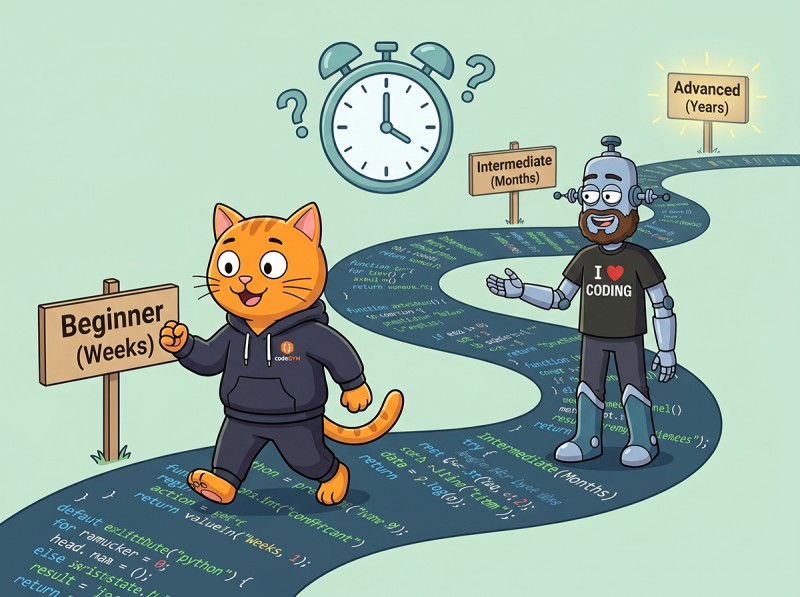
Short version: basics in 3-4 weeks at one hour a day, comfortable enough to build small projects in 3-6 months, and job-ready in 6-12 months. The longer answer depends on your prior experience, daily consistency, and what you mean by "learn." This page focuses on the time question specifically, for the broader picture of what Python is and how to start, see our complete guide to learn Python as a beginner. The brackets below are grounded in CodeGym's Python-learner cohort data and academic practice-hours research.
Key Takeaways
Across CodeGym's Python track (10+ years of cohort data, 2015-2026), beginners typically reach basics-fluency in 3-6 months and junior job-ready level in 6-12 months at 1-2 hours of daily practice.
Two weeks of intensive 4-hour days is the realistic minimum to write small scripts unassisted; one week is hello-world fluency only.
Prior coding experience in any language cuts your timeline by roughly 30-50%.
Most learners who quit do it in months 2-3 to the tutorial-loop trap, not because Python is hard.
Which Python Learning Goal Should You Pick First?
The phrase "learn Python" hides four very different goals, each with a different timeline. Sorting which one you actually want is the most useful thing you can do before opening any tutorial.
Goal
Time at 1 hr/day
Time at 2 hr/day
What you can do
Read and modify scripts
2 weeks
1 week
Tweak existing code
Write small scripts from scratch
2 months
1 month
Automate Excel, scrape pages
Build a portfolio project
4 months
2 months
Flask web app, data pipeline
Interview-ready for junior role
9 months
5 months
Live-coding fluency, portfolio
Data scientist entry-level
14 months
8 months
Pandas, ML basics, SQL
These numbers come from CodeGym's task-completion analytics across our Python learners since 2015. They assume consistent daily practice, not "30 hours one weekend, nothing for two weeks." Stack Overflow's 2024 Developer Survey adds context: 51% of professional developers use Python in their work, and most picked it up while already coding in another language (Stack Overflow Developer Survey, 2024).
What Affects Your Python Learning Timeline Most?
Four variables move your timeline more than anything else. The biggest is daily consistency. The smallest is the language itself.
Prior programming experience
If you already code in any language, expect to cut the timeline by 30-50%. Variables, loops, functions, and data structures transfer directly. You're only learning new syntax and Python's specific idioms (indentation, list comprehensions, the import system). The Stack Overflow Developer Survey 2024 found that 51% of professional developers already use Python alongside their primary language (Stack Overflow Developer Survey, 2024), which suggests most pros pick it up while working.
Daily consistency vs. weekend cramming
This matters more than most learners want to hear. Research from Springer's Educational Psychology Review on spaced versus massed practice finds that distributed sessions produce stronger retention than concentrated cramming, and the effect is largest for novel skills like coding (Springer Educational Psychology Review, 2021). Four 50-minute sessions across a week beat one 4-hour weekend marathon. The mechanism is working-memory recovery between sessions.
Practice vs. passive learning
Watching a Python video is not learning Python. Reading a Python book is closer, but still not enough. Writing code is. The split that works across CodeGym learners: roughly 70% active coding, 30% reading or watching. If your ratio is reversed, your timeline doubles.
Specialization choice
"Generic Python" is faster to learn than "Python for data science" or "Python for machine learning," because the latter come with pandas, NumPy, scikit-learn, statistics, and SQL on top. A career-switcher targeting data engineering should plan 12-18 months, not 6.
How Do You Build a 12-Week Roadmap?
For most beginners studying part-time, the first three months matter more than any other period. Get this right and the rest of the timeline takes care of itself. The full month-by-month plan is in our Python learning roadmap, but here is the compressed first quarter.
Weeks 1-2 — Syntax fluency
Variables, types, control flow (if, for, while), functions, lists, dictionaries, strings, basic file I/O. By day 14 you should be able to write a 30-line script without looking up syntax. The exit criterion is whether you can read someone else's small script and predict what it prints.
Weeks 3-4 — First mini-projects
Tip calculator, to-do CLI, simple weather script using a free API. Three projects, each ≤4 hours of work. Skip frameworks (no Django, no Flask, no machine learning). The point is gluing concepts together, not building anything impressive.
Weeks 5-8 — Intermediate concepts
Object-oriented programming, modules and imports, virtual environments, error handling, and basic API consumption with the requests library. By the end of week 8 you should be able to build a 200-line script with proper structure, not just a procedural blob.
Weeks 9-12 — Pick a specialization
Web (Flask), data (pandas), or automation (scripting + scheduling). Pick one. Build one portfolio-worthy project in your chosen track. By week 12 you have a complete, working, public-on-GitHub project to show.
How Do Daily Hours Translate to Total Months?
The single most useful chart for setting expectations. Based on CodeGym's observed cohort data, junior-level Python competence takes roughly 250-400 hours of focused practice. Divide that by your daily hours and you get a real timeline.Source: CodeGym Python track analytics, 2015-2026 cohort. Retrieved 2026-05-11.One pattern worth flagging: more than four hours of new-skill learning a day rarely works for adult beginners. Cognitive fatigue caps absorption, and the additional hours produce diminishing returns. If you're full-time and want to go fast, two 90-minute deep sessions with a long break in between beat one 4-hour grind.
Why Do Many Self-Taught Learners Slow Down?
The common reason people miss their timeline is not the language. It's three predictable traps that show up at predictable moments. The deep breakdown is in common Python mistakes beginners make. Here are the three that affect timelines most.
The tutorial-loop trap (month 2)
You finish a tutorial, feel like you know Python, hit a real problem, freeze, and reach for the next tutorial instead of pushing through. Escape it by writing 20 minutes of code daily without any guide, even when stuck. Confusion is the signal you're learning, not the signal to switch tutorials.
The framework-too-soon trap (month 3)
You finish basics and immediately jump to Django or scikit-learn before understanding decorators, decorators-of-decorators, or what self means. Frameworks reward fundamentals. Spend the extra month on intermediate Python before any framework.
The perfection trap (month 4-5)
You start a portfolio project, refactor it eight times, never finish it. Recruiters look at finished v1 projects, not perfect v8 architectures. Ship the ugly working version, then iterate. Whether Python is hard isn't the question. Whether you can finish is. The realistic difficulty floor is covered in how hard Python actually is for beginners.
Which Study Methods Match These Timelines?
The study method matters more than any specific resource. Three patterns hit the timelines above:
For 1-2 hours/day, 6-month track: Read the official Python tutorial at python.org cover to cover, then write three small scripts each week that mimic what you just read.
For evening pace, 1 hour/day, 9-month track: Pick a personal project you'll actually use (an automation, a data analyzer, a small bot) and code on it 30 minutes a day. Treat the project as the curriculum.
For intensive 4-hour/day, 3-month track: Run two 90-minute focused sessions per day on a graded task track with instant feedback, with a long break between. The shorter the feedback loop, the faster skills form.
If you want a structured path with instant feedback on every exercise, the CodeGym Python track is built for the consistency problem specifically: 800+ small tasks with automatic checking, organized into levels. First level is free, full curriculum on the pricing page.
Start with CodeGym Python — Free Tier
800+ practical tasks across 62 gamified levels. First level is free, no credit card required.
You can learn the basic syntax in one week of full-time study, but not enough to build anything meaningful or pass a junior interview. Across CodeGym's Python learners, two weeks of intensive 4-hour days is the realistic minimum to write small scripts unassisted. One week gets you hello-world fluency, not working skill.
Can I learn Python in 1 month?
Yes for fundamentals. Variables, control flow, functions, lists, dicts, and basic file I/O are realistically learnable in one month at four hours a day, five days a week. That maps to roughly 80 focused hours, the lower end of the basics threshold observed across CodeGym's Python learners. Job-ready is a different bar that takes 6-12 months.
Can I learn Python in 30 days for a job?
Realistically, no. 6-12 months of focused study is the typical range for entry-level Python roles based on CodeGym's cohort data. 30 days gets you syntax and one small project. Recruiter screens want 3-5 portfolio projects, Git fluency, and basic testing knowledge, which need months of consistent practice to build. Our Python interview questions for beginners shows what the bar actually looks like.
How long does it take to master Python?
Mastery is different from learning. Most professional Python developers report 3-5 years of full-time work before they feel mastery in their specialization (web, data, ML). The Stack Overflow Developer Survey 2024 shows 38% of respondents have coded for 15+ years (Stack Overflow, 2024), which gives a sense of the depth past the initial learning curve.
The Bottom Line: Pick Your Pace, Commit to Daily
Python isn't hard; finishing is. Most learners who hit their 6-month or 12-month timeline are the ones who showed up most days for an hour, not the ones who studied 8 hours every other weekend. Pick the daily commitment you can actually sustain, write the goal on something visible, and start today. The map is settled. The walking is what's left.
If you want the broader overview (what Python actually is, what you can build, how to structure your first month), start with our complete beginner's guide to learn Python.



GO TO FULL VERSION