Devpost
Participate in our public hackathons
Devpost for Teams
Access your company's private hackathons
Grow your developer ecosystem and promote your platform
Drive innovation, collaboration, and retention within your organization
By use case
Blog
Insights into hackathon planning and participation
Customer stories
Inspiration from peers and other industry leaders
Planning guides
Best practices for planning online and in-person hackathons
Webinars & events
Upcoming events and on-demand recordings
Help desk
Common questions and support documentation
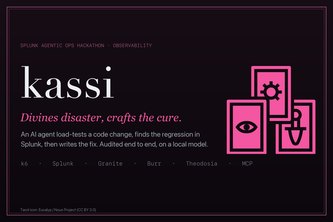
An AI agent on an audited state machine: it load-tests a code change, correlates the regression with Splunk telemetry, finds the root cause, and writes the fix, every step streamed back to Splunk.
Predictive Blast Radius for Splunk alerts — pushes future-cascade impact into the alert payload at fire time.
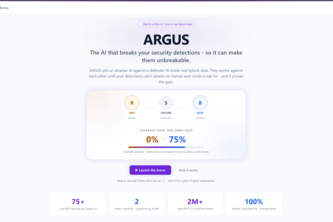
ARGUS finds the gaps in your Splunk detection rules before attackers do. One AI invents new attacks, another fixes the rule, and every improvement is proven live.
A multi-agent AI tool that refines Splunk logs pre-ingestion. It identifies noise, auto-generates nullQueue filters, and quantifies your storage and license savings.
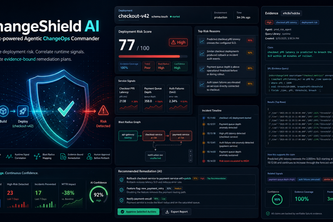
Splunk-grounded AI agents that catch risky deployments before they become incidents, scoring deploy risk, finding root cause, and writing human-approved fixes back to Splunk.
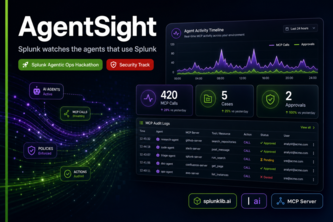
Who watches the MCP agents querying your Splunk data? AgentSight does - native Splunk observability for AI agents: real MCP audit logs, agent-specific detections, and splunklib.ai investigation.
Describe a Splunk add-on in plain English; an AI agent inside Splunk using the Splunk Agent SDK, builds it with ucc-gen, validates with AppInspect, and self-corrects until the package ships clean.
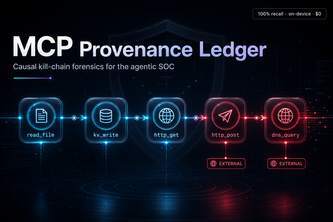
Kill-chain forensics for the agentic SOC, native to Splunk, narrated on-device, $0.
Ten AI agents that autonomously engineer, red-team, and deploy Splunk detections — cutting alert noise 99% while proving MITRE coverage, ROI and compliance.
An autonomous security agent that uses the Splunk MCP Server to triage alerts, execute SPL queries, and write MITRE-aligned incident reports in 90 seconds.
Unravel reconstructs an active intrusion (phishing to domain compromise) from live Splunk telemetry and tells us what happened, why it matters, and what to do, while the attack is still in progress.
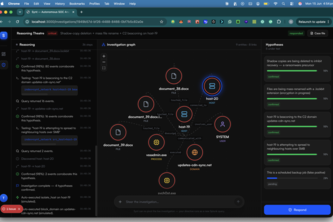
An autonomous SOC analyst on Splunk: it forms hypotheses, queries via the MCP Server, reasons with hosted models, and hands you a MITRE-mapped case file with a one-click response.
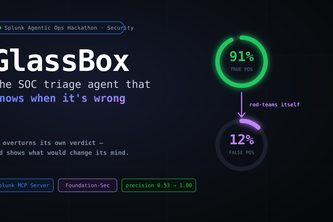
An agentic SOC analyst for Splunk: investigates alerts via the MCP Server, reasons with Foundation-Sec, red-teams its own verdict, and proves it cuts false alarms without missing attacks.
Splunk-native agent that captures SOC analyst reasoning, not just events, and serves it back as SPL commands, a CLI, and MCP tools for AI agents.
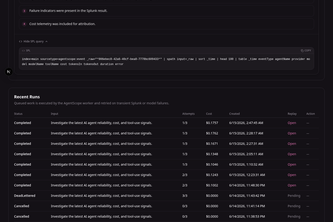
A control plane that queues agent work, a black-box recorder that captures every model call and tool invocation through the Splunk MCP Server to produce a risk-graded operations report.
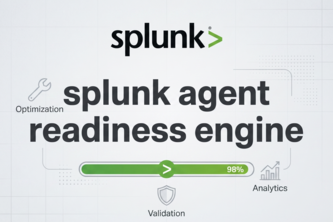
Splunk MCP Server connected AI to Splunkbase,without semantic descriptions,most apps remain unusable by agents.Our solution autogenerates this missing semantic data,making any Splunk app agent ready
Splunk multi-agent war room: a fired detection becomes an auditable incident brief plus a backtested SPL fix that cuts false alarms 75%, in under 3 minutes.
Keep-powered alert correlation meets Shuffle-backed response and Splunk-native AI investigation.
Disaster coordination that works when the grid goes down.
AI agent that triages Splunk security alerts end-to-end — writing its own SPL through the Splunk MCP Server and returning a MITRE-mapped verdict in seconds.
Your SOC's AI co-pilot — detects, investigates, and explains every threat before your analyst opens a ticket.
An autonomous vulnerability management agent inside Splunk that ingests live CVE threats, scores business risk with AI, and self-remediates critical exposures—from detection to containment in seconds.
Co>dev is an AI-powered Splunk Copilot that prevents costly searches, automates CIM onboarding, deploys dashboards from natural language, and monitors itself through a closed-loop telemetry system.
Paste a threat advisory; an AI agent writes a Splunk detection, backtests it against real attack data, fixes its own false positives, and deploys it on your approval — in minutes.
1 – 24 of 315