Discover next-gen
AI tools & startups.
Curated directory of the best AI tools. Submit your project to get high-quality backlinks and traffic.
Why Choose thistools?
thistools is your go-to platform for discovering cutting-edge AI tools and innovative tech products. We curate the best tools from around the world, helping you find the perfect solutions for your productivity, automation, and creative needs.
Daily Curated Picks
Every day, we feature fresh AI tools and startups selected for quality and launch momentum.
Quality-First Curation
We prioritize tools that solve genuine problems and offer exceptional user experiences.
Community-Driven Rankings
Trending lists are driven by real user feedback so the most valuable tools rise.
>> LAUNCHING_TODAY

Klyve is an AI-powered platform designed to generate professional motion graphics videos from a user's prompt. It is intended for SaaS companies and individuals who need to create engaging promotional content without the extensive time, cost, or technical expertise typically required. The traditional process of creating a high-quality motion graphics video often involves significant investment, either through hiring expensive freelance designers and agencies or dedicating substantial personal time to learning and operating complex software like After Effects. This can be a major bottleneck for startups and businesses looking to quickly produce marketing materials. Klyve addresses this challenge by employing a suite of seven specialized AI agents. These agents collaboratively handle the entire video production pipeline. The process begins with an AI agent generating a script based on the user's prompt. Following the script, another agent creates a storyboard to visualize the video's flow. Subsequently, AI agents manage the animation and rendering phases, bringing the storyboard to life as a polished motion graphics video. Key features of Klyve include its ability to compose bespoke, on-brand motion graphics ads. The platform can incorporate a user's specific brand colors, product screenshots, and narration directly into the generated video. This ensures that the final output is not only professional but also accurately reflects the user's brand identity and product. Unlike traditional methods that require manual keyframing and intricate timeline editing in software like After Effects, Klyve automates these complex processes. Users do not need to possess any technical skills in motion design or video editing. The system is designed for simplicity, requiring only a prompt and brand assets to produce a finished ad. Klyve's unique approach involves an AI director that orchestrates the seven specialized agents. A critical aspect of its internal workings is the generation of structured output that is validated against a schema before rendering. This method prevents the AI from writing freeform animation code, which can lead to unpredictable errors, and instead ensures consistent quality and reliability in the final video output. The primary benefit for users is the significant reduction in time and cost associated with video production. Klyve enables the creation of professional-grade motion graphics ads that would typically cost upwards of $1,000 and take two weeks to produce, all generated quickly and efficiently from a simple text prompt. Concrete use cases for Klyve include generating launch videos for new SaaS products, creating promotional ads for existing software features, or producing explainer videos that clearly communicate a product's value proposition. Businesses can quickly iterate on marketing messages by generating multiple video variations from different prompts. While specific pricing tiers are not detailed, the content mentions "Free Options," suggesting that some form of free access or trial may be available. The platform is web-based, accessible through a browser, and its technology stack includes components like Claude Code and AWS Lambda, indicating a cloud-native architecture. The target audience includes SaaS companies, marketers, and product managers who need efficient video creation solutions. In summary, Klyve offers a streamlined, AI-driven solution for generating professional motion graphics videos, democratizing video production for businesses by removing technical barriers and reducing costs.

KlientFlow is a specialized CRM designed to help freelancers and solo founders effectively manage their client outreach and follow-up processes. It focuses on proactive engagement by highlighting who is waiting for a response today, rather than just recording past interactions. The tool aims to prevent lost opportunities by ensuring timely and context-aware communication with potential and existing clients across various digital platforms. The problem KlientFlow addresses is the common challenge of losing track of client conversations and forgetting to follow up, which can lead to missed business opportunities. Traditional CRMs often focus on logging historical data, but they may not provide a clear, actionable view of immediate follow-up needs. For individuals managing their own outreach, this can result in a disorganized workflow, overwhelming spreadsheets, or missed client requests, ultimately impacting business growth. One of KlientFlow's key features is its ability to preserve the context of each conversation. This means that when it's time to reply, users have immediate access to the details of their previous interactions, ensuring that follow-up messages are relevant and personalized. This feature is crucial for building rapport and demonstrating attentiveness to clients. Another core capability is the automated scheduling of follow-ups. Instead of relying on manual reminders or complex calendar systems, KlientFlow manages the timing of your next outreach. This ensures that no potential client falls through the cracks due to an oversight, providing a consistent and reliable follow-up system. KlientFlow also incorporates AI-assisted drafting to streamline the message creation process. When a follow-up is due, the tool can prepare an editable draft, saving users time and effort. This feature helps maintain a professional tone and ensures that messages are well-crafted, even when users are busy. The platform integrates with popular outreach channels, including LinkedIn, Instagram, and email. This allows users to manage their communications across these different platforms from a single, unified interface, simplifying their workflow and reducing the need to switch between multiple applications. KlientFlow's unique approach is its focus on what's next. It shifts the paradigm from retrospective CRM data to a forward-looking, action-oriented system. By presenting users with a clear list of who needs a response today, it empowers them to prioritize their outreach efforts efficiently. The primary benefit for users is the assurance that they will not lose clients due to forgotten follow-ups. This leads to improved client relationships, increased conversion rates, and ultimately, business growth. By automating and organizing the outreach process, KlientFlow frees up valuable time for freelancers and solo founders to focus on other aspects of their business. Concrete use cases include freelancers managing inquiries from potential clients on LinkedIn, solo founders following up with leads generated from Instagram DMs, or even individuals needing to schedule a reminder to respond to an important email after a specific period. The tool is designed for scenarios where consistent, context-aware communication is key to closing deals or nurturing relationships. KlientFlow is currently offered for free, indicating a freemium or early-access model. It is primarily a web-based application, catering to users who manage their outreach digitally. While specific integrations beyond the mentioned platforms are not detailed, the focus is on streamlining outreach for freelancers and solo entrepreneurs. In summary, KlientFlow provides a focused solution for managing client outreach, ensuring that no opportunity is missed by intelligently scheduling follow-ups and preserving conversation context, making it an indispensable tool for busy professionals.

Bolcho AI is a specialized AI voice platform engineered to empower businesses in building, deploying, and scaling sophisticated multilingual AI phone and web agents. It is meticulously crafted to cater to the unique linguistic landscape of India, offering native language support, exceptionally low latency, and seamless telephony integrations. This platform provides the flexibility for developers to incorporate their preferred Large Language Models (LLMs), Speech-to-Text (STT), and Text-to-Speech (TTS) providers, enabling the creation of highly customized and effective voice AI solutions. The development of Bolcho AI stems from a recognized gap in the market: while voice AI technology has advanced significantly, many existing platforms are designed with a Western-centric approach. These platforms often struggle with the complexities of Indian languages, regional accents, the intricacies of Indian telephony systems, and the low latency required for natural, human-like conversations. Bolcho AI addresses these challenges by providing an infrastructure specifically built to overcome these limitations, ensuring that AI agents can communicate effectively and naturally with users across India. One of the core capabilities of Bolcho AI is its robust support for multilingual interactions. The platform is designed to handle a wide array of Indian languages, ensuring that businesses can connect with their customers in their preferred language. This native language support extends to understanding regional accents and nuances, which are often stumbling blocks for generic voice AI solutions. Furthermore, Bolcho AI prioritizes ultra-low latency in its operations. This is critical for maintaining conversational flow, preventing awkward pauses, and ensuring that the AI agent responds in near real-time, mimicking human conversational speed and responsiveness. Flexibility in the AI stack is another key feature. Bolcho AI allows businesses and developers to bring their own LLMs, STT, and TTS providers. This 'bring-your-own' approach is invaluable for organizations that have specific requirements, existing investments in certain AI models, or a desire for greater control over the performance and characteristics of their voice agents. It means users are not locked into a proprietary ecosystem and can leverage the best-in-class components that suit their needs, whether for accuracy, cost-effectiveness, or specific language capabilities. Bolcho AI also integrates seamlessly with telephony systems. This is essential for deploying AI agents that operate over phone lines, enabling businesses to automate voice-based customer interactions. The platform simplifies the process of connecting AI capabilities to existing phone infrastructure, making it easier to launch voice agents for various business functions. The goal is to enable the rapid deployment of production-ready voice agents, significantly reducing the time and effort required to bring AI-powered communication solutions to market. The overall approach of Bolcho AI is to provide a comprehensive yet flexible infrastructure for voice AI. Instead of offering a one-size-fits-all solution, it provides the foundational technology and the necessary integrations, allowing businesses to build agents tailored to their specific use cases and linguistic requirements. This focus on adaptability and localization is what sets Bolcho AI apart from more generic voice AI platforms. The benefits for users are substantial. By leveraging Bolcho AI, businesses can achieve greater efficiency in their customer service and sales operations, reduce operational costs, and improve customer satisfaction through more natural and localized interactions. The ability to deploy agents quickly means faster time-to-market for new communication strategies and a quicker return on investment. Concrete use cases for Bolcho AI include automating customer support to handle frequently asked questions and resolve common issues, streamlining sales processes by engaging potential leads and qualifying them, and managing appointment bookings for various services. It can also be used for customer engagement initiatives, such as conducting surveys or providing information, all in the local language. Bolcho AI is positioned as a web-based platform, offering accessibility and ease of use for businesses. While specific pricing tiers are not detailed, the mention of 'free options' suggests a freemium model or a free tier for initial access. The platform is targeted at businesses operating within India, including those in sectors like sales, support, healthcare, education, and government services, who need to communicate effectively with a diverse, multilingual customer base. In summary, Bolcho AI offers a powerful, localized, and flexible solution for building and deploying AI voice agents in India, enabling businesses to connect with their customers more effectively through natural, multilingual conversations.

TextMyPill is a service designed to help individuals and their families manage medication adherence through automated reminders sent via WhatsApp. The platform aims to simplify the process of remembering to take medications by leveraging existing communication channels and artificial intelligence, making it accessible to users of all ages and technical abilities. The core problem TextMyPill addresses is the difficulty many people, particularly the elderly or those with complex medication schedules, face in consistently taking their prescribed drugs. Traditional reminder apps often require new downloads, account creations, and learning new interfaces, which can be significant barriers. This leads to missed doses, reduced treatment efficacy, and potential health complications. TextMyPill bypasses these hurdles by integrating directly into a widely used application, WhatsApp. One of the key features of TextMyPill is its AI-powered prescription scanning. Users can simply snap a photo of a handwritten or printed prescription, and the AI automatically reads and processes the medication details. This eliminates the need for manual data entry, saving time and reducing the potential for errors. The system then uses this information to set up timely reminders. Another significant capability is the delivery of reminders directly through WhatsApp. This approach ensures that reminders reach users on a platform they are already familiar with and use frequently. The service avoids the need for patients to download any new applications or create additional accounts, thereby removing a major barrier to adoption, especially for older family members. TextMyPill also offers comprehensive family management. A single dashboard allows users to set and manage medication reminders for multiple family members, including parents, spouses, and themselves. This centralized control is particularly useful for caregivers who are responsible for the medication schedules of several individuals, providing peace of mind and efficient oversight from anywhere in the world. Confirmation and tracking are streamlined through simple interactions within WhatsApp. Family members can confirm they have taken their dose by replying with a simple message like "Taken it." If a dose is missed, Pillo automatically follows up with reminders and notifies the caregiver. The platform also provides adherence tracking, allowing users to see who took what and when, offering valuable insights into medication compliance. TextMyPill employs a unique methodology centered on minimizing user friction. By integrating with WhatsApp and utilizing AI for prescription input, it ensures a zero-behavior-change approach for the patient. The system is designed to be intuitive and accessible, focusing on delivering timely prompts and confirmations without demanding new technological skills from the user. The benefits for users include improved medication adherence, reduced risk of missed doses, and greater peace of mind for both patients and caregivers. The platform's multilingual support in English, Hindi, and Marathi adds a personal touch, making reminders more relatable and effective for a diverse user base. Specific use cases for TextMyPill include managing daily medications for chronic conditions like hypertension and diabetes, ensuring children take their prescribed medicines on time, and assisting elderly family members with complex medication regimens. It's also beneficial for individuals managing multiple prescriptions with different timings throughout the day. TextMyPill is available with a free 7-day trial. The service is built with technologies like Supabase and Cloudflare Pages, and it operates as a web-based platform. The target audience includes individuals seeking a simple, effective way to manage their own or their family's medication schedules, particularly those who find traditional reminder apps cumbersome. In summary, TextMyPill offers a user-friendly, AI-enhanced solution for medication reminders, leveraging WhatsApp to ensure consistent adherence without requiring new app downloads or complex user interfaces, thereby simplifying healthcare management for families.

YourSitee is a visual link-in-bio platform designed for creators, businesses, and individuals seeking a unified and personalized online presence. It aims to move beyond the typical list of buttons, offering a more engaging and branded experience for users to showcase their digital footprint. The problem YourSitee addresses is the fragmented nature of online identities and the often uninspired presentation of link-in-bio pages. Many existing solutions feel like generic lists or overly complex tools, failing to capture the unique personality of the user. YourSitee seeks to bridge this gap by providing a flexible yet simple platform that allows for genuine self-expression. Key features include a highly customizable page builder with over 20 diverse widgets. These widgets range from social media embeds, videos, and images to more functional elements like countdown timers, event listings, and custom markdown sections, allowing users to tailor their page to their specific needs and content. The platform also boasts an AI Editor that simplifies the migration process by enabling users to import their existing Linktree pages or social profiles by simply pasting a URL, significantly reducing the effort required to switch platforms. For those looking to understand their audience, YourSitee includes built-in analytics. This feature allows users to track essential metrics such as page visits, click-through rates on individual links, geographical data of visitors, and identify their top-performing content. This data provides valuable insights into audience behavior and content effectiveness. The platform emphasizes personalization, allowing users to build a page that truly reflects their brand or personal style, rather than a generic template. The AI import feature is designed to make the transition from other services seamless, ensuring that users are not held back by the migration process. YourSitee operates on a philosophy of providing a robust free experience while offering advanced features through a Pro plan. The core functionality, including page building and basic analytics, is available for free, with an option to try the Pro version for 30 days. This approach aims to make the platform accessible to a wide range of users. The benefits for users include a consolidated online presence, a more visually appealing and personalized bio link, deeper insights into audience engagement through analytics, and a simplified content management process. It empowers users to present a cohesive and professional image online. Concrete use cases for YourSitee include musicians sharing their latest releases and tour dates, influencers linking to their social media, e-commerce businesses directing customers to products, and personal brands showcasing their portfolio and services. It's ideal for anyone who needs to centralize their online links and content in one accessible location. YourSitee is positioned for creators, businesses, and individuals active on social media. While specific pricing tiers beyond the free option and a 30-day Pro trial are not detailed, the platform is accessible via web. Integrations mentioned include social platforms like Instagram, YouTube, TikTok, X, LinkedIn, GitHub, Spotify, Discord, Twitch, and payment platforms like Patreon and Ko-fi, among others. In essence, YourSitee offers a modern, customizable, and insightful solution for managing your digital identity, making your bio link a valuable asset rather than just a list of links.

InvoProof is a platform designed to help freelancers automatically generate verified reviews and build a credible public portfolio. It serves freelancers by transforming every paid invoice into a verifiable case study, ensuring that their professional achievements are backed by genuine client feedback. The primary purpose is to provide a trustworthy and automated way for freelancers to showcase their work and client satisfaction. Traditionally, freelancers often face challenges in collecting genuine testimonials. Many existing review systems rely on self-reporting or manual requests, leading to a lack of trust and the prevalence of fake reviews. This makes it difficult for potential clients to assess a freelancer's true capabilities and reliability, leaving many portfolio pages with blank or unconvincing testimonial sections. One of the core features of InvoProof is its invoice-verified review system. When a freelancer sends a professional invoice and the client successfully pays it, the client is prompted to leave a review. This review is provably tied to that specific real payment, ensuring its authenticity. This eliminates the need for freelancers to chase clients for feedback, as the process is automated and directly linked to the transaction. Another key capability is the automatic creation of case studies. Once a client leaves a verified review, InvoProof transforms this feedback into a case study that is automatically added to the freelancer's public portfolio. This provides concrete, verifiable proof of the freelancer's work and client satisfaction, enhancing their professional credibility without manual intervention. The platform also includes a professional invoice builder. This tool allows freelancers to create and send clean, professional invoices to their clients, streamlining the billing process. Alongside the invoice builder, InvoProof offers a status tracker for all invoices. This feature helps freelancers keep tabs on where each invoice stands, from creation to payment, improving financial management and client communication. Furthermore, InvoProof provides a shareable portfolio page. This dedicated page consolidates all the verified case studies and reviews, offering a comprehensive overview of a freelancer's expertise and client feedback. This page can be easily shared on professional platforms like LinkedIn and X, making it simple for potential clients to access and verify a freelancer's track record. InvoProof operates on a unique methodology that directly links client reviews to financial transactions. By using a one-time token generated upon payment, the system ensures that only clients who have actually paid for services can leave a review. This creates a closed-loop system that guarantees the integrity of the feedback and the resulting case studies. The benefits for users are significant. Freelancers gain enhanced credibility and trust from potential clients due to the verified nature of their reviews and case studies. The automation of testimonial collection and portfolio updates saves valuable time, allowing freelancers to focus more on their core work. Ultimately, InvoProof helps freelancers close more deals by presenting undeniable proof of their skills and client satisfaction. Concrete use cases for InvoProof include a graphic designer who uses it to automatically gather verified reviews for logo designs and branding projects, which then populate their portfolio. A web developer can use it to showcase client feedback on completed websites, directly linked to paid project invoices. Freelance writers can use it to display verified reviews for articles and content creation services, building trust with potential clients seeking writing expertise. InvoProof is primarily targeted at freelancers across various industries. The platform is web-based, ensuring accessibility from any device. While specific tech stack details are not provided, it functions as a SaaS product. The service offers a free tier for up to 3 projects, with paid plans available for more extensive use, including a $9/month option or a $49 lifetime purchase. This tiered pricing makes it accessible for freelancers at different stages of their careers. In summary, InvoProof offers a powerful, automated solution for freelancers to build trust and credibility by converting paid invoices into verified case studies, simplifying the process of showcasing client satisfaction and professional achievements.

Finamie is a personal finance tool designed to help users effortlessly log expenses and gain immediate, detailed insights into their spending habits. It is built for individuals who find traditional expense tracking cumbersome and time-consuming, offering a more intuitive and accessible way to manage their money. The core problem Finamie addresses is the friction associated with manual expense logging. Many existing expense trackers require users to open an app, manually input transaction details, select categories, and add notes. This process often leads to incomplete data as users eventually stop tracking, rendering the financial data less useful. Finamie aims to solve this by making the logging process as simple as speaking, ensuring more consistent and comprehensive financial tracking. One of the key features of Finamie is its voice-logging capability. Users can simply hold a button and state their expenses, and the app automatically extracts the amount, currency, category, and description. This hands-free approach significantly reduces the time and effort required to record transactions, making it easier to maintain an accurate financial record. Beyond simple logging, Finamie provides instant spending insights. It connects recorded transactions to income and financial goals, offering analytics that reflect a user's actual financial situation rather than generic charts. This personalized approach helps users understand their spending in a more meaningful context. Finamie also introduces a novel way to create custom analytics. Users can describe the specific insights they want to track in a chat interface, eliminating the need to navigate complex settings screens. This conversational approach to data analysis makes it more accessible for users to get the information they need. An important aspect of Finamie's design is its user-friendly onboarding. It allows users to record transactions and see initial analysis before creating an account. This record-before-signup approach removes initial friction and allows users to experience the value of the tool immediately, aligning with the goal of making financial tracking less daunting. Finamie works by leveraging voice recognition to capture expense data, which is then processed to extract key financial details. This data is integrated with income and goal information to generate personalized financial analytics. The platform's unique approach lies in its conversational interface for creating custom reports and its emphasis on a frictionless user experience from the very first interaction. The benefits for users include a more consistent and complete financial record due to the ease of voice logging. Users can expect to gain a better understanding of their spending patterns, track progress towards financial goals more effectively, and access personalized financial insights without the usual complexities of financial management tools. Concrete use cases for Finamie include individuals who are constantly on the go and need a quick way to log expenses, such as freelancers or business travelers. It's also beneficial for those who struggle with the discipline of manual data entry for budgeting apps. Anyone looking to get a clearer picture of where their money goes, from daily coffee purchases to larger expenditures, can utilize Finamie. Finamie is available as a web application. The product is offered for free. The target audience includes individuals seeking a simpler, more engaging way to manage their personal finances and gain insights into their spending habits. In summary, Finamie revolutionizes expense tracking by enabling users to log expenses through voice commands, providing instant, personalized financial insights and making money management more accessible and less burdensome.

Zen Whisper is a dictation tool designed for Mac users who need a private and efficient way to convert speech to text across all their applications. It empowers individuals to dictate directly into any app by simply holding a shortcut, ensuring that their audio data remains on their device. The core speech recognition technology operates locally, providing a secure and privacy-focused dictation experience. The problem Zen Whisper addresses is the common limitation of existing dictation tools, which often rely heavily on cloud processing. This can raise privacy concerns and introduce latency. For professionals and individuals who handle sensitive information or simply prefer to keep their data local, cloud-based dictation is not ideal. Zen Whisper offers a solution by bringing powerful speech recognition directly to the user's Mac, making dictation both accessible and secure. One of the key features of Zen Whisper is its on-device speech recognition. This means that the core process of converting spoken words into text happens entirely on your Mac, without any audio being sent to external servers. This ensures a high level of privacy and security for your dictation. Another significant capability is its ability to dictate into any Mac application. By holding a shortcut, users can seamlessly input text into documents, emails, code editors, or any other software, making it a versatile tool for various workflows. Zen Whisper also provides searchable transcripts. After dictating, users can easily search through their past transcriptions, allowing them to quickly find specific information or review previous notes. The product includes voice memo functionality, enabling users to record and transcribe longer audio segments directly within the app. Furthermore, it offers media transcription, which allows for the transcription of audio and video files, as well as supported links, making it useful for content creators and researchers. For users requiring advanced capabilities, Zen Whisper offers Pro tools. These tools are designed to enhance the dictation and transcription experience, potentially including support for larger local models for improved accuracy or advanced features like translation. The product also supports over 100 languages, with a particular focus on strong multilingual workflows for users in India, catering to a diverse user base with specific language needs. The overall workflow of Zen Whisper is designed to be integrated and seamless. Users activate dictation with a shortcut, speak, and the text appears in their chosen application. The local processing ensures speed and privacy. Post-dictation, features like transcript search and voice memos are readily available within the app, creating a cohesive environment for managing spoken and written content. The benefits for users include enhanced privacy due to on-device processing, increased efficiency by dictating directly into any app, and the convenience of having all transcription-related tools in one place. The ability to transcribe various media types and support for numerous languages further adds to its value proposition. Concrete use cases for Zen Whisper include quickly drafting emails or documents, taking notes during meetings without typing, transcribing interviews or lectures, capturing ideas on the go, and even dictating code or technical terms with the aid of its dictionary and snippet features. For multilingual users, it facilitates communication and content creation across different languages. Zen Whisper is targeted at Mac users, including writers, developers, students, and professionals who value privacy and efficiency. While specific pricing tiers are not detailed, it is mentioned that the product starts with a free trial, remains usable on a free tier, and offers paid scaling options. The platform is primarily for macOS. In summary, Zen Whisper provides a private, on-device dictation solution for Mac users, enabling seamless text input into any application while offering powerful features like searchable transcripts, media transcription, and multilingual support.

PraiseEngine is an AI-native review platform designed to streamline the process of collecting and publishing customer testimonials. It aims to convert customer conversations into valuable social proof that can enhance a business's online presence and credibility. The platform is built for a variety of users, including solopreneurs, SaaS scaleups, and agencies, all of whom require automated trust generation without the risks associated with auto-publishing. The core problem PraiseEngine addresses is the inefficiency and ineffectiveness of traditional review collection methods. A blank textarea, often presented to happy customers, leads to writer's block, resulting in generic or non-existent reviews. Furthermore, auto-publishing reviews introduces risk, while manual collection methods result in scattered feedback across various documents and communication channels. This fragmentation makes it difficult to leverage customer insights effectively. PraiseEngine offers a solution through its AI-native review loop, making customer feedback collection frictionless and accurate. A key feature is the 3-question adaptive interview, which replaces intimidating open-ended textareas with a short, context-aware Q&A tailored to the specific business. This conversational approach guides customers through sharing their real results and experiences. Another significant capability is the grounded AI drafting. This feature transforms customer answers into polished, editable reviews by extracting only their actual words, thereby preventing AI hallucinations and ensuring accuracy. This ensures that the testimonials are authentic and directly reflect the customer's experience. The platform incorporates an approve-first moderation gate, giving teams complete control over the review process. Users can review and approve or reject each entry before it is published, mitigating the risks associated with auto-publishing and maintaining brand integrity. PraiseEngine also facilitates the creation of an SEO flywheel through dual embeds and public profiles. Testimonials can be published via one-line website embeds or as indexable SEO review profiles that utilize Review JSON-LD schema. These profiles also provide backlinks, further boosting search engine visibility. The overall methodology of PraiseEngine involves replacing the passive collection of reviews with an active, guided interview process powered by AI. This ensures that the feedback gathered is not only accurate but also compelling and useful for marketing purposes. The platform emphasizes user control through its moderation system and provides multiple options for showcasing the collected social proof. The benefits for users include automated trust generation, improved SEO through indexable review profiles and JSON-LD schema, and a more efficient collection process that overcomes customer writer's block. By leveraging AI, PraiseEngine ensures that testimonials are grounded in customer words, providing authentic social proof. Concrete use cases for PraiseEngine include embedding a widget of top customer reviews on a company's website, showcasing customer success stories on a dedicated public profile page, and using the collected testimonials for marketing campaigns. The platform can also be used to gather feedback for product development or service improvements. PraiseEngine offers a Free plan, with paid tiers including Starter ($29), Growth ($79), and Agency ($199), each with defined team seat limits. Paid plans offer features like custom profile colors, custom widget colors, and removal of the "Powered by PraiseEngine" badge. The platform supports 11 locales for widget language selection and offers four display layouts for widgets: Standard, Grid, Carousel, and Marquee. Reviews can be sorted by rating, date, or other criteria in both the dashboard and public profiles. In summary, PraiseEngine is an innovative AI-driven platform that simplifies the collection and deployment of customer testimonials, transforming them into powerful, SEO-optimized social proof that builds trust and enhances online visibility.

Termexo is a local Windows workbench designed to enhance the workflow of developers using AI coding agents such as Claude Code and Codex. It aims to consolidate these tools into a single, manageable, and recoverable workspace, streamlining the process of interacting with multiple AI agents simultaneously. The problem Termexo addresses stems from the increasing complexity of managing multiple AI coding agents. Developers often find themselves juggling several projects, each potentially utilizing different AI models or requiring distinct configurations. This can lead to a fragmented workflow, where managing terminal sessions, API keys, and agent states becomes more time-consuming than the actual coding tasks. The need for a unified and efficient environment for these powerful tools is paramount for productivity. One of the core features of Termexo is its ability to arrange real PTY terminals in custom grids. This allows users to visualize and manage multiple agent sessions concurrently, creating a personalized workspace layout that suits their specific needs. This visual organization helps in keeping track of different tasks and agents without losing context. Termexo also excels in session recovery. It enables users to search for and resume native sessions, meaning that even after a reboot or application restart, the context of previous work can be restored. While it does not checkpoint live processes, it restores the workspace layout, model/profile selection, and conversation context, allowing agents to be relaunched with their previous state. Files written during a session are preserved on disk, ensuring that progress is not lost. Another significant capability is the notification system. Users are alerted when an agent requires approval, preventing tasks from stalling and reducing the need for constant manual monitoring. This proactive notification system ensures that developers can attend to agents only when necessary, maintaining focus on their primary coding tasks. Furthermore, Termexo simplifies the management of AI models. It allows users to switch between Claude-compatible model profiles without the need to rebuild environment variables. Crucially, API keys are securely stored in Windows Credential Manager and are isolated per model profile, ensuring that different projects or clients have their credentials separated and protected. Termexo operates on a local-first principle, meaning it runs directly on the user's Windows machine without requiring a Termexo account. This approach enhances privacy and security, as all data and configurations are stored locally. The application is designed to run agents on native Windows, avoiding potential path translation issues that can arise with WSL workarounds. The benefits for users include increased productivity through better organization and session management, reduced context-switching overhead, and enhanced security for API keys. By centralizing AI agent interactions, Termexo frees up developers to focus more on coding and less on managing their development environment. Concrete use cases for Termexo include managing multiple AI agents for different projects simultaneously, such as one agent working on backend development while another assists with frontend tasks. It's also ideal for developers who frequently switch between client projects and personal projects, needing to maintain separate configurations and API keys. Recovering from unexpected system reboots or application crashes without losing significant work is another key scenario. Termexo is specifically designed for Windows users. While specific pricing details are not provided, it is offered for free. The product falls under categories such as Productivity, Developer Tools, and Artificial Intelligence, catering to developers and technical users who leverage AI in their coding workflows. In summary, Termexo provides a robust, local Windows environment for managing AI coding agents, offering features like custom terminal grids, session recovery, approval notifications, and secure, isolated model profiles to boost developer efficiency and streamline AI-assisted development.
>> ALL_LOGS

Unquestion is designed to revolutionize how businesses collect information by replacing traditional, static forms with an intelligent AI conversational agent. It is intended for anyone who needs to gather data from users, customers, or leads, aiming to significantly improve completion rates and data quality compared to conventional methods. Traditional online forms often suffer from high abandonment rates. Users may become disengaged by lengthy or rigid question sets, leading to incomplete submissions and lost opportunities. This problem is exacerbated when the required information is complex or requires nuanced understanding. Unquestion addresses this by transforming the data collection process into a dynamic, human-like conversation. One of the core features of Unquestion is its no-code, drag-and-drop interface for building conversational flows. Users can easily construct question sequences, statements, and even integrate booking links. Each question can accept free text, multiple-choice buttons, or a combination, providing flexibility in how information is gathered. This visual editor allows for intuitive form creation without requiring any technical expertise. Unlike rigid decision trees, Unquestion's AI actively runs the conversation. It analyzes each user's response, determines if it meets the required criteria, and intelligently asks follow-up questions when necessary. This adaptive approach ensures that all essential information is collected. The AI can also dynamically route users based on their answers, for example, directing an interested prospect directly to a demo booking. Unquestion excels at transforming messy, free-text input into clean, structured output. The AI extracts the precise answer for each question and automatically tags responses. This results in a well-organized data table, eliminating the need to manually sift through lengthy transcripts. This structured data is readily usable for analysis and further processing. The platform supports multilingual capabilities, allowing it to converse in any language. Furthermore, it offers customization options to match a brand's identity, including multiple themes and font choices. This ensures that the conversational form feels like a natural extension of the user's brand, enhancing the overall user experience. Unquestion provides flexibility in how it can be deployed. It can be seamlessly embedded onto a webpage, providing an integrated experience for visitors, or shared as a standalone link, making it easy to distribute across various channels. The primary benefit for users is a significant increase in form completion rates and the acquisition of higher-quality, structured data. By engaging users in a natural conversation, Unquestion reduces abandonment and ensures that all necessary information is captured accurately and efficiently. Concrete use cases for Unquestion include lead generation, where the AI can qualify leads by asking targeted questions; customer feedback collection, where a conversational approach encourages more detailed responses; event registration, streamlining the process with interactive questions; and job applications, making the initial screening more engaging. It can also be used for surveys, research, and any scenario requiring detailed user input. Unquestion offers a free tier with 250 free conversations, making it accessible for small businesses and individuals to try. The platform is web-based, accessible via a website, and is built with Artificial Intelligence at its core, positioning it within the SaaS and Marketing technology landscape. In summary, Unquestion transforms data collection from a static, often frustrating experience into an engaging, AI-driven conversation, ensuring higher completion rates and delivering clean, actionable data for businesses.

Pokey is a small, innovative menu bar application designed to enhance the visual engagement of screen sharing sessions. It transforms the user's cursor into a dynamic, animated element that visually taps the screen when a click occurs. This feature aims to make screen shares more memorable and interactive, moving beyond the standard, static cursor. The problem Pokey addresses is the inherent monotony and lack of engagement often found in routine screen-sharing activities. In professional settings, particularly during repetitive team syncs, stand-up meetings, sales calls, or feedback sessions, screen shares can become dull and unmemorable. This can lead to reduced attention spans and a less impactful communication experience. Pokey seeks to inject personality and a sense of fun into these interactions, making them more enjoyable and effective. One of Pokey's key features is its ability to customize the cursor's appearance. Users can choose from a variety of cursor styles, including a polite pointing hand, a playful cat paw, or even a more expressive middle finger for specific situations. This allows for a level of personalization that can match the tone of the meeting or the user's personal style, making the cursor a unique identifier. Another significant capability is Pokey's adaptive interaction. The app intelligently responds to the user's clicking intensity. Gentle clicks result in a subtle visual nudge, while more forceful or rapid clicking triggers a more pronounced animation. This dynamic feedback mechanism ensures that the cursor's actions are contextually relevant, enhancing the visual communication without being overly distracting. Pokey also offers a way to soften tense moments during screen shares. When reviewing errors, providing tough feedback, or navigating complex issues, the animated cursor can serve as a lighthearted visual cue, potentially easing tension and fostering a more relaxed atmosphere. This subtle addition can contribute to a more positive and productive discussion. The overall functionality of Pokey is centered around its simplicity and direct impact. As a menu bar application, it is designed to be unobtrusive yet readily accessible. The core mechanism involves replacing the standard cursor with animated alternatives that provide visual feedback upon clicking, effectively turning the cursor into a focal point that captures attention. The benefits of using Pokey include making screen shares more unmissable and memorable. It helps break the ice on calls, adds a spark of fun to repetitive meetings, and can soften difficult conversations. Ultimately, it aims to make the screen-sharing experience more enjoyable and less prone to audience disengagement. Specific use cases for Pokey include adding personality to routine team syncs and stand-ups, breaking the ice during initial sales calls and introductory meetings, and softening tense moments when reviewing errors or delivering constructive feedback. It can also be used to add a touch of humor to presentations or tutorials. Pokey is a tiny menu bar app for Mac. While specific pricing details are not provided, a launch discount code "NOMOREBORING" is mentioned for a reduced price of $2.99 for the first 99 hunters. The product is built for Mac users who engage in frequent screen sharing and wish to add personality to their calls. In essence, Pokey is a delightful utility that transforms the mundane cursor into an engaging visual element, ensuring that your screen shares are not only seen but also remembered, all while adding a much-needed dose of fun to professional communication.

Curate is a personal media tracking application designed for individuals who are serious about the films, books, and television shows they consume. It provides a unified platform to log, rate, and review all forms of media, offering a more personal and curated discovery experience. The problem Curate aims to solve is the fragmentation and algorithmic bias present in many existing media tracking platforms. Users often find themselves juggling multiple apps for different media types (e.g., Letterboxd for films, Goodreads for books) or relying on systems that prioritize engagement over genuine taste. This can lead to a less personal discovery process and a cluttered digital life. One of the core features of Curate is its comprehensive tracking capability. Users can log everything they watch and read, including movies, TV series, and books. This allows for a centralized record of media consumption, making it easy to recall past ratings, reactions, and notes. The platform supports adding ratings, reactions, and personal notes to each item, providing a detailed personal history of media engagement. Discovery is another key aspect, with Curate emphasizing "real human taste" over algorithmic recommendations. The platform offers curated collections of top films, TV shows, and books, allowing users to explore hand-picked content. This feature helps users discover quality media without the noise of traditional recommendation engines. Additionally, users can see what their friends are watching and reading, fostering a more social and trusted discovery process. The social layer of Curate is being built with a focus on genuine connection and curiosity, not exploitation. It aims to connect users with like-minded individuals whose recommendations can be trusted. Unlike platforms with likes and comments, Curate's social interactions are centered around the media itself, creating a shared record of what users genuinely love. Curate offers robust import functionality to ease the transition for new users. It supports importing data from popular platforms like Letterboxd, Goodreads, StoryGraph, Trakt, and TV Time. These importers bring across ratings, reviews, watch/read dates, future watchlists, reading lists, and custom lists. Future imports for IMDb and general CSV files are also planned. The overall approach of Curate is to provide a simple, clean, and ad-free environment. It prioritizes user experience and personal connection, aiming to be a joyful space for media enthusiasts. The platform is designed to feel personal rather than overly social, with interactions focused on shared taste and genuine discovery. The benefits for users include a streamlined media tracking experience, a more personal and trustworthy discovery process, and the ability to connect with others who share similar tastes. By eliminating ads and algorithmic manipulation, Curate allows users to focus on the media they truly enjoy and discover new content that aligns with their preferences. Concrete use cases for Curate include managing personal watchlists and reading lists, discovering new films and books through curated collections, seeing what friends are consuming, and building a personal archive of media ratings and reviews. It's ideal for anyone who wants a single, organized place to keep track of their media consumption and find new recommendations. Curate is available for free and is primarily a web-based application. The target audience includes individuals who are passionate about films, books, and TV shows and are looking for a more personal and less algorithm-driven way to track their media and discover new content. The platform is built by Will Blacklock. In summary, Curate offers a refreshing alternative for media tracking, prioritizing user taste, genuine discovery, and a clean, ad-free experience, all within a single, unified platform.

Yamanote 3D offers a free, immersive browser-based experience that recreates the journey along Tokyo's iconic Yamanote Line. It is designed for individuals seeking a calming and realistic ambient background for activities such as studying or working, providing a unique sensory experience that goes beyond typical background noise generators. The inspiration behind Yamanote 3D stems from a desire to create a more engaging and realistic ambient soundscape for focus and relaxation. Traditional background noise loops can feel artificial, whereas the Yamanote Line, being a real, continuous loop around central Tokyo, offers an authentic and seamless auditory and visual environment. This project aims to solve the problem of finding a non-distracting yet immersive background for productivity by leveraging the natural rhythm of a real urban transit system. Key features include the ability to freely explore an E235 train carriage. Users can walk through the interior, choose a seat, and observe the passing cityscape. This interactive element allows for a more personal and engaging experience compared to passively watching a video. Another significant feature is the realistic sound design. The experience incorporates authentic train sounds and city ambience, including station announcements. This attention to auditory detail is crucial for creating the intended calm and immersive atmosphere, making it feel like a genuine train journey. The environment is a 3D recreation of Tokyo's Yamanote Line. Users can watch the city unfold outside the windows as the train travels. The simulation accurately reflects the time of day, with sunrise and sunset following the actual date, and also dynamically adjusts crowds, announcements, and weather conditions to match the real-world progression. Yamanote 3D operates on a unique methodology by utilizing the natural, continuous loop of the Yamanote Line. This eliminates the need for artificial looping or restarts, providing a seamless and indefinite experience. The simulation pauses completely when the tab is not visible to conserve resources, though resuming it can be tricky to avoid sudden jumps in the train's position. The primary benefit for users is the creation of a focused and calming environment. By providing realistic, non-repetitive ambient sounds and visuals, the product helps users concentrate on their work or studies without the distraction of artificial loops. The immersive nature of the experience can also evoke a sense of presence and tranquility. Concrete use cases include using Yamanote 3D as a background for deep work sessions, study periods, or simply as a relaxing ambient experience while commuting virtually. It can also serve as a nostalgic or exploratory tool for those interested in Tokyo's urban landscape and transit system. The product is a free browser experience, accessible via the web. It is developed by Bruno Paiva and is available on GitHub. The time of day within the simulation syncs with the real clock in Tokyo, though users can also manually set the time and date on the home screen. In essence, Yamanote 3D offers an authentic and endlessly explorable 3D simulation of Tokyo's Yamanote Line, providing a uniquely immersive and calming background experience for productivity and relaxation.

ViiTor Translate is a tool designed to deliver real-time translated subtitles across various platforms including livestreams, videos, meetings, and classes. It is available on iOS, Android, and Chrome, aiming to make content more accessible by overcoming language barriers as they happen. The problem ViiTor addresses stems from the limitations of traditional translation tools when dealing with fast-paced, context-rich audio. Literal translations often fail to capture the essence of conversations that include slang, cultural references, and inside jokes, leading to misunderstandings or missed connections for viewers. This is particularly prevalent in dynamic content like livestreams where immediate comprehension is key. One of ViiTor's core features is its ability to process live audio using advanced speech technology. This allows it to generate subtitles that are not only fast but also contextually relevant. The product is built to handle the nuances of spoken language, ensuring that the translated subtitles reflect the true meaning and tone of the original speech, rather than just a word-for-word conversion. A significant capability is the 'Fan Dictionary' feature. This allows users to contribute and save fandom-specific terms, names, and community jargon. By incorporating these custom entries, ViiTor ensures that specialized language, common in communities like K-pop or VTuber fandoms, is accurately translated, enhancing the viewing experience for niche audiences. The 'Floating Subtitles' feature is designed for seamless integration with popular platforms such as YouTube, TikTok, and Bilibili. Users can enable these subtitles to appear directly over the video content without needing to switch applications or screens. This provides an uninterrupted viewing experience, allowing users to stay engaged with the content while benefiting from real-time translation. ViiTor also offers enhanced subtitle modes. For Product Hunt launch, it introduced lower-latency subtitles for faster translation delivery. Additionally, a new dual-language mode allows users to view both the translated captions and the original captions simultaneously. This feature is beneficial for language learners or those who want to cross-reference translations, ensuring accuracy and aiding comprehension. The product's approach leverages proprietary speech technology to interpret live audio and translate it in real-time. It focuses on understanding the context and intent behind the words, moving beyond simple literal translation to provide a more natural and accurate representation of the spoken content. This is further augmented by user-generated content through the Fan Dictionary. The benefits for users include improved comprehension of foreign language content, enhanced engagement with international creators and communities, and a more inclusive viewing experience for those who do not speak the original language. It bridges communication gaps in live events and digital content, making information and entertainment universally accessible. Concrete use cases for ViiTor Translate include following K-pop livestreams, understanding VTuber content, watching international anime discussions, participating in global online meetings, attending online classes taught in a different language, and even facilitating face-to-face conversations with individuals who speak different languages. ViiTor is available on iOS and Android mobile devices, as well as through a Chrome extension for desktop users. It supports over 20 languages and offers a free trial. The product is ideal for fans of K-pop, VTubers, and anime, as well as students, professionals, and anyone interacting with multilingual content or individuals. In summary, ViiTor Translate revolutionizes how users consume foreign language content by providing context-aware, real-time translated subtitles that capture the nuances of speech, making global communication more accessible and engaging.

Omnitopical is an AI-powered platform designed to transform your website into an industry authority by establishing comprehensive topical coverage. It is built for businesses and individuals looking to significantly improve their search engine rankings and establish themselves as a go-to resource within their niche. The internet is saturated with content, making it increasingly difficult for websites to stand out and rank for relevant keywords. Many businesses struggle to create a cohesive content strategy that covers all aspects of their industry, leading to missed opportunities and lower search visibility. Omnitopical addresses this by providing a systematic approach to building deep topical authority, ensuring your website is recognized by search engines as a comprehensive and authoritative source of information. Omnitopical offers a suite of features to achieve full topical coverage. It begins by mapping out your entire topical landscape, identifying all relevant subtopics and keywords. Based on this map, it generates over 10 different strategic content types, going beyond simple blog posts to create a rich content ecosystem. The platform also designs and hosts your SEO-ready website, ensuring a professional and optimized online presence. Key capabilities include the automatic structuring of internal linking, which is crucial for SEO and user navigation, creating a connected web of content that search engines can easily crawl and understand. It also incorporates spam and quality checks to maintain high content standards. Furthermore, Omnitopical automates the generation of metadata and schema markup, essential for improving search engine understanding and rich snippet display. To ensure maximum visibility, the platform handles submission to search engines. It continuously works to expand your topical coverage, adapting to new trends and user search behavior. This comprehensive approach ensures that your website not only publishes content but does so strategically to build authority and trust. Omnitopical's unique methodology focuses on building an interconnected content ecosystem rather than just publishing individual pieces of content. By mapping, writing, linking, and publishing across a wide range of topics, it creates a powerful network of information that signals expertise to search engines. This end-to-end engine is designed to make your website the default answer in its category. The primary benefit for users is achieving significant improvements in search engine rankings and establishing themselves as industry authorities. By covering topics comprehensively, users can expect increased organic traffic, enhanced brand credibility, and a stronger online presence. The goal is to become the definitive resource that users and search engines turn to. Specific use cases include businesses aiming to dominate search results for their industry keywords, content creators looking to build a comprehensive resource hub, and agencies seeking an efficient way to manage client SEO and content strategies. For example, a SaaS company could use Omnitopical to cover every aspect of the problem their software solves, becoming the leading authority in that space. Omnitopical is available for $99/month and is primarily a web-based platform. The product is targeted at website owners, content marketers, SEO professionals, and businesses aiming to grow their online presence through organic search. The platform leverages AI to automate many of the complex and time-consuming tasks involved in building topical authority. In essence, Omnitopical provides a complete solution for transforming a website into a recognized industry authority by systematically building out comprehensive topical coverage and optimizing it for search engines.

SyncStaq is a tool designed to automatically sync Stripe billing data directly into Google Sheets. It is intended for businesses and individuals who rely on Google Sheets for financial analysis and reporting, aiming to provide them with up-to-date and accurate billing information without manual intervention. The core problem SyncStaq addresses is the staleness of financial data when using traditional export or script methods that rely on creation dates. These methods often fail to capture subsequent changes like refunds, subscription updates, or disputes, leading to inaccurate reports and a lack of real-time financial visibility. This can cause significant issues for businesses needing to calculate commissions, track revenue share, or reconcile payments accurately. SyncStaq's primary feature is its ability to sync a comprehensive range of Stripe billing data, including charges, invoices, invoice line items, customers, subscriptions, payouts, and disputes. This data is organized into distinct, structured tabs within Google Sheets, making it easy to navigate and analyze. A key differentiator of SyncStaq is its data synchronization method. Instead of relying on creation dates, it syncs directly from Stripe's event stream. This ensures that any changes to a record, such as a refund processed after the initial charge, are reflected in the Google Sheet, keeping the data current. The tool provides read-only access to Stripe data, ensuring security and preventing accidental modifications to your Stripe account. Furthermore, it offers hourly synchronization, meaning your Google Sheets are updated frequently to reflect the latest transactions and status changes. SyncStaq operates by connecting to your Stripe account and continuously monitoring its event stream. It then translates these events into structured data within your Google Sheets, automatically updating existing records when changes occur, rather than just appending new ones. This approach ensures that historical data remains accurate and reflects the true financial status. The benefits for users include having always-current Stripe billing data in a familiar environment like Google Sheets. This eliminates the need for manual data exports and reduces the risk of errors, allowing for more accurate financial reporting, commission calculations, and revenue share tracking. Specific use cases for SyncStaq include calculating partner revenue share based on actual paid invoices, reconciling Stripe fees and refunds accurately, tracking subscription revenue over time, and generating reports for internal analysis or board presentations. It's particularly useful for businesses that have historically struggled with outdated data from manual Stripe exports. SyncStaq offers a 14-day free trial, allowing users to test its capabilities before committing. While specific pricing tiers are not detailed, the availability of a free trial suggests a freemium or paid model. The product is web-based, accessible through Google Sheets. In summary, SyncStaq provides a reliable and automated solution for keeping Stripe billing data current in Google Sheets, addressing the critical issue of data staleness and enabling more accurate financial analysis and reporting.

AgentMicro is a local-first macOS menu-bar companion designed to help users supervise parallel Codex Desktop and CLI tasks. It provides a clear overview of task status, project details, elapsed time, and results directly from the macOS menu bar, allowing users to quickly access the corresponding Codex Desktop task with a single click. The problem AgentMicro addresses is the difficulty of tracking multiple concurrent AI tasks, especially when working with tools like Codex. Users often lose track of which tasks are running, which have completed, or which require their input, leading to decreased productivity and potential missed opportunities. AgentMicro aims to solve this by providing a centralized, at-a-glance view of task progress without introducing additional complexity or requiring users to navigate away from their current workflow. Key features include the surfacing of task state, project information, and elapsed time. The application uses five distinct visual states in the menu bar: blue for thinking, green for an unread result, orange for input needed, red for an error, and white for idle. This visual encoding allows users to quickly understand the status of their tasks without needing to open the Codex application itself. Furthermore, AgentMicro displays the project name associated with each task and the current turn's duration. It also includes a fast-mode badge, indicating specific operational states. The application is designed to be privacy-focused, observing local metadata only and never uploading prompts, responses, source code, or task history. AgentMicro offers an optional enhanced detection mode that requires Accessibility permissions. This mode provides more nuanced status updates but is strictly opt-in and does not perform any automated actions like clicking, typing, or approving tasks on behalf of the user. The base mode operates without Accessibility permissions, ensuring a higher level of privacy and security for users concerned about data access. The product's approach is local-first, meaning all processing and data observation happen directly on the user's macOS machine. This ensures that sensitive information, such as prompts and code, remains private and is not transmitted to any external servers. The menu bar interface is designed to be unobtrusive yet informative, providing essential status updates without adding unnecessary noise. The primary benefit for users is improved efficiency and reduced cognitive load when managing multiple AI tasks. By having immediate access to task status and the ability to jump directly to the relevant task, users can streamline their workflow, stay organized, and respond to task requirements more promptly. Concrete use cases for AgentMicro include developers managing multiple AI coding assistants, researchers running parallel data analysis tasks, or anyone using Codex for complex projects that involve numerous sequential or parallel steps. The menu bar provides a constant, low-friction way to monitor progress across all these activities. AgentMicro is free, open-source, and specifically designed for macOS users. It integrates with both Codex Desktop and CLI tasks. The application is developed by Andy and is available for download, with a focus on privacy and user control. In summary, AgentMicro is an essential tool for macOS users working with Codex, offering a privacy-conscious, menu-bar-based solution for real-time task supervision that enhances productivity and simplifies workflow management.

Monolite is a platform designed to transform passive audiences into active participants during presentations, events, and meetings. It empowers creators to build engaging, interactive experiences that foster participation and provide valuable insights into audience engagement. The tool is ideal for anyone looking to liven up traditional formats and ensure their audience is not just listening, but actively involved. The problem Monolite addresses is the common issue of disengagement during live events, such as town halls, training sessions, conferences, and product launches. In these settings, audiences are often present but silent, leading to a lack of interaction and feedback. Monolite aims to bridge this gap by providing a dynamic way to capture attention and encourage active involvement, making events more memorable and impactful. Key features include instant QR join, allowing attendees to participate directly from their phone browsers by simply scanning a QR code, eliminating the need for app downloads or account registrations. This seamless entry ensures maximum participation without technical barriers. The platform offers a variety of game types, including Trivia, Versus, and Word Cloud games, specifically designed to enhance training, onboarding, town halls, and product launch events. Custom branding is another significant feature, enabling users to align the visual appearance of the games with their event's theme or company's branding. This enhances the professional look and feel of the interactive elements. Furthermore, Monolite provides detailed post-event reports that quantify audience engagement, offering valuable data that can impress leadership and sponsors by demonstrating the success of interactive initiatives. Monolite also supports a self-paced mode, where a public link can be published, allowing individuals to join and interact with the games at their own convenience, without the need for a live host. This flexibility extends the reach and usability of the interactive content beyond scheduled live events. The product works by allowing creators to set up interactive games that can be accessed via a QR code or a public link. Participants engage through their web browsers, responding to prompts, answering questions, or contributing to word clouds in real-time. The platform then collects and analyzes this interaction data. The benefits for users include increased audience engagement, improved retention of information through interactive learning, and the ability to gather concrete data on participation levels. This data can be used to assess the effectiveness of presentations and events, and to demonstrate the value of interactive elements to stakeholders. Concrete use cases for Monolite include making company-wide town halls more engaging by incorporating live polls and trivia, enhancing training sessions with interactive quizzes to test knowledge retention, and boosting participation during product launches with dynamic Q&A sessions or word cloud activities. It can also be used for community events to foster interaction and gather feedback in a fun, gamified way. Monolite is available for free, with a special offer of 3 months free for launch. The target audience includes event managers, community builders, HR professionals, marketing teams, and educators who regularly host presentations or events and seek to increase audience interaction. The product is web-based, accessible via any browser, and does not require specific platform integrations beyond standard web access. In summary, Monolite is a powerful tool for turning any audience into active participants by providing easy-to-use interactive games with custom branding and insightful reporting, making events more engaging and data-rich.

Quillly is designed to empower users by transforming their AI assistants, such as Claude, ChatGPT, and Cursor, into a comprehensive publishing team. The primary purpose of Quillly is to streamline the content creation and publishing workflow, allowing users to generate and deploy SEO-optimized content with minimal manual intervention. The problem Quillly addresses stems from the time-consuming and complex nature of content publishing, especially for individuals or small teams managing multiple products or websites. The founder experienced firsthand the significant time investment required for tasks beyond content generation, such as code commits, deployments, and SEO optimization, which detracted from core product development. This process, when multiplied across several products, became unsustainable, highlighting the need for an automated solution. One of Quillly's key features is its ability to create SEO-scored content. The AI generates blogs, documentation, and changelogs that are optimized for search engines, aiming to improve visibility and organic traffic. This feature ensures that content not only exists but is also positioned to perform well in search results. Another significant capability is the automated live publishing of content. Once a domain is connected, Quillly allows AI-generated content to be published directly to the website in seconds. This eliminates the manual steps typically involved in pushing content live, such as opening pull requests or triggering deployments. Quillly also handles the submission of published content to multiple search engines. Specifically, it submits content to seven search engines, ensuring broader reach and faster indexing. This automated submission process helps content get discovered more quickly by users searching online. Furthermore, the platform provides comprehensive tracking of rankings, indexing status, and traffic. Users can monitor how their content is performing in search results, understand its indexing status, and analyze traffic patterns, all within a unified dashboard. This analytics component is crucial for understanding content effectiveness and making data-driven decisions. The product operates on a unique methodology where it acts as a central control point (MCP server) for AI-driven publishing. By connecting a domain once, users can instruct their AI assistant to write content, and Quillly manages the entire lifecycle from creation to live publication and performance tracking. For advanced features like in-depth analytics per page, meta tag optimization, and AI agent responses, Quillly can function as a reverse proxy for chosen endpoints, ensuring content is displayed on the user's website while managed through Quillly. The benefits for users include significant time savings, reduced manual effort, and improved SEO performance. By automating the publishing process and optimizing content for search engines, Quillly allows users to focus on content strategy and product development rather than the mechanics of publishing. Concrete use cases for Quillly include generating and publishing daily blog posts for multiple products, creating and updating documentation for software releases, and announcing new features or updates via changelogs. The founder, for instance, uses Quillly to manage blogs for four different products, with Claude Code routines scheduled daily for each, publishing content with zero intervention. Quillly is designed for individuals and teams looking to scale their content production and SEO efforts efficiently. While the content mentions support for self-hosted websites and integration with AI assistants like Claude, ChatGPT, and Cursor, specific details on tech stack, pricing tiers, or other integrations are not explicitly detailed beyond its core functionality and the mention of a reverse proxy option.

Polygres is designed to empower AI agents by transforming a PostgreSQL database into their working memory. It allows for the retrieval of structured rows, connected relationships, semantic matches, and full-text search results through a unified, hybrid API. This innovative approach eliminates the necessity for separate vector stores, graph databases, or complex synchronization pipelines, enabling developers to build grounded AI agents that leverage existing data. The core problem Polygres addresses is the challenge AI agents face with context limitations. Traditional methods often require significant infrastructure overhead, including dedicated vector databases, graph databases, and intricate sync pipelines to manage and retrieve relevant information. This complexity can hinder development speed and increase operational costs. Polygres simplifies this by making the database itself the agent's context window, facilitating the deployment of advanced AI capabilities like graph RAG with ease. One of Polygres's key features is its ability to retrieve structured rows directly from your PostgreSQL database. This means AI agents can access precise, tabular data as needed, ensuring accuracy and relevance in their responses. This capability is crucial for applications requiring factual data retrieval and manipulation. Beyond structured data, Polygres excels at retrieving connected relationships within the database. By understanding and leveraging the relational nature of PostgreSQL, it can fetch related data points, providing a more comprehensive understanding of the context for the AI agent. This is particularly useful for building agents that need to navigate complex data structures. Polygres also incorporates semantic matching, allowing AI agents to find information based on meaning rather than just keywords. This is achieved by integrating vector search capabilities directly into the database, enabling more nuanced and intelligent data retrieval. This feature is vital for applications that require understanding natural language queries and finding conceptually similar data. Furthermore, the platform supports full-text search, ensuring that agents can efficiently find information based on textual content. This hybrid approach, combining relational, graph, and vector context at the source, provides a robust foundation for AI applications. Users can opt for the managed cloud service or self-host using the open-source components. Polygres operates by integrating directly with your PostgreSQL database. It acts as an intermediary, allowing AI agents to query the database for structured data, relationships, semantic similarities, and full-text matches. This unified access point simplifies the architecture and ensures that the AI agent always has access to the most up-to-date information without the need for data synchronization. The primary benefit for users is the creation of more capable and efficient AI agents. By providing a seamless and integrated context window, Polygres helps agents perform better, reduce operational costs associated with managing multiple data stores, and accelerate development cycles. The ability to build grounded agents over existing data streamlines the process of deploying AI solutions. Concrete use cases for Polygres include building AI agents that act as customer support bots, internal knowledge base assistants, or data analysis tools. For instance, a customer support agent could query customer history, product details, and support tickets directly from the database to provide accurate and context-aware assistance. Another use case is an AI-native product that needs to access and process user data stored in PostgreSQL to personalize experiences. Polygres is suitable for developers building AI agents, copilots, memory systems, and AI-native products. It offers both a managed cloud service and open-source components for self-hosting. The product is currently free to use. Specific integrations or tech stack details beyond PostgreSQL are not explicitly detailed, but the emphasis is on working with existing Postgres schemas. In summary, Polygres offers a groundbreaking solution for AI development by transforming PostgreSQL into an intelligent, unbounded context window, simplifying infrastructure and enhancing AI agent capabilities.
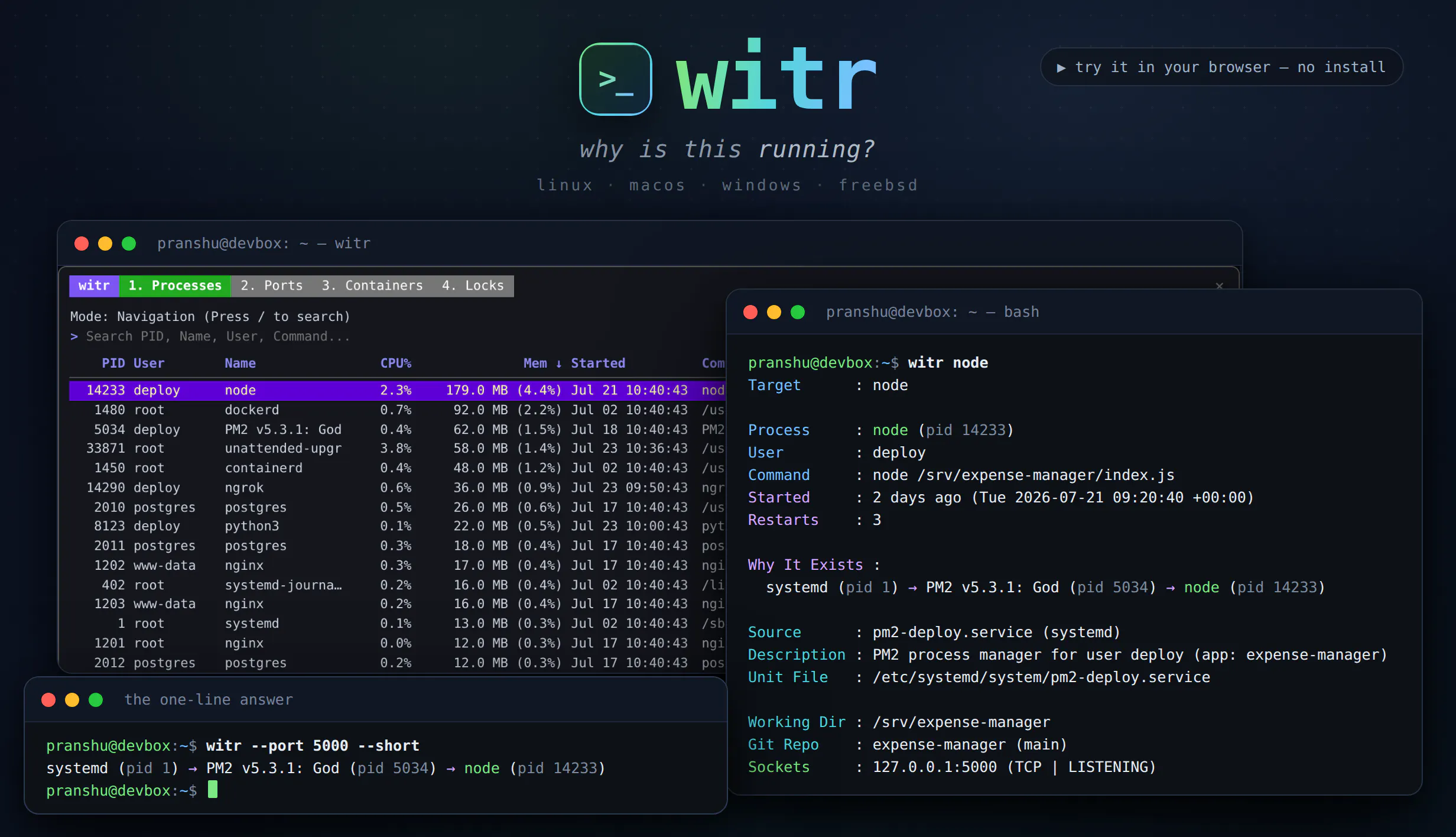
witr is a command-line utility designed to answer the question "Why is this running?" for processes, PIDs, ports, containers, or files. It provides a deeper understanding of system activity by tracing the chain of execution back to its origin, unlike traditional tools like ps, top, or lsof which only show what is currently active. The problem witr addresses is the common frustration of encountering an unknown process, port, or container and having no clear way to determine its purpose or origin. Existing tools can identify the presence of these entities, but they fail to explain the context or the sequence of events that led to their execution. This lack of clarity can lead to confusion, wasted time in debugging, and potential security concerns. One of the core features of witr is its ability to trace the ancestry chain. When pointed at a specific process, PID, port, container, or file, witr reconstructs the sequence of events that led to its existence. This chain can include systemd units, supervisor processes, cron jobs, or shell sessions, providing a comprehensive view of how the target entity was initiated. Another key capability is the identification of the initiator and the timing of the process. witr not only shows who started a process but also when and from where it was launched. This historical context is crucial for understanding system behavior and for auditing purposes. witr also highlights important warnings associated with running processes. This can include information such as a process running as root, binding to all interfaces (0.0.0.0), having a deleted binary, or exhibiting a restart loop. These warnings are vital for system administrators and developers to quickly identify potential issues or misconfigurations. For interactive use, witr offers a Text User Interface (TUI) that presents information across different tabs: Processes, Ports, Containers, and Locks. This TUI allows for live searching and provides an ancestry side panel for quick reference, making it easy to explore system activity in real-time. Beyond the interactive TUI, witr is designed for scripting and automation. It offers a `--short` option for a concise, one-line representation of the ancestry chain and a `--json` output format that includes meaningful exit codes. This makes it suitable for integration into automated workflows and scripts, providing structured data and clear status indicators. The overall approach of witr is to provide a unified and insightful view of process origins. By leveraging system information and tracing parent-child relationships, it offers a more complete picture than disparate command-line tools. Its static Go binary distribution ensures ease of deployment across various operating systems. The benefits for users include faster debugging, improved system understanding, and enhanced security awareness. By quickly identifying the root cause of running processes and associated warnings, users can resolve issues more efficiently and proactively manage their systems. Concrete use cases for witr include diagnosing why a specific port is occupied, understanding the origin of an unexpected process consuming resources, tracing the lifecycle of a containerized application, or investigating file lock contention. For example, a developer might use witr to determine which service is responsible for binding a critical port, or a system administrator could use it to find out why a particular process is consuming excessive CPU. witr is a free, open-source tool available as a single static Go binary for Linux, macOS, Windows, and BSD. It is suitable for developers, system administrators, and anyone who needs to understand the intricacies of process execution on their systems. The tool is licensed under Apache-2.0. In summary, witr is an indispensable tool for system introspection, offering a clear and actionable explanation for why processes are running, thereby simplifying complex debugging and system analysis tasks.

Ctrl+Shift+3 is a community platform that prioritizes a calm, chronological, and text-first user experience. It is designed for individuals and groups seeking an alternative to the often overwhelming and profit-driven nature of current social media platforms. The core purpose is to foster genuine connection and sharing without the distractions of vanity metrics. The proliferation of social media has led to platforms prioritizing profit over user well-being, resulting in environments that can be overwhelming and even detrimental. This has prompted a need for alternatives that address the issues of excessive technicality, privacy concerns, and the relentless pursuit of engagement at all costs. Ctrl+Shift+3 aims to address this by offering a more mindful and user-centric approach to online communities. One of the key features of Ctrl+Shift+3 is its chronological feed. Unlike algorithms that dictate what users see, this platform presents content in the order it is posted, ensuring a straightforward and predictable experience. This approach allows users to stay updated without missing important information due to algorithmic prioritization. The platform is text-first, emphasizing the content of messages and discussions over multimedia elements. This focus on text encourages clearer communication and a more direct exchange of ideas. It strips away unnecessary visual clutter, allowing users to concentrate on the substance of the conversations. Ctrl+Shift+3 deliberately omits vanity metrics such as likes, follows, and other engagement counts. By removing these elements, the platform aims to reduce social pressure and encourage authentic interaction. The focus shifts from seeking validation to sharing thoughts and links in a more genuine manner. The platform is built with a philosophy of 'Web 4,' blending the simplicity and community spirit of Web 1 and 2 with modern technology, enhanced privacy, and user data control. This approach seeks to create a more balanced and ethical online environment. Users of Ctrl+Shift+3 can expect a calmer and more sane online experience. The platform fosters genuine sharing of thoughts and links, free from the pressures of performance metrics and algorithmic manipulation. It offers a space for meaningful interaction and connection. This platform is ideal for individuals and communities who are disillusioned with the current social media landscape and are looking for a more mindful and authentic way to connect online. It can be used for sharing updates, discussing ideas, and building communities without the noise and distractions of mainstream platforms. Ctrl+Shift+3 is available as a web application and also has an iOS app. The platform is free to use. The development team is focused on maintaining a sustainable model that covers infrastructure costs and essential operations, prioritizing user experience over maximum profit. In essence, Ctrl+Shift+3 offers a refreshing return to simpler, more intentional online interactions, providing a calm, chronological, and text-first community space that prioritizes genuine connection and user well-being over profit-driven engagement.

VulX Watch is designed to address the growing challenge of securing codebases, particularly those heavily influenced or generated by AI. It serves developers and teams who are building applications rapidly, often with AI assistance, but lack dedicated security teams or the tools to independently verify the safety of their code. The problem VulX Watch solves stems from the inherent limitation of AI code generation: the AI that writes the code cannot reliably audit its own work. This creates a security blind spot, especially for smaller teams or individual developers who may not have the resources or expertise for traditional security reviews. As new vulnerabilities are discovered in libraries and dependencies, code that was once considered safe can quickly become a security risk, leaving developers in a state of uncertainty. One of VulX Watch's core features is its continuous re-checking of your codebase. After you connect your GitHub repository, VulX Watch independently reviews the code that has been shipped. It actively monitors for newly discovered vulnerabilities in your project's dependencies and within the code itself. This ensures that your codebase remains current with the latest security information, preventing code that was safe at the time of deployment from becoming vulnerable later. Another key capability is the provision of evidence and exact line references for every finding. When VulX Watch identifies a vulnerability, it doesn't just flag an issue; it provides the supporting evidence and points to the precise line of code responsible. This detailed information is crucial for developers to quickly understand the nature of the vulnerability and implement the necessary fixes efficiently. The product operates with a read-only approach, meaning it never touches your actual code. This read-only access ensures that your codebase remains secure and that VulX Watch acts solely as an independent auditor. This non-intrusive method builds trust and allows developers to integrate security verification without concerns about accidental code modification or data breaches. VulX Watch offers a straightforward setup process, primarily involving connecting a GitHub repository. Once connected, the system automatically begins its continuous scanning and monitoring. This automation is designed to be low-maintenance, allowing teams to focus on building rather than managing complex security tools. The primary benefit for users is gaining confidence that their code remains safe and secure over time, especially in the context of AI-generated code. By providing continuous verification and detailed findings, VulX Watch helps users avoid the risks associated with shipping code that might later become vulnerable, thereby reducing potential security incidents and the need for emergency fixes. Concrete use cases for VulX Watch include small development teams building applications with AI coding assistants, individual developers who want an independent check on their AI-generated code, and any project that relies on external libraries and dependencies that may have undiscovered vulnerabilities. It's particularly useful for projects where rapid iteration and deployment are prioritized, but security cannot be compromised. VulX Watch is currently free to try and connects directly to GitHub repositories. While specific pricing tiers are not detailed, the emphasis on being free for builders suggests an accessible model for its target audience. The product is web-based, accessible through a browser interface. In summary, VulX Watch provides an essential, independent security layer for AI-assisted code development, offering continuous vulnerability monitoring and detailed verification to ensure code remains safe and trustworthy.
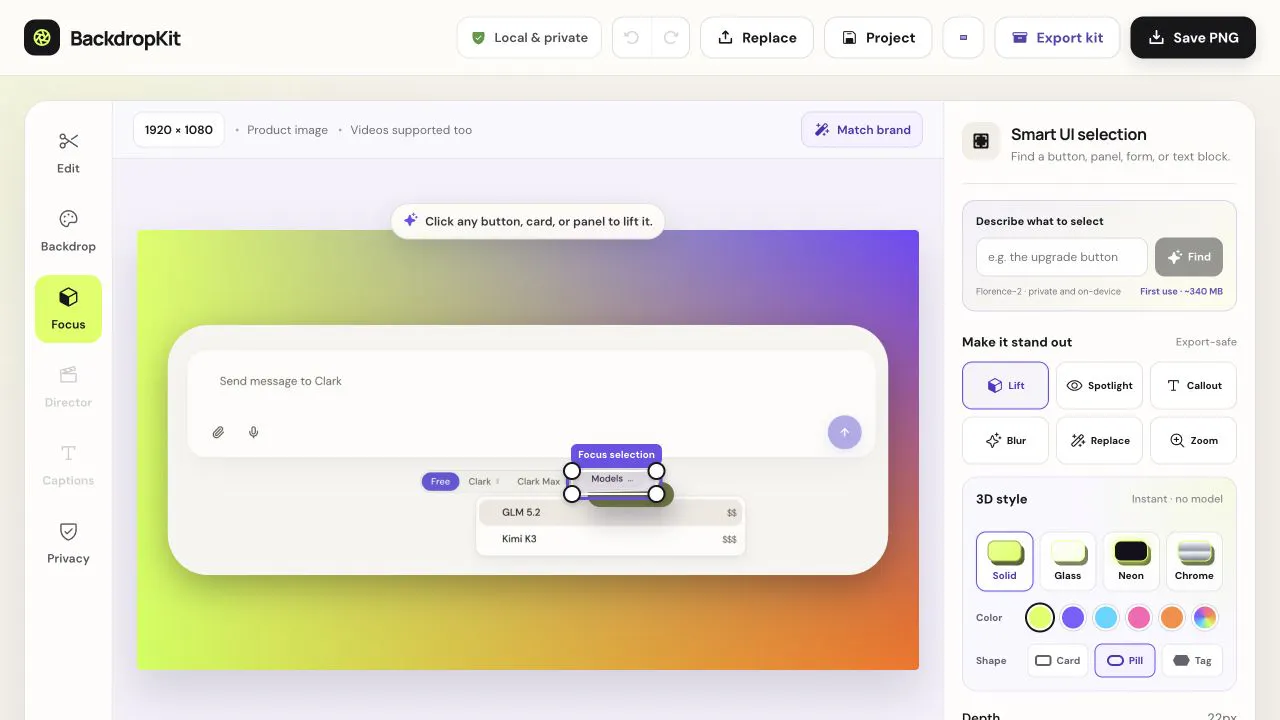
BackdropKit is a tool designed to help creators and developers produce professional-looking launch assets from raw product screenshots and demo videos. It caters to anyone needing to present their software or product visually for marketing and promotional purposes, aiming to streamline the creation of a complete launch kit. The problem BackdropKit addresses is the time-consuming and often complex process of making product visuals ready for launch. Many creators struggle with creating visually appealing backgrounds, drawing attention to key interface elements, and ensuring sensitive information is not inadvertently exposed in screenshots or videos. This often leads to manual editing across multiple tools, increasing the effort and potential for errors. One of the core features of BackdropKit is its ability to handle backgrounds. Users can either add their own custom backgrounds or utilize the tool's generative capabilities to create them. This allows for consistent branding and a more professional aesthetic for launch materials. Additionally, the tool enables users to spotlight and call out specific UI elements within their screenshots or videos. This feature helps to guide the viewer's attention to the most important aspects of the product, enhancing clarity and impact. BackdropKit also provides functionality to redact sensitive text, such as personal data, client names, or confidential information, directly within the visuals. This ensures privacy and security without requiring separate editing software. The tool is capable of exporting a variety of formats essential for a launch kit. This includes high-resolution images, video files, animated GIFs, and thumbnails, all tailored to fit various platform requirements. Beyond visual assets, BackdropKit can also generate accompanying post copy and alt text. This integrated approach saves users the effort of creating these text elements separately, ensuring consistency with the visual content and improving accessibility and SEO. The entire process runs locally within the user's browser, meaning no data is sent to external servers, ensuring complete privacy and security for all uploaded or generated content. The product's unique approach lies in its commitment to local processing. By running entirely in the browser, BackdropKit eliminates the need for cloud uploads, ensuring that sensitive product visuals remain private. This also means the tool is free to use and does not impose watermarks on the exported assets, providing a clean and professional output. The primary benefit for users is the significant reduction in time and effort required to create professional launch assets. By consolidating multiple editing and export functions into one tool that runs locally, BackdropKit offers a private, efficient, and cost-effective solution for product launches. Users can achieve polished visuals without compromising on privacy or incurring additional costs. Concrete use cases for BackdropKit include preparing screenshots for app store listings, creating engaging video snippets for social media campaigns, generating GIFs to showcase interactive features, and producing thumbnails for product demo videos. It's also useful for generating consistent visual assets for website landing pages and press kits. BackdropKit is targeted at product makers, designers, and marketers who need to create launch materials. The tool is free to use and operates entirely within the web browser, making it accessible without installation. While specific integrations or tech stack details are not provided, its local browser operation suggests a focus on web technologies. In summary, BackdropKit empowers users to quickly and privately transform raw product visuals into complete, channel-ready launch kits, emphasizing ease of use, privacy, and professional output.

DepthData is designed to be the definitive system of record for a company's AI expenditure and adoption. It serves businesses that are increasingly subscribing to multiple AI tools, such as ChatGPT, Claude, and Copilot, but struggle to track their overall spending, identify active users, and manage underutilized licenses. The proliferation of AI tools has created a significant challenge for organizations. Companies often find themselves paying for numerous services without a clear understanding of their financial commitment or how these tools are being utilized across different teams. This lack of visibility makes it difficult to optimize budgets, ensure compliance, and make informed decisions about future AI investments. DepthData addresses this by consolidating information from disparate AI platforms into a single, comprehensive dashboard. One of DepthData's core features is its commitment to verified data. Every metric presented is explicitly labeled with its verification method, ensuring transparency and trust. This approach means that the system never reads user prompts, focusing solely on metadata such as usage patterns and seat assignments. This strict adherence to data privacy and verification builds confidence for security-conscious organizations. The platform offers a unified view of AI spend and adoption across all connected tools. It aggregates data from various AI vendors, presenting it in an audit-ready format. This allows finance and IT departments to easily track expenses, identify which employees are using which tools, and pinpoint idle seats, thereby enabling better resource allocation and cost savings. DepthData provides detailed insights into AI tool usage. It goes beyond simple seat counts to show actual usage data, helping to identify underutilized licenses or tools that may be redundant. This granular view empowers businesses to make data-driven decisions about their AI tool stack, ensuring they are getting the most value from their investments. Another key capability is the ability to attribute spend to specific teams and projects. By allowing managers to assign employees to departments and projects within the platform, DepthData rolls up costs accordingly. For tools that support project-level cost reporting, this data is pulled directly. For others, spend is allocated based on individual project usage, with clear labeling to distinguish between measured and allocated costs. DepthData operates on a principle of data integrity and transparency. It connects to AI tools via their APIs, extracting only the necessary metadata. The system prioritizes using direct billing information where available and supplements this with usage data and contract pricing inputs for tools that do not offer direct cost APIs. A crucial aspect of its methodology is the clear labeling of all figures as either 'MEASURED' or 'ALLOCATED,' preventing the misinterpretation of estimates as hard facts. The benefits for users include enhanced financial control over AI spending, improved adoption tracking, and increased operational efficiency. By providing a clear, verifiable audit trail, DepthData helps organizations avoid unexpected costs, optimize their AI tool portfolio, and ensure that their investments align with business objectives. Concrete use cases for DepthData include finance teams needing to reconcile AI tool expenses across multiple vendors, IT departments managing software licenses and user access, and project managers tracking the cost of AI-driven features. It is also valuable for security teams reviewing tool access and data privacy compliance. DepthData is positioned as a SaaS solution. While specific pricing tiers are not detailed, the product is available via its website. The platform integrates with various AI tools through their APIs. The underlying technology stack is not explicitly detailed, but it emphasizes read-only, metadata-only access to ensure security and privacy. In summary, DepthData offers a vital solution for companies navigating the complex landscape of AI tool adoption, providing a transparent, verifiable, and unified view of spend and usage to drive informed decision-making and cost optimization.

Screencap is a powerful tool designed to capture and structure how work actually happens within a team. It records screen activity, including clicks, keystrokes, and window context, enabling teams to transform these real-world workflows into structured datasets. These datasets are invaluable for training artificial intelligence models and developing automation solutions, ensuring that the knowledge and processes of a team are preserved and accessible. The core problem Screencap addresses is the loss of institutional knowledge. Often, critical workflows exist only in the minds of individuals or are poorly documented. When team members leave or when complex processes need to be repeated, significant time is lost trying to reconstruct the steps involved. Screencap provides a persistent memory for these workflows, preventing knowledge from being lost and streamlining the process of recreating tasks. One of Screencap's key features is its comprehensive recording capability. It captures not just the screen but also user interactions like clicks and keystrokes, along with the context of the active window. This detailed capture ensures that the recorded workflow is a true representation of how tasks are performed, providing rich data for analysis and training. Privacy and security are paramount in Screencap's design. The tool enforces consent and privacy during recording, automatically blocking sensitive applications such as password managers and banking software before any data is written. This ensures that highly confidential information is never captured, providing peace of mind for users and teams. Furthermore, Screencap employs robust scrubbing and review processes. Before any recorded data leaves a user's machine, it is scrubbed of sensitive information and reviewed. This multi-layered approach to privacy, including app-level blocking and content-level masking, ensures that data is anonymized and secure, allowing teams to confidently use the tool for sensitive workflows. Screencap operates with a unique methodology focused on capturing raw, real-world usage. Unlike curated demos, it records the actual steps users take, including any deviations or unexpected actions. This approach provides a more accurate and representative dataset for AI training and process analysis. The tool is also open-source, fostering transparency and community involvement in its development. The benefits for users include the creation of accurate AI training data, improved documentation of processes, and the preservation of team knowledge. By transforming messy, real-world usage into structured datasets, Screencap helps teams build more effective AI models and automations, while also serving as a reliable record of how work is done. Concrete use cases for Screencap include documenting complex software implementation steps, analyzing user interaction patterns to identify bottlenecks in a workflow, or creating training materials for new employees by showcasing actual task execution. It can also be used to audit and understand how specific business processes are carried out in practice. Screencap is available for macOS and is open-source. The product offers a free trial for solo users and encourages team pilots. While specific pricing tiers are not detailed, the emphasis on accessibility suggests options for various team sizes and needs. The core functionality revolves around capturing and structuring user interaction data for AI and automation purposes. In summary, Screencap provides an essential solution for teams looking to capture, structure, and secure their real-world workflows, transforming them into valuable datasets for AI training and automation while prioritizing user privacy and data integrity.

TraceLLM is an observability platform specifically built for AI applications operating in production environments. It offers developers comprehensive visibility into their Large Language Model (LLM) workflows, enabling them to monitor and diagnose issues effectively. The platform is designed for developers and teams building and deploying AI-powered applications who need to ensure their systems are running smoothly and efficiently. The core problem TraceLLM addresses is the difficulty in understanding the internal workings of AI applications once they are live. Traditional observability tools are often insufficient for the unique challenges of LLM-based systems. Developers frequently face questions about why requests fail, which specific prompts cause problems, how much token usage is occurring, where latency originates, and which model calls are slowing down the application. Without specialized tools, pinpointing these issues can be a time-consuming and frustrating process, potentially leading to poor user experiences and increased operational costs. TraceLLM provides detailed monitoring of several key aspects of LLM applications. It tracks prompt execution, allowing developers to see how prompts are processed and identify any issues within them. The platform also monitors token consumption, which is crucial for managing costs and understanding resource usage. Latency is meticulously tracked across different stages of the LLM workflow, helping to pinpoint performance bottlenecks. Furthermore, TraceLLM monitors spans, which represent individual operations or stages within the application, and captures any errors that occur, providing a clear picture of application health. A significant feature of TraceLLM is its ability to monitor model calls. This allows developers to see the interactions with various LLM providers, understand the timing and parameters of these calls, and identify if a specific model is underperforming or causing delays. By providing this granular insight into model interactions, TraceLLM helps in optimizing model selection and usage. TraceLLM supports OpenTelemetry (OTLP) for exporting traces. This integration is vital as it allows TraceLLM to seamlessly fit into existing observability stacks. Developers can leverage their current tools and infrastructure, such as SigNoz, Tempo, or Honeycomb, to analyze the traces generated by TraceLLM, making it easier to adopt and gain value from the platform without a complete overhaul of their monitoring systems. The platform's approach focuses on providing a purpose-built solution for AI workloads. It aims to offer complete visibility by tracing prompts, spans, token usage, latency, model calls, and errors all within a unified view. This comprehensive tracing capability is essential for diagnosing complex issues that might span multiple components of an AI application. The primary benefit for users of TraceLLM is the ability to quickly identify and resolve bottlenecks in their production AI applications before they impact end-users. This leads to improved application performance, reduced operational overhead, and better cost management through insights into token consumption. The platform empowers developers with the data needed to optimize their AI systems effectively. TraceLLM is particularly useful in scenarios involving complex agentic workflows or Retrieval Augmented Generation (RAG) pipelines. For instance, it can trace individual spans for agent planning, tool execution (like CRM lookups), document searches, and the final LLM chat completion. This detailed breakdown helps in understanding the performance of each component and identifying where delays or errors are occurring within these intricate flows. TraceLLM is offered as a free, open-source solution, targeting developers and teams working with AI applications. While specific integrations and tech stack details beyond OpenTelemetry are not explicitly detailed, its open-source nature suggests flexibility for integration. The platform is primarily web-based, accessible through its website. In summary, TraceLLM provides essential observability for production AI applications by leveraging OpenTelemetry to offer deep insights into LLM workflows, enabling developers to monitor, diagnose, and optimize their AI systems efficiently.

Poth Labs functions as a comprehensive "customer brain" for companies, transforming scattered customer knowledge into a connected network of relationships and behaviors. It is designed for businesses seeking a deeper, more integrated understanding of their customer base, moving beyond siloed data to uncover actionable insights. The core problem Poth Labs addresses is the fragmentation of customer knowledge within organizations. Information about customers is often dispersed across numerous sources like call recordings, support tickets, CRM entries, analytics platforms, surveys, and internal documentation. This makes it incredibly difficult, if not impossible, for teams to answer critical questions, such as identifying the drivers of churn among high-value accounts or understanding why customers adopt or abandon specific features, as these insights require synthesizing data from multiple disparate sources. Poth Labs builds a living model of customers by connecting various data points. This model integrates information about customers, accounts, features, behaviors, and conversations from different systems. The primary capability is to reason across this comprehensive customer knowledge base, rather than simply summarizing isolated documents or data points. This allows for the unlocking of questions that no single source can answer. A key feature is its ability to ground every conclusion in evidence. When Poth Labs provides an answer, it can trace it back to the specific data points and relationships within its model that support that conclusion. This ensures transparency and trust in the insights generated. If the necessary information to answer a question is not present in the existing data, Poth Labs has the capability to launch adaptive surveys and interviews to collect the missing data. The platform's approach involves understanding everything a company already knows about its customers. It then uses this understanding to build a dynamic model that represents the complex web of customer interactions and attributes. This model is not static; it evolves as new data is integrated, providing a continuously updated view of the customer landscape. By reasoning across this integrated customer knowledge, Poth Labs enables businesses to gain a holistic understanding of their customer base. This leads to more informed decision-making regarding customer retention, product development, and overall customer strategy. The ability to identify subtle patterns and connections that would otherwise remain hidden in siloed data is a significant benefit. Concrete use cases include identifying the root causes of customer churn, understanding the drivers behind feature adoption or abandonment, and answering complex questions about customer behavior that require synthesizing information from sales, support, and product usage data. It can also help in identifying at-risk accounts by recognizing patterns of declining engagement or silence in activity data. Poth Labs is positioned as a SaaS solution. While specific integrations are built customer-by-customer during onboarding, it aims to pull data from common systems such as call recording tools (e.g., Clari, Fireflies, Granola), product analytics platforms (e.g., PostHog, Amplitude, Mixpanel), CRMs, and support tools. The platform supports flexible data ingestion methods, including near real-time via webhooks or streaming, and scheduled syncs. In essence, Poth Labs provides a unified and intelligent layer for understanding customers, enabling companies to move from fragmented data to actionable, evidence-based insights that drive business growth and customer satisfaction.

Franchise Builders™ is an all-in-one solution for franchisors looking to establish and grow their franchise businesses. The platform is designed to simplify the complex process of franchise creation, offering tools to generate critical legal documents, manage franchise operations, and list opportunities on a dedicated marketplace. Its primary purpose is to empower franchisors by providing a centralized system for all their franchise development needs. The process of building a franchise involves significant legal and operational hurdles, including the creation of detailed disclosure documents, franchise agreements, and comprehensive operations manuals. These documents are crucial for legal compliance and for ensuring consistency and quality across all franchise locations. Without specialized tools, franchisors often face lengthy, expensive, and complex processes, which can be a major barrier to expansion. One of the core features of Franchise Builders™ is its ability to generate essential legal documentation. This includes the Franchise Disclosure Document (FDD), which is a legally required document providing detailed information to potential franchisees. It also facilitates the creation of the franchise agreement, the legal contract between the franchisor and franchisee, and the operations manual, which outlines the day-to-day procedures and standards for running a franchise business. This automated document generation saves significant time and legal costs. Beyond document creation, Franchise Builders™ offers a franchise portal. This portal serves as a central hub for managing franchise relationships and operations. It allows franchisors to communicate with franchisees, share updates, and monitor performance. The portal aims to enhance communication and operational efficiency, ensuring that all parties are aligned and informed. Another key capability is the ability to list franchise opportunities on the FMLS marketplace. This marketplace provides a platform for franchisors to reach potential franchisees actively seeking opportunities. By integrating listing services, Franchise Builders™ helps franchisors attract new candidates and expand their network more effectively. Franchise Builders™ operates by integrating these critical functions into a single, user-friendly platform. It leverages technology to automate document generation and centralize franchise management, offering a streamlined approach to franchise development. The platform aims to demystify the franchise creation process and make it accessible to a wider range of businesses. The benefits for franchisors include significant cost savings on legal fees, reduced time to market for new franchise offerings, and improved operational consistency across their network. By simplifying these complex processes, Franchise Builders™ enables franchisors to focus more on growth and support. Specific use cases for Franchise Builders™ include new franchisors looking to create their initial FDD and franchise agreement, established franchisors seeking to update their operations manuals, and businesses aiming to expand their reach by listing opportunities on the FMLS marketplace. It's also useful for franchisors needing a centralized system to manage communications and resources for their existing franchisees. Franchise Builders™ is a web-based platform accessible via a website. While specific pricing details are not provided, the mention of "Payment Required" suggests it is a paid service. The platform is targeted at franchisors and businesses looking to franchise their operations. It is also noted to have an Android launch tag, though its direct application on Android is not detailed. In summary, Franchise Builders™ provides franchisors with a powerful, integrated solution to generate legal documents, manage their franchise network, and list opportunities, thereby simplifying and accelerating franchise business development.

Gemini Robotics 2 is Google DeepMind's latest advancement in artificial intelligence, specifically engineered to imbue robots with sophisticated capabilities for interacting with the physical world. This system aims to equip robots with the ability to understand their surroundings, reason through complex tasks, and execute actions with precision. It is designed for robots of various shapes and sizes, enabling them to perform intricate physical tasks and engage in collaborative efforts with other robots. The development of Gemini Robotics 2 addresses the growing need for intelligent agents that can bridge the gap between digital intelligence and physical action. As AI has made significant strides in processing text, images, and data, the next frontier is applying this intelligence to real-world scenarios. This system represents a crucial step towards creating robots that are not just automated machines but truly intelligent partners capable of navigating and operating effectively in dynamic environments. One of the core capabilities of Gemini Robotics 2 is its whole-body intelligence. This allows robots to coordinate their entire physical structure for more effective and nuanced movements and interactions. Coupled with this is dexterous manipulation, which enables robots to handle objects with a high degree of precision and control, essential for tasks requiring fine motor skills. Furthermore, the system incorporates adaptive reasoning, allowing robots to analyze situations, make informed decisions, and adjust their actions in real-time based on new information or changing conditions. These features collectively empower robots to move beyond pre-programmed routines. The whole-body intelligence ensures that a robot's movements are not just functional but also efficient and context-aware. Dexterous manipulation opens up possibilities for robots to perform tasks previously requiring human hands, such as assembling intricate components or handling delicate materials. Adaptive reasoning is key to enabling robots to operate autonomously in unpredictable environments, learning from experience and improving their performance over time. The system's ability to handle complex physical tasks is a significant leap forward. This could range from intricate assembly line work to performing delicate operations in research or healthcare settings. Additionally, Gemini Robotics 2 facilitates multi-robot collaboration, allowing multiple robots to work together seamlessly on a shared objective. This coordination is vital for large-scale operations, complex manufacturing processes, or disaster response scenarios where teamwork is essential for success. Gemini Robotics 2 operates by leveraging advanced Gemini models, which serve as the AI brain for the robots. These models process sensory input, interpret environmental data, and generate commands for the robot's actuators. The system's architecture is designed to integrate perception, reasoning, and action into a cohesive whole, enabling robots to exhibit intelligent behavior in the physical realm. This approach moves away from traditional robotics, which often relies on rigid programming, towards a more dynamic and learning-based paradigm. The benefits for users and industries are substantial. Gemini Robotics 2 promises to enhance productivity, improve safety in hazardous environments, and enable new applications for robotics that were previously unfeasible. By bringing advanced AI into the physical world, it paves the way for robots that can work more effectively alongside humans, augmenting human capabilities and taking on tasks that are dangerous, repetitive, or require high precision. Potential use cases for Gemini Robotics 2 are diverse. In manufacturing, it could enable highly automated and flexible production lines. In logistics, robots could autonomously manage warehouses and sort packages with greater efficiency. In research, it could assist scientists with complex experiments or sample handling. The system's adaptability also suggests potential applications in areas like elder care, exploration, or even domestic assistance, where robots need to navigate and interact with complex human environments. Gemini Robotics 2 is presented as a research preview and an AI infrastructure tool, indicating its role in advancing the field of robotics. While specific integrations, tech stack details, or pricing plans are not detailed, its development by Google DeepMind positions it at the forefront of AI research. The product is positioned for developers and researchers looking to build the next generation of intelligent robotic systems. In essence, Gemini Robotics 2 represents a significant stride in artificial intelligence, empowering robots with the intelligence to understand, reason, and act within the physical world, thereby accelerating the realization of advanced robotic capabilities and their integration into various aspects of human life.

Mubert is the world's first AI-operated technology designed to generate music in real-time, with the primary goal of assisting client-oriented businesses in their growth. The platform addresses the growing need for dynamic and personalized audio experiences in digital products and services. Traditional music licensing can be complex and costly, while custom music production is time-consuming and expensive. Mubert aims to bridge this gap by providing an accessible, scalable, and copyright-protected solution for businesses seeking to integrate unique audio elements into their offerings. Mubert's core functionality lies in its ability to generate infinitely diverse music streams across any genre. This AI-driven approach allows for real-time music creation, ensuring that the audio content is always fresh and tailored to specific needs. The platform's advanced engine is capable of producing tracks up to two hours long, offering substantial flexibility for various applications. A key feature of the Mubert API is its enhanced control over music generation. Users can now edit tracks and swap individual stems, allowing for more precise customization without needing to start from scratch. This capability transforms the music generation process from a one-off output to an editable asset, providing greater creative freedom and revision potential. The new engine powering Mubert API focuses on consistency across entire tracks. This ensures that the generated music maintains a cohesive sound and quality, which is crucial for applications where a seamless audio experience is desired. This consistency is particularly important for stem swapping, making the edits more impactful and integrated. Mubert also offers real-time music streaming, providing a continuous and low-latency audio experience. This is distinct from the stem-swapping feature, which is an editing operation on an existing track rather than a real-time generation. The API integrates with developer tools through Skills for Claude and Codex, simplifying the integration process and reducing development time. The overall methodology of Mubert involves leveraging artificial intelligence to understand user prompts and business requirements, translating them into unique musical compositions. The platform's architecture supports both real-time streaming and on-demand track generation and editing, offering a versatile toolkit for developers and businesses. The benefits for users include the ability to boost user Lifetime Value (LTV) through UX personalization and the creation of stronger lifestyle brands. Businesses can leverage Mubert to create unique audio identities, enhance user engagement, and differentiate their products in a competitive market. Concrete use cases for Mubert include integrating personalized soundtracks into games, creating adaptive playlists for fitness and wellness apps, generating background music for streaming services, and developing unique audio for creator tools. The API can also be used for NFT soundtracks or as a feature within educational platforms. Mubert is targeted at businesses and developers looking to integrate AI-generated music into their products. The platform provides an API for seamless integration into existing pipelines. Specific details on pricing plans are not explicitly detailed in the provided content, but the mention of 'Annual Pro Subscription' and 'Annual Ambassador (Free) Plan' suggests a tiered offering. In summary, Mubert provides a powerful, flexible, and copyright-protected AI music generation API that empowers businesses to create custom, real-time audio experiences, enhance user engagement, and build distinctive brand identities.

NexaLibre is a secure hosting platform designed to transform AI-generated code into live, production-ready applications with ease. It also provides a seamless way to deploy from a curated selection of hundreds of open-source applications for users who prefer not to build from scratch. The primary purpose of NexaLibre is to eliminate the complexities of server setup and management, enabling developers and creators to launch their projects quickly and efficiently. The challenge of deploying applications, especially those generated by AI, often involves intricate server configurations, security management, and ongoing maintenance. Traditional hosting solutions can be time-consuming and require specialized knowledge, creating a barrier for many who want to bring their ideas to life. NexaLibre addresses this by abstracting away the complexities of infrastructure, allowing users to focus on their code and applications rather than the underlying servers. One of the key features of NexaLibre is its ability to instantly deploy AI-generated code. Users can take code produced by artificial intelligence tools and, with NexaLibre, turn it into a live, functional application without manual intervention in the deployment process. This significantly speeds up the development lifecycle, from idea to a deployed product. For those who do not wish to generate code from AI, NexaLibre offers a library of hundreds of open-source applications. These applications are readily available for deployment, providing a quick start for various project needs. This feature caters to users who need a reliable application without the overhead of custom development or complex setup. NexaLibre emphasizes security and reliability through its automated hosting services. It includes built-in HTTPS, ensuring secure connections for all deployed applications. This is crucial for protecting user data and maintaining trust with end-users. The platform also provides reliable backups, safeguarding applications against data loss and ensuring business continuity. Seamless custom domain support is another significant feature. NexaLibre allows users to connect their own domain names to their deployed applications, providing a professional and branded online presence. This integration is straightforward, removing the typical hurdles associated with DNS configuration and domain mapping. NexaLibre operates on a philosophy of simplifying the deployment pipeline. By handling the intricacies of server management, security protocols, and infrastructure maintenance, it provides an automated and streamlined experience. The platform aims to be the bridge between code creation and live application, making robust hosting accessible to everyone. The benefits for users are clear: faster deployment times, reduced technical overhead, enhanced security with HTTPS, data protection through reliable backups, and a professional appearance with custom domain support. NexaLibre empowers users to launch their AI-driven projects or open-source applications without the typical stress and complexity associated with server management. Concrete use cases for NexaLibre include developers deploying AI-generated prototypes for rapid testing, startups launching their Minimum Viable Products (MVPs) quickly using open-source templates, and individuals creating personal projects or portfolios without needing deep server administration skills. It's ideal for anyone who wants to get an application online swiftly and securely. NexaLibre is positioned as a solution for developers, AI enthusiasts, and creators looking for efficient deployment. While specific tech stack details are not provided, the emphasis on automated hosting, security, and ease of use suggests a modern, cloud-native infrastructure. Pricing information is not explicitly detailed, but the mention of "Payment Required" and a discount suggests a paid service. In summary, NexaLibre democratizes application deployment by offering a secure, automated, and user-friendly hosting solution that turns AI-generated code or open-source projects into live applications with minimal effort.

Servey is a tool designed to mirror your Mac's interface onto your iPhone and iPad, allowing users to control their computer remotely. It provides comprehensive control, including mouse and keyboard input, and a functional terminal interface, making your Mac accessible from your mobile devices. The primary problem Servey addresses is the need for remote access to a Mac without being physically present. Traditional remote access solutions can sometimes be cumbersome or lack the full functionality required for complex tasks. Servey aims to bridge this gap by offering a seamless and powerful remote control experience. One of Servey's key features is its ability to mirror the entire Mac interface to your iPhone or iPad. This includes full mouse and keyboard control, enabling users to interact with their Mac as if they were sitting in front of it. The hardware acceleration ensures that this mirroring is smooth and responsive, especially when used on a local network. Another significant capability is the inclusion of a real terminal. This allows users to access and operate the command line interface of their Mac directly from their mobile devices. This feature is particularly useful for developers, system administrators, or anyone who frequently uses terminal commands. Servey also emphasizes privacy and security by offering private peer-to-peer connectivity. This means that your connection is direct and secure, without relying on intermediary servers, which is crucial for sensitive data and operations. The product's approach leverages hardware acceleration for a smooth and lag-free experience, particularly on home networks. This optimization ensures that the remote control feels as close to native as possible, minimizing frustration for the user. The benefits for users include the convenience of accessing their Mac from anywhere, the ability to perform tasks remotely without needing to be at their desk, and the flexibility of using their iPhone or iPad as a full-fledged remote control for their computer. Concrete use cases include managing a Mac from the couch, accessing files or applications remotely while on the go, or using the terminal for quick command-line tasks without needing to boot up the Mac itself. Servey is targeted towards Mac users who need remote access, particularly those who value a responsive and feature-rich experience. The product is available for iOS and Mac platforms. Pricing information is not explicitly detailed but launch tags indicate "Free Options." In summary, Servey provides a robust solution for remote Mac control, offering a mirrored interface, full input capabilities, and a functional terminal, all while prioritizing a smooth and private user experience.

E.Y.E. by Expert Chase is an advanced AI designed to serve as a comprehensive personal intelligence system for everyday life. Its primary function is to help users organize and manage all facets of their daily activities within a single, unified platform. By drawing upon a user's real-life data, E.Y.E. provides personalized responses and insights, moving beyond generic AI interactions to offer truly relevant assistance. The core problem E.Y.E. addresses is the fragmentation of digital life management. Users often juggle numerous applications for tasks, calendars, health tracking, finance, and notes, leading to inefficiency and a lack of holistic oversight. E.Y.E. aims to consolidate these disparate functions, offering a streamlined and integrated experience that empowers users to stay organized, focused, and proactive in managing their lives. One of the key features of E.Y.E. is its ability to act as a unified organizer. It replaces the need for separate to-do list apps, calendar applications, and note-taking tools by consolidating these functionalities. Users can manage their schedules, tasks, and important information all within E.Y.E., ensuring everything is accessible and organized from a central hub. E.Y.E. also functions as a comprehensive tracker for various aspects of a user's life. This includes food tracking, sleep monitoring, habit formation, fitness activities, and financial management. By integrating data from these areas, the AI can provide a holistic view of a user's well-being and progress, offering insights and support based on their personal data. Native integrations are a significant capability of E.Y.E., enhancing its utility by connecting with existing digital tools. The product supports integrations with Apple Calendar, Google Calendar, Apple Reminders, Google Tasks, Apple Health, and Google Health Connect. This allows E.Y.E. to sync with users' existing data sources, providing a seamless experience and ensuring that personal information is up-to-date and accessible within the AI's framework. The product's unique approach lies in its AI-driven personalization. E.Y.E. learns from the user's real-life data, enabling it to provide answers and support that are tailored to their specific context, rather than relying on general knowledge. This personalized intelligence aims to make AI genuinely useful in practical, everyday scenarios. The benefits for users include enhanced organization, improved focus, and a greater sense of control over their daily lives. By consolidating multiple applications into one, E.Y.E. reduces digital clutter and streamlines workflows, allowing users to be more efficient and proactive. The AI's ability to provide personalized insights can also lead to better decision-making and goal achievement. Concrete use cases for E.Y.E. include daily planning, where users can organize tasks and check their calendar for the day ahead, receiving AI support throughout. It can also be used for health monitoring, tracking fitness goals, and managing personal finances. The integration with various apps allows for a comprehensive overview of a user's life, from appointments to workouts to spending habits. E.Y.E. is available on Web, iOS, and Android platforms, catering to users within both the Apple and Google ecosystems. The product emphasizes its integrations with popular calendar, task management, and health applications. While specific pricing tiers are not detailed, the mention of "One subscription. Unlimited AI." suggests a subscription-based model. In essence, E.Y.E. by Expert Chase aims to be the central intelligence for your everyday life, consolidating all your personal data and activities into one AI-powered platform for unparalleled organization and personalized support.

AI Search Console is designed to empower SEO and GEO teams by offering a systematic approach to monitoring and analyzing their brand's visibility within AI-generated search results. It aims to replace time-consuming manual checks with automated, repeatable data collection and analysis across various leading AI platforms. The current landscape of AI search presents a significant challenge for businesses. Traditional SEO metrics do not fully capture a brand's presence in AI-driven responses, which often rely on a diverse range of sources beyond standard web pages. This gap makes it difficult for teams to understand their true visibility, identify content gaps, and measure the effectiveness of their strategies in this new frontier. Key features include the ability to track brand mentions and rankings at an individual prompt level across multiple AI models such as ChatGPT, Claude, Gemini, and Perplexity. Users can gain insights into their share of voice compared to competitors, identify which domains and pages are cited in AI answers, and pinpoint specific prompts where their brand appears or is notably absent. This granular analysis helps in understanding the nuances of AI visibility. The platform also facilitates competitor analysis, allowing users to monitor how their competitors are performing in AI search results. This includes understanding competitor visibility, identifying content gaps that competitors might be filling, and analyzing the sources that AI models rely on when generating responses about competitors. This competitive intelligence is crucial for refining SEO and content strategies. Furthermore, AI Search Console offers robust reporting capabilities. It enables users to generate client-ready reports directly from the platform, eliminating the need for manual data compilation in spreadsheets or the use of screenshots. This feature streamlines the reporting process, making it easier to communicate AI visibility performance to stakeholders and clients. The product operates by analyzing AI search results for specific prompts and models. It then aggregates this data to provide a comprehensive overview of a brand's presence, competitor landscape, and the underlying sources influencing AI responses. This methodology ensures that the analysis is consistent and reflects the dynamic nature of AI-generated content. The primary benefit for users is the ability to move from guesswork to data-driven decision-making regarding their AI search presence. By understanding where and why their brand is (or isn't) appearing, teams can optimize their content and SEO efforts to improve visibility, drive traffic, and maintain a competitive edge in AI-powered search environments. Specific use cases include SEO agencies demonstrating their value to clients by providing measurable AI visibility reports, brands identifying content gaps in AI responses that they can then fill, and GEO teams understanding how local businesses are represented in AI-generated local search results. It's also valuable for content creators who want to see if their articles are being cited by AI models. AI Search Console is positioned for SEO and GEO teams, as well as brands focused on digital visibility. The product is offered for free. It is a web-based application. In summary, AI Search Console provides essential analytics for understanding and improving brand visibility in the rapidly evolving landscape of AI search, offering detailed insights and actionable data for SEO and GEO professionals.

Focus Room is designed to transform YouTube into a personal, structured learning platform. It caters to individuals seeking to maximize the educational value of YouTube content by providing a course-inspired interface that organizes videos and playlists for focused learning. The vast amount of educational content available on YouTube is often hindered by distractions like recommendations, comments, and unrelated videos, making it challenging for users to engage in deep, consistent learning. Focus Room addresses this by removing these distractions and offering a more organized and interactive learning environment. Key features include the ability to convert educational videos and entire playlists into organized courses. Users can navigate through lessons using timestamped topics, allowing for precise access to specific points within a video. The platform also offers the functionality to generate concise summaries of video content, aiding in quick review and comprehension. Furthermore, Focus Room enables users to create notes and to-do lists directly within the learning interface, helping to consolidate information and action items. Progress tracking is integrated, allowing learners to monitor their completion of courses and individual lessons. For future reference, users can bookmark courses they are interested in or have completed. To facilitate a seamless transition, users can access YouTube content directly within Focus Room by prefixing "focusroom.club/" before a supported YouTube URL. This feature ensures that the learning experience is initiated without leaving the platform's structured environment. Focus Room operates by creating a dedicated learning space that strips away the typical YouTube interface's clutter. It leverages YouTube's educational content while imposing a structured, course-like framework, thereby facilitating a more intentional and effective learning process. The primary benefit for users is the transformation of passive video watching into focused, consistent learning. By organizing content and providing tools for note-taking and progress tracking, Focus Room helps users retain more information and achieve their learning goals more efficiently. Potential use cases include students organizing lecture videos for specific courses, professionals upskilling through tutorials, or hobbyists learning new skills from YouTube channels. Any scenario where educational YouTube content is consumed can be enhanced by Focus Room's structured approach. Focus Room is available for free. It is a web-based platform, accessible through any browser. The product is developed by Akshaj Dev. In essence, Focus Room empowers users to harness the wealth of educational material on YouTube by providing a dedicated, distraction-free, and structured environment for organized learning and knowledge retention.

Sorinai is an interactive AI notepad designed to work alongside users during meetings and calls. It aims to provide real-time assistance, enhance note-taking capabilities, and offer instant answers to queries, thereby improving the overall meeting experience. The problem Sorinai addresses is the common limitation of AI tools that are primarily useful before or after an event, but not during the critical moments. While AI excels at planning, research, and summarizing past events, it often falls short when immediate assistance is needed during a live interaction, such as closing a deal, delivering a pitch, or understanding complex information in real-time. One of Sorinai's core features is its ability to take notes interactively. It automatically fills in user-defined note templates as the call progresses, enhancing the notes based on what is being discussed and written. Users can also download a filled version of their notes in Word or PDF format, ensuring that important details are captured and organized efficiently. Another key capability is its real-time question-answering function. Users can ask questions like "What did that acronym mean?" or "Is what they just said true?" and receive immediate answers. This feature acts as a private, in-the-moment assistant, providing crucial information without the need to interrupt the flow of the conversation or ask potentially embarrassing questions aloud. Sorinai also offers the ability to query past meetings. Users can ask questions about one meeting or across all their recorded meetings, allowing for quick retrieval of information and insights from previous discussions. This feature helps in recalling details and synthesizing information from multiple interactions. The product's unique approach lies in its presence *during* the conversation, rather than just before or after. Unlike other tools that might transcribe passively, Sorinai actively engages with the user and the ongoing discussion. Furthermore, it prioritizes user control over notes; instead of replacing user input with a machine-generated summary, it works by tidying and filling in around what the user has already identified as important, ensuring that the user's perspective remains central. The benefits for users include more effective note-taking, real-time access to information, and enhanced comprehension during meetings. By providing instant answers and context, Sorinai helps users stay engaged, informed, and confident during critical discussions. Concrete use cases for Sorinai include sales calls, where users can get instant clarification on product details or client needs; pitch meetings, where quick answers to potential questions can be provided; and complex technical discussions, where understanding acronyms or specific jargon in real-time is crucial. Sorinai is available for Mac and Windows operating systems. The product is offered for free with unlimited notes. It is categorized under Productivity, Notes, and Meetings. In summary, Sorinai provides an interactive AI notepad that actively assists users during calls by taking notes, enhancing them, and answering questions in real-time, ensuring users have the information they need when it matters most.

Laxis is an AI-powered platform designed to enhance productivity by seamlessly integrating meeting management and voice dictation capabilities. It serves professionals who frequently engage in meetings or require efficient ways to capture and process spoken information, aiming to streamline workflows and reduce manual effort. The modern professional landscape often involves a demanding schedule of back-to-back meetings, coupled with the need for rapid documentation and communication. Traditional note-taking methods can be time-consuming and disruptive, while standalone dictation tools often lack the context and summarization features necessary for effective meeting follow-up. Laxis addresses this gap by providing a unified solution that captures the essence of conversations and transforms spoken words into actionable text. One of the core features of Laxis is its AI meeting assistant. This capability allows the platform to record, transcribe, and summarize every meeting without introducing a bot into the participant list, which users have found to be a significant advantage. It generates personalized summaries, identifies automatic action items, and offers over 50 report templates. Furthermore, Laxis provides live translation in more than 100 languages, ensuring that language barriers do not impede understanding or collaboration during global meetings. Complementing its meeting features, Laxis offers an AI voice keyboard. This functionality enables users to dictate notes and emails, converting their voice into clean, formatted text at speeds up to four times faster than traditional typing. The system intelligently handles punctuation and filters out filler words, ensuring that the output is polished and ready for use. This feature is particularly beneficial for individuals who need to quickly capture thoughts or draft communications on the go. The platform's ability to function as both a meeting assistant and a dictation tool addresses a common pain point for professionals who previously had to juggle separate applications for these tasks. By consolidating these functionalities, Laxis aims to provide a more integrated and efficient user experience. Laxis operates on a unique methodology that prioritizes a bot-free meeting experience, respecting the natural flow of conversations. Its AI processes the audio to generate summaries and action items, and its voice keyboard integrates with various writing platforms to facilitate faster input. This dual approach ensures that users can both capture meeting insights and generate content efficiently. The benefits for users include significant time savings, estimated by users to be hours per week, and a more streamlined workflow. By automating transcription, summarization, and dictation, Laxis frees up professionals to focus on more strategic tasks rather than getting bogged down in administrative work. The live translation feature also enhances global communication and inclusivity. Concrete use cases for Laxis include sales professionals who can use it to record client calls, generate summaries, and dictate follow-up emails to prospects. Content creators and podcasters can leverage it to transcribe interviews and automatically generate show notes. Project managers can use it to capture action items from team meetings and distribute them to attendees. Any professional who participates in frequent meetings or needs to quickly convert spoken ideas into written text can benefit from Laxis. Laxis is trusted by over 100,000 professionals and is available as a web application. While specific pricing tiers are not detailed, the mention of "Free Options" suggests a freemium model. The platform is categorized under Productivity, Meetings, and Artificial Intelligence. In summary, Laxis provides a powerful, integrated AI solution for managing conversations, offering bot-free meeting summarization and a high-speed voice dictation tool to significantly boost professional productivity.

Virre is a private relationship intelligence system designed to help individuals and professionals transform their existing connections into meaningful opportunities. It serves as a centralized hub for managing your professional network, conversations, personal goals, upcoming events, and essential follow-ups. The system intelligently recommends who matters most, explains why they are significant, and suggests the most appropriate next steps to nurture these relationships, all while ensuring that interactions remain authentic and not purely transactional. The impetus for creating Virre stems from observing talented individuals navigate career transitions and the realization that a large network doesn't always equate to knowing the right person to contact during critical moments. Traditional networking tools often focus on collecting contacts, while CRMs are geared towards managing business transactions. Virre aims to bridge this gap by providing a more human-centric approach, focusing on the context behind relationships and connecting individuals to their broader career objectives. One of Virre's core capabilities is its ability to consolidate your entire network, including past conversations, defined career goals, scheduled events, and pending follow-ups. This comprehensive overview allows the system to provide personalized recommendations. It identifies key individuals within your network, clarifies their relevance to your objectives, and suggests specific actions to take, ensuring that your networking efforts are strategic and impactful. The system is built to remember the nuances of your interactions. It captures important details that might otherwise be forgotten, such as personal milestones or specific challenges mentioned in conversations. By logging these details, Virre helps you recall and reference them later, strengthening relationships by showing genuine attention and care, which is crucial for maintaining meaningful connections over time. Virre's approach emphasizes building relationships proactively, rather than only reaching out when there's a specific need. It helps users understand who matters in their professional sphere and why, providing context that informs effective communication and engagement strategies. This focus on understanding and context is key to fostering authentic professional bonds. Virre operates by integrating various aspects of your professional life into a single, private system. It goes beyond simple contact management by analyzing the context of your relationships, aligning them with your career goals, and prompting thoughtful actions. This methodology ensures that your networking efforts are both efficient and genuinely relationship-focused. The primary benefit for users is the ability to cultivate stronger, more meaningful professional relationships. By leveraging Virre, individuals can navigate career changes more effectively, identify new opportunities, and build a robust support network. The system empowers users to be more strategic and intentional in their networking, leading to better career outcomes and more fulfilling professional connections. Virre can be used in various scenarios, such as preparing for a career transition, seeking new job opportunities, nurturing client relationships, or strengthening connections within a professional community. It helps users identify who to reach out to for advice, support, or collaboration, ensuring they are well-prepared and informed. Virre is positioned as a relationship intelligence platform for professionals, events, and communities. It is designed for individuals who want to build and maintain meaningful professional relationships without turning them into mere transactions. The platform integrates career goals, contacts, conversations, follow-ups, introductions, and opportunities, aiming to foster genuine connections. In essence, Virre provides a private, intelligent system to deepen your professional network by focusing on context, relevance, and timely action, ensuring your connections remain strong and supportive throughout your career journey.

Pally serves as an AI personal assistant, accessible through iMessage, RCS, and phone calls. It is designed for individuals who are overwhelmed by messages and manual tasks, including founders, salespeople, recruiters, and creators, as well as anyone who struggles to keep up with communication. The core problem Pally addresses is the burden of managing constant communication and repetitive tasks that consume valuable time. In today's digital landscape, individuals are often drowning in messages across various platforms, leading to missed opportunities, delayed responses, and increased stress. Pally aims to alleviate this by automating these manual processes, allowing users to focus on more critical aspects of their work and lives. Pally offers a range of features to streamline communication and task management. It can reply to unread direct messages across iMessage and WhatsApp in your unique tone, leveraging its native connection to these inboxes. The assistant can also make phone calls on your behalf to book tables, chase quotes, or handle hold music, saving you the hassle. Furthermore, Pally can execute transactions like booking flights or purchasing items using secure, one-time virtual cards. It also provides summaries of ignored group chats, offers location-based reminders, and tracks promises made to ensure follow-through, retaining CRM-like functionality without the administrative overhead. One of Pally's key capabilities is its proactive nature. It doesn't just wait for commands; it initiates contact by texting you first. This includes preparing you for upcoming meetings, flagging urgent items that require your attention, and reminding you of tasks you might otherwise forget, such as personal commitments like calling your mother. The product's unique approach lies in its accessibility and integration. There's no need to open a separate app; users interact with Pally by simply texting it, just as they would a friend. Pally then connects to various other platforms and tools, including inboxes, calendars, files, tasks, and the web, acting as a central hub for managing digital interactions. Pally's primary benefit is saving users time and reducing the mental load associated with constant communication. By automating responses, managing tasks, and providing proactive assistance, it helps users stay on top of their communications, avoid leaving people on read, and ensure commitments are met. Concrete use cases for Pally include responding to customer inquiries on WhatsApp, scheduling appointments via phone calls, making online purchases, summarizing lengthy group discussions, and receiving timely reminders for meetings or personal errands. It effectively acts as a digital chief of staff, handling the operational details so users can concentrate on strategic objectives. Pally is positioned as a free service, with the potential for a Pro version. It integrates with iMessage, RCS, and phone calls, and can also connect to Slack. The underlying technology allows it to learn and adapt to user tone per person and per channel, aiming to minimize the data it holds by accessing information on demand from connected platforms. In essence, Pally offers a seamless, text-based interface to an AI personal assistant that automates communication and tasks, freeing up users' time and mental energy by integrating directly into their existing messaging workflows.

agentOS offers a novel approach to AI agent development by providing a Linux operating system as a library, directly within your backend process. This eliminates the traditional overhead and complexity associated with sandboxes, virtual machines, or separate SaaS solutions. The primary purpose is to streamline the deployment and management of AI agents, making them more efficient and cost-effective. It is designed for developers and teams building applications that leverage AI agents, aiming to simplify infrastructure management and enhance agent capabilities. The problem agentOS addresses is the common challenge faced when deploying AI agents into production. Developers often find themselves rebuilding the same infrastructure repeatedly, including code execution environments, file storage solutions, orchestration engines, permission management, and state persistence that survives restarts. This typically involves setting up and managing separate sandbox providers, object storage, workflow engines, and significant amounts of glue code to connect them. agentOS aims to consolidate these needs into a single, manageable library, reducing development time and operational complexity. Key features of agentOS include robust execution capabilities, allowing agents to run programs written in Node.js (with native V8 JIT compilation), Python, Bash, and other subprocesses with Linux-like semantics. This enables agents to write a single program rather than relying on chaining multiple tool calls, simplifying agent logic. The filesystem is persistent and POSIX-compliant, allowing developers to mount cloud storage like S3 or Google Drive, or host directories, and interact with them using standard file operations and shell tools. Orchestration is another core feature, providing durable workflows, cron jobs, shared sessions, and agent-to-agent communication. These workflows are written as normal application code and are automatically checkpointed, ensuring resilience. Control mechanisms allow developers to expose typed backend functions to agents securely, without granting direct credentials. Permission requests can be reviewed within the application's UI, and resources can be capped per agent, offering fine-grained control over agent operations. agentOS is built on WebAssembly, which contributes to its lightweight nature. This results in fast cold starts, approximately 4.8ms, and a small memory footprint of around 22MB per agent, significantly reducing the resource requirements compared to dedicated VMs. This efficiency is crucial for scaling agent deployments cost-effectively. The system also supports process isolation from the host backend, communicating via UDS, with plans for an additional layer of security through process jailing. The overall methodology of agentOS is to embed a virtual operating system for each agent directly into the host backend process. This is achieved through WebAssembly, allowing for rapid execution and minimal resource consumption. Unlike traditional sandboxes, agentOS integrates deeply, offering a familiar Linux-like environment while maintaining security through process isolation. This approach simplifies the development lifecycle by providing a consistent and powerful environment for agents. The benefits for users include significant cost savings, with agentOS being up to 254 times cheaper than traditional sandbox alternatives. Developers experience faster development cycles due to the integrated library approach and reduced infrastructure management. The system's efficiency leads to lower operational costs and the ability to scale agent deployments more effectively. Security is also a key benefit, leveraging the established security model of WebAssembly, similar to that used by Chrome and Cloudflare Workers. agentOS can be used in various scenarios, such as automating complex workflows that require file manipulation and command-line execution, building multi-agent systems where agents need to communicate and coordinate, or developing applications that require secure execution of untrusted code. For instance, an agent could be tasked with analyzing data from S3, processing it using Python scripts, and then orchestrating the results into a report, all managed within the agentOS environment. The product supports popular AI models including Claude Code, Codex, OpenCode, Pi, Eve, and Flue, and allows users to bring their own agents. It is open-source under the Apache 2.0 license and can be installed with a single npm command, deploying wherever Node.js can run. This makes it highly accessible for developers already working within a Node.js ecosystem. In summary, agentOS revolutionizes AI agent deployment by offering a cost-effective, efficient, and integrated Linux operating system as a library, powered by WebAssembly, enabling developers to build and scale sophisticated agent applications with unprecedented ease.

Task Monki is an open-source desktop application designed to streamline the management of coding agents, guiding them through the complete development process from task initiation to the creation of pull requests. It is built for developers and teams who leverage AI agents for coding tasks and seek a more integrated and efficient workflow. The development process, particularly when involving AI agents, can become fragmented and require significant manual oversight. Developers often juggle multiple agents, track their progress, manually review outputs, and coordinate feedback loops for revisions. This can lead to inefficiencies, lost context, and a slower development cycle. Task Monki aims to consolidate these disparate elements into a single, cohesive application, automating much of the management overhead. One of the core functionalities of Task Monki is its ability to run multiple tasks concurrently. This allows users to initiate and monitor several coding agent tasks simultaneously, significantly boosting productivity. Users can easily follow the progress of each individual agent, gaining visibility into their work without needing to manually check each one. This parallel processing capability is crucial for tackling complex projects or managing a variety of development needs at once. Task Monki provides a seamless preview of every result generated by the coding agents. This feature eliminates the need for manual setup of services or containers to view outputs. Developers can quickly inspect the work done by the agents, allowing for rapid iteration and feedback. The ability to preview results directly within the application ensures that context is maintained and that potential issues can be identified early in the process. Collaboration and iterative improvement are central to Task Monki's design. The application allows users to send work generated by one agent to another agent for review and potential fixes. This creates an automated quality assurance and refinement loop, where agents can build upon each other's work. This is particularly useful for tasks requiring multiple stages of development or specialized agent capabilities for different parts of the process. A standout feature is the ability to bring multiple agents into the same discussion. This enables agents to interact with each other, compare their approaches, and even challenge assumptions. This multi-agent dialogue can lead to more robust solutions and a deeper understanding of the problem space. Users can observe these interactions, gaining insights into how different AI perspectives converge or diverge. Task Monki operates by providing a unified interface for managing these AI coding agents. It abstracts away the complexities of setting up and running individual agent tasks, allowing users to focus on the overall development workflow. The application facilitates a structured approach to agent collaboration, from initial task assignment through to final review and integration. The primary benefit for users is a significantly more efficient and integrated development process when using coding agents. By automating task management, previewing, and inter-agent communication, Task Monki reduces manual effort and accelerates the path from idea to deployable code. It aims to make the use of AI agents more practical and powerful for everyday development tasks. Concrete use cases include managing an agent to write initial code, then passing that code to another agent for review and bug fixing, and finally having a third agent generate documentation. Another scenario involves using multiple agents in a discussion to explore different architectural approaches for a new feature, with the user intervening only when a definitive decision is needed. The application is also useful for running parallel tasks like generating unit tests for existing code or refactoring different modules of an application simultaneously. Task Monki is an open-source desktop application. It is free to use. The product is targeted at developers and teams working with AI coding agents. While specific integrations and tech stack details are not explicitly listed, its nature as a desktop app suggests it runs on common operating systems. Further details on preparation for previews can be found in its documentation. In summary, Task Monki empowers developers to harness the full potential of coding agents by providing a centralized, efficient, and collaborative platform for managing the entire development lifecycle, from task inception to pull request.

Totem is a Chrome extension designed to help users manage and engage with their saved X (formerly Twitter) threads. It transforms the often-neglected bookmark feature into a functional reading environment, making it easier for users to revisit and consume content they've previously saved. The problem Totem addresses is the common user behavior of bookmarking valuable X threads with the intention of reading them later, only for those bookmarks to become an unmanageable and unread collection. This leads to valuable information being lost or inaccessible, defeating the purpose of saving it in the first place. The extension aims to solve this by creating a pleasant and organized reading experience for these saved threads. One of Totem's key features is its ability to unroll threads into a clean, full-width article format. This eliminates the clutter of the typical X interface, allowing users to focus solely on the content. Users can also highlight and annotate specific parts of the threads, similar to how one might mark up a book, to emphasize key points or personal insights. The extension provides a robust search functionality, enabling users to find specific threads or information within them by keywords, even within their entire bookmark collection. Totem also offers export capabilities, allowing users to send their highlights and entire threads to note-taking applications like Obsidian or in Markdown format. This facilitates further organization and integration of saved content into personal knowledge management systems. The extension aims to transform the browser's new tab page into a calm space dedicated to reading saved content, rather than a gateway to endless scrolling or distractions. Another significant aspect of Totem is its approach to surfacing content. It presents a curated daily queue of approximately five threads, prioritizing those that are unread, recently saved, pinned, or flagged. This system helps users gradually engage with their saved content rather than being overwhelmed by a large backlog. The selection process considers factors like reading progress, recency, and user-defined importance. The product works by leveraging X's internal web GraphQL endpoint, reusing the user's existing login session to access bookmarks. This method avoids scraping the DOM or relying on paid APIs, making it a stable solution. It handles media within threads, including GIFs, videos, and images, rendering them inline and allowing for interaction such as playing videos or enlarging images. Code highlighting is also supported. The primary benefit for users is the ability to actually read and utilize the X threads they save, turning a passive bookmarking habit into an active learning or information gathering process. It enhances productivity by making saved content easily accessible and actionable, and reduces the feeling of being overwhelmed by digital clutter. Concrete use cases include community managers saving launch announcements and ecosystem updates for later reference, researchers organizing valuable threads for their projects, and individuals wanting to revisit insightful discussions or tutorials. The export feature is particularly useful for integrating X content into personal knowledge bases for long-term reference and analysis. Totem is a free Chrome extension. It is open-source and built using React. The primary target audience includes individuals who frequently bookmark X threads but struggle to revisit them, such as content creators, researchers, students, and professionals looking to organize and consume information more effectively. In summary, Totem provides a much-needed solution for managing X bookmarks by transforming them into an organized, distraction-free reading experience, encouraging users to engage with and benefit from the content they save.

ClariLayer functions as an AI context layer designed to integrate with the AI tools you use daily. Its primary purpose is to establish and maintain durable context regarding your data, metrics, analyses, and other relevant information. This persistent context is maintained across different sessions and even across various tools, eliminating the need for repetitive explanations of your data. The problem ClariLayer addresses stems from the common experience of working with data-driven companies where metric definitions frequently change, documentation becomes outdated, and data schemas present issues. This leads to inefficiencies and a constant need to re-establish context when interacting with AI tools. ClariLayer aims to solve this by providing a stable and accessible layer of understanding for AI agents. One of the key features of ClariLayer is its ability to provide durable context. This means that the information about your data, metrics, and analyses is stored and remains accessible over time, regardless of whether you are actively using the tool or switching between different AI applications. This durability ensures consistency and reduces the cognitive load on the user. Another significant capability is cross-session and cross-tool context persistence. ClariLayer ensures that the context you build is not lost when you close a session or move to a different AI tool. This allows for a more seamless and continuous workflow, as the AI can pick up where you left off without requiring you to re-input or re-explain previous information. ClariLayer also handles conflicts and outdated information effectively. When different definitions of a metric or data point arise, ClariLayer makes these conflicts visible, along with their origins, preventing the AI from making assumptions. If the underlying data source changes, the AI can reconcile saved definitions against fresh evidence, flagging discrepancies and allowing for corrections. The system maintains a history of these changes, ensuring that the latest version supersedes older ones while preserving the integrity of past information. The product's approach involves connecting with any AI tool you use, acting as an intermediary that manages and provides context. It allows users to bootstrap context from their existing projects, making it easy to get started. The system is designed to be integrated with your AI workflows, enhancing their efficiency and accuracy. The benefits for users include significant time savings by eliminating the need to re-explain data, improved accuracy in AI-generated insights due to consistent context, and a more streamlined workflow. By maintaining a clear and accessible understanding of data, ClariLayer empowers users to leverage AI more effectively. Concrete use cases for ClariLayer include Sales Operations within unicorn startups, managing data pipelines on platforms like Databricks and Snowflake, and maintaining CRM context. It is also applicable to public infrastructure software development, where consistent data understanding is crucial. ClariLayer is currently free for individuals. The product connects to AI over MCP and is designed for analysts and data professionals. While specific integrations and tech stack details are not extensively detailed, the mention of Databricks and Snowflake suggests compatibility with data warehousing solutions. In summary, ClariLayer provides a vital AI context layer that ensures your data's context is durable, consistent, and readily available across all your AI interactions, saving time and enhancing analytical precision.

Epilude is a voice dictation tool designed for Mac users who want to convert speech into polished text quickly and privately. It is intended for anyone who frequently writes on their Mac, from professionals drafting emails and code reviews to individuals looking for a more efficient way to capture their thoughts. The problem Epilude addresses is the need for a seamless and private dictation experience. Traditional voice typing often involves sending audio to the cloud, raising privacy concerns. Furthermore, raw transcriptions can be messy, requiring significant editing. Epilude aims to solve this by providing a fully on-device solution that not only transcribes but also refines the text, saving users time and ensuring their data remains secure. One of Epilude's core features is its rapid transcription and cleanup. Users can hold a key, speak their text, and release it, with Epilude processing the audio into polished text in approximately one second. This includes automatic punctuation, formatting, and the removal of unnecessary rambling or filler words, making the output ready for immediate use. Another key capability is its tone matching. Epilude intelligently adjusts the formality and style of the transcribed text to suit the application it's being used in. For instance, it will adopt a formal tone for emails and a more casual tone for messaging apps, ensuring the text feels natural and appropriate for its context. Privacy is a paramount feature of Epilude. The entire process, from transcription to cleanup, runs locally on the user's Mac. This means that no audio data is ever sent to external servers, providing a high level of security and peace of mind for users concerned about data privacy. Epilude utilizes its own fine-tuned speech-to-text and cleanup models, optimized for Apple Silicon. The system is designed to be efficient, with a focus on minimizing its footprint while maximizing performance. The process involves transcribing raw speech, then applying sophisticated models to punctuate, clean up, and format the text according to the target application's context. The benefits for users include significant time savings due to the speed of transcription and automatic cleanup. The on-device processing offers unparalleled privacy, as sensitive voice data never leaves the user's machine. Additionally, the tone-matching feature ensures that the output is contextually appropriate, reducing the need for manual edits. Epilude can be used in various scenarios. For example, a developer can dictate longer prompts for AI coding assistants, then use Epilude to quickly refine them. Writers can use it to capture ideas on the go, transforming spoken thoughts into clean text for documents or notes. It's also ideal for composing emails and messages more efficiently, especially for those who find typing cumbersome or time-consuming. Currently, Epilude is available for Mac and is optimized for Apple Silicon. Full on-device cleanup requires 16GB of RAM, though basic transcription and formatting are available on smaller Macs. The company is working on optimizing for more platforms and specifications in the future. Pricing details are not explicitly mentioned, but it is listed under 'Free Options' on Product Hunt. In summary, Epilude provides a fast, private, and intelligent voice dictation solution for Mac users, transforming spoken words into polished, context-aware text directly on their device.

Blomma's Resume Support is a new tool designed to assist job seekers in navigating the complex hiring process. It aims to help individuals get their resumes noticed by both automated systems and human recruiters, ultimately increasing their chances of securing an interview. The tool provides practical advice, skill development suggestions, and resume edits tailored to improve visibility and achieve callbacks. The problem this tool addresses is the common experience of applying for jobs and receiving no response, often due to resumes being filtered out by Applicant Tracking Systems (ATS) before a human ever sees them. Many candidates never learn why their application was unsuccessful, leaving them with no clear path for improvement. This lack of feedback can be a significant barrier to career advancement. One of the key features of Blomma's Resume Support is its ability to analyze how a resume reads to different audiences, including ATS, recruiters, and hiring managers. This comprehensive analysis helps users understand the strengths and weaknesses of their current resume. The tool then identifies specific skills that should be highlighted to capture attention and suggests which skills might need further development to align with job requirements. Another significant capability is the resume rewriting function. Blomma's tool can reconstruct a resume to emphasize the real outcomes and achievements that are most likely to lead to callbacks. This goes beyond simple keyword optimization, focusing on presenting a candidate's value proposition effectively. The goal is to ensure that a candidate's skills are clearly seen and understood by potential employers. The tool also provides practical advice and actionable edits. It doesn't just point out problems; it offers concrete solutions and guidance on how to improve the resume. This includes advice on storytelling within the resume, presenting metrics effectively, and identifying the skills that are crucial for standing out in a competitive job market. Blomma's approach is to provide insights that are often withheld due to politeness or time constraints in traditional hiring processes. By simulating how different systems and individuals perceive a resume, the tool offers a more objective and actionable form of feedback. This allows users to gain a clearer understanding of what makes a resume effective. The primary benefit for users is enhanced visibility in the job application process. By understanding how their resume is interpreted and by receiving tailored suggestions for improvement, job seekers can increase their chances of getting noticed and securing interviews. The tool empowers individuals with the knowledge to present their skills and experiences more effectively. Concrete use cases for this tool include individuals who are frequently applying for jobs without receiving callbacks, those looking to pivot their careers and needing to adapt their resumes to new roles, and job seekers who want to ensure their resumes are optimized for both ATS and human reviewers. It's also useful for understanding how to present achievements and metrics in a compelling way. This tool is free to use and is accessible via a web platform. While specific integrations or tech stack details are not provided, the tool is built by the Blomma team, which also offers broader AI-powered career coaching services. The focus is on providing accessible and personalized career support. In summary, Blomma's Resume Support offers a unique and practical solution for job seekers struggling to get their applications noticed, providing clear, actionable feedback and resume enhancements to improve their chances of career success.

ResumizeAI is an AI-powered tool designed to help individuals take full control of their job hunt by automating the creation of tailored application materials. It allows users to paste any job posting or search live openings directly within the platform. The AI then matches the user's real experience to the specific requirements of the job posting, generating a customized resume and cover letter in mere seconds. This capability is built to significantly reduce the busywork associated with applying for jobs, enabling users to submit more targeted and effective applications. The traditional job application process often involves a significant amount of repetitive and time-consuming work. After finding a job posting that aligns with their career goals, applicants typically spend considerable time manually rewriting their resumes and cover letters to highlight relevant skills and experiences. This tailoring is crucial for standing out, yet it is often the most dreaded part of the job search. ResumizeAI addresses this pain point directly by automating the tailoring process, making it faster and more efficient. One of the core features of ResumizeAI is its ability to paste any job posting and have the AI analyze it. This allows the system to understand the specific keywords, skills, and qualifications the employer is seeking. Complementing this, the tool also enables users to search for live job openings directly within the application, providing a centralized hub for job searching and application preparation. The AI then meticulously matches the user's provided background and experience against these identified job requirements. Beyond tailoring, ResumizeAI offers robust output options. Users can export their newly customized resume and cover letter as a polished PDF document. This ensures that the final application materials are professional, clean, and ready for submission. Furthermore, the platform allows users to publish a shareable profile at their own unique URL. This feature provides a convenient way to present a comprehensive overview of their professional qualifications online, which can be easily shared with recruiters or potential employers. A key aspect of ResumizeAI is its commitment to producing honest and specific content, avoiding generic AI filler. The goal is to ensure that the generated materials accurately reflect the user's actual experience and qualifications, making them genuinely competitive. This focus on authenticity is critical for building trust and credibility with hiring managers. ResumizeAI functions by taking user-provided experience and job posting details, processing them through its AI algorithms to identify key matches and discrepancies. It then synthesizes this information into tailored application documents. The process is designed to be intuitive, allowing users to build their background once and then leverage it for multiple applications without starting from scratch each time. The primary benefit for users is the significant reduction in time and effort required for job applications. By automating the tailoring process, ResumizeAI frees up job seekers to focus on other aspects of their search, such as networking or interview preparation. The tool aims to make the job hunt less daunting and more productive. Concrete use cases for ResumizeAI include individuals applying for multiple positions in a competitive market, recent graduates needing to adapt their entry-level experience to various roles, and career changers looking to highlight transferable skills. It's also useful for professionals applying for senior roles that require highly specific experience matching. ResumizeAI is available as a web application. While specific pricing tiers are not detailed, the mention of 'Free Options' suggests a freemium model or a free tier is available. The target audience includes job seekers, professionals, and recent graduates. The product is categorized under Resume tools, Hiring software, and AI Workflow Automation. In summary, ResumizeAI empowers job seekers by automating the critical and often tedious task of tailoring resumes and cover letters, enabling more efficient and effective job applications through intelligent AI matching.

SceneNote is a free video feedback tool designed to streamline the review process for video editors and their clients. It allows users to paste a link to their video from platforms such as YouTube, Vimeo, or Dropbox, and then collect feedback without requiring any accounts or uploads from the reviewers. The primary goal is to make video feedback quick, easy, and frictionless for everyone involved. Traditionally, video review tools often necessitate account creation, file uploads, or recurring subscriptions, which can be cumbersome for both editors and clients. This process can lead to delays and added costs, especially for feedback that is only needed for a short period at the end of a project. SceneNote addresses this by offering a free, account-free solution that leverages existing video hosting platforms, thereby reducing the overhead associated with traditional feedback tools. Key features of SceneNote include the ability to paste a video link and immediately start collecting feedback. Reviewers can leave timestamped comments directly on the video, draw annotations directly on the frame to highlight specific visual elements, and record voice notes that are automatically transcribed. The tool also supports versioning, allowing users to track different iterations of a video and associate feedback with the correct version. Task management is also integrated, helping to organize the feedback process. One of the standout features is the export functionality. SceneNote allows users to export all collected feedback as a CSV or EDL file. This data is then imported directly into popular video editing software such as Adobe Premiere Pro, DaVinci Resolve, and Final Cut Pro, where each note appears as a marker on the timeline. This integration significantly speeds up the revision process by eliminating the need to manually transfer timestamps and feedback. The core of SceneNote's functionality is built around its link-based approach. Instead of hosting user videos, it utilizes links to videos already hosted on platforms like YouTube (unlisted), Vimeo, or Dropbox. This method significantly reduces operational costs, allowing SceneNote to remain free. Reviewers do not need to sign up or log in, making the feedback process as simple as clicking a link and leaving a comment. SceneNote offers several benefits to its users. It eliminates the friction of account creation for reviewers, ensuring faster and more consistent feedback. By providing timestamped comments and frame-specific annotations, it reduces ambiguity and the need for multiple revision rounds caused by vague feedback. The seamless integration with professional editing software saves editors valuable time by automatically creating timeline markers from feedback. Concrete use cases for SceneNote include freelance filmmakers sending cuts to clients for review, creative agencies gathering feedback from stakeholders on marketing videos, or internal teams collaborating on video projects. For instance, an editor can share a Vimeo link of a rough cut, and the client can add timestamped notes about specific scenes or dialogue, even drawing an arrow on the frame to indicate a desired change. This feedback is then exported as markers directly into the editor's timeline in Premiere Pro. SceneNote is primarily targeted at freelance editors, creative agencies, and any business owner who utilizes video content. While the core functionality is free, the makers have indicated that heavier pro features might become paid add-ons in the future. The tool is web-based and integrates with popular video editing software through its export feature. In summary, SceneNote provides a free, account-free, and integrated solution for video feedback, simplifying the review process for editors and clients by leveraging existing video links and exporting notes directly into professional editing workflows.

Cercle is a mobile application designed to foster deeper connections among close friends and combat the pervasive issue of loneliness. It allows users to share their current mood and see how their friends are feeling, creating a more authentic and supportive social environment. The app is intended for individuals who want to maintain meaningful relationships and be more attuned to the emotional well-being of their inner circle. The product addresses the growing problem of loneliness and the challenges of maintaining genuine connections in an increasingly digital world. The inspiration behind Cercle stems from observing friends struggling in silence, where the lack of communication made it difficult to offer support. Traditional communication methods can feel burdensome, leading to avoidance and a disconnect, even among close friends. Cercle aims to bridge this gap by providing a low-friction way to express and understand emotional states. One of the core features of Cercle is its mood-sharing functionality. Users can quickly log their current mood, which is then visible to their selected friends. This provides an immediate snapshot of how everyone is doing, removing the guesswork from initiating contact. The app also features a home-screen widget that displays friends' mood updates live, ensuring users are aware of who might need support without them having to ask. Another key aspect is the reciprocal nature of the platform. To see a friend's mood update, a user must first log their own mood. This mutual exchange encourages consistent engagement and ensures that the value is shared. This mechanic is designed to make the connection feel balanced and less one-sided, fostering a sense of shared experience and mutual care. Cercle also incorporates a "bat signal" feature. This allows users to send a subtle notification to their friends indicating they need support or simply want their friends to check in. This feature is designed to be a low-pressure way to signal distress or a need for connection without the obligation of explaining the situation immediately. For users who may struggle with consistent engagement, Cercle has built-in prompts. If a user hasn't logged their mood for more than three days, the app will gently prompt them to check in. This helps to maintain a baseline of communication and ensures that friends remain aware of each other's general well-being. Cercle operates on a simple yet effective methodology: it prioritizes authentic emotional sharing over superficial interactions. By making mood logging a prerequisite for viewing others' moods, it creates a natural incentive for participation. The app aims to facilitate proactive support by making emotional states visible, allowing friends to offer help before it's explicitly requested. The benefits for users include stronger, more authentic friendships, reduced feelings of loneliness, and a greater ability to provide timely support to loved ones. By understanding a friend's mood, users can tailor their communication and offer comfort or space as needed, leading to more meaningful interactions and a reinforced sense of connection. Cercle can be used in various scenarios. Long-distance couples can use it to stay updated on each other's daily emotional states, preventing misinterpretations during calls. Siblings living apart can use it to be there for each other when keeping in touch is difficult. Friend groups who can't connect daily can still be aware of each other's well-being and reach out when a friend might be going through a tough time. Cercle is a free application. It is available on mobile platforms, with a focus on providing a home-screen widget for quick access. The app is designed for individuals seeking to deepen their connections with close friends and family. The primary value proposition is to provide a simple, authentic way to stay connected and support each other's emotional well-being. In essence, Cercle acts as a modern-day "bat signal" for friendships, enabling users to proactively care for their friends' emotional needs and foster a more connected and supportive community, one mood update at a time.

Leaping AI is designed to empower companies operating in the physical world, such as those in home remodeling, roofing, and other trades, by automating their communication channels. The platform allows businesses to manage both inbound and outbound calling and texting, enabling them to run sophisticated, multi-threaded campaigns that can span several weeks. The core purpose is to streamline customer interactions, ensure consistent follow-up, and improve overall operational efficiency for industries that traditionally rely heavily on direct customer contact. The problem Leaping AI addresses is the significant challenge businesses in physical trades face with lead management and customer communication. Missed calls, slow response times to inquiries, and insufficient follow-up can lead to lost business opportunities and a poor customer experience. Traditional methods are often labor-intensive and prone to human error, especially when managing a high volume of leads or customer interactions. Leaping AI aims to solve this by providing an automated, scalable solution that ensures no lead or customer query falls through the cracks. One of the key features of Leaping AI is its ability to automate inbound and outbound calling and texting. This allows companies to engage with potential customers and existing clients without manual intervention. The system can initiate calls and send texts as part of a structured campaign, ensuring consistent communication over time. This automation is crucial for businesses that need to reach a large number of contacts efficiently. Another significant capability is the AI agents' capacity to handle over 100 parallel conversations. This means the system can simultaneously engage with a multitude of customers, significantly increasing the volume of interactions that can be managed. The AI agents are also multilingual, allowing businesses to cater to a diverse customer base without language barriers. This parallel processing and multilingual support are vital for scaling communication efforts. Leaping AI also offers robust CRM integration, allowing seamless data flow between the communication platform and existing business systems. This integration ensures that customer information is up-to-date and accessible, and that communication activities are logged appropriately. The platform helps put essential tasks like appointment scheduling, customer service interactions, and confirmation calls on autopilot, freeing up human resources for more complex or high-value activities. The product's approach to multi-day campaigns is a core differentiator. Unlike single-call solutions, Leaping AI maintains context and conversation history across multiple interactions over an extended period. This ensures that when an AI agent or a human representative follows up, they have a clear understanding of previous discussions, preventing repetitive questions and providing a more cohesive customer experience. The system also manages consent and Do Not Call (DNC) lists in a channel-agnostic manner, meaning a spoken request to stop calls is treated the same as a texted STOP, ensuring compliance and respecting customer preferences across all communication channels. The benefits for users include the elimination of missed calls, a faster speed to lead, and more thorough lead follow-ups. By automating these processes, businesses can improve their conversion rates, enhance customer satisfaction, and reduce operational overhead. The ability to run multi-day campaigns ensures persistent engagement, which is critical for nurturing leads in industries with longer sales cycles. Specific use cases for Leaping AI include appointment setting for home remodeling contractors, follow-up calls for roofing companies after providing a quote, and customer service confirmations for trade services. It can also be used for lead qualification, appointment reminders, and post-service follow-ups to gather feedback or schedule future work. Leaping AI is particularly suited for companies in the home improvement, roofing, and general trades sectors. While specific pricing and plan details are not provided, the mention of 'Free Options' suggests a potential freemium model or trial availability. The platform is web-based, allowing access from any internet-connected device. In summary, Leaping AI provides an advanced AI-powered communication solution for physical world businesses, automating multi-day calling and texting campaigns to enhance lead management, customer service, and operational efficiency.

Liminal provides a collaborative workspace designed for seamless interaction between humans, AI agents, and teams. It functions as an AI-native second brain, allowing users to bring their own agents and maintain ownership of their files. The core purpose is to streamline workflows that involve AI agents by offering a unified and accessible platform for knowledge management and collaboration. The problem Liminal addresses stems from the evolving nature of work where AI agents are becoming primary interfaces. Traditional tools like Notion and Google Docs are not optimized for this shift, often leading to slow and expensive interactions with AI models. The maker experienced friction when their agent, Claude Code, worked best with local markdown files, a format that existing collaboration tools struggled to handle efficiently, thus necessitating a new approach to workspace management. One key feature is the ability to work directly with your agent, not just through it. When an agent writes files to disk in markdown or HTML, Liminal instantly renders them as a clean user interface. This allows for natural review and editing within a browser, eliminating the struggle of wrestling with raw markdown code and providing a more intuitive user experience. Liminal also facilitates instant sharing without friction. A lightweight CLI syncs the workspace to the cloud in real time. By sharing a link, teammates can access the same live workspace, ensuring that edits made by one person or agent are instantly reflected on another's disk. This eliminates the need for cumbersome processes like sending markdown files over Slack, hosting HTML, or relying on slow cloud storage solutions like Google Drive. The product acts as a shared second brain for every agent on the team. Since files reside locally, each agent has direct access to all the information the team has written, decided, and learned. This direct access ensures no external calls or lag, preserving context between sessions and making knowledge readily available for AI agents. Furthermore, Liminal operates without a middleman, avoiding what the maker calls 'MCP tax.' Direct file access means no intermediate model calls, no proprietary formats, and no wasted tokens. This approach makes context cheap, fast, and consistently fresh, optimizing the efficiency of AI-driven workflows. Liminal's overall approach is to bridge the gap between local file formats that AI agents understand and the need for real-time, collaborative editing and viewing. It leverages a lightweight CLI for synchronization and a browser-based interface for rendering and editing, creating a cohesive environment for human-agent collaboration. The benefits for users include a more efficient workflow when collaborating with AI agents, reduced costs associated with AI model interactions, and the creation of a continuously updated, shared knowledge base. By owning their files and having direct agent access, users can build a more robust and accessible 'second brain' for their team. Specific use cases include directing an AI agent to write files in markdown or HTML, which Liminal then renders for immediate review and editing. Teams can collaborate on documents, share project updates, or collectively build a knowledge base, with all changes syncing in real-time. This is particularly useful for workflows where AI agents are central to content creation and management. Liminal is designed for individuals and teams who are heavily invested in using AI agents as their primary interface for work. It is particularly beneficial for those who find traditional note-taking and document collaboration tools inadequate for agent-based workflows. The product is free to use, accessible via web, and utilizes technologies that enable real-time synchronization and local file management. In essence, Liminal redefines collaborative workspaces by centering them around AI agents and local file formats, creating a dynamic and efficient shared second brain for modern teams.
Pawesome is a comprehensive AI-native inbound engine designed specifically for B2B SaaS companies. It integrates three core components: a Content Engine for generating marketing materials, a Lead Collection system to capture potential customers, and an Analytics suite to track performance. The entire platform is built around a unique "Company Brain" that learns and understands your specific business, ensuring all outputs are aligned with your brand and strategy. The problem Pawesome addresses is the fragmentation and inefficiency of modern inbound marketing. While AI has made content creation faster, it hasn't solved the challenges of making that content unique, on-brand, and effective for lead generation. Companies often rely on multiple disparate tools for content creation, SEO, lead capture, and analytics, requiring significant effort to connect them and ensure consistent messaging. This "glue work" consumes valuable time and resources, detracting from strategic growth initiatives. The Content Engine is a key feature, capable of generating various marketing assets such as blog posts, landing pages, and social media updates. It draws directly from the "Company Brain" to ensure content is not only SEO-optimized but also reflects the company's specific voice, product details, and value propositions. Before any draft is finalized, it undergoes brand and fact-checking to maintain accuracy and consistency. Lead Collection is seamlessly integrated, allowing users to create forms in minutes. A significant advantage is its automatic UTM attribution for every submission, which links leads directly back to the specific content piece that generated them. This provides clear insight into content performance and ROI. The AI Visibility audit is another crucial feature. It assesses how well search engines, AI crawlers (like Googlebot, GPTBot, ClaudeBot), and LLMs can access and understand content on your website. It provides a grade for individual pages and offers specific technical recommendations for improvement, going beyond generic SEO scores. The "Company Brain" is the foundational element of Pawesome. Users feed it their company's documentation, product information, ideal customer profiles (ICP), brand voice guidelines, and competitive positioning. This centralized knowledge base ensures all AI-generated content is deeply rooted in the company's unique identity and strategy, preventing generic or off-brand outputs. Pawesome operates on a continuous loop: users provide input to the Company Brain, generate content briefs grounded in that knowledge, receive long-form drafts, and then create variants for different platforms. The system then captures leads with attribution and provides visibility audits to inform the next content cycle. The primary benefit for users is a streamlined and more effective inbound marketing process. By centralizing knowledge and automating key tasks, Pawesome reduces the time spent on manual integration and content refinement. This allows marketing teams to focus on strategy and growth, while ensuring their content is consistently on-brand, SEO-optimized, and demonstrably effective in generating leads. Specific use cases include generating a series of blog posts on a new product feature, creating landing pages for a specific campaign with integrated lead forms, and auditing existing website content for AI crawler accessibility. The platform helps identify which content pieces are most effective at driving demos and understanding how different AI bots perceive a company's online presence. Pawesome is designed for B2B SaaS companies. While specific pricing tiers are not detailed, it is mentioned that there are "Free Options" and a free tier that is "Free to start, no card." Integrations are not explicitly listed, but a user request for a Slack integration suggests this is a potential future development. The technology stack is not detailed, but it is described as "AI-native." In summary, Pawesome offers an integrated, AI-powered solution for B2B SaaS inbound marketing, leveraging a unique "Company Brain" to ensure content relevance, lead generation effectiveness, and AI visibility, thereby simplifying and optimizing the entire marketing funnel.

Prompt Anything is a tool designed to make prompt engineering accessible and effective for users of any skill level. It allows individuals to create more detailed and precise prompts for a wide range of AI applications, including building web applications, developing strategies, fixing code, creating agents, and establishing workflows. The core purpose is to enable users to prompt AI models more efficiently and with less difficulty, ensuring better and more tailored results. The problem Prompt Anything addresses is the common issue of weak AI output stemming from poorly constructed prompts. Many users struggle to articulate their needs to AI models in a way that yields optimal results. This often leads to frustration, wasted time, and inefficient use of AI resources. Prompt Anything aims to bridge this gap by translating user intent into expert-level prompts, thereby improving the quality and relevance of AI-generated content and solutions. One of the key features of Prompt Anything is its ability to generate expert prompts based on simple English descriptions. Users describe their desired outcome, and the tool constructs a detailed and effective prompt. This is supported by 13 distinct modes tailored for various applications such as agents, web apps, image generation, video creation, code development, and copywriting. This versatility ensures that users can leverage the tool for a broad spectrum of AI-driven tasks. Another significant capability is the use of smart questions to capture user context. Prompt Anything engages users with intelligent queries to gather all necessary information, ensuring that the generated prompts are highly specific and relevant to the user's unique needs and goals. This interactive approach helps to refine the prompt and align it perfectly with the intended application, leading to more accurate and useful AI outputs. The tool also incorporates cost-optimized routing to select the most appropriate LLM for a given task. By analyzing the prompt and user requirements, Prompt Anything intelligently routes the request to the best-suited model, whether it's for efficiency, cost-effectiveness, or specific capabilities. This ensures that users are not only getting high-quality results but also managing their AI resource consumption effectively. Prompt Anything employs a unique methodology that combines user input with intelligent prompt generation and model selection. The process begins with the user describing their need in plain English. The tool then asks clarifying questions to gather context, constructs an optimized prompt, and routes it to the most suitable LLM. This streamlined approach aims to deliver 80 to 100 percent of the desired build in a single attempt, significantly accelerating the development and execution of AI projects. The benefits for users include a substantial reduction in the time and effort required for prompt engineering. By automating the creation of complex prompts, Prompt Anything saves weeks of work and minimizes the consumption of AI tokens. This leads to faster project completion, reduced costs, and a more positive overall experience with AI tools. The guidance provided by Quill, the mascot, further enhances user experience by making the process more intuitive and engaging. Concrete use cases for Prompt Anything include building a web application by describing its functionality, developing a marketing strategy by outlining objectives, fixing bugs in existing code by providing the problematic snippet, creating autonomous agents for specific tasks, and designing complex workflows. It can even be used for more personal tasks, like finding the perfect birthday gift idea for a mother, demonstrating its broad applicability. Prompt Anything is designed for a wide audience, from beginners to experienced professionals in AI. It is available as a web application, with a free starting option that requires no credit card. The tool leverages advanced LLMs and is integrated with services like Openrouter and Kimchi for model selection and routing, as indicated by its ability to look at arena.ai for user intent and model optimization. In summary, Prompt Anything empowers users to overcome the challenges of prompt engineering, enabling them to harness the full potential of AI models with ease and efficiency. It transforms complex AI interactions into straightforward conversations, delivering high-quality results and saving valuable time and resources.

Athena by Shoplazza is an AI-powered orchestrator agent designed to streamline the entire e-commerce lifecycle. It assists users in building polished, launch-ready online stores complete with pages, products, and localized copy. Beyond the initial setup, Athena actively manages the ongoing operations of the business, ensuring it runs smoothly and efficiently. The platform is built to handle a wide range of tasks, from initial store creation to complex daily operations, making it a comprehensive solution for e-commerce merchants. The core problem Athena addresses is the fragmentation and complexity of managing an e-commerce business. Traditionally, launching a store involves numerous disparate tools and manual processes for design, product management, marketing, logistics, and customer service. This often leads to inefficiencies, errors, and a significant time investment for merchants. Athena aims to unify these functions, providing a single point of control and automation to simplify operations and allow merchants to focus on growth rather than day-to-day tasks. One of Athena's key capabilities is its ability to build a complete, launch-ready store. Users can describe their business, upload product photos, or provide an existing store link, and Athena generates all necessary components, including pages, products, policies, and localized copy. This eliminates the need for extensive manual setup and customization, allowing businesses to go live faster. Furthermore, Athena excels at bulk product creation, enabling merchants to add numerous items to their catalog efficiently. This feature is crucial for businesses with large inventories or those frequently introducing new products. Athena also automates critical operational workflows. This includes setting up discounts, configuring shipping options, and launching ad campaigns. By handling these tasks, Athena frees up merchants' time and ensures that promotional activities and logistical aspects are managed effectively. The platform's integration of payments, logistics, fulfillment, and loyalty programs into a single system means the store is not just a storefront but a fully operational business ready to handle transactions and customer retention. Visual content creation is another significant feature. Athena can generate model shots, lifestyle images, and ad creatives directly from plain product photos. This capability removes the need for expensive photoshoots or external design services, providing visually appealing marketing assets efficiently. The platform also focuses on maintaining brand consistency across all generated content, including product descriptions and ad copy, by using a persistent brand profile that users can shape and update. Athena operates as an orchestrator agent, coordinating various aspects of the commerce stack. It works by integrating with the core commerce platform, such as Shoplazza, remaining the source of truth for key records like customers, products, and orders. Athena coordinates workflows and sends approved actions back to relevant systems, preventing the orchestration layer from becoming a competing data source. This approach ensures data integrity and simplifies management. The benefits for users include launching a finished store quickly, rather than spending time fixing templates. The unified platform simplifies management by having one AI handle building, stocking, marketing, and operating the store. Merchants gain access to professional visuals without a studio and benefit from a platform that supports not just the storefront but also the underlying business operations like payments and fulfillment. Specific use cases for Athena include quickly launching a new e-commerce store, efficiently creating and managing large product catalogs, automating the setup of discounts and promotions, generating marketing visuals from product photos, and preparing ad campaigns. It is particularly useful for merchants who want to scale their operations without a proportional increase in manual effort. Athena is designed for e-commerce merchants and focuses on commerce workflows. While it integrates deeply within the Shoplazza ecosystem, it can leverage third-party apps available through Shoplazza. Expansion into orchestrating popular accounting, CRM, and email marketing platforms is a planned next step. The platform offers a free option to build the first store, with bonus credits and a free trial available upon signup. In summary, Athena by Shoplazza acts as an intelligent agent that not only builds a complete e-commerce store but also manages its day-to-day operations, offering a unified and efficient solution for online businesses.

TouchGrass is a sophisticated break reminder application specifically designed for macOS users. Its primary function is to help individuals maintain healthy work habits by prompting them to take regular breaks. Unlike traditional time-based reminders that can be disruptive, TouchGrass employs a context-aware approach, ensuring that reminders are delivered at opportune moments, thereby respecting the user's workflow and concentration. The problem TouchGrass addresses is the common issue of users, especially those who spend extended periods in front of their computers, neglecting essential breaks. Traditional break reminders often fail because they interrupt users during critical tasks like meetings, media consumption, or deep work sessions, leading to them being ignored or disabled. This neglect can result in physical strain, eye fatigue, and reduced overall productivity and well-being. TouchGrass aims to solve this by providing a more intelligent and less intrusive solution. One of the key features of TouchGrass is its context-aware reminder system. It automatically detects and pauses reminders during activities such as meetings, calls, media playback, and screen recordings. This ensures that users are not interrupted during crucial moments, making the reminders more effective and less annoying. The application also intelligently counts time spent away from the Mac as a completed break, recognizing that users may naturally take breaks without needing an explicit prompt. TouchGrass also incorporates specific health-focused reminders. It prompts users to blink regularly to prevent eye strain, suggests improvements for posture to avoid physical discomfort, and reminds them to rest their eyes and hands after prolonged typing sessions. These targeted prompts contribute to a healthier computing experience and can help mitigate the negative physical effects of prolonged screen time. Privacy is a core design principle of TouchGrass. The application is built to run entirely locally on the user's Mac, meaning no data is sent to external servers. Crucially, it never requests Accessibility permissions, which are often a point of concern for users and IT departments regarding data access. This commitment to privacy ensures that users can feel secure while using the application. TouchGrass operates by utilizing privacy-friendly system signals provided by macOS. It monitors idle time, media playback status, sleep/wake events, screen recording status, and the microphone indicator. By combining these signals, it intelligently determines when a user is actively engaged in work versus when they might be naturally taking a break, all without needing invasive permissions or accessing sensitive user data like calendar events, screen content, or keystrokes. The benefits for users include improved physical well-being through reduced eye strain and better posture, enhanced focus by avoiding disruptive interruptions, and increased overall productivity by integrating breaks seamlessly into their workflow. The context-aware nature ensures that breaks are taken when needed and not when they are inconvenient, leading to a more sustainable work routine. Concrete use cases for TouchGrass include remote workers who spend long hours on video calls and need reminders to stretch and rest their eyes, developers who experience deep focus sessions and need breaks that don't interrupt their flow, and students who spend extended periods studying at their computers. It's also beneficial for anyone looking to build healthier digital habits without the annoyance of traditional timers. TouchGrass is available for macOS. It offers a 7-day free trial, followed by a one-time purchase of $3.99, which includes lifetime updates. The application is developed by Saran and is built with privacy as a paramount concern, avoiding the need for Accessibility permissions and running entirely locally. In summary, TouchGrass provides an intelligent, privacy-focused break reminder solution for macOS users, ensuring that essential breaks are taken at the right moments to promote health, focus, and productivity without invasive data access.

SF Apartment Finder, also known as Criblist, is a web-based tool designed to simplify the process of finding apartments for rent in San Francisco. It transforms the often tedious task of apartment hunting into an engaging, swipeable experience, akin to a dating app. Users can set their specific criteria, such as budget, desired number of bedrooms, preferred neighborhoods, and non-negotiable features, and the platform will present them with a curated deck of live rental listings. The traditional apartment search in San Francisco can be a frustrating and time-consuming endeavor. It typically involves manually checking multiple platforms like Craigslist and various property management websites, often encountering duplicate listings and losing track of promising options. This repetitive cycle leads to the creation of spreadsheets and a general sense of overwhelm. SF Apartment Finder addresses this problem by consolidating these disparate sources into a single, user-friendly interface, eliminating redundancy and streamlining the discovery process. A core feature of SF Apartment Finder is its swipeable interface, which allows users to quickly review rental listings. Each listing can be swiped to indicate interest ('Keep') or disinterest ('Pass'), or to open the original listing for more details. This visual and interactive approach makes browsing through numerous options much more efficient and less monotonous than traditional list views. The platform also allows users to save desirable listings for future reference. The tool's search functionality is highly personalized. Users can input their maximum budget, the number of bedrooms they require, and specify particular neighborhoods they are interested in. Additionally, they can list 'must-have' features or dealbreakers, ensuring that the results are highly relevant to their individual needs and preferences. This granular control helps users narrow down their search effectively. SF Apartment Finder aggregates live rental listings from a variety of sources. This includes popular platforms like Craigslist, as well as direct listings from local property management companies such as Brick + Timber, RentSFNow, Mosser, and J. Wavro. By pulling data from these diverse sources, the tool provides a more comprehensive overview of the available rental market in San Francisco. The underlying technology powering SF Apartment Finder is Context.dev. This platform provides the necessary APIs to fetch live listing pages from the web (HTML API) and then parse this unstructured data into a structured inventory format (Extract API). The Brand API helps in maintaining the recognizability of each source. This robust backend ensures that the data presented to the user is current and accurately represented. One of the key benefits of using SF Apartment Finder is its commitment to relevance. The platform is designed to avoid overwhelming users with irrelevant options. If no listings genuinely match the user's specified criteria, the tool will clearly state this rather than presenting a list of unsuitable apartments. This focus on quality over quantity ensures a more productive search experience. SF Apartment Finder is particularly useful for individuals who are actively searching for a new place to live in San Francisco. It can be used by students, young professionals, couples, or families looking to relocate within the city. The tool is also beneficial for those who are new to the city and need assistance navigating the local rental market. This tool is completely free to use and requires no login, making it easily accessible. It is also fully open-source, reflecting a commitment to transparency and community involvement. The platform is built using technologies that enable efficient data aggregation and presentation, providing a seamless user experience for apartment seekers. In summary, SF Apartment Finder offers a modern, efficient, and user-friendly solution to the complex challenge of San Francisco apartment hunting, leveraging technology to provide a curated and personalized rental search experience.

PureBox.ai is an AI-powered tool designed to help users manage their Gmail inboxes more effectively. It aims to reduce the anxiety and overwhelm associated with managing a large volume of emails by providing a transparent and user-controlled cleanup process. The service is for anyone who struggles with inbox management, particularly those who find traditional rule-based systems cumbersome or untrustworthy. The problem PureBox.ai addresses is the common fear and stress associated with an overflowing inbox. Many users, like the founder, experience anxiety over missed important messages buried under promotional emails, newsletters, and other less critical communications. This often leads to avoidance, which exacerbates the problem. Existing solutions, such as manual filtering or automated deletion tools, can sometimes worsen the anxiety by creating a 'black box' where users don't know what's being removed or why. One of the core features of PureBox.ai is its 'review-first' approach. Unlike other inbox tools that require users to set up complex rules upfront, PureBox.ai analyzes your Gmail history to provide personalized suggestions from the outset. This means the AI learns from your existing habits, such as which senders you open, reply to, or ignore, to tailor its recommendations to your specific routine. Another key capability is the AI-driven categorization of emails into three distinct piles: Attention (emails likely requiring user interaction), Archive (emails safe to file away), and Trash (emails safe to delete). This structured approach helps users quickly identify what needs their immediate focus and what can be safely processed. Transparency is a central tenet of PureBox.ai. Every suggestion made by the AI comes with a plain-English explanation, such as "newsletter, unopened for 8 months." This ensures that users understand the rationale behind each proposed action, eliminating the 'black box' feeling and building trust in the system. Nothing is moved or deleted without explicit user approval. Furthermore, PureBox.ai ensures that all actions are performed within the user's actual Gmail account. Emails marked for trash are not permanently deleted immediately but are moved to the Gmail trash bin, where they remain for 30 days. This provides a crucial safety net, allowing users to recover any accidentally trashed emails, reinforcing the 'undo' capability and user control. PureBox.ai operates by connecting to your Gmail account via Google's OAuth, ensuring that your password is never shared. The service then utilizes a Large Language Model (LLM) to read and analyze each email. Based on this analysis and your historical email interactions, it generates categorized suggestions. The entire process is designed to be non-intrusive, with no data being sold, and Pro subscriptions funding the service. The primary benefit for users is the reduction of inbox-related anxiety and the regaining of control over their digital communication. By surfacing what truly needs attention and providing clear reasons for its suggestions, PureBox.ai helps users feel less overwhelmed and more confident in managing their email. The relief comes not just from an empty inbox, but from the peace of mind that comes with a manageable and transparent system. Potential use cases include managing personal inboxes overwhelmed by subscriptions and notifications, clearing out old promotional emails, and ensuring important work-related messages are not missed. It's particularly useful for individuals who have previously struggled with inbox zero methodologies or have lost trust in automated email management tools due to their opaque nature. PureBox.ai is available as a web application. The service offers a free tier for a sample of the inbox to allow users to test its utility before committing to a paid subscription. The company emphasizes its commitment to data privacy, stating that user data is never sold. The core technology relies on AI and LLMs for email analysis and categorization. In summary, PureBox.ai offers a trustworthy and user-centric approach to Gmail cleanup by leveraging AI for personalized suggestions, maintaining transparency with clear explanations, and ensuring user approval for all actions, thereby reducing inbox anxiety and restoring control.

Pulse Island is a macOS application designed to repurpose the notch on MacBooks, turning it into a functional and informative Dynamic Island. It aims to provide users with quick access to essential information and app states without requiring them to switch windows or applications. The tool is for MacBook users who want to maximize the utility of their device's screen real estate. The problem Pulse Island addresses is the underutilization of the notch area on MacBooks, which often serves no purpose beyond housing the camera. This space can be leveraged to display real-time information, enhancing productivity and user experience by providing glanceable updates. Without such a tool, users might miss important notifications or have to interrupt their workflow to check for information. One of the key features is an intelligent clipboard manager. It doesn't just store copied items; it intelligently displays them. For instance, copying a hex color code shows a color swatch, a screenshot appears as a thumbnail, and a URL displays the host instead of a long string. Users can filter this history by links, colors, images, or code, making it easier to find specific copied items. Pulse Island also integrates with music playback. It supports Spotify, Apple Music, and any browser tab playing audio like YouTube or SoundCloud, displaying album artwork and offering scrubbing capabilities directly from the notch. This allows for seamless control and monitoring of music playback without leaving the current application. For productivity, the app includes a meeting scheduler. It displays a countdown to upcoming meetings and pulls Zoom, Meet, or Teams links, enabling one-click joining directly from the notch. Additionally, Pulse Island can display various system and environmental information, including weather forecasts, connected device status, CPU usage, RAM consumption, and network activity, consolidating information typically found across different system utilities. The application's technical approach is noteworthy. It uses a fixed, transparent panel for the main window, with the Dynamic Island elements animating within it using SwiftUI. This method avoids animating the entire window frame, which can be a bottleneck for high frame rates (120fps), ensuring a smoother visual experience. It is built natively in Swift, avoiding Electron, and emphasizes privacy by not requiring an account or sending telemetry. Clipboard history is stored in RAM only and never written to disk, with specific exclusions for sensitive types like passwords. The benefits for users include enhanced productivity through glanceable information, improved workflow by reducing the need to switch applications, and a more engaging user interface for their MacBooks. The privacy-focused design also offers peace of mind regarding sensitive data. Concrete use cases include quickly seeing the current song playing, checking the time remaining until a meeting, reviewing recent clipboard items with visual previews, or monitoring system resource usage during demanding tasks. It's useful for anyone who frequently copies and pastes, attends online meetings, or wants to keep an eye on system performance. Pulse Island is a free application until July 28th, 2026. It is designed for macOS and is built using native Swift. The application is not yet notarized by Apple, which may prompt a security warning on first launch. In summary, Pulse Island creatively repurposes the MacBook notch into a dynamic information hub, offering a suite of useful features from clipboard management to system monitoring, all within a privacy-conscious, native Swift application.

Openbase empowers users to manage a team of AI coding agents entirely through voice commands, offering a hands-free and screen-free experience. This innovative tool is designed for developers and teams who want to maintain control over their AI agents without being tethered to a laptop. The core problem Openbase addresses is the disconnect that arises when AI agents can work asynchronously, but human supervision still requires constant laptop interaction. This often pulls users back to their desks, negating the benefits of asynchronous work. Openbase bridges this gap by enabling users to dispatch tasks, steer agents during their work, and approve critical changes simply by speaking. Key features include voice-based task dispatch, allowing users to initiate coding tasks from anywhere. Agents can be steered mid-work through voice commands, providing dynamic control over the development process. Crucially, Openbase facilitates voice approvals for significant actions like opening pull requests, committing code, and pushing changes, ensuring human oversight without requiring a physical interface. Another significant capability is the ability to manage AI agents without a screen or desk. This means users can interact with their AI coding team while on the go, during commutes, or in environments where a laptop is impractical. The system works across various AI providers, offering flexibility in choosing the best agents for specific tasks. Openbase also ensures seamless synchronization with your local machine. Any work initiated or approved via voice commands syncs back to your computer, allowing you to pick up exactly where you left off at your desk. This feature guarantees that progress is not lost and provides a smooth transition between mobile and desktop workflows. The product's unique approach lies in its voice-first interaction model for AI agent management. Instead of relying on graphical interfaces or complex command lines, Openbase leverages natural language processing to interpret voice commands, making AI agent supervision accessible and intuitive. The benefits for users include increased productivity by allowing work to continue even when away from a desk, enhanced flexibility in managing AI agents from any location, and a more streamlined workflow by reducing the need for constant context switching between devices. Concrete use cases include initiating a new feature development while on a walk, steering an AI agent to fix a bug during a commute, or approving a pull request from a mobile device without needing to access a laptop. This allows for continuous progress on coding projects regardless of the user's physical location or available tools. Openbase is open-source under the AGPL-3.0 license and is currently in private beta with a waitlist. It offers a free trial for its hosted version, with voice and TTS models costing $20/month. A developer pathway allows users to self-host using free local models like Kokoro. In summary, Openbase revolutionizes AI agent management by enabling voice-controlled operations from anywhere, ensuring continuous productivity and seamless integration with desktop workflows.
