It’s been an amazingly long time since we featured top pin-up artist Gil Elvgren, so today you see a set of his preliminary sketches circa 1940s and ’50s. He was active through five decades, so there are probably hundreds of these items floating around. We’ll put up another set in a bit. You can see more of his work here and here.
They don't always go rogue but this one probably should have.
By now you’re realizing that Bond knock-offs were a thing in Italy during the 1960s. You’re looking at a poster for another one—Agente S03: Operazione Atlantide, known in English as Operation Atlantis—which premiered in Italy today in 1965 and starred John Ericson. Playing a secret agent (named Steele, George Steele) he’s asked by the RIU, or Uranium Research Institute, to find out what’s behind the disappearance of their technicians in North Africa, where they were investigating—wait for this—the survivors of the lost continent of Atlantis. The Atlanteans (or is that the word for people from Atlanta?) have built their new settlement right atop a large cache of uranium.
These folks don’t want outsiders poking around, and we can understand that. After all, the trauma of having your original city sink beneath the waves must be overwhelming. But Ericson will poke. It’s not personal—it’s the job. The RIU doesn’t have the budget of Bond’s Q Branch, but it’s able to give him an Alfa Romeo to aid his investigation. It really doesn’t come in handy, though, as amazingly, Ericson in short order is drugged, stuffed in a footlocker, and slated to be flown to the very lair of the brain trust behind the plot he’s supposed to foil. Why do villains always do this?
So off to North Africa Ericson goes, rattling around inside the locker, somehow managing in the extreme Sahel heat not to cook like a rump roast. It’s at moments like this that it’s clear the filmmakers weren’t too serious, yet so many comedic opportunities were ignored. For example, when asked his nationality at one point by a cop, Ericson says, “American.” To which the cop says, “Prove it.” And Ericson pulls ID from his jacket. What should’ve happened instead is Ericson should have kneed the cop in the nuts, and the cop, writhing in the dirt, should have groaned agonizingly between gritted teeth: “Yup, he’s*gasp* American, alright.”
Our larger point is that, like so many Bond clones, Agente S03: Operazione Atlantide lands with a thud because it needs a dose of unpredictability. And Ericson needs an added layer of couldn’t-give-a-fuck. Budget affects everything from casting to sets to special effects to stunt choreography, but competent writers are actually not that hard to find if you bother to look for one, so in our view poor scripts are unforgivable. We will, however, give the team credit for working China into the plot. Red scare much? Why, yes, thank you. If this movie turns up anywhere in your vicinity—duck and cover.
She wanted to travel north, but ended up going all kinds of sideways.
Poster art sets up expectations of what you’re going to see, but sometimes it’s misleading. This poster for Pick-Up registers as cheap sexploitation. The cheap part, at least, is correct. The movie is a bizarre tale about a pair of hitchhiking girls who accept a ride from a guy driving a GM bus/motor home from Miami to Tallahassee for delivery. He takes a wrong turn during a rainstorm and the trio get lost in the Florida Everglades.
At that point lead actress Jill Senter mainly frolics and gets laid by Alan Long, while tarot reading, astrology spouting co-star Gini Eastwood is high and hallucinating most of the time. She’s chased by a frightening clown, and imagines Pythia, mythological priestess of Apollo, giving her a scepter. Interestingly, Pythia is played by black actress Bess Douglass, which is a bit of Odyssey-like “historical inaccuracy” that would induce fits of outrage from certain people. She’s in the movie for only two moments, but her presence struck us because part of the work we do is in Hollywood’s social media sector, which is bombarded with anti-black sentiment these days.
Pick-Up isn’t properly an exploitation flick. Director Bernard Hirschenson and screenwriter John R. Winter have deeper pretensions than that, with musings about humanity’s place in nature, changing morality, and mysticism, along with flashback trips through teenaged memory, including one of Eastwood being molested by a Catholic priest. These flashbacks really drive home that there’s determined artful intent behind this movie.
For example, during Senter’s reverie she loses her virginity with a boy her age, a sequence soundtracked by the extremely pretty song, “Touch Me,” by Claudia Moore. This is an affecting interlude and is one reason the movie resonates. There’s skin throughout, yes, but not of any brainless variety. It’s all naturalistic and steeped in hippie ethos. We’re sort of hippies ourselves, so we liked Pick-Up. If you’re a fan of Easy Rider or Zabriskie Point, you might—and we say might—like it too. It premiered today in 1975.
Hah hah. Not a chance, buster. I want to be social, but not that social.
Very nice cover on this 1954 Carnival Books edition of Albert L. Quandt’s Social Club. It was painted by Robert Schulz, who signed at lower right. We’ve read Quandt before. See here.
She's got nothing to hide but an uncontrollable compulsion to enjoy life to the fullest.
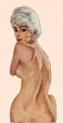
At top is a poster for Brigitte Bardot’s Et Dieu… créa la femme, known in English as …And God Created Woman, which, after premiering in France in 1956, opened in the U.S. today in 1957. Notice the X certification. That’s because Bardot went nude, though without showing the front of her body, of course. There are versions of this promo out there that aren’t faded, but this one spoke to us. The source photo is above too, as you see. It’s oriented in reverse. Nearly every version of the photo we’ve seen has Bardot’s hair on her right shoulder, so it looks like the poster designers flipped her. There are many other posters for the film, including a fantastic one here, and the French version in a group here. We’ll probably share more examples later.
In the movie, in case you’ve never seen it, Bardot is an orphaned girl aged eighteen living with two guardians outside St. Tropez, working in their book store in town, and greatly desired by both the fifty-something local tycoon Curd Jürgens and the thirtyish working class Christian Marquand. The former uses money to ply Bardot, while the latter has good looks and a decent heart. Bardot prefers Marquand, but flirts with both, and generally behaves in ways that finally cause her guardians to decide to send her back to the orphanage until she’s twenty-one. Instead, Marquand’s naive younger brother, played by Jean-Louis Trintignan, offers to marry Bardot to save her from that fate. She agrees, and the tangled web of Bardot and her men becomes a Gordian knot.
Et Dieu… créa la femme is always cited as a film that broke censorship barriers in the U.S. when it finally played there, and it’s indeed a bit scandalous. We love the part when Bardot, having just consummated her marriage to Trintignan, lounging naked in bed, answers his question of whether she can ever love him by saying, “I love this.” Her meaning is clear: You, I’m not sure I’ll grow to love, but I love fucking. Later, her wild dance in a jazz club with a black bandleader as her husband and suitors stare aghast symbolizes the fear of every white male of the time (and many today).
Bardot is controversial, having been convicted more than once by French courts of inciting racial hatred, but speaking only of her artistic output, where would cinema be without her? In the same place, we suppose, because someone else would have played her roles, but it’s difficult to imagine. Et Dieu… créa la femme is a must-watch for cinephiles—assuming they can tolerate Bardot. It has a few of the usual issues common to movies of the period, particularly a presumption of physical ownership over women’s bodies, but hell—it was 1956. What can you expect? Viewed in context the movie can be seen as quasi-feminist, though those inclinations are punished. But even if the men of Et Dieu… créa la femme eventually win the battle of the sexes, Bardot sends a bold shot across the bow.
I'm sorry, but your husband isn't available right now. He'll be in and out and in and out all day.
There’s nothing like a secretary who can anticipate your needs. It’s a symbiotic relationship. And biological too, sometimes, at least in vintage fiction. This cover was painted by Ray Pease for Gene Harvey’s, aka Jack Hanley’s, 1953 sleazer Office Sinner, which is a re-issue of 1951’s The Loves of Alice Brandt. You can see that here.
She never takes it off. Not for sleeping. Not for showers. Not for anything.
Above: a stunner of a shot of Prague born German actress Dagmar Lassander. So far we’ve seen her in Le foto proibite di una signora per bene, aka The Forbidden Photos of a Lady Above Suspicion, and La lupa mannara, aka Legend of the Wolf Woman, but she made more than sixty films, so we’ll probably see her again. Until then this will have to do. It first appeared in 1968 in Sir! magazine.
It's a hard fight to get up there and an even harder fight to stay.
This beautiful promo completes our coverage of Toei Company’s pinky violence flick Sukeban: Tamatsuki asobi, known in English as Girl Boss: Crazy Ball Game. What you see here is its tatekan style poster. The standard version is here, along with details about the film, and the eki-bari is here. The movie premiered today in 1974 with Yûko Kanô in the starring role.
This outfit is perfect for my new White House Press Secretary gig. My rage really opened lucrative doors for me.
Yup, it’s another cover for William Bradford Huie socially probing novelThe Revolt of Mamie Stover. This is the third we’ve shared, but only because they’re all interesting. Sphere Books takes the femme fatale concept to its far reaches with this fishnet and lingerie clad, liquor swilling blonde. The gun isn’t hers, though—a paid agitator left it there. Sphere, which we’d never heard of before, somehow wangled rights to this popular classic, later became a pre-eminent sci-fi publisher and is still operating today. This is copyright 1969.
This nice Italian poster was made for Kitten with a Whip, released in Italy as La gatta con la frusta. It’s uncredited, and the movie, as is the case ninety percent of the time when dealing with Italy, has no premiere date. We’ve covered this film already, as well as the source novel by Wade Miller. If you’re interested, you can read about the first here, and the second here.
In Newark, New Jersey, the organized crime figures Dutch Schultz, Abe Landau, Otto Berman, and Bernard “Lulu” Rosencrantz are fatally shot at the Palace Chophouse restaurant. Schultz, who was the target, lingers in the hospital for about a day before dying. The killings are committed by a group of professional gunmen known as Murder, Inc., and the event becomes known as the Chophouse Massacre.
1950—Al Jolson Dies
Vaudeville and screen performer Al Jolson dies of a heart attack in San Francisco after a trip to Korea to entertain troops causes lung problems. Jolson is best known for his film The Jazz Singer, and for his performances in blackface make-up, which were not considered offensive at the time, but have now come to be seen as a form of racial bigotry.
1926—Houdini Fatally Punched in Stomach
After a performance in Montreal, Hungarian-born magician and escape artist Harry Houdini is approached by a university student named J. Gordon Whitehead, who asks if it is true that Houdini can endure any blow to the stomach. Before Houdini is ready Whitehead strikes him several times, causing internal injuries that lead to the magician’s death.
1973—Kidnappers Cut Off Getty's Ear
After holding Jean Paul Getty III for more than three months, kidnappers cut off his ear and mail it to a newspaper in Rome. Because of a postal strike it doesn’t arrive until November 8. Along with the ear is a lock of hair and ransom note that says: “This is Paul’s ear. If we don’t get some money within 10 days, then the other ear will arrive. In other words, he will arrive in little bits.” Getty’s grandfather, billionaire oilman Jean Paul Getty, at first refused to pay the 3.2 million dollar ransom, then negotiated it down to 2.8 million, and finally agreed to pay as long as his grandson repaid the sum at 4% interest.
1947—HUAC Hearings Begin
The House Un-American Activities Committee begins its investigation into communist infiltration of Hollywood, resulting in a witch hunt that destroys lives, ruins careers, and makes Senator Joseph McCarthy the most feared politician of the era.
1968—Jackie Kennedy Marries
Former First Lady Jacqueline Kennedy marries Greek shipping tycoon Aristotle Onassis. The marriage comes as a total surprise to the American public, and results in a terrible backlash against her and also makes her the number one target of paparazzi for years.
This uncredited cover for Donald Henderson Clarke's 1949 novel Louis Beretti has one of the better fight covers we've seen. It's a one-sided fight, and the winning side is the bottom of a shoe. Great work.
How many femme fatales does it take to hang a picture? One, but with pain, according to the cover of Conald Lueger's De Pekelzonde. Maybe she should hire a handyman next time. This is from the Belgian imprint Uitgeverij Publiforce, and the art is by Peter Driben.
This is a beautiful George Gross cover painted for Joe Weiss's 1952 novel Girls Out of Hell! Gross is one of the most consistently eye-catching artists of the mid-century era, and one of the most collectible.