Practical Implementation of LoRA Fine-Tuning (1) – Training Instruction Models

Practical Implementation of LoRA Fine-Tuning (1) - Training Instruction Models

In the previous article, we introduced the principles of LoRA fine-tuning. In this issue, we will get hands-on with supervised fine-tuning (SFT) of a basic pre-trained model, transforming it into an instruction model capable of interacting with users in a dialogue system. LoRA Fine-Tuning Principles JunJun AI, WeChat Official Account: JunJun AI. What exactly is … Read more

Understanding Large Model Fine-Tuning: What Are the Differences Between SFT and LoRA?

Understanding Large Model Fine-Tuning: What Are the Differences Between SFT and LoRA?

In the application of large models, “fine-tuning” is a crucial step to adapt general models to specific scenarios — for example, enabling ChatGPT to write product copy or allowing LLaMA to answer industry-specific questions, both of which rely on fine-tuning. However, many people confuse SFT and LoRA, two core technologies: both are based on optimizing … Read more

Why Do Multi-Agent LLM Systems Fail?

Why Do Multi-Agent LLM Systems Fail?

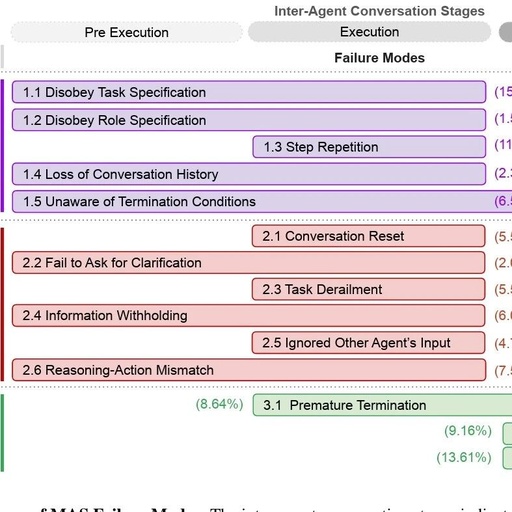
Why do multi-agent LLM systems fail? Abstract Despite the growing enthusiasm for multi-agent systems (MAS), which consist of multiple LLM agents collaborating to complete tasks, their performance improvements in popular benchmark tests remain minimal compared to single-agent frameworks. This gap highlights the necessity of analyzing the challenges that hinder the efficiency of MAS. In this … Read more

Why Do Multi-Agent LLM Systems Fail?

Why Do Multi-Agent LLM Systems Fail?

Multi-Agent Large Language Model (LLM) systems can fail? Recently, the University of California, Berkeley published a significant paper titled “Why Do Multi-Agent LLM Systems Fail?” which delves into the reasons for the failures of MAS systems, outlining 14 specific failure modes and providing corresponding improvement suggestions. Below is the translation of the paper, Enjoy. Introduction … Read more