New to Rust? Grab our free Rust for Beginners eBook Get it free →
What Is RAG (Retrieval-Augmented Generation) for Codebases | From Zero to AI Hero

Retrieval-augmented generation (RAG) gives an AI coding assistant selected evidence from your repository before it answers. The useful version of RAG for codebases is a retrieval pipeline with access controls, ranking, context limits, and tests for whether the chosen evidence supports the generated change.
A model cannot infer repository facts it never received
A large language model (LLM) may know JavaScript syntax, testing conventions, and common frameworks. It does not know that your calculateTax function accepts decimal rates, that your authentication helper wraps a vendor library, or that an architecture decision record forbids a dependency.
Missing private project knowledge is different from a training knowledge cutoff.
The model needs request-time evidence from files, symbols, tests, documentation, commits, or issue records.
Codebase RAG has an indexing path and a query path
Repository retrieval performs work before and during a request. Separating those paths makes stale indexes, poor ranking, and bad generation easier to diagnose.
The indexing path prepares searchable units
An indexer selects allowed files, parses them, and splits useful units such as functions, classes, documentation sections, or configuration blocks. Each unit keeps metadata including its path, language, symbol name, commit, and access scope.
A search index can store lexical terms, dense embeddings, graph relationships, or a combination.
The repository-level code RAG survey describes sparse, dense, graph-based, hybrid, and agent-style retrieval, which is why “RAG equals a vector database” is too narrow.
The query path finds evidence and builds context
A request such as “write a test for calculateTax” is converted into a search query. Retrieval gathers candidates, ranking keeps the strongest pieces, and a context builder removes duplicates before placing the selected code and metadata beside the request.
Generation happens after that selection. The model can draft a test from checkout.js and payments.md, but its answer still needs execution because supplied context does not guarantee correct reasoning.
| Stage | Input | Failure to watch |
|---|---|---|
| Filter | Repository permissions and ignore rules | Secret or unauthorized file enters the candidate set |
| Retrieve | Request plus repository index | Required symbol or document is absent |
| Rank | Candidate code and metadata | Relevant evidence falls below weaker matches |
| Assemble | Ranked chunks and token budget | A definition is separated from its contract |
| Generate | Request plus selected context | Answer contradicts the supplied evidence |
| Verify | Generated change and project checks | Plausible code fails tests or policy |
A small retrieval script makes the boundary visible
The script below uses token overlap rather than embeddings.
That baseline is intentionally small, yet it exposes the contract every larger system must honor: return identifiable evidence before asking a model to generate code.
const chunks = [
  {
    path: "src/checkout.js",
    text: "export function calculateTax(subtotal, rate) { return subtotal * rate; }",
  },
  {
    path: "test/checkout.test.js",
    text: "import { calculateTax } from '../src/checkout.js';",
  },
  {
    path: "docs/payments.md",
    text: "Tax rates enter calculateTax as decimal values such as 0.2.",
  },
  {
    path: "src/auth.js",
    text: "export function verifyToken(token) { return Boolean(token); }",
  },
];

const query = "Write a test for calculateTax with a decimal tax rate";
const tokens = (value) => new Set(value.toLowerCase().match(/[a-z0-9_]+/g) ?? []);
const queryTokens = tokens(query);

const ranked = chunks
  .map((chunk) => {
    const overlap = [...tokens(`${chunk.path} ${chunk.text}`)]
      .filter((token) => queryTokens.has(token)).length;
    return { ...chunk, overlap };
  })
  .sort((a, b) => b.overlap - a.overlap)
  .slice(0, 2);

console.log(`Query: ${query}`);
console.log("Retrieved context:");
for (const chunk of ranked) {
  console.log(`- ${chunk.path} (overlap: ${chunk.overlap})`);
  console.log(`  ${chunk.text}`);
}
console.log("\nPrompt payload:");
console.log(JSON.stringify({ query, context: ranked.map(({ path, text }) => ({ path, text })) }, null, 2));
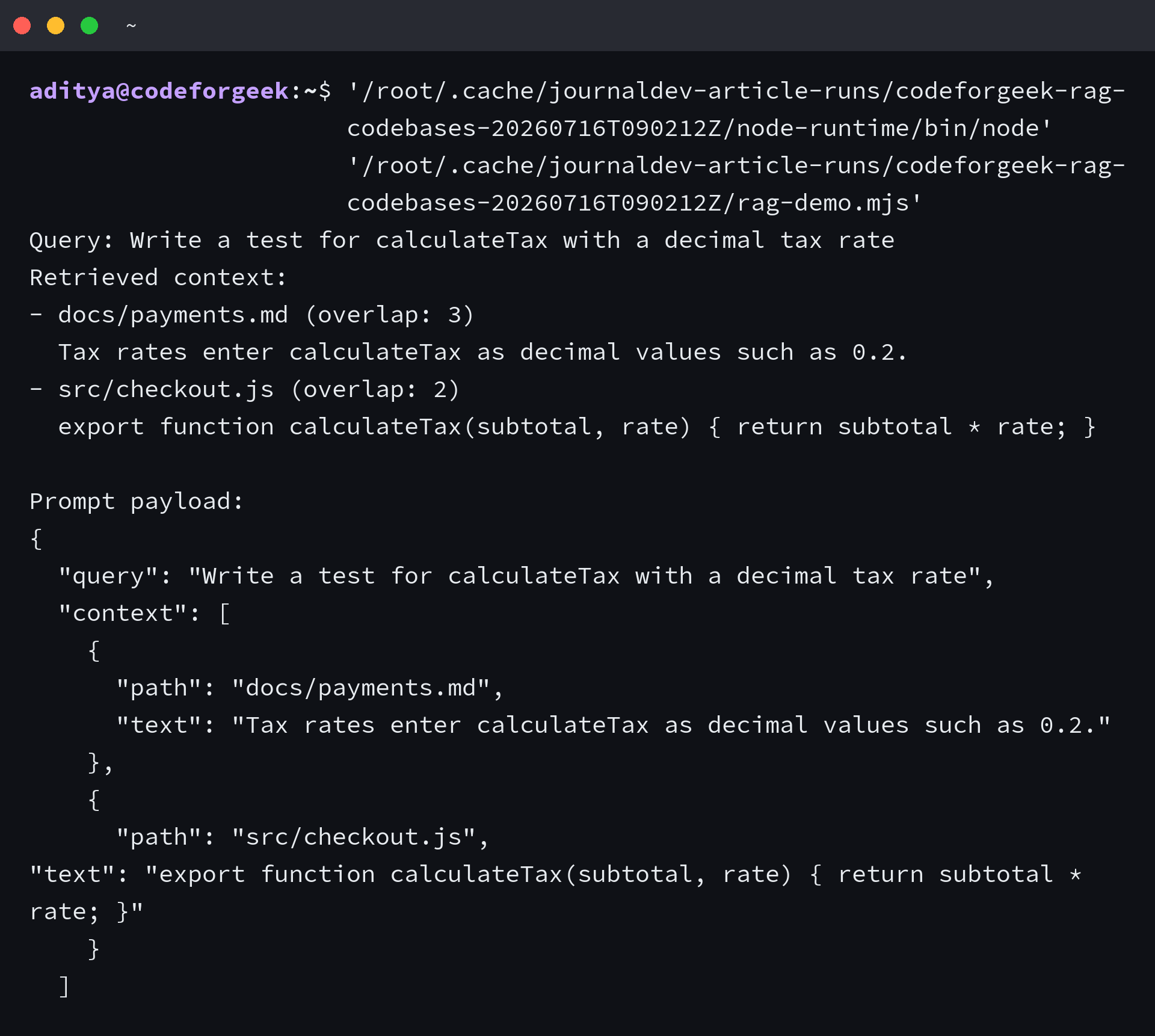
My Node.js 24.18.0 execution selected payments.md and checkout.js, then produced a prompt payload that preserved both file paths and source text.
Token overlap works when a query contains calculateTax and the repository uses the same identifier. Semantic search helps when the request says “sales tax” but the implementation uses calculateTax, and hybrid retrieval keeps exact symbol matches from disappearing behind approximate similarity.
Chunking should preserve code structure
Fixed-size text slices can cut a function away from its signature, comments, tests, or imports.
Syntax-aware chunks give retrieval a better unit, though large classes may still need smaller members plus parent metadata.
The Continue custom code RAG guide describes chunking because embedding models accept limited input. Repository tools often add file paths and symbol metadata so ranking can prefer the correct definition over a coincidental mention.
- Keep paths and symbols. A snippet without provenance is hard to inspect or cite.
- Attach neighboring context selectively. Imports, interfaces, and tests may explain a function better than more lines from the same body.
- Track the revision. An answer grounded in an old commit can be precise and wrong.
- Exclude generated and sensitive files. Build output, dependency folders, secrets, and credentials should never enter the candidate set.
Repository indexes must follow code changes and permissions
An index loses trust when a renamed function or changed contract remains searchable under old content. GitHub states that Copilot answers and tasks work best when the repository semantic index is up to date, and its documentation explains how repository indexing is managed.
GitHub repository indexing documentation also separates indexed repository context from the model itself.
The Visual Studio Code workspace context documentation notes that workspace search can combine an index with local and remote sources.
Privacy depends on the complete request path. A local index does not keep code local if retrieved snippets are later sent to a hosted model, and a hosted index needs repository permissions that match each user before search runs.
Retrieval quality and answer quality need separate tests
A generated answer can fail because retrieval missed the evidence or because the model ignored good evidence. One end-to-end score hides which component needs work.
| Test | Question | Useful measure |
|---|---|---|
| Retrieval fixture | Did the expected file or symbol appear? | Recall at k and rank of the expected artifact |
| Context inspection | Did selection include enough contract information? | Required paths present and irrelevant chunks removed |
| Generation check | Did the answer follow retrieved evidence? | Citation support and contradiction count |
| Execution check | Does the proposed change work? | Tests, type checks, lint, and build result |
| Security check | Could the requester retrieve restricted content? | Denied fixtures remain absent at every rank |
Start with requests whose supporting files you can name.
A fixture that expects checkout.js and payments.md gives you a concrete retrieval target before you measure whether the drafted test passes.
Choose simpler search when it already solves the task
RAG adds indexing, storage, freshness, permissions, ranking, and evaluation work. File search and symbol lookup may be enough for a small repository with exact identifiers.
Use semantic or hybrid retrieval when vocabulary differs across requests and code, when the repository is too large for direct context, or when documentation and implementation must be searched together. If you want to see how numerical representations support that search, read the code embeddings guide.
Managed assistants can remove part of the indexing burden.
The GitHub Copilot setup guide shows how workspace context appears inside Visual Studio Code, and the retrieval checks above remain useful when an answer misses a project contract.
Frequently asked questions
What does RAG mean for a codebase?
Retrieval-augmented generation searches repository artifacts for evidence related to a request, adds selected evidence to the model context, and asks the model to answer from that context.
Does codebase RAG require a vector database?
No. Small repositories can start with file search, symbol lookup, or lexical ranking. Embeddings and vector storage become useful when semantic similarity must work across more code and documentation.
Does RAG stop an AI model from hallucinating?
No. Better context can reduce unsupported answers, but retrieval can miss the needed file and generation can misuse a correct snippet. Evaluate retrieval and generated code separately.
Is codebase RAG automatically private?
No. Your deployment decides where indexes live, which files are indexed, and whether retrieved snippets are sent to an external model provider. Exclusion rules and access controls must apply before retrieval.
How is RAG different from fine-tuning?
RAG supplies repository evidence at request time. Fine-tuning changes model weights. RAG fits changing project knowledge, and fine-tuning fits repeatable behavior or style when you have suitable training data.
Repository size, data sensitivity, and the expected questions determine how much retrieval infrastructure the codebase needs.
Treat retrieved code as evidence, not permission
Repository RAG earns its place when it retrieves the right artifacts, respects access boundaries, and leaves enough provenance for you to inspect the answer. Keep the file paths, run the generated change, and debug retrieval before changing the model whenever the required evidence never reached the prompt.