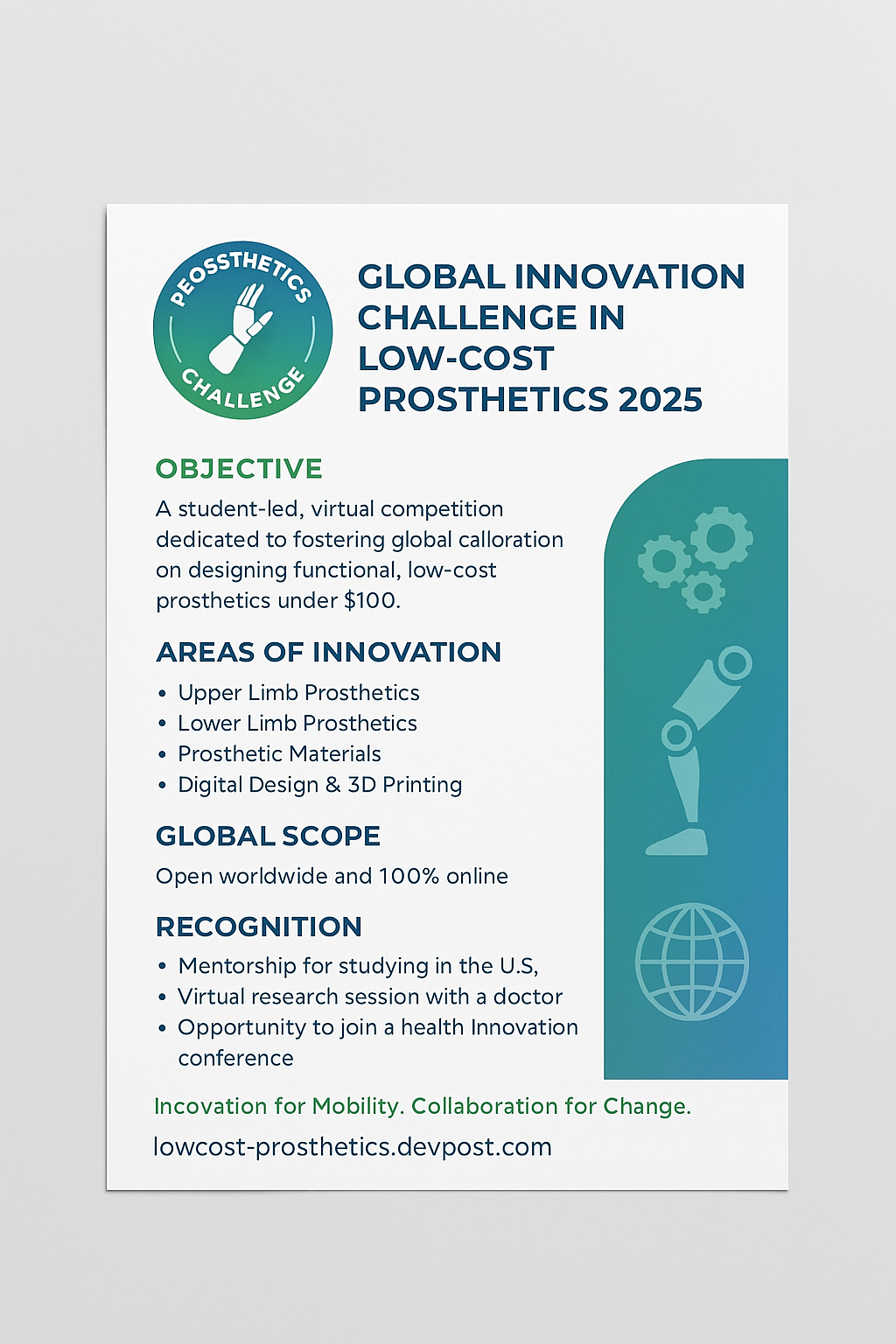
📅 Timeline
- Registration Opens: August 30, 2025
- Introductory Virtual Workshops: September 1–7, 2025
- Project Building Period: September 8 – October 10, 2025
- Submission Deadline: October 15, 2025
- Judging Period: October 16–25, 2025
- Final Event & Winners Announcement: October 30, 2025
✅ Eligibility
- Open to students and young innovators of all ages and nationalities.
- Teams of 1–5 participants are accepted.
- No advanced medical knowledge required—open to students, innovators, and social entrepreneurs.
- All projects must be submitted in digital format and open-source.
📌 Project & Submission Requirements
What to Build
- A prototype or concept of a low-cost prosthetic device (under $100).
- CAD designs or 3D models.
- Diagrams or sketches of the prosthetic.
- Clear documentation of materials and estimated costs.
- A brief plan for implementation in underserved communities.
What to Submit
- Project description (500–1000 words) explaining design, functionality, and social impact.
- Design files (CAD, 3D models, diagrams, or open-source schematics).
- Short video (2–5 minutes) presenting the prototype and the team.
- Team bios with roles and responsibilities.
🏆 Awards
Instead of monetary prizes, participants will gain unique opportunities for learning and collaboration:
- Personalized advisory sessions on how to apply for studies in the United States.
- Exclusive virtual talks with doctors and international researchers.
- Publication of projects on a global innovation platform.
- Invited access to an international youth health innovation congress.
- Post-challenge collaboration: the winning team will continue working together with the organizer to further develop and implement their project.
📊 Judging Criteria
Projects will be evaluated according to the following criteria:
- Innovation & Creativity (30%) – Original, practical, and impactful solutions.
- Affordability (20%) – Can be developed for under $100 using accessible materials.
- Functionality & Usability (20%) – The prototype fulfills its purpose and is ergonomic.
- Global Social Impact (20%) – Demonstrates benefits for underserved communities.
- Documentation & Presentation (10%) – Clarity, quality, and professionalism of the submission.
