Image

Newton’s Cradle Isn’t Really Perpetual

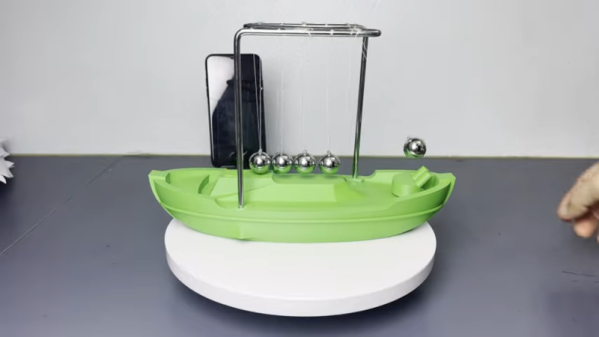
If any astute Hackaday reader saw [dongvua90]’s Newton’s cradle go on without human intervention all day long, they’d probably suspect the truth: there’s a battery and a magnet involved. But it is a nice desk piece, and you might be able to fool your less enlightened friends that you’ve discovered perpetual motion. Watch the resulting faux perpetual motion machine in action in the video below.

The trick is to sense the ball’s travel and inject a little electromagnetic pulse at just the right time. No problem for an ESP32 and a proximity sensor like the ones you find on some 3D printers. In fact, there’s very little custom circuitry. Everything is a module, and even the Newton’s cradle is cut out of a premade toy. A printed case and some software are really the heart of the design.

We can imagine this might be an interesting science demonstrator. Show the class the cradle with the electronics turned off, then subtly turn it on and ask the class what changed. You could even make the point by having students do it normally, while only you can get it to keep going forever, and challenge them to deduce what’s going on.

You might correctly imagine that this isn’t the first one of these we’ve seen. You can also build one that is sort of simulated.

Continue reading “Newton’s Cradle Isn’t Really Perpetual”

A series of simulations of a shape are shown, with that shape traced out in a petri dish with a laser below. The shape is roughly like a 90-degree corner bisected by a third arm.

Printing Fungal Art With Laser Control

Preservationists usually take great care to prevent fungi from appearing the world of art, but in the case of [Kexin Wang]’s Funguy project, the fungus itself is the art. It uses a laser diode to repeatedly trace an outline onto a dish of agar gel in which fungus is growing, and the photophobic fungus grows only up to the edge of the laser-traced figure, potentially creating complex designs.

This project evolved out of a research project in which they developed a computer model for fungal growth, then used its predictions and a laser to control a fungus’s growth pattern. The model has two parts: a temporal convolutional neural network which learns fungi growth patterns from a series of images, and a cellular automaton to simulate these growth patterns under different starting conditions. The cellular automaton’s rules aren’t fixed; each cell runs a small neural network which learns the rules under supervision from the convolutional network. By training these networks on images of the growth stages of three different fungi, it was able to realistically predict the different growth patterns of the different species.

To actually control the growth pattern, the researchers tried a series of different wavelengths and laser powers; shorter wavelengths tended to work better, with a 405 nm laser working best. The growth model complemented the laser setup by predicting in which areas the growth medium had run out of nutrients. Since fungus would no longer spread in these regions, the laser no longer needed to trace these sections. The Funguy kit’s laser system itself is similar to a laser engraver, with an XY-kinematic system seemingly built from a DVD drive frame. It uses fungi from the Mucor genus, though it can print with other photophobic microorganisms, such as slime molds.

This project seems aimed at artistic and educational uses, but considering the various electronic parts that have been made of fungi, more functional applications should be possible.

Image

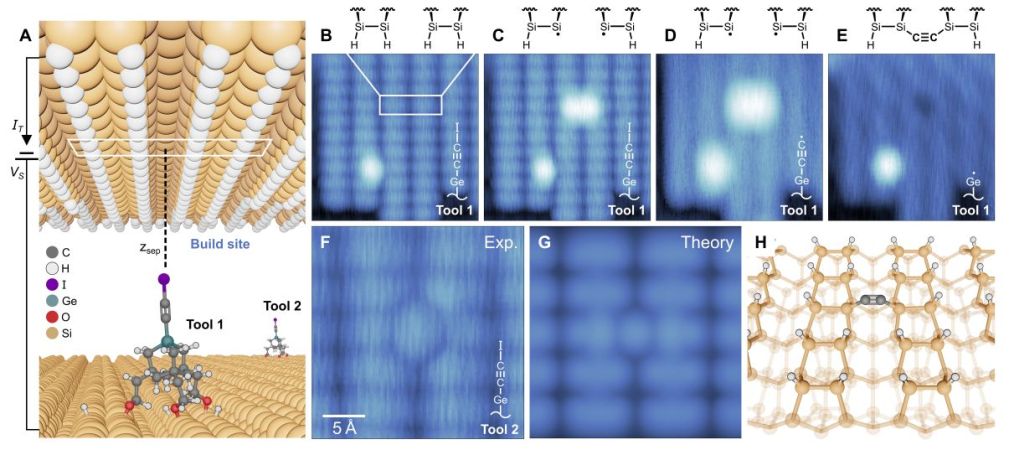
Mechanosynthesis Of Atomic Carbon Structures Using Inverted-Mode STM

Generally chemical synthesis involves putting a variety of compounds together in an environment where they will react and self-assemble into the desired product. You could also imagine simply putting the atoms in the right place: direct mechanical manipulation. This mechanosynthesis is however not that simple, despite the deceptive appearance of those ball-and-stick representations in high school chemistry class.

This is demonstrated in a recent (pre-publication) study by [Megan Cowie] et al. using inverted-mode STM. Using a scanning tunneling microscope (STM) you can measure a surface on a nanoscale, with the inversed principle used in inverted-mode STM (IM-STM) to physically move individual molecules. In the paper the construction of carbon-based 3D structures using IM-STM is demonstrated.

In the paper it is demonstrated how C2 units can be moved using the tip of an IM-STM setup for subsequent polyyne structure construction through C-C bond formation at the target site. Although it’s not quite yet the leap into Neal Stephenson’s The Diamond Age with its science-based matter compilers – i.e. molecular assemblers – it’s definitely another step closer to making advanced feats of nanotechnology a part of every day life.

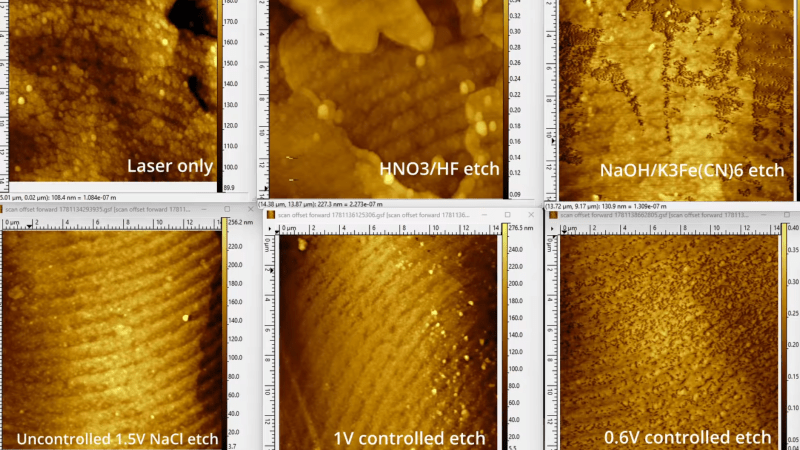
A series of six sepia-tinted micrographs is shown. The images show the surface of a piece of steel after various etching treatments.

Seeing Bacteria, Nanoprisms, And More With An Atomic Force Microscope

Unlike almost every other kind of microscope, atomic-force microscopes (AFMs) don’t use any kind of optical beam to image their subjects. Instead, they physically detect the subject’s surface with a tiny probe, repeating this thousands of times to build up a height map of the subject, sometimes with a resolution below a single nanometer. [Ben Krasnow] got to use an AFM in an investigation of one of his projects, and shared some unusual uses of it in his latest video.

Continue reading “Seeing Bacteria, Nanoprisms, And More With An Atomic Force Microscope”

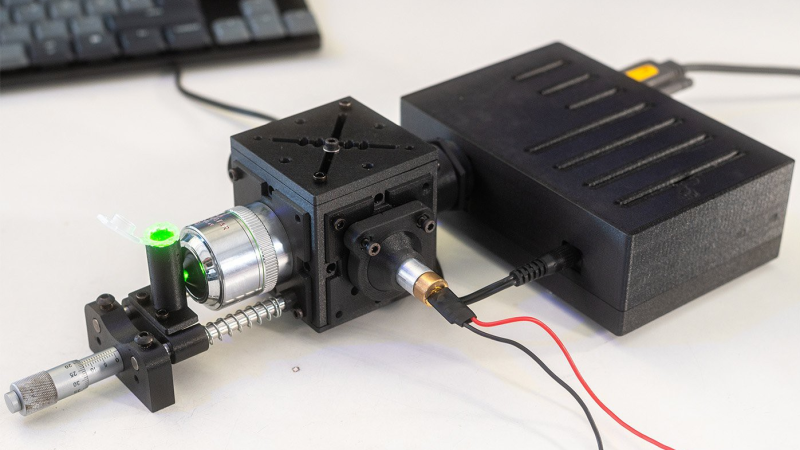
A black plastic cube is shown in front of another, larger rectangular black plastic box. The plastic cube has a silver microscope objective protruding from one side, with green light being emitted from it into a small plastic tube held on a positioning stage.

2026 Frikkin Lasers Challenge: A 3D-Printed Raman Spectrometer

When light reflects off a surface, not all of it reflects off at the same wavelength; some photons impart a portion of their energy to raising the vibrational energy of the surface’s molecules, and are thus scattered away at a lower energy and longer wavelength. This is called Raman scattering, and the precise wavelength shifts are characteristic of the particular molecule being illuminated. It can therefore be used in Raman spectroscopy to identify molecules; these spectrometers are normally elaborate, expensive instruments, but [Allegedly Science] was able to build a simple system with surprising sensitivity.

Continue reading “2026 Frikkin Lasers Challenge: A 3D-Printed Raman Spectrometer”

Image

Settling The Debate On Soldered Versus Crimped High-Current Connectors

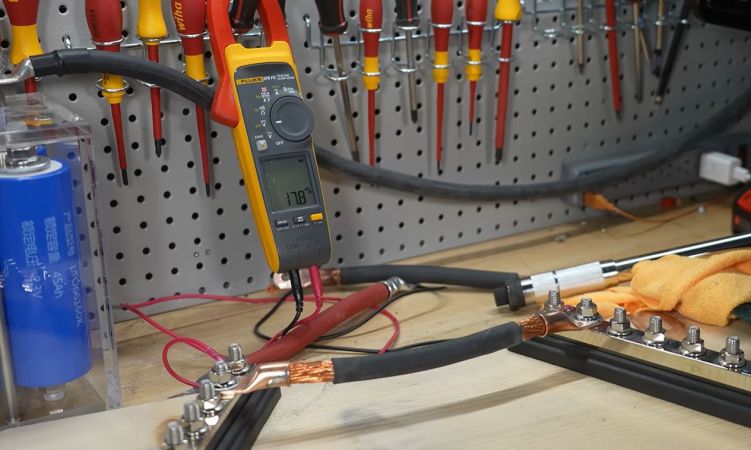
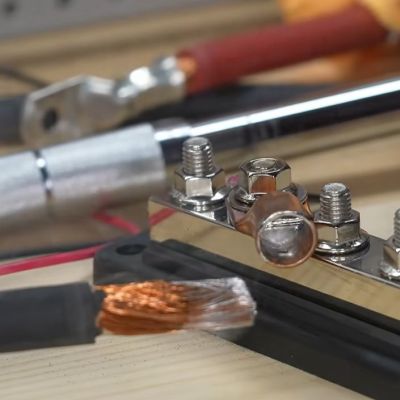
For some reason there’s heated debate around the topic of whether high current carrying wiring ought to use crimped or soldered connections, even though the industry standard is to crimp everything. As a practical demonstration of why this is the case, [Will Prowse] set up a test involving a rig capable of dispensing a few hundred amps through both a crimped and a soldered copper cable.

Image

Prior to making things go spicy, [Will] made sure to check the resistance of the two cables, noting that the soldered version had significantly lower resistance than the crimped connectors. This could be one metric that proponents of soldered connectors can point to as a benefit.

Of course, the main benefit of crimping is that you create a cold weld if crimped properly, which is a sold-state welding process that effectively blends two metal surfaces together. This is also why wire wrap is generally considered to be so very reliable, as it creates a gas-free, solid connection that does not rely on a softer, dissimilar material like solder to hold things together. Of note here is also that the cold weld process tends to continue for a while, so this kind of connection is likely to get better over time.

In the subsequent testing this difference is demonstrated quite well, especially when both cables are subjected to the sort of mechanical abuse that would be expected in an installation, such as vibrations and direct impacts. Here the soldered connections quickly begin to fail, resulting in one soldered connector even unsoldering itself due to heat development. Ultimately cold welding is simply superior over relying on a flimsy and capricious interface of intermetallic compounds.

Continue reading “Settling The Debate On Soldered Versus Crimped High-Current Connectors”

Image

Trying Out Viewer Suggestions For Levitation On An Induction Cooker

Doing something once is fun, but if you get interesting feedback from viewers on how to make things even more fun, you can only follow all of these instructions and put more random objects on top of an induction cooker, as [Brainiac75] fortunately did.

Much like in the first video, the goal here is to use the Lorentz force that is induced in the object for levitation, ideally without having said object depart for orbit, melt into a puddle of molten metal or be a general hazard to anyone standing in the same room.

Image

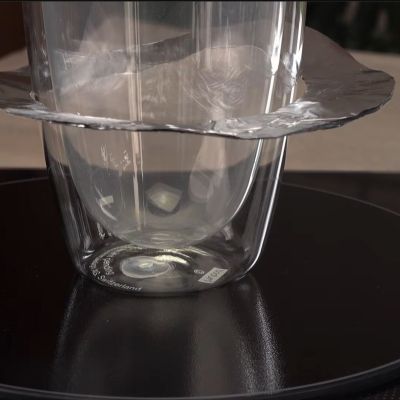
Some of the suggestions were rather benign, such as improving the aluminium foil ring by adding four times more layers to create more mass. Unfortunately adding more layers here had the device refuse to turn on due to the absence of a suitable ferromagnetic target. The difference between the working versions with one to three layers was here also not really noticeable. Various aluminium and copper tape configurations were then attempted, but without much success.

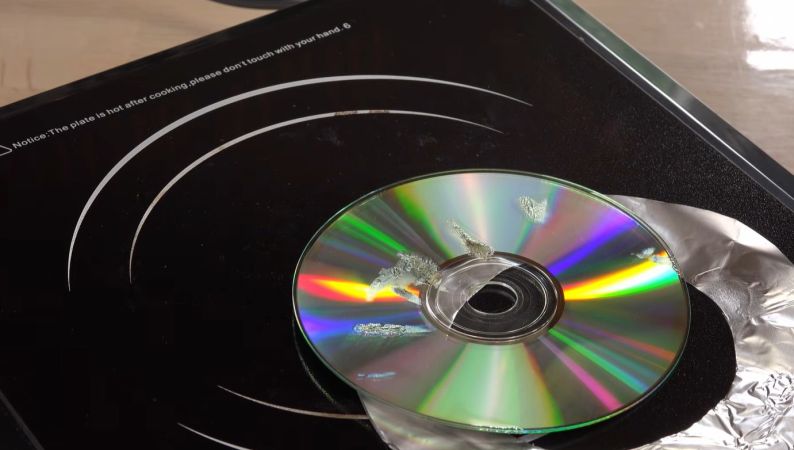
Of note is that while levitating, the metal gets pretty hot. At one point a CD even gets melted to aluminium foil. Even the use of water-filled aluminium cans will only give you so much time, and ramping down the power level on the induction cooker only revealed that this particular model operates only at either at full blast or off. Correspondingly a new induction cooker with claimed constant output was obtained for the next experiments at lower levels.

Interestingly, it was this new induction cooker set to a more reasonable output level that showed the first reasonably static levitation results without immediate conflagration or molten metal splatter risk. Whether this is the kind of levitation display that you want to set up in your living room in lieu of a boring magnetic one is still a good question, but at least this demonstration got downgraded to something potentially safe enough to play around with in a physics class.

Continue reading “Trying Out Viewer Suggestions For Levitation On An Induction Cooker”