Image

Die Casting Comes Home

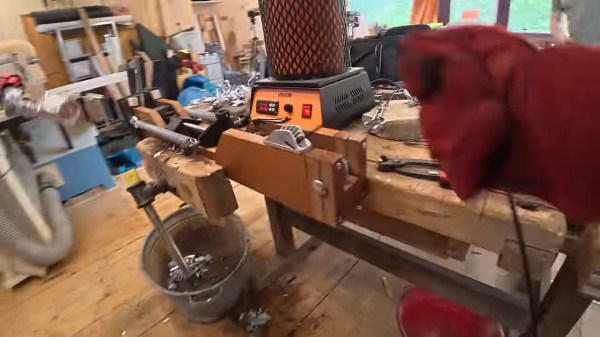
You don’t normally think of die casting as something to do at home. Pressurized fluids demand respect at all times, which is perhaps in part why we see most projects skipping hydraulics for linear actuators. When the pressurized fluid is molten metal? Well, we’d say don’t try this at home, except that’s exactly what this video by [Know Art] is making us want to do. He’s doing die-cast aluminum, and it looks way easier than we thought it would.

If you’re wondering why anyone would attempt such a thing, it’s for the same reason die-casting has been an industrial powerhouse for the last couple hundred years — you can crank out a lot of parts, very quickly, with excellent detail and dimensional stability. You just need a mold, which in this process is called a die, and a way to squeeze metal into it with some force.

In this case the die was carved on a desktop CNC machine. Depending on how long you want your die to last, you’ll need something hard and heat resistant, like the graphite used in this video. Graphite is also used in constructing the piston for the injector, which is made from a modified hydraulic cylinder and a couple of old trampoline springs.

He first tests the setup with molten wax before moving onto aluminum, as the process is the same regardless: pour the hot liquid in, release the springs to provide the pressure that forces it into the die, and a part is made. It looks easy, if a bit frantic, as you have to work fast before the metal cools in the cylinder.

After CNC milling, EDM machining and all the fun things we’ve learned how to do with lasers and 3D printers, and now this we’ve got to wonder– is there any industrial process you can’t hack onto your desktop? We’ve even seen the chemists get in on the game.

Continue reading “Die Casting Comes Home”

Image

A Die-Cast Car Subframe, Pushing The Limit Too Far?

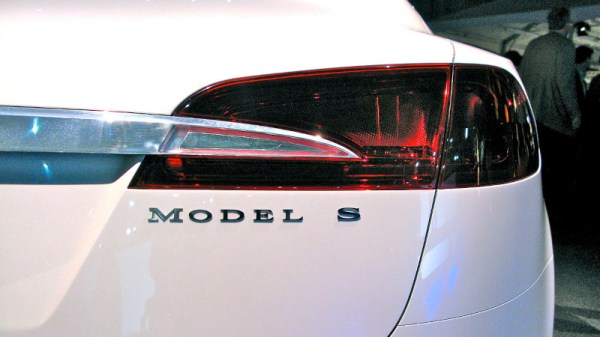
A piece of manufacturing news from Tesla Motors caught our eye, that Elon Musk’s car company plans to die-cast major underbody structures — in effect the chassis — for its cars. All the ingredients beloved of the popular tech press are there, a crazy new manufacturing technology coupled with the Musk pixie dust. It’s undeniably a very cool process involving a set of huge presses and advanced 3D-printing for the sand components of the mould, but is it really the breakthrough it’s depicted as? Or has the California company simply scored another PR hit?

We produced an overview of die casting earlier in the year, and the custom sand moulding in the Tesla process sounds to us a sort of half-way house between traditional die casting and more conventional foundry moulding. I don’t doubt that the resulting large parts will be strong enough for the job as the Tesla engineers and metallurgists will have done their work to a high standard, but I’m curious as to how this process will give them the edge over a more traditional car manufacturer building a monocoque from pressed steel. The Reuters article gushes about a faster development time which is no doubt true, but since the days of Henry Ford the automakers have continuously perfected the process of making mass-market cars as cheaply as possible. Will these cast assemblies be able to compete with pressed steel when applied to much lower-margin small cars? I have my doubts.

Aside from the excessive road noise of the Tesla we had a ride in over the summer, if I had a wish list for their engineers it would include giving their cars some longevity.

Header: Steve Jurvetson, CC BY 2.0.

Image

The Die Is Cast!

We all know the basics of how metal casting works, a metal is heated up to melting point and the resulting liquid metal is poured into a mold. When the metal sets, it assumes the shape of the mold. It’s a straightforward way to reliably replicate a metal item many times over, and the basics are the same whether the metal is a low-temperature alloy in a silicone mould or a crucible of molten steel poured into a sand mould.

The mould is black sand in a cast iron box, and the pattern piece is half submerged in it
A sand mould being formed around a pattern. Lukas Stavek, CC BY-SA 3.0 .

What we all understood as casting in our conversation was sand casting. Sand is packed around a pattern of the piece to be cast, and then the pattern is removed leaving a cavity in its shape which becomes the mould. There are refinements to this process and the mould is frequently formed in two halves, but it’s something that’s even practical to do in a hackerspace level setting.

A refinement of sand casting is so-called lost-wax casting, in which a hollow wax model of the piece to be cast is packed around with sand, and when the metal is poured onto the top of it the wax melts and the wax is melted out before pouring the metal in to take its place. A variation on this appears here from time to time, so-called lost-PLA casting, where the wax model is replaced with a PLA 3D print.

Injection Molding For Metals

Diagram of a die casting machine
A die casting machine. Ahmed elbhje, Public domain.

Where our confusion crept in was with die casting. We could recognise a die-cast piece, but just what is die-casting, and how is a die-casting made? The answer there lies in mass-production, because a snag with sand casting is that  a sand mould can be labour intensive to produce. Much better to come up with a quick-turnaround process that re-uses the same mould over and over, and save all that time!

Enter the die-casting, to metalwork what injection moulding is to polymers. The die is a mould made out of metal, usually with liquid cooling, and the casting is done not by pouring but by forcing the molten metal into the mould under pressure. The whole process becomes much quicker, meaning that it can become a piece of process machinery spitting out castings rather than a labour-intensive individual task. The metals used for die-casting are the lower temperature ones such as aluminium, zinc, and their alloys, but  you will find die-castings in all conceivable places.

It’s obvious that Hackaday editors are not experienced foundrymen even if some of us grew up around metalwork, but we know that among our readers lie genuine experts in all sorts of fields. If that’s you and you operate a die-casting machine, please take a moment to tell us about it, we really would like to know more!

Header: Constantin Meunier, Public domain.

Image

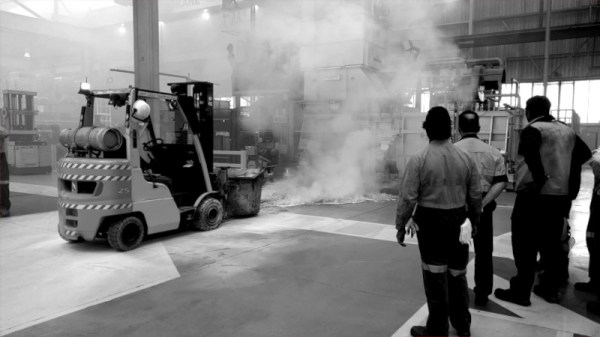
Water And Molten Aluminium Is A Dangerous Combination

It is not uncommon for a Hackaday writer to trawl the comments section of a given article, looking for insights or to learn something new. Often, those with experience in various fields will share kernels of knowledge or raise questions on a particular topic. Recently, I happened to be glazing over an article on aluminium casting with interest, given my own experience in the field. One comment in particular caught my eye.

 And no, the water won’t cause a steam explosion. There’s a guy on youtube (myfordlover, I think) who disproves that myth with molten iron, pouring the iron into water, pouring water into a ladle of molten iron and so on. We’ll be happy to do a video demonstrating this with aluminum if so desired.

Having worked for some time in an aluminium die casting plant, I sincerely hope [John] did not attempt this feat. While there are a number of YouTube videos showing that this can be done without calamity, there are many showing the exact opposite. Mixing molten aluminium and water often ends very poorly, causing serious injury or even fatalities in the workplace. Let’s dive deeper to see why that is.

Continue reading “Water And Molten Aluminium Is A Dangerous Combination”

Image

Peeking Inside A VW Gearbox Reveals Die Casting Truths

Recently, I was offered a 1997 Volkswagen Golf for the low, low price of free — assuming I could haul it away, as it suffered from a thoroughly borked automatic transmission. Being incapable of saying no to such an opportunity, I set about trailering the poor convertible home and immediately tore into the mechanicals to see what was wrong.

Alas, I have thus far failed to resurrect the beast from Wolfsburg, but while I was wrist deep in transmission fluid, I spotted something that caught my eye. Come along for a look at the nitty-gritty of transmission manufacturing!

Continue reading “Peeking Inside A VW Gearbox Reveals Die Casting Truths”