Image

To Build More Believable Bots, Simulate The Neurochemistry

Giving machines the ability to communicate nonverbally has real value, and [Drew Smith] clearly thinks your robot deserves better than an emoji. He shared a very interesting approach with his project Kindalive.

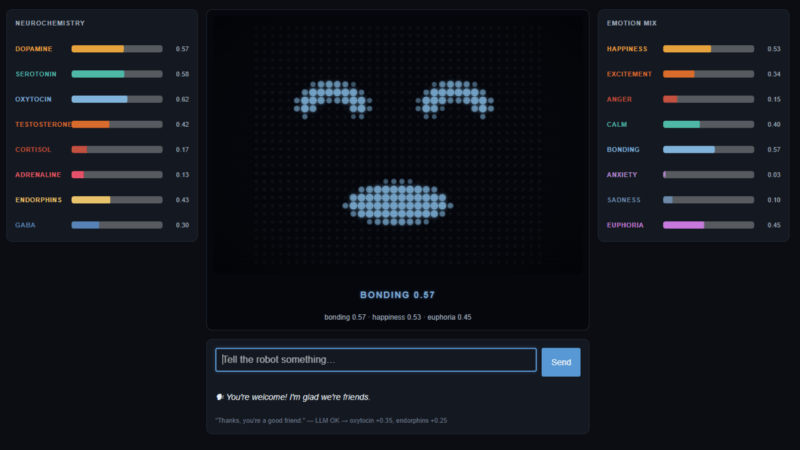
Kindalive is a simulated dot-matrix robot face that responds believably to input text, modeling and expressing both short-term and long-term moods. It’s pure Python and modular enough to invite using it elsewhere, but that’s not the really interesting part.

ImageWhat sets [Drew]’s project apart is the way he models eight key neurochemicals (including dopamine and cortisol) as the foundation from which to derive emotional states. That’s an approach we certainly haven’t seen before.

Conventional sentiment analysis uses a large language model (LLM) to apply discrete labels to communication, but Kindalive doesn’t do that. It even goes so far as to model the decay and interplay between its simulated neurochemicals to derive emotional states on the fly. It’s more fluid and organic, and reflects both short-term and long-term mood changes.

Physical representation of the emotional mix is done by altering twelve key facial movements (brow raise, lip corner pull, mouth open, and others of that nature) known as the Facial Action Coding System (FACS). These twelve elements combine to express emotion nonverbally with facial expressions. It’s what drives the simulated dot-matrix robot face seen in the image above, and could easily be used to drive a real LED matrix, or servos on an animatronic face.

Much of communication is nonverbal. Humans even weigh nonverbal higher when there’s a mismatch between the content of verbal and nonverbal communication. So, there’s clear value in having robots able to express themselves as such.

Importantly, a realistic and human-like face is entirely unnecessary — something every Star Wars fan already knows. Cartoon eyes and basic sounds are enough to make robots easier to relate to and work with, even if blinking is also important but hard to get just right.
Image

3D Printed Head Can Unlock Your Phone

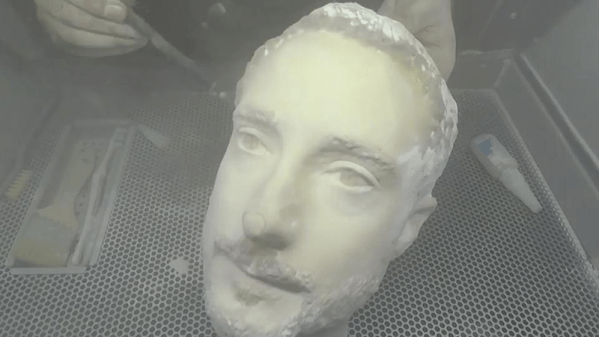
[Thomas Brewster] writes for Forbes, but we think he’d be at home with us. He had a 3D printed head made in his own image and then decided to see what phones with facial recognition he could unlock. Turns out the answer is: most of them — at least, those running Android.

The models tested included an iPhone X, an LG, two Samsung phones, and a OnePlus. Ironically, several of the phones warn you when you enroll a face that the method may be less secure than other locking schemes. Conversely, one phone had a faster feature that is known to make the phone less secure.

Continue reading “3D Printed Head Can Unlock Your Phone”

Image

Robo Face Speaks

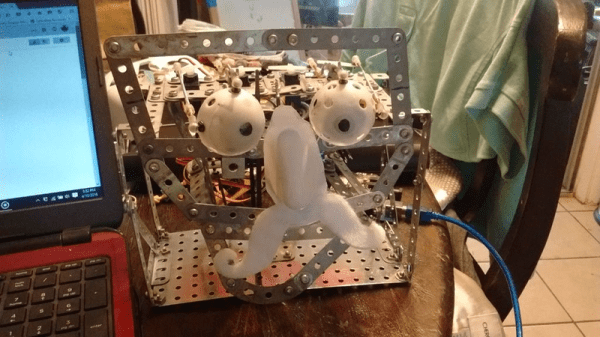
If you are doing a senior design project in engineering school, it takes some guts to make a robotic duplicate of the school’s president. He or she might be flattered, or completely offended. Us? We laughed out loud. Check out the video below. Spoiler: the nose/moustache wiggle at the end kills us every time.

The project uses a variety of parts including a plastic mask, an Erector set, and the obligatory Arduino with an MP3 shield. There are many articulated parts including eyes, nose, mouth, and wiggly moustache. The face uses RC servos, although [gtoombs] says he’d use stepper motors next time for smoother motion.

Continue reading “Robo Face Speaks”

Image

Face Recognition For Your Next Con

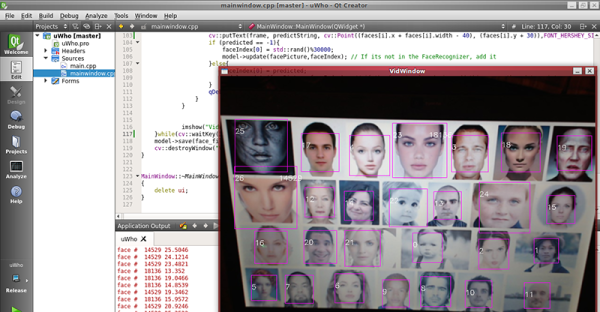
[jwcrawley] is busy planning for the Makevention coming up in Bloomington, Indiana in late August. One problem when working any con is manning the door; it’s a good idea to know how many people are there, and you can’t double count people. Previously, the volunteers used dead trees to estimate how many people have turned up. This year they might go with a more technological solution: face recognition and tracking.

The project is called uWho, and it uses the faceRecognizer class in OpenCV. The purpose of the entire project is to identify who someone is from previous frames. If your face is unknown to the program, your likeness – rather, a few points of data – are added to the database of faces. It’s simple, and according to [jwcrawley], it works.

While this is technically the best way to count how many unique people show up to Makevention, there will be some discussions to see if this solution is appropriate. The program only saves unique data from a face locally, and does nothing online. It’s less evil than whatever Facebook does, but there are obvious privacy implications here.

Link to the Makevention.

Your Face On A Bot

[youtube=http://www.youtube.com/watch?v=fLoRpRu_KPo]

We’ll file this one under “creepy yet amusing”. You can now order a MechRC robot with a 3d replica of your own head mounted to it. The site thatsmyface.com is offering this as a product. Simply take some pictures of your face upload them and mark some options. They’ll send you your robotic replica, ready to go. As they point out at botjunkie, they’ll put any face on there that you have some decent pictures of. That’s even creepier.