The Church of St. Polyeuktos in Constantinople

I have many simmering anxieties as a scholar. Among them is my worry about having to publish the North Basilica at Polis on Cyprus by myself. This means immersing myself again in the literature of Early Christian architectural history. Among the most interesting features of the North Basilica is the presence of apsidal exedrae on the north and south wall of the church. This is not only unprecedented on Cyprus, but rather unusual for Early Christian architecture in general.

As an effort to slowly dip my toes back into the waters of architectural history, I read Fabian Stroth’s volume in the Cambridge Elements series The Church of St. Polyeuktos at Constantinople (2024). I started with this book partly because this church has always fascinated me (and if I recall correctly my architectural history advisor in graduate school, James Morganstern, worked at the dig) and Stroth clearly recognizes the buildings legendary status as the best point of departure for his survey of the church’s architecture. 

For those who don’t know, construction in the 1960s revealed this church and prompted emergency salvage excavations under the direction of Martin Harrison. The church was built in the 6th century by Anicia Juliana who was the last surviving member of the Theodosian dynasty. She evidently had a rivalry with Justinian and this had long framed the construction of this church as part of the motivation for Justinian to build Ay. Sophia. Anicia Juliana’s poetic inscription which appeared on a series of entablature blogs confirms the identification of the church and seals its unique place in both architectural and literary history of the capital as this inscription also appears in the Greek Anthology

Stroth has little patience for such romantic interpretations of the church and its place in the architectural history of the capital. While not dismissing the church’s opulent character, which inescapable on the basis of the poetic inscription and fragmentary sculpture, Stroth explores the place of the church’s basilica style architectural remains in the correspondence between Harrison and the various collaborators and reviewers who helped shape the final publication of the building. Stroth’s work is useful in establishing that this building did not have a dome and reinforcing Jonathan Bardill’s argument along those lines. Instead, the building had a series of three exedrae surmounted by half domes along the north and south sides of the main aisle. Interestingly, Stroth does not venture a guess as to the function of these exedrae and generally does not address liturgical concerns in his work beyond admiration of the ambo and solea. This is probably wise.

By unpacking the place of St. Polyeuktos in relation to other churches in Constantinople and releasing the building from the burden of its legends, Stroth opened the door to more sober analysis of the building which demonstrated the remarkable flexibility of the basilica plan as a framework for architectural and decorative innovation. The elaborate nature of some of the architectural sculpture (with hints of the “Orientalizing” influence of Sassanid) alone rewards greater attention as it transforms the staid form of the basilica into a brilliant framework for artistic creativity.

Stroth’s attention to the later life of the church was commendable if cursory. The transformation of the atrium to a cemetery, for example, likely testifies to the changing function of that space liturgically (and in keeping with the post-10th century date of this change) as well as the changing function of this particular church. Locating the building in its urban context more fully would have helped me to understand this transformation which seems not uncommon among buildings across the Mediterranean (and echoes with the transformation of the South and North basilicas on Cyprus, although this is probably irrelevant beyond my own interest!).

There’s not much more to my take on this little book than that. It’s under 100 pages, well-written, and an interesting take on an interesting building. It was the perfect way to dip our toes back into 

Traveling Tuesday

Last week I had the wonderful experience of traveling to Boston to attend a roundtable around a book manuscript that is currently under review. The manuscript is by Eric Driscoll and focuses on the place of the Hexamilion Wall in Byzantine and modern political thinking. Since the book is still wending its way through the publishing process, I’ll leave details aside, other than to say that the book feel poised to make a significant impact on how people think both about the Hexamilion Wall and the tricky matter of Greek identity both in the Medieval and Modern periods.

Having just gone through a traditional review process for my book and found it somewhat confusing (at best) and unsatisfactory (at worst), I was blown away by how much more collegial, supportive, and natural our conversation was around the manuscript. It felt like the best version of a seminar. 

In particular, I was struck by how attentive the group was to the relationship between details in the manuscript and its various larger arguments. The group had really sharp experts on various elements of this expansive manuscript, but since the group collectively understood their task to critique the entire manuscript, there was a real balance between the specific critiques and general insights. This meant that the participants in the workshop always articulated their critiques of the evidence and interpretation in light of the overall argument. Of course, the best traditional reviewers tend to do this too, but in this environment it felt especially balanced and I came away feeling like the quality of critiques were much higher than most reviews that I’ve experienced (as a reviewer or as someone reviewed).

Of course, this kind of intervention (in the best way) isn’t cheap and I can’t imagine that the environment would be ideal for all books, all authors, and all reviewers. At the same time, I can imagine that this kind of review experience would be especially valuable for books and authors that take greater risks or seek to approach problems in unconventional ways.

From the stand point of a reviewer, I also found the experience quite remarkable. It turned reviewing from a rather solitary task that had relatively modest pay offs into a conversation which made me feel like not only was I contributing to field but also developing as a scholar myself.

My institution is perhaps a bit too isolated for this to be financially (and logistically) viable for us in a regular way. MIT is close enough to so many institutions both in Boston itself and further afield on the East Coast. 

It also gave me a chance to see MIT’s campus including (on the recommendation of Kostis Kourelis), Ereo Sarinnen designed chapel which I wasn’t able to get into (unfortunately), nevertheless it still cut quite a figure adjacent to the Sarinnen designed Kresge Auditorium. The chapel had plenty of Late Roman and Byzantine flavor to it which made it an appropriate dessert after a great day of conversation about the Hexamilion Wall.

Image

Image

No trip to MIT is complete (evidently) without checking out The Great Dome flanked by post-peak foliage.

Image

The foliage also made my view during the workshop especially distracting:

Image

More on Walls

I’ve been thinking and talking about walls a good bit lately — including an hour long conversation with David Pettegrew about the fortification of the eastern Corinthia. Last week I posted some scrappy notes on the Hexamilion Wall vaguely related to a paper that I’ll give in November at Michigan State. 

David and I discussed three key things relevant to understanding the Hexamilion Wall.

First, we acknowledged that considering how (and whether) the wall functioned as a fortification is important to trying to unpack the motivation for the wall. Gregory argued in the Isthmia dedicated to the wall that is served to protect the Peloponnesus for the kind of large overland invasion witnessed in the later 4th century. The destructive impact of Alaric’s Visigoths might have been at the forefront of the Imperial administration’s mind. The wall would have prevented a large land based army from moving easily into the Peloponnesus. 

Of course, a large land based army invading the Peloponnesus would have been quite an unusual thing historically with only a handful of examples. More than that, there’s little reason to imagine that the Peloponnesus in the 5th century was particularly valuable territory for the Roman state. This isn’t to say that it was not valuable, but an army invading the Peloponnesus would have effectively entered a cul-de-sac and not a particularly profitable place to invade. Moreover, the absence of a wall would have not made the passage south into the Peloponnesus particularly easy. The Venetians, for example, appear to have managed passage south in the Morea through a series of smaller fortifications along the northern side of Mt. Oneion which runs immediately to the south of the Hexamilion Wall. Hellenistic fortifications along the top of Mt. Oneion may represent another method of preventing an army from moving south through various passes into the Peloponnesus. The city of Corinth often served as a sufficient deterrent (or a “fetter”) for armies moving through the region as well. A Hellenistic barrier wall served to block passages into the Peloponnesus, but it was erected by an alliance of largely Peloponnesian cities rather than an entity outside the Peloponnesus (similar to the Venetian walls which we’ve connected to the Second Venetokratia).

In short, the Hexamilion Wall is a bit strange when considered in light of earlier efforts to fortify the Isthmus and when considered in the larger context of Late Roman strategy. It may be then that residents of the Peloponnesus lobbied for the construction of the Hexamilion. Or that it served a strategy dictated by defense in depth which created “speed bumps” designed to slow the movement of any invading army and manifested itself in city walls, rural fortifications, garrisons, and even barrier walls like the Hexamilion. Later sources, such as Procopius, point in this direction. 

This brings us to the second point: perhaps the wall’s value both in the 5th century and later was largely symbolic. There is no doubt that Late Antiquity was an era of monumentalized architecture. The construction of city walls, massive basilica style churches, monumental villas, and dramatic urban features characterized a theatrical-turn in Late Antique architecture. The vivid use of walls to symbolize cities (and regions) in mosaic pavements, for example, stresses their prominence in the representation of the city in Late Antiquity and corresponds to ambitious urban fortification campaigns around the Empire. 

If the Hexamilion is as much symbolic as strategic, its location at both a point of north-south transit and east-west movement across the Isthmus makes sense. It would represent both an expression of imperial power, but also — as David noted to me — an expression of local power and wealth. Travelers through the region would have either passed through the wall to points south or walked in its shadows as they moved east-west to either Kenchreai or Lechaion. In later centuries, the construction of monumental Christian basilicas similarly marked the presence of Christian, ecclesiastical, regional, and even imperial authority. Later inscriptions — such as those crediting Justinian and Viktorinus from Isthmia and Corinth — reflect the deep entanglement of sacred power, imperial power, and fortification which by the 6th century appears to be standard in many places around the empire. In this case, the wall might represent the power of the empire (and its increasingly entanglement with sacred power) to protect its communities. In this context, the strategic needs of the wall would have been secondary to its symbolic power. This is also in keeping with a history of symbolic gestures by emperors at the Isthmus.

We might complain that such a gesture seems dramatic and inefficient, and that would certainly be true, but it is hard to imagine that Nero’s doomed effort to dig a canal across the Isthmus was any less of an inefficient and dramatic gesture. After all, Roman engineers were no fools and they must have understood that the topography and geology doomed the project from the start.

Finally, the research of myself and my colleagues at Isthmia has largely focused on the afterlife of the wall and the buildings adjacent to it on the Isthmus. These communities might have been ignorant of the wall’s strategic or symbolic function when they used its abandoned fortress as a place of burial or occupied the collapsing ruins of a Roman bath building into its ramparts.

On the other hand, these people likely contributed to place making in much the same way as the builders, architects, funders, and defenders of the wall did. As I noted last week, but Jon Frey and myself have noted that despite the monumentalized character of imperial investment in the Isthmus, there are signs of resistance throughout Late Antiquity. While we should not expect these signs to operate on the same monumental level as churches, fortresses, and walls, the presence of fish and boats inscribed in the still-wet mortar of the fortress and wall, the presence of liturgical variation in nearly contemporary church buildings, and the reuse of the wall and fortress at Isthmia as the backdrop for domestic activities and agriculture suggest that Corinthian lives continued the shadow of imperial investment. The walling of the gate to the fortress may suggest, on the one hand, that there was no longer a monumentalized way through the wall after the later 6th century. On the other hand, it hints that there were likely any number of less monumental ways over, under, or through the wall by that time.  

The existence of handmade pottery in contexts adjacent to and inside the fortification may even indicate that the wall did not disrupt the movement of technologies, cultures, and groups through and along the wall in the Late Antique and Early Byzantine period. In fact, the presence of these so-called “Slavic Pots” in contexts along the wall speak to the wall’s irrelevance or even fundamental inadequacy as a barrier. History seems to indicate that the wall never served its strategic function either and was probably always too long to serve as anything more than a proteichisma before the mass of Mt. Oneion or the strategic location of the city of Corinth astride major east-west and north-south routes. Perhaps, in the end, that was all that it was meant to be. 

Carceral Corinth

One of the luxuries that I sacrifice when I’m abroad is keeping up with recent publications in my field. My reading tends to become decidedly less professional when I’m overseas. This is mostly because during the day I’m focused on the material culture and archival material in front of me, and in the evenings, I prefer to read to unwind from a busy day.

Image

That said, I did take a bit of time to read a recent Hesperia article on carceral Corinth: Matthew D. C. Larsen’s “A Prison in Late Antique Corinth,” Hesperia 93.2 (2024), 337-379. The largest part of the article deals with a series of inscriptions found in the northwest shops of the city that indicate that this area was used as a prison in the Late Antiquity. The inscriptions, which were made in paving slabs presumably inside the prison cells, show that prisoners prayed not only for deliverance from their fate, but also that those who put them in prison suffer. I suspect that this is a sentiment as old as prisons themselves. 

The article draws on evidence from the turn of the 20th century excavation notebooks to show that the slabs derived from the pavement of the prison building and the material under these slabs confirms a broadly Late Roman date for this phase of the building. This is moderately interesting, although I would have enjoyed a more detailed description of the modifications of this building to accommodate this particular function. That said, I did enjoy the observation that officials would have moved prisoners through public spaces after they received their sentences in the city’s courts. It would seem that the “perp walk” has an ancient precedent.

I also wondered a good bit about the place of the prison in the city itself. It would appear that the prison occupied a prominent place along the north side of the ancient forum. While I admit to know understanding the condition and function of the Roman forum at the time that the prison functioned, the argument that the location of the prison in Late Antiquity may have invoked the memory of the location of the so-called captives facade in Corinth is appealing. In this construction, prisoners of the state would have become human embodiments of the power of the Roman Empire (or its local surrogate in the city officials in Corinth) to bring order to the unruly. Another intriguing observation is that the prison stood outside, but near to the city wall which Sanders argued ran along the eastern side of the forum. Thus that prison would have been outside of the public space of the Late Roman city, but it might have been in some kind of dialogue with the wall of the city. In an explicitly contemporary reading: the wall and the prison both represent tools for ordering space and society and often coincide.

The most interesting aspect of this article is nestled in the footnotes. The author is evidently working on a monograph titled Early Christians and Incarceration: A Cultural History. Larsen notes that the prison at Corinth is converted to a chapter in a later phase. The role that religious spaces play in bringing order to society has parallels with the role of prisons. The imposition of order through routine and clearly delineated spaces reinforced their moralistic character (at least of contemporary penitentiaries) to reform individuals. At the same time, it is interesting to observe that prisons produced confessors and martyrs whose defiance of authority led to their sanctification. 

Travels: Patras to Ioaninna

Over the weekend, my colleagues Scott Moore, Richard Rothaus, and I took a bit of a break from the Corinthia. We went west to Patras and then turned north to visit Ioannina and sites along the way as we returned.

As a happy coincidence I discovered a short book that starts in Arta before proceeding to Ioannina and Patras: The Personal Narrative of the Sufferings of J. Stephanini (1829). The book is the first person narrative from a Greek from a wealthy family who was enslaved when the Ottomans retook Patras during the opening phases of the Greek War of Independence. The book apparently achieved some minor celebrity status in the US among abolitionists and supporters of Greek independence. It foregrounded Ottoman cruelty and demonstrated the brutality of slavery as an institution by illustrating how an Ottoman master could dehumanize “even” a white, Christian, European Greek. 

The first chapters of the book depict Staphanini’s idyllic childhood in the cities of Arta and Ioannina and his family’s move to Patras to avoid the rapaciousness of Ali Pasha who controlled most of Epirus at the time. In Patras, his fortunes changed for the worse as he was captured by Ottoman forces at the fall of the city in the opening stages of the Greek War of Independence. Despite the harrowing turn in Stephanini’s narrative (which I am considering assigning in my Greek History class in the spring), his description of Ioannina provided a pleasant mental image for my postprandial stroll by Ioannina’s lake.

(This isn’t to trivialize the vivid brutality of Stephanini’s larger work which deserves its own post. The significance of the story of an enslaved Greek both to the American abolitionist movement and to efforts to raise support for the new Greek nation offers a window into the place of Greece in the American imagination and activism in the 19th century.) 

On the way to Ioannina, we stopped for lunch at Amphilochia, a town on the Ambracian Gulf. While there, we paid tribute to Andreas Stratos who published a six-volume political history of the 7th century after a long and distinguished career as a politician. 

Image

We then stopped for a few minutes in Arta where we just missed being able to visit the Panayia Paregoretissa, but I was able to snap a few exterior photos as a consolation prize (see what I did there?).

Image

After an evening in Ioannina, we stopped at Cassope to admire the Hellenistic site there and the dramatic, if hazy, views of the Ambracian Gulf and the monument to the Women of Zalongo

Image

Image

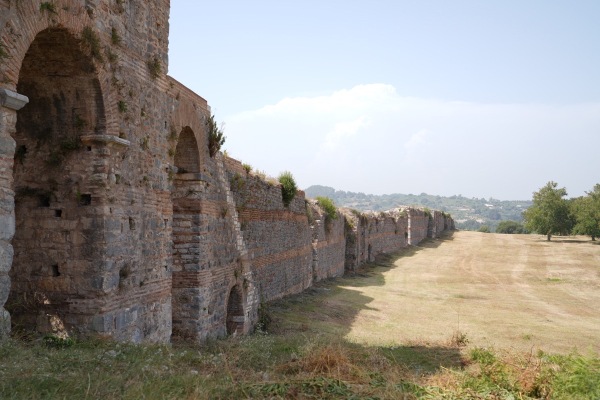
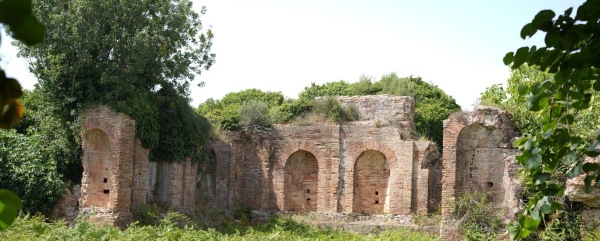
Finally, we spent a few hours admiring the walls of Nikopolis and its churches and sites. 

Image

Image

Image

Like any good vacation, we were more tired by the end of the trip than we were at the start, but it was great to spend some time with great colleagues, good books, and sites that inform our research.

Two for Tuesday from Hesperia

I was excited to see that the latest issue of Hesperia (93.1 for those of you keeping a scorecard) arrived just in time for the weekend. Since there was no Formula 1 this weekend, I was able to read an article during the time that I would have ordinarily been sitting and listlessly watching a car race.

There were two articles of note in the recent issue. One is the official “not a preliminary report” from our work in the Western Argolid Regional Project. This article has been a long time coming. At some point, I know that I wrote a good bit for it and it went through a bit of a meat grinder during the pandemic with some significant reorganizations and direction changes and now … we have an article! The long gestation of this article reflects both the challenges of writing as a committee as well as the pandemic inflected situation from which it arose. In fact, I can’t remember the last time that I saw my co-authors face-to-face (other than Melanie Godsey in Cyprus last summer).

In any event, it is out thanks to my coauthors who did not lose faith in it. If you want an offprint of it, drop me a line.

At almost 50 pages we anticipated that our joint with be the longest in the issue (our generous royalties are dictated partly by the percentage of pages that our work constitutes for the issue as a whole), but we were outdone by a sixty page article on a single Tang dynasty coin in a 13th century context from Corinth: Ching-Yuan Wu’s “A Tang Dynasty Coin in 13th-Century Corinth: Context and Transmission.”

Yeah, the royalty thing was a joke.

Wu’s article, on the other hand, is not. It’s brilliant. 

First, the coin itself, which you can see here, is a MacGuffin. A single 8th century coin in a 13th century fill isn’t sufficient to say much about anything even if the coin is a very long way from home.

The coin’s unique dimensions and weight give us some hints of its story which appears to have its origins in the confusion (and unfamiliar to me) history of 8th century Central Asia where rival empires and their puppets and allies clashed, traded, and negotiated. The gossamer strands traced by Wu dissolve into ambiguity but hint at ties to the “Church of the East,” Judeo-Persian traders, and the chaotic aftermath of the Persian Empire (whose heir Peroz, the son of the Yazdegerd III, died in Chang’an).

The coins travels from the East and its arrival in the Mediterranean introduce us to an interconnected world where the so-called “End of Antiquity” not only didn’t disrupt millennia-old networks of contact across Central Asia, but also activated new ones structured, for example, by the “Church of the East” which had established churches from Salamis on Cyprus to the western borders of the Tang Empire in China. Judeo-Persian traders who moved through the polyglot communities of Central Asia and traded as well as fulfilled certain diplomatic functions. 

Of course, knowing that these communities and groups existed and being able to trace the exact route of this one Tang period coin are two different things. And even if it was possible to know where and how the coin reached Corinth, the exceptional character of this find, in this context, at this site will make it hard to generalize. That said, the coin did afford an opportunity to bring China and the Mediterranean a bit closer together through the detailed examination of the circumstances that could have brought this coin to Corinth.

In the end, this 60+ page article has almost nothing to do with the coin and its context at Corinth, but provides a narrow foundation for a much larger story that, in the end, is probably more relevant for how we understand the 8th century world than any specific context at any specific site. It is a credit to Hesperia that they were willing to publish something like this. Not only is this paper massive, but it ultimately uses this coin to survey a disparate and fascinating body of scholarship that offers a foundation for integrating “traditional Mediterranean archaeology” (among the most parochial archaeologies) into a broader conversation about global connectivity.

Postscript

One thing that I wish Hesperia would start doing is insisting that authors link to the massive digital archive at ASCSA.net. This includes links to the coin itself (here), its context (here), the pages in the notebook (here), and other objects associated with the coin in the same fill (here). While I understand that some of these links are not stable, it is nevertheless possible to create stable links (e.g. this).

It would also be wonderful for an article like this, that might be read by scholars well outside of the usual Hesperia readership, to offer links to relevant earlier Hesperia articles outside of JSTOR (such as this one here). One of the best things that Hesperia did many years ago is release their archive for free. It feels like they could do more to celebrate these accomplishments and take ownership of their quiet leadership in not only improving access to the raw materials necessary for archaeological analysis and study, but also the century of scholarship from Corinth.

Two Article Tuesday: Cyprus Edition

The last month or so has seen a little pair of recent articles on material from the region of Polis-Chrysochous in northwestern Cyprus. Both article take advantage of the remarkable continuity of settlement at the site and in the wider region which appears to have avoided the disruptions associated with the so-called “Arab Raids” in the 7th century and the attendant contraction of settlement and economic activity of the later 7th and 8th centuries. In fact, there’s a growing evidence that residents of Polis continued to build and adapt churches, remained connected to the Roman state, and perhaps even important (and export?) agricultural produce and luxury goods during these centuries.

A.-M. Sdralia, A. Sarris, V. Kassianidou, and Th. Rehren published an analysis of two copper slag deposits associated with smelting in the region of Polis in the Journal of Archaeological Science: Reports. This builds upon work that the same team published earlier this year which provided 7th-century carbon-14 dates for two slag heaps near Polis: one at Argaka and one at Pelathousa (which I blogged about here).

The most recent article, “Late Roman metallurgical site patterns, the case studies of two smelting sites in Western Cyprus” expands upon this earlier work to consider the resources, labor, and markets necessary to support large-scale smelting in the 7th and 8th century near Polis. They challenge the view of Late Roman smelting activity proposed by Paul Raber in the 1980s. Raber argued that copper production was both local and occasional. 

Sdralia and colleagues suggest that this might explain evidence for copper production at smaller sites such as Pelathousa or Ay. Kononas (on the Akamas which also shows signs of use into the 7th century), the large slag heap at Argaka suggests regular, large scale production perhaps even for export. They base their argument on both access to a larger workforce from the city of Polis (and presumably economies of scale for the various material requirements for smelting) and access to the sea which would have facilitated the export of refined copper ore possible. The recovery of a cache of 8th century seals, including those associated with Roman diplomatic or naval officials from the coastal zone of Polis indicates that the city may have remained connected to traditional maritime networks. A possible 8th century date for the reconstruction of the South Basilica at Polis suggests ongoing economic activity in the city. The production of copper for local use and export would, of course, have supported both Byzantine and Arab interests inasmuch as it contributed to island’s tax base from which both sides drew revenue.

The second article of this two article gaggle is from Christiana Kelepeshi and Jelena Živković and titled “Reassembling the pieces, reassessing the picture: an analytical study of medieval pottery (mid. twelfth–sixteenth c.) from Polis Chrysochous, Cyprus” in Archaeological and Anthropological Sciences 16 (2024). They took thin sections of both glazed and course Medieval pottery from excavated contexts near the North Basilica (EG.0) and studied the fabric and slips. The results of this work were not particularly surprising. The fine wares conformed to a number of regional patterns initially centered around Paphos (perhaps produced at Lemba or the Fabrica Hill workshops known from excavations) before shifting, perhaps in the late-14th century to production centered around Lapithos. Aegean imports appeared early in the sequence and should perhaps be associated with workshops at Chalcis. Coarse wares appear to be local.

The fabrics published from contexts at Polis demonstrate the continued engagement of the site in networks of local and regional exchange. The material used in this analysis derived from the contexts adjacent to the North Basilica in the area of E.G0 in the Princeton grid. This area emerged in the Middle Ages as as a major burial ground and the monumental and well-adorned church suggests that burials may have attracted the veneration. The nature of the structure associated with the church (and, indeed, the state of the church itself) remains unclear because the site hasn’t received full publication (and as of last summer continued to be excavated as part of the Department of Antiquities site management plan). There is reason to suspect on the basis of its location alone that this was not an ordinary building. In other words the material present in the contexts associated with this building may well reflect both the economic reach of the city’s elite as well as the changing tastes at their table.

Cyprus and the Virgin of the Passion

Just a short post this morning as I continue recovering from the holiday season!

Over the weekend, I had the pleasure of reading Matthew Milliner’s Mother of the Lamb: The Story of a Global Icon (Fortress 2022). The book tells the story of the icon of the Virgin of the Passion from its origins on Cyprus during the troubled 12th century to its emergence as a global icon in the 19th and 20th century (usually known as Our Lady of Perpetual Help). A nice short conversation about the icon and his book appeared in Christianity Today about a week ago. It’s a really nice book.

As Milliner noted in his interview, it is a bit odd to read a book about an icon depicting Mary and the infant Jesus (typically, though not always in the pose of the Hodegetria) flanked by an angel holding the lance that pierced Jesus’s side and an angel holding the cross. In other words, this is an icon of the baby Jesus which anticipates his passion on the cross. 

Milliner situates the origins of this icon in the troubled world of 12th century Constantinople and Cyprus fractured by theological controversies and threatened by the closing noose of Crusader aggression. The icon painter Theodore Apsevdis travels to Cyprus where he not only painted the engleistra of Ay. Neophytos, but also created a novel depiction of the Virgin at the church of Virgin of the Vetches (Panagia tou Araka) at Lagoudera in the Troodos Mountains of Cyprus. Milliner connects the Virgin of the Passion to the scion of the a Byzantine aristocratic family on the island who had recently lost his position of power to the conquest of the island by King Richard of England in the lead up to the Third Crusade. From its origins in this troubled moment, the Virgin of the Passion emerged as a potent counterpoint to the triumphant Virgin who icons and presence protected the City and Empire. The Virgin of the Passion gave hope to the vanquished by emphasizing both the humanity of Christ through his mother Mary and the redemptive power of the Passion itself. While this is hardly a Christmas story, it is what makes Christmas important.

Setting aside the theological (and Christological) insights that this icon offers, Milliner’s book situates the Virgin of the Passion in a particular historical context. By unpacking the history of this icon, Milliner demonstrates how the history of the Byzantine world even in its darkest hours and the history of Cyprus can inform not only how we understand currents in contemporary piety, but also how a study of the past opens up new forms of spiritual understanding and new opportunities for religious experiences.

Cyprus has long stood outside the major currents of history and generally sees only the briefest of mentions in the history of Mediterranean or even the Roman and Byzantine world. Milliner’s book moves Cyprus to center stage and demonstrates the value present in understanding the history of a small island at the crossroads of the Medieval world.      

Baptisteries in Greece and Cyprus

For some reason baptistery projects take a long time to come out. This week, two baptistery related projects of mine somehow reached milestones. It’s a Christmas miracle.

The first is the MASSIVE Cambridge Guide to the Architecture of Christianity edited by Richard A. Etlin. I had only a tiny contribution to this gigantic and long simmering project: “Early Christian Baptisteries.” From what I can tell, I started working on this project in 2010 or so. In fact, this project took so long to come to pass that you have to go to my OLD blog to find a draft of the published manuscript: You can read that draft of it here. You can check out the table of content here. I’m particularly pleased to have slipped an image of the Lechaion baptistery into this article!

Yesterday, I completed a draft of another long simmering project on the Early Christian baptisteries of Cyprus. It is a companion piece to one that David Pettegrew and I wrote on the Early Christian baptisteries of Greece.  

If you’re into baptisteries and into Cyprus, I think this as good a place as any to start. Note the bibliography at the end for key additional reading and reference!

The Baptisteries of Cyprus

Scholars have long recognized Cyprus as a crossroads in the Eastern Mediterranean during the Late Roman period. This location of the island between the Levant, Asia Minor, and the Aegean and its wealth during the Roman and Late Roman period shaped its distinct ecclesiastical and Christian history. The island’s location made it a predictable stopover for St. Paul (Acts 9:27; 11:19-26). Its connection to the Levant inspired traditions of prominent early bishops on the island including Paul’s companion Barnabas and the resurrected Lazarus. By the fourth century, the island sent three bishops to the Council of Niceae including St. Spyridon and by the end of the century produced the charismatic St. Epiphanius whose status a heretic hunter drew him to Constantinople to participate, albeit briefly, in the machinations surrounding St. John Chrysostom’s condemnation at the Synod of the Oak in 403. The prominence of Cypriot bishops in the first half-millennium of Christianity is just one indicator of the political and religious significance of the island. Indeed, the sudden discovery of the relics of St. Barnabas in the 5th century, helped bolster the island’s case for ecclesiastical independence from the See of Antioch and reinforce the uniquely autocephalos relationship between the Metropolitan bishop of Cyprus at Salamis-Constantia and the Patriarch in Constantinople. The prominence of the church and its leaders also fostered the growing number of relics on the island and helped make the island a place for pilgrims to stop on their way to the Holy Land. Even in the 7th century, as the Late Roman Eastern Mediterranean started to dissolve under the pressures of religious and political schism, Cyprus remained a key node in Christendom. Displaced populations, such as thousands of Armenians captured during the Persian wars, and displaced bishops, such as Cypriot-born St. John the Almsgiver who fled Egypt in advance of the Persian attacks on Alexandria, found new homes on the island. Throughout the Early Christian period, the island’s location, economic and political prominence, and ecclesiastical stature ensured that its churches were both impressive and diverse in style and shape (see Gordon and Caraher 2018; Mecalf 2009; Zavagno 2017).

Considering its geographic, political, and ecclesiastical context, it is hardly surprising that Cypriot churches drew freely on the architecture of the Near East, Asia Minor, and the Aegean coasts. This diversity of church architecture on the island suggests the presence of different communities with different liturgical practices as well as different groups of builders with access to different material and techniques. Like many places in the Mediterranean, the paucity of clearly dated buildings also means that our chronology of these churches remains provisional. Only a handful of the over 100 Early Christian churches on Cyprus have dates established on the basis of published archaeological excavations (for the most recent catalogue of Cypriot churches see Maguire 2012). As a result, it is difficult to discern development over time or to link architectural trends to the ecclesiastical history of the island. This is particularly disappointing as Cyprus’s location, distinct ecclesiastical history, and remarkable continuity has make it a useful for understanding the dissemination and transformation of church architecture in the Early Byzantine period.

Despite the large number of churches excavated on Cyprus, there are only six well-preserved baptisteries. Three are in the neighborhood of Metropolitan See on the island, Salamis-Constantia: Ay. Epiphanios in the city itself, Ay. Triada and Ay. Philon on the Karpas Peninsula. The are also two well preserved baptisteries at the Episcopal Basilica at Kourion and the coastal site of Ay. Georgios-Peyias. Most recently, the Department of Antiquities excavated a baptistery at the site of Petounta in Larnaka district (Georgiou 2013). There are several poorly preserved or poorly published baptisteries that add to this meager corpus. At the site of Shyrvallos near Paphos, salvage excavations revealed a baptistery in the early 1960s (Metcalf 2009, 459 with citations). An unpublished baptistery stands to the west of the basilica excavated east of the harbor at Amathous. There is also evidence suggesting a baptismal installations at the Chrysopolitissa basilica at Paphos.

The small number of baptistries excavated on Cyprus appears to be partly an accident of discovery and partly a feature of the island’s distinctive ecclesiastical landscape. The best preserved examples of baptisteries suggest that there was a tradition of monumental and architecturally elaborate structures that often stood adjacent to, but separate from the main body of the church. As a result, these monumental baptisteries tend to appear most commonly at churches excavated extensively. Urban contexts for many of the churches on Cyprus and salvage excavation practices has meant that excavators only occasionally opened the kind of exposures necessary to reveal the presence of a baptistery complex. It is hardly surprising, then, that three of the six well-preserved baptisteries are associated with churches located amid large scale excavations (Ay. Epiphanios at Salamis, The Episcopal Basilica at Kourion, and the baptistery basilica at Ay. Georgios-Peyia). Conversely, the absence of monumental baptisteries at Paphos, for example, which was an important ecclesiastical city with Biblical associations and the absence of any substantial Early Christian remains from the city of Kition (modern Larnaka) almost certainly reflects accidents of discovery.

That said, there is also some evidence that Cypriots developed smaller and simpler alternatives to the large-scale baptisteries present at the basilicas identified by large-scale excavations. These alternatives may have included mobile fonts, the use of annex rooms common to the Cypriot churches, or even space in the aisles, atria, or narthex. The presence of the remains of a baptistery in the south apse of the Chrysopolitissa basilica at Paphos and may well indicate the use of moveable baptismal fonts. Stewart suggests that a gap in the opus sectile floor in the north apse of Amathus Acropolis basilica might represent the remains of a displaced baptismal font at this building that otherwise lacks a formal baptismal space (Stewart 2013, 292).

The monumental baptisteries present on the island suggest adult baptism which perhaps correlates with the large-scale conversion of the island over the course of the 5th century. The baptisteries at Kourion, Ay. Philon, and Ay. Epiphanios are on slightly different orientations from their associated churches which would seemingly suggest either earlier or later construction. The excavators at Kourion and Ay. Philon, however, saw the similarities in form between the baptisteries and the basilicas at these sites as evidence for their close contemporaneity. Megaw largely dated the church at Kourion on the basis of coins found in foundation trenches and argues for a fifth century date for the basilica and links it to the prominent bishop Zeno who attended the Council of Ephesus in 431 (Megaw 2007, 158). Ay. Philon appears to have a similar date on the basis of numismatic evidence and the perhaps tenuous attribution of this church to Ay. Philon, a descendent of Ay. Epiphanios (Megaw and du Plat Taylor 1981). The church at Ay. Epiphanios was famously dated on the basis of the Life of Ay. Epiphanios in which God tells the fourth-century Bishop Epiphanios to build a church. This dates the church to the late 4th century at earliest and considering the scale and opulence of the building, it is probably safer to date the church to the early 5th century with modifications continuing into the 6th century. The baptistery is likely associated with the first phase of the building. The similarities between the baptistery at Ay. Trias and that of the nearby Ay. Philon (as well as the baptistery at Kourion and Ay. Epiphanios) would seem to support a 5th century date for that structure and coincides with the date assigned by Papageorghiou at least partly on the basis of a coin of Honorius (395-425) (Papageorghiou 1964, 372-374). The baptistery and basilica at Peyia with its Aegean influences is an outlier in terms of design, but seems likely to date to the 6th century if it is contemporary with its associated church (Papageorghiou 1985, 316). The baptistery at the site of Mazotos-Petounta produced coins dating from between the 4th and 7th century (Georgiou 2013, 123). Without additional context for these finds, it remains difficult to assign to this building a narrower date, but its general form suggests a fifth or sixth century date. These centuries represents a period of aggressive church building perhaps linked as much to the growing Christian population on the island at to efforts by Cypriot bishops to assert their independence from Antiochene authority at the Council of Ephesus in 431 (Maguire 2012, 138).

Richard Maguire’s 2012 dissertation offers the most convenient, recent, and thoughtful survey of the churches on Cyprus. He argues that the design of the four baptisteries – Ay. Epiphanios, Ay. Trias, Ay. Philon, and Kourion – served to support a processional baptismal rite (Maguire 2012, 97-139). To this we can add, albeit tentatively, the baptistery at Mazotos-Petounta. The basilica associated with this baptistery was not excavated, but it nevertheless shares sufficient similarities with the four studied by Maguire to be added to that group. He proposes a rite involving four spaces linked by corridors. A large atrium space allowed the catechumens to gather prior to the start of the rite itself. The candidate then proceeded into an apodyterion where pre-baptismal rites took place and the individual undress before moving to the font itself. Cruciform fonts suggest at least partial immersion and complemented the role of movement associated with the processional rite. The candidate would have walked down into the font by means of a staircase on one of the font’s cross arms and ascended, newly baptized, by another. They would then continue to the chrismarion where the newly baptized Christian received anointing with oil. Presumably then the fully baptized member of the church would enter the basilica and experience the full liturgy. Maguire suggests a link to the baptismal rituals and architectural forms at Jerusalem, Sidé in Turkey, Gerash, and the pilgrimage church at Qalat Sem’an in Syria. Considering the close, if sometime fraught, connections between the church on Cyprus and the ecclesiastical landscape of the wider Levant, this seems plausible. Moreover, the character of Cypriot baptisteries do appear to emphasize processional movement through a series of discrete spaces that mediate the converts liturgical and physical entry into the church.

A mild outlier of this group is the baptistery at Peyia. Its circular font is unusual for Cyprus, with only the poorly preserved font at the site of Shyrvallos in Paphos sharing this shape. The location of the Peyia baptistery to the west of the atrium rather than connected to the main nave may hint at an alternative baptismal liturgy, the use of the atrium as the start of the baptismal processional route, or just constraints imposed by the neighboring buildings. A similar arrangement is apparently present at the still unpublished basilica near the harbor at Amathus which might have reflect the physical limits of the church’s situation near the coast (Keane 2021, 52).

The association of baptisteries with the seats of bishops has largely been a given on the island. The close association of the imposing church of Ay. Epiphanios with the bishops of Salamis-Constantia make it the obvious cathedral. The size, location, and opulence of the Kourion basilica, baptistery, and residential space makes it the cathedral of that city. The baptistery at Peyia likely seems to be associated with a cathedral as is evident in the presence of a synthronon at the church and the adjacent elite residence plausibly associated with the bishop. The later synthronon at the site of Ay. Philon and the elaborate annex rooms may well indicate that it was also a probable cathedral. At the same time, the presence of a baptistery some 20 km away from Ay. Philon at the site of Ay. Triada suggests that some non-cathedral churches may have been also equipped with baptisteries on the island. Metcalf suggests that the church and the baptistery at Ay. Triada predated the more elaborate cathedeal at Ay. Philon and the bishop moved his seat sometime in the fifth century (Metcalf 2009, 275). It is more difficult to explain within the limits of contemporary evidence why some cathedrals lacked obvious baptisteries. The scant evidence for architecturally distinct baptisteries at the massive basilicas at Paphos, including the largely unpublished Chrysopolitissa church, may suggest that in these contexts baptisms took place using moveable fonts or less substantial installations that stood within the liturgical space of the church itself. This would allow us to understand, for example, the Chrysopolitissa as the cathedral of the city despite its lack of a formal baptistery.

The handful of baptisteries on Cyprus reflect a certain amount of continuity of design, ritual and tradition likely centered on around the seat of the metropolitan bishop at Salamis-Constantia. There are, however, some indications for the perennial tension on the island between local practices and broader regional influences. The presence of an Aegean-style baptistery at Peyia on the western side of the island suggests that the influence of the church at Salamis may have had its limits. While this would be hardly surprising, the relative paucity of excavated baptisteries on Cyprus makes speculative any conclusion surrounding the traditions and practices broadly operating on the island. The likely use of moveable fonts which may have left only faint traces in the archaeological record, chronological ambiguities, and the limits to many excavations, further complicates our understanding of ancient practices on the island. The remains that do exist, however, suggest that Cypriot baptismal rituals centered on processional movements similar to those found elsewhere in the Eastern Mediterranean.

Bibliography

du Plat Taylor, J. and A.H.S. Megaw. 1981. Excavations at Ayios Philon, the Ancient Carpasia. Part II. The Early Christian Buildings. Report of the Department of Antiquities, Cyprus, 209-250.

Georgiou, G. 2013. An Early Christian baptistery on the south coast of Cyprus. Cahiers du Centre d’Études Chypriotes 43: 117-126

Gordon, J. M., and W. R. Caraher. 2018. The Holy Island. In D. K. Pettegrew, W. R. Caraher, and T. Davis, eds., The Oxford Handbook of Early Christian Archaeology. Oxford University Press. 475-494.

Keane. C. 2021. “More than a Church: Late Antique Ecclesiastical Complexes in Cyprus.” Ph.D. Diss. Ludwig-Maximilians-Universität, Munich.

Maguire, Richard. 2012. “Late Antique Basilicas on Cyprus sources, contexts, histories.” PhD diss., University of East Anglia.

Megaw, A. H.S. ed. 2007. Kourion: Excavations in the Episcopal Precinct. Washington D.C.: Dumbarton Oaks.

Metcalf, M. 2009. Byzantine Cyprus 491-1191. Nicosia: Cyprus Research Centre.

Papageorghiou, A. 1964. Ἡ Παλαιοχριστιανικὴ καὶ Βυζαντινὴ Ἀρχαιολογία καὶ Τέχνη ἐν Κύπρῳ κατὰ τὸ 1963. Ἀπόστολος Βαρνάβας 25: 153-162, 209-216, 274-284, 349-353.

Papageorghiou, A. 1985. L’architecture paléochrétienne de Chypre. Corsi di Cultura sull’Arte Ravennate e Bizantina 32: 229-334.

Stewart, C. 2013. Military Architecture in Early Byzantine Cyprus. Cahiers du Centre d’Etudes Chypriotes 43: 287-306.

Zavagno, L. 2017. Cyprus between the Late Antiquity and the Early Middle Ages (ca. 600-800): An Island in Transition. London: Routledge.

More New Work on Early Christian Attica

At the end of the semester, I tend to experience a bit of priority creep as the number of “do right now” projects (grading, end of semester deadlines, and so on) begins to encroach on the “do sometime soon” or “wouldn’t it be cool to do?” projects. That kind of ontological ambiguity which is only heightened by the symbolic weight of the end of the year and gnawing fatigue that comes from the end of a semester causes bad decision making.

All this to say, I kept reading around some of the very recent work on Early Christian Attica. 

Three more things as a follow up to my post from yesterday.

First, I finished reading chapter 6 titled “Aspects of Christianity in Athens, Attica, and Adjacent Areas” in Cilliers Breytenbach and Elli Tzavella new book, Early Christianity in Athens, Attica, and Adjacent Areas, from Paul to Justinian (1st-6th cent. AD) published by Brill as the first volume in a series called Early Christianity in Greece (ECG).

It’s a really nice synthesis of the archaeology, textual, and epigraphic data with a view toward producing the kind of study that would support comparative analysis of Christianization both in Greece and the wider Eastern Mediterranean world. This kind of generalizable study is particular commendable for a city like Athens where archaeologists have tended to celebrate its uniqueness (especially in the Classical period) and the number and intensity of excavations and the city’s 19th and 20th century history creates a sample that calls into question how representative the city would be even for the later periods. That said, the sober analysis of Breytenbach and Tzavella drawn from cemeteries, epigraphy, architecture, and texts reveals a region that underwent gradual conversion to Christianity (perhaps punctuated by episodes of violence). 

The attention to cemeteries and associate inscriptions, on the one hand, allows the authors to probe social and economic organization of the Christian community on a granular level by noting the prevalence of family burials and the range of professions named in Christian epigraphy. They could contrast this with the story of monumental architecture which traced the consolidation of worship, certain aspects of the economy, and ecclesiastical authority around church buildings. Whether churches absorbed the function of civic and pre-Christian cults or developed a completely distinctive range of functions is left to the reader to decide.

Second, one particularly useful observation made in Breytenbach and Tzavella’s work is that the absence of monasticism in Greece has perhaps been overstated. Epigraphic evidence from Athens, Megara, and Argos suggest that monastic communities did exist in Greece despite the absence of architectural evidence for monasteries. To be honest, fourth fifth century monasticism appeared across a wide wide range of architectural forms from rural villas to urban palaces, massive purpose built monasteries, and scattered, ephemeral, and informal hermitages across the Eastern Mediterranean landscapes. The absence of explicit material traces for monasteries in Greece is no more surprising than the absence of evidence for house-churches or other spaces associated with an emerging Christianity that had not fully accommodated its institutionalize shape.  

Third, I very much enjoyed Georgios Deligiannakis’s “From Paganism to Christianity in Late Antique Athens: A Re-Evaluation” in Ilinca Tanaseanu-Döbler and Leonie von Alvensleben’s Athens II: Athens in Late Antiquity (2020). Deligiannakis turns his keen eye to the evidence of Christianization at Athens and in Greece and argues that despite the privileged position that Greece has enjoyed in the history of ancient religion, the evidence for the Christianization of Greece does not appear to be much different from the process as experience elsewhere in the Eastern Roman Empire.

He makes a few keen observations that I think benefit any archaeologist serious about Christianization in Greece. First, he observes that the absence of chronological control over the construction of Early Christian churches in Greece makes them a poor indicator of Christianization as a diachronic process. The excavation of a house church in Messenia which may have remained in use into the fifth century reveals that Christian communities may have continued to meet in a wide range of spaces even as monumental basilica-style churches sprouted across the landscape. 

He also argues that, if we accept Mango’s proposed fifth-century date for the conversion of the Parthenon into a church (rather than the more conventional seventh-century chronology), this changes significantly how we see the Christianization of Athens. Rather than assuming that the pagan cult practices tenaciously hung out against a Christian onslaught, it suggests a city that recognized its pagan past as part of its Christian present and rather than seeking to erase pre-Christian monuments sought to integrate them into the Christianized symbolic and ritual landscape. This finds parallels both in Greece (at Delphi and Olympia, for example, although these are not necessarily chronologically locked down) and at sites such as Aphrodisias in Anatolia which likewise saw a 5th century conversion of a temple.

That said, Deligiannakis points out that this doesn’t mean there were no episodes of violence between Christianity and paganism, but instead these appear sporadic and episodic. This not only proposed the kind of nuanced landscape that includes various individuals and groups with different levels of believe and commitments that manifests itself in different kinds of interactions. I was heartened to see that Deligiannakis took seriously my colleague Richard Rothaus’s work in the Corinthia (as well as Tim Gregory’s reading of the Christianization of Greece). 

There are a number of other interesting and useful pieces in the Ilinca Tanaseanu-Döbler and Leonie von Alvensleben volume including some that seek to survey recent developments (with particular attention to work done by Italian scholars) in the archaeology of Late Antique Athens. If this were to ever become a serious research concern for me, I am sure that I would eagerly devour these works. Even though that is unlikely at present, I will certainly consider the contributions in both of these volumes as I return to work in the Corinthia this spring.