Adam Smith and the mercantile system

Thus far these past few weeks (see here, here, here, here, here, here, here, here, here, and here), we have surveyed the first 11 additions in Adam Smith’s pamphlet Additions and Corrections to the First and Second Editions of Dr. Adam Smith’s Inquiry into the Nature and Causes of the Wealth of Nations (1784). Next up, then, is Addition #12,

This particular addition to Smith’s 1784 pamphlet is significant for many reasons. In summary, Smith begins Addition #12 by explaining the logic of what he calls “the mercantile system”. Next, he surveys in tedious details Britain’s many mercantile laws and explains how these protectionist laws got enacted in the first place. And then he concludes with a blistering attack against these laws. (It is also worth noting that Addition #12 is the second-longest part of Smith’s 1784 pamphlet. It contains an entirely new chapter to The Wealth of Nations: Chapter 8 of Book IV of Smith’s magnum opus).

1. Smith’s nuanced picture of “the mercantile system”

Smith begins Addition #12 by describing the ostensible “ultimate object” of mercantilism: “Its ultimate object, … it pretends, is always the same, to enrich the country by an advantageous balance of trade.” (Smith 1784, p, 23, my emphasis) How does mercantilism go about obtaining this “advantageous balance of trade”? According to Smith, “the mercantile system” attempts to achieve this aim in two different ways:

“Through the encouragement of exportation and the discouragement of importation are the two great engines by which the mercantile system proposes to enrich every country, yet with regard to some particular commodities it seems to follow an opposite plan: to discourage exportation and to encourage importation.” (Id.)

In other words, mercantilists don’t always favor exports, and they don’t always reject free trade. Sometimes, they oppose exports and allow imports! But how does a mercantilist draw this line? How does he decide which goods to export and which goods to import? Here, Smith draws a crucial distinction between “instruments of trade” and “materials of manufacture”:

It [the mercantile system] discourages the exportation of the materials of manufacture, and of the instruments of trade, in order to give our own workmen an advantage, and to enable them to undersell those of other nations in all foreign markets; and by restraining, in this manner, the exportation of a few commodities, of no great price, it proposes to occasion a much greater and more valuable exportation of others.” (Id.)

2. Smith’s survey of Britain’s mercantilist laws

At the time he was writing his 1784 pamphlet, Smith was a Commissioner of Scottish Customs and was thus familiar with Britain’s mercantilist laws. By way of illustration, Smith identifies many specific “materials of manufacture” that are exempt from the payment of all duties (see paragraph 3 at p. 24 of Addition #12), including sheep’s wool, cotton wool, undressed hides, seal skins, as well as “pig and bar irons”, and he also identifies those “materials of manufacture” whose importation is not only allowed but even encouraged via bounties (see paragraphs 6 to 14 at pp. 26-29 of Addition #12), including “timber fit for masts, yards, and bowspirits” (para. 7 on p. 22); “tar, pitch, and turpentine” (paras. 7 & 8 on p. 26); “indigo” (para. 9 on pp. 26-27); “undressed flax” (para. 10 on p. 27); “wood from America” (para. 11 on pp. 27-28); “raw silk” (para. 12 on p. 28); pipe, hogshead, and barrel staves (para. 13 on p. 28); and “hemp from Ireland” (para. 14 on pp. 28-29).

What was the rationale behind these exemptions and bounties? Why do mercantilists favor the importation of some particular goods but not others? According to Smith, their rationale is twofold:

“It [the mercantile system] encourages the importation of the materials of manufacture in order that our own people may be enabled to work them up more cheaply, and thereby prevent a greater and more valuable importation of the manufactured commodities.” (Id.)

At the same time, however, some “materials of manufacture” are subject to strict and severe export restrictions, such as and wool. (See, for example, paras. 15 to 23 at pp. 29-34 of Addition #12.) Ditto the exportation of “fuller’s earth or fuller’s clay” (para. 33 on p. 38), raw hides and other unfinished leather goods (paras. 34 & 34 on pp. 38-39), various metals (para. 36 on p. 39), lead and lead ore (para. 38 on p. 40), “coals” (para. 42 on p. 43), and “frames or engines for knitting gloves or stockings” (para. 43 on p. 43). To paraphrase Smith (para. 16 on p. 29), the export of all these goods were either “discouraged” by high duties or forbidden altogether by “absolute prohibitions”.

But why did the legislature enact this complex web of mercantilist laws in the first place? And what effect did these laws have in practice? Smith addresses both of these key questions next. (To be continued …)

Image
Posted in Uncategorized | Tagged , , , | Leave a comment

2026 World Cup anthem: Dai Dai (en español)

Bonus link: “Laws of the Game” (official rulebook of football/soccer). Bonus link #2: “In the United States, Every World Cup Team Is a Home Team” (NYT)

Posted in Uncategorized | Leave a comment

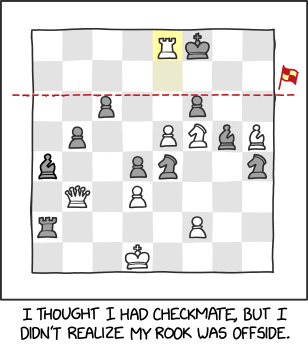
If chess had an offside rule

Offside
Continue reading
Posted in Uncategorized | Leave a comment

Then and now: the market for outer space orbits

Nota bene: I will resume my series of blog posts on Adam Smith’s 1784 pamphlet on Monday, 13 July.

On this day (10 July) in 1962, the world’s first telecom satellite, Telstar 1, was launched by NASA from the Cape Canaveral Air Force Station in Florida. According to Wikipedia (see here), Telstar 1 remained active for only 7 months before it prematurely failed due to Starfish Prime, a high-altitude nuclear test conducted by the United States.

Although Telstar 1 is no longer operational, it remains in Low-Earth Orbit. Today, by contrast, there are over 10,000 active communications satellites in orbit! (See here or here, for example.) This is one reason why I have proposed replacing the current system of granting launch licenses for free with outer space auctions or an orbit congestion fee. See also here.

Continue reading
Posted in Uncategorized | 1 Comment

Adam Smith redux

I concluded my survey of Addition #11 of Adam Smith’s pamphlet Additions and Corrections to the First and Second Editions of Dr. Adam Smith’s Inquiry into the Nature and Causes of the Wealth of Nations (1784) in my previous post. Next up is Addition #12 (pp. 23-47), where Smith adds an entirely new chapter to his great treatise: Chapter 8 of Book IV of The Wealth of Nations (“Conclusion of the Mercantile System”). As it happens, I surveyed that chapter earlier this year as part of my commemoration of the 250th anniversary of the publication of Smith’s second magnum opus. (See my blog post from 3 March 2026: “The true villains in The Wealth of Nations“.) Yet I now see that Smith added this particular chapter between 1778 and 1784, i.e. while he was a Commissioner of Scottish Customs and Salt Duties, so I will start from scratch and explore this chapter in far greater detail starting on Monday, 13 July.

Adam Smith Institute Marks 250 Years Since The Publication of the ...
Posted in Uncategorized | Leave a comment

Some closing thoughts on Adam Smith’s critique of the herring bounty scam

Thus far this week (see here and here), we have been rehearsing Adam Smith’s sundry arguments against “the herring bounty scam” (my term) on pages 13 to 22 (Addition #11) of his 1784 pamphlet Additions and Corrections to the First and Second Editions of Dr. Adam Smith’s Inquiry into the Nature and Causes of the Wealth of Nations. But Smith saves the best for last, so let’s take a closer look at the last two paragraphs of Addition #11 (p. 22).

Here, Smith tries to find one last-ditch way of defending the herring bounty in the penultimate paragraph of Addition #11:

“If any particular manufacture was necessary, indeed, for the defence of the society, it might not always be prudent to depend upon our neighbours for the supply; and if such manufacture could not otherwise be supported at home, it might not be unreasonable that all the other branches of industry should be taxed in order to support it. The bounties upon the exportation of British-made sailcloth and British-made gunpowder may, perhaps, both be vindicated upon this principle.” (Smith 1784, p. 22)

But the herring bounty, Smith goes on to explain in the concluding paragraph of Addition #11, cannot be defended on these national-security grounds. Instead, Smith anticipates Mancur Olson’s classic critique of rent-seeking behavior, The Logic of Collective Action, and then he describes this susbsidy as a “great folly” (my emphasis):

“But though it can very seldom be reasonable to tax the industry of the great body of the people in order to support that of some particular class of manufacturers, yet in the wantonness of great prosperity, when the public enjoys a greater revenue than it knows well what to do with, to give such bounties to favourite manufactures may, perhaps, be as natural as to incur any other idle expense. In public as well as in private expenses, great wealth may, perhaps, frequently be admitted as an apology for great folly. But there must surely be something more than ordinary absurdity in continuing such profusion in times of general difficulty and distress.” (Id.)

This ugly rent-seeking reality of politics — governments favoring discrete groups of favored merchants and manufacturers at the expense of productive pursuits and diffuse taxpayers — is one of the main themes of The Wealth of Nations. But Smith is also making a more profound point in this particular passage: a wealthy nation (like, say, the United States today) might be able to afford to subsidize such foolish and counter-productive projects like herring fisheries, but it is the height of “absurdity” to do so “in times of general difficulty and distress.”

Simply put, Smith’s critique of the herring bounty scam is not just some “obscure corner[] of the overgrown forest of Smith’s mind” or a mere “ephemeral dispute[]” of Smith’s “particular time and place.” (See Emma Rothschild, “Adam Smith in the British Empire,” in S. Muthu (editor), Empire and Modern Political Thought, Cambridge University Press (2012), pp. 184-198.) Smith’s even-handed but devaststing critique of the herring bounty scam is not only relevant today, especially considering the enormous public debt ($39 trillion) the U.S. has now accumulated; it is also one of the most important parts of The Wealth of Nations. (To be continued.)

Adam Smith in EL PAÍS English
Posted in Uncategorized | 2 Comments

Adam Smith’s *negative invisible hand*

Nota bene: I credit my colleague and friend John Alcorn with the idea of a “negative invisible hand”.

As I mentioned in my previous post, Addition #11 of Adam Smith’s 1784 pamphlet provides many reasons why the herring bounty is a scam.

Reason #1. Opportunity costs.

We saw this argument in my previous post. In brief, the true cost of the herring bounty not only includes the actual amount of the subsidy/payout; it must also include the cost of the tax revenue not collected from the duty-free salt provided to the herring fisheries.

Reason #2. Goodhart’s law.

In what has to be one of the most memorable passages in Smith’s entire corpus of writings, Smith writes (my emphasis):

“Secondly, the bounty to the white-herring fishery is a tonnage bounty; and is proportioned to the burden of the ship, not to her diligence or success in the fishery; and it has, I am afraid, been too common for vessels to fit out for the sole purpose of catching, not the fish, but the bounty.” (Smith 1784, p. 19)

According to Smith, the herring bounty was based on the size of the ship (the “tonnage”), not on how hard the crew worked or how many fish they caught, as a result, ship owners built big ships and went out to sea just to collect the cash reward (“the bounty”) instead of doing the hard work of fishing! (Cf. Goodhart’s law: “When a measure becomes a target, it ceases to be a good measure.” Here, ship owners were able to rig the system because the fishing subsidy was based on the size of the ship rather than the amount of fish actually caught. In other words, all incentive systems will be gamed.)

Reason #3. Unseen costs.

Next, Smith identifies the hidden costs of the herring bounty. In addition to the lost tax revenues (see Reason #1 above), Smith explains how the fishing subsidy also harmed the local boating industry via a kind of negative invisible hand (my emphasis):

“Thirdly, the mode of fishing for which this tonnage bounty in the white-herring fishery has been given (by busses or decked vessels from twenty to eighty tons burden), seems not so well adapted to the situation of Scotland as to that of Holland, from the practice of which country it appears to have been borrowed. Holland lies at a great distance from the seas to which herrings are known principally to resort, and can, therefore, carry on that fishery only in decked vessels, which can carry water and provisions sufficient for a voyage to a distant sea. But the Hebrides or western islands, the islands of Shetland, and the northern and northwestern coasts of Scotland, the countries in whose neighbourhood the herring fishery is principally carried on, are everywhere intersected by arms of the sea, which run up a considerable way into the land, and which, in the language of the country, are called sea-lochs. It is to these sea-lochs that the herrings principally resort during the seasons in which they visit those seas; for the visits of this and, I am assured, of many other sorts of fish are not quite regular and constant. A boat fishery, therefore, seems to be the mode of fishing best adapted to the peculiar situation of Scotland, the fishers carrying the herrings on shore, as fast as they are taken, to be either cured or consumed fresh. But the great encouragement which a bounty of thirty shillings the ton gives to the buss fishery is necessarily a discouragement to the boat fishery, which, having no such bounty, cannot bring its cured fish to market upon the same terms as the buss fishery. The boat fishery, accordingly, which before the establishment of the buss bounty was very considerable, and is said have employed a number of seamen not inferior to what the buss fishery employs at present, is now gone almost entirely to decay.” (Id. at pp. 19-20)

In Scotland, herrings swim directly into the deep, protected bays near the coast or “sea-lochs”. (Pictured below, for example, are the sea lochs of Argyll.) Scotland’s geography thus makes local, small-boat fishing more efficient absent a tonnage subsidy. In Holland, by contrast, fish are far out in the deep ocean, so the Dutch need large ships (called “busses”) with extra supplies. Since the herring bounty was based on the size of the ship, the big ships were able to outcompete the small boats, and a once-thriving local boat industry was ruined. How much harm was caused? Alas, as Smith explains, this harm was unseen by the government:

“Of the former extent, however, of this now ruined and abandoned fishery, I must acknowledge that I cannot pretend to speak with much precision. As no bounty was paid upon the outfit of the boat fishery, no account was taken of it by the officers of the customs or salt duties.” (Id. at p. 20)

Reason #4. Perverse price effects.

Here, Smith explains why the herring bounty may have actually ended up increasing the cost of this staple to the public (my emphasis):

“Fourthly, in many parts of Scotland, during certain seasons of the year, herrings make no inconsiderable part of the food of the people. A bounty, which tended to lower their price in the home market, might contribute a good deal to the relief of a great number of our fellow-subjects, whose circumstances are by no means affluent. But the herring buss bounty contributes to no such good purpose. It has ruined the boat fishery, which is, by far, the best adapted for the supply of the home market, and the additional bounty of 2s. 8d. [two shillings and eightpence] the barrel upon exportation carries the greater part, more than two-thirds, of the produce of the buss fishery abroad. Between thirty and forty years ago, before the establishment of the buss bounty, fifteen shillings the barrel, I have been assured, was the common price of white herrings. Between ten and fifteen years ago, before the boat fishery was entirely ruined, the price is said to have run from seventeen to twenty shillings the barrel. For these last five years, it has, at an average, been at twenty-five shillings the barrel. This high price, however, may have been owing to the real scarcity of the herrings upon the coast of Scotland. I must observe, too, that the cask or barrel, which is usually sold with the herrings, and of which the price is included in all the foregoing prices, has, since the commencement of the American war, risen to about double its former price, or from about three shillings to about six shillings. I must likewise observe that the accounts I have received of the prices of former times have been by no means quite uniform and consistent; and an old man of great accuracy and experience has assured me that, more than fifty years ago, a guinea was the usual price of a barrel of good merchantable herrings; and this, I imagine, may still be looked upon as the average price.” (Id. at pp. 20-21)

Although Smith entertains other possible reasons why the price of herrings may have gone up (e.g. overfishing and an increase packaging costs), he concludes that, at best, the herring bounty has had no effect on the price of herrings, “All accounts, however, I think, agree that the price has not been lowered in the home market in consequence of the buss bounty.” (Id. at 21)

Reason #5. Adverse selection.

Lastly, Smith makes an original “adverse selection” argument against the herring bounty. According to Smith, the bounty encouraged “rash undertakers” to enter the fishing industry for sole purpose of milking the government (again, my emphasis):

“When the undertakers of fisheries, after such liberal bounties have been bestowed upon them, continue to sell their commodity at the same, or even at a higher price than they were accustomed to do before, it might be expected that their profits should be very great; and it is not improbable that those of some individuals may have been so. In general, however, I have every reason to believe they have been quite otherwise. The usual effect of such bounties is to encourage rash undertakers to adventure in a business which they do not understand, and what they lose by their own negligence and ignorance more than compensates all that they can gain by the utmost liberality of government. In 1750, by the same act, which first gave the bounty of thirty shillings the ton for the encouragement of the white-herring fishery (the 23 Geo. II. chap. 24.), a joint-stock company was erected, with a capital of five hundred thousand pounds, to which the subscribers (over and above all other encouragements, the tonnage bounty just now mentioned, the exportation bounty of two shillings and eightpence the barrel, the delivery of both British and foreign salt duty free) were, during the space of fourteen years, for every hundred pounds which they subscribed and paid in to the stock of the society, entitled to three pounds a year, to be paid by the receiver-general of the customs in equal half-yearly payments. Besides this great company, the residence of whose governor and directors was to be in London, it was declared lawful to erect different fishing-chambers in all the different outports of the kingdom, provided a sum not less than ten thousand pounds was subscribed into the capital of each, to be managed at its own risk, and for its own profit and loss. The same annuity, and the same encouragements of all kinds, were given to the trade of those inferior chambers as to that of the great company. The subscription of the great company was soon filled up, and several different fishing-chambers were erected in the different outports of the kingdom. In spite of all these encouragements, almost all those different companies, both great and small, lost either the whole, or the greater part of their capitals; scarce a vestige now remains of any of them, and the white-herring fishery is now entirely, or almost entirely, carried on by private adventurers.” (Id. at pp. 21-22)

Again, we see Smith’s negative invisible hand in play. I will provide some closing thoughts on Smith’s critique of the herring bounty in my next post.

Maalie: The sea lochs of Argyll

Posted in Uncategorized | 2 Comments

The herring subsidy scam

Happy birthday, Adela! (Also, my blog is 13 years old today, 6 July!) As I mentioned at the end of my previous Adam Smith post (see here), Smith devotes Addition #11 (pp. 13-22) of his 1784 pamphlet to the herring bounty. Here, he begins by making the best possible case for such bounties (my emphasis):

“Something like a bounty upon production … has been granted upon some particular occasions. The tonnage bounties given to the white-herring and whale fisheries may, perhaps, be considered as somewhat of this nature. They tend directly, it may be supposed, to render the goods cheaper in the home market than they otherwise would be.” (Smith 1784, p. 13)

Smith, however, lays his cards on the table. He concludes that such fishery bounties are a waste of money:

“In other respects their effects, it must be acknowledged, are the same as those of bounties upon exportation. By means of them a part of the capital of the country is employed in bringing goods to market, of which the price does not repay the cost together with the ordinary profits of stock.” (Id. at pp. 13-14)

The Scottish customs commissioner then tries to defend this subsidy on national security grounds (again, my emphasis):

“But though the tonnage bounties of those fisheries do not contribute to the opulence of the nation, it may perhaps be thought that they contribute to its defence by augmenting the number of its sailors and shipping. This, it may be alleged, may sometimes be done by means of such bounties at a much smaller expense than by keeping up a great standing navy, if I may use such an expression, in the same way as a standing army.” (Id. at p. 14)

Adam Smith, however, is not persuaded by this argument either. In fact, he concludes that the politicians who voted in favor of this subsidy policy have been fooled:

“Notwithstanding these favourable allegations, however, the following considerations dispose me to believe that, in granting at least one of these bounties, the legislature has been very grossly imposed upon.” (Id.)

In the remainder of Addition #11, Smith gives us four specific reasons why the herring bounty is counterproductive. First off, Smith claims “the herring buss bounty seems too large.” (Id.) Why too large? Because herring must be cured with salt, and the government delivered salt to the herring fish-curers without charging them the standard salt tax: “The salt with which these herrings are cured is sometimes Scotch and sometimes foreign salt, both which are delivered free of all excise duty to the fish-curers.” (Id. at pp. 14-15) As an aside, did Smith obtain this information about the provision of duty-free salt in his role as Commissioner of Scottish Customs and Salt Duties?

But in addition to waiving the salt tax, the government also paid fishermen a cash bonus (or “bounty”) for every barrel of herring they exported: “Upon every barrel of herrings exported there is, besides, a bounty of 2s. 8d. [i.e. two shillings and eightpence], and more than two-thirds of the buss caught herrings are exported.” (Id. at 15)

Next, Smith combines the lost tax revenue from the tax-free salt along with the cash export bounty and concludes that the government spent, in some cases, over one pound (£) to subsidize a single barrel of herrings!

“Put all these things together and you will find that, during these eleven years, every barrel of buss caught herrings, cured with Scotch salt when exported, has cost government 17s. 11 3/4 d. [80 pence]; and when entered for home consumption 14s. 3 3/4 d. [71.5 pence]; and that every barrel cured with foreign salt, when exported, has cost government 1l. 7s. 5 3/4 d. [£1.37]; and when entered for home consumption 1l. 3s. 9 3/4 d. [£1.19].” (Id.)

After making these careful but tedious calculations, Smith concludes that a barrel of herring sold for an average of about 21 shillings (one guinea): “The price of a barrel of good merchantable herrings runs from seventeen and eighteen to four and five and twenty shillings, about a guinea at an average.” (Id.) In other words, the total cost of the herring bounty was nearly equal to the actual market value of the fish! (See the figures in the indented passage quoted above.)

Before proceeding to his other three anti-subsidy arguments, Adam Smith dons his accountant’s cap, so to speak, and cross-checks his startling conclusion with the actual data. Here, Smith presents the relevant data in two tables. The first table (p. 16) shows the number of barrels of herrings caught as well as the bounties paid from the winter fishing season of 1771 to the winter fishing season of 1782, while the second table (p. 18) shows the number of bushels of foreign salt and Scots salt delivered duty-free to the herring fisheries during this same period of time (5 April 1771 to 5 April 1782). Nota bene: I will proceed to Smith’s three remaining anti-subsidy arguments in my next post.

Rigby's Encyclopaedia of the Herring SMITH, ADAM: WEALTH OF NATIONS -  Rigby's Encyclopaedia of the Herring
Posted in Uncategorized | 5 Comments

Sunday song: Koko

🇨🇷 Greetings from under the volcano in La Fortuna, Costa Rica! 🇨🇷 According to Spotify (see here), this sexy song, by the 27-year-old Puerto Rican singer and songwriter Omar Courtz, is one of the most downloaded tunes in the Central American nation this week.

Posted in Uncategorized | Leave a comment

Adam Smith, the Don Quijote of economics?

To my North American readers, happy 4th of July! In my previous post, we saw Adam Smith’s scathing critique of farm subsidies. (This critique appears in Additions #8 and #9 (pp. 10-12) of his 1784 pamphlet.) As it happens, the Scottish customs commissioner — recall that Smith had been serving as a royal customs official in Edinburgh since 1778 — picks up right where he left off in Addition #10 (p. 13). Here, Smith makes two further points about subsidies (“bounties”). First off, Smith launches a blistering attack on the “country gentlemen” (i.e. farmers) who have lobbied the government for farm subsidies:

“They loaded the public revenue with a very considerable expense; they imposed a very heavy tax upon the whole body of the people; but they did not, in any sensible degree, increase the real value of their own commodity; and by lowering somewhat the real value of silver, they discouraged in some degree, the general industry of the country, and, instead of advancing, retarded more or less the improvement of their own lands, which necessarily depends upon the general industry of the country.” (Smith 1784, p. 13) [*]

Next, Smith draws a general distinction between bounties upon exportation (i.e. subsidies designed to promote the exportation of the goods being subsidized) and bounties upon production (i.e. subsidies designed to promote local jobs):

“To encourage the production of any commodity, a bounty upon production, one should imagine, would have a more direct operation than one upon exportation. It would, besides, impose only one tax upon the people, that which they must contribute in order to pay the bounty. Instead of raising, it would tend to lower the price of the commodity in the home market; and thereby, instead of imposing a second tax upon the people, it might, at least, in part, repay them for what they had contributed to the first.” (Id.)

In other words, bounties designed to promote jobs should generate positive economic effects overall compared to bounties designed to promote exports. But Smith concludes Addition #10 with the following wry observation: “Bounties upon production, however, have been very rarely granted.” (Id.) But that said, there was at least one major “bounty upon production” in Britain at this time: the bounty for white-herring fish.

For his part, Smith was not only aware of this particular subsidy; he devotes 13 pages and 50-plus paragraphs of his 1784 pamphlet to this subject (Addition #11, pp. 13-22), where he shows how the herring bounty wastes taxpayer money, destroys local jobs, and increases food prices. I will therefore proceed to Addition #11 on Monday, 6 July (the 13th anniversary of this blog); in the meantime, the following questions are worth pondering: why do governments continue to subsidize production? (See, for example, the infographic pictured below.) Why has Adam Smith’s scathing critique of government subsidies fallen on deaf ears? (To be continued.)

Which U.S. Companies Receive the Most Government Subsidies? :  r/FluentInFinance

* = This passage was placed at the end in paragraph 24 of Chapter 5 of Book IV of the third and subsequent editions of The Wealth of Nations, where Smith is discussing “our country gentlemen”.

Posted in Uncategorized | 4 Comments