
The Audio Stuff
Audiophiles seeking unbiased reviews of high-end audio equipment have a valuable resource in The Audio Stuff. This websi...
Randify
Privacy-conscious organizations managing sensitive data have long faced a troubling choice: anonymize customer or patien...

GCS Cheats
For gamers seeking a competitive edge in online multiplayer games, GCS Cheats offers a solution that promises to level t...
Text2SQL
For many organizations, SQL query writing remains a bottleneck. Non-technical team members struggle to access data indep...
FacelessGenie
Automated video generation is reshaping how independent creators scale their output. FacelessGenie addresses a real cons...
Recently Listed
543 launches
Premium
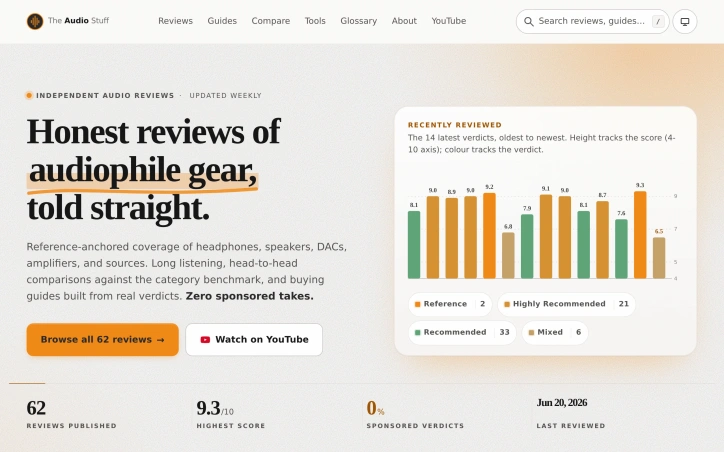
Audiophiles seeking unbiased reviews of high-end audio equipment have a valuable resource in The Audio Stuff. This website delivers in-depth, comparative reviews of various audiophile gear, including headphones, speakers, DACs, amplifiers, and sources, helping enthusiasts make informed purchasing decisions. The site's commitment to honesty and transparency is evident in its strict no-sponsored-content policy, ensuring that all reviews are based solely on the reviewer's thorough testing and comparison. What stands out about The Audio Stuff is its rigorous review methodology, which involves long listening sessions and head-to-head comparisons against category benchmarks. This approach provides readers with a clear understanding of each product's strengths and weaknesses. The site's reviews are also accompanied by buying guides built from real verdicts, further assisting readers in their purchasing decisions. The Audio Stuff's content is comprehensive, covering a range of products from various manufacturers. The reviews are detailed, with scores and verdicts that help readers quickly grasp the reviewer's opinion. The site also features video reviews on YouTube, offering an alternative format for those who prefer visual content. Some products reviewed on the site come with significant price tags, such as the HIFIMAN Arya Unveiled at $1,299 and the HIFIMAN Serenade at $999, while others, like the Douk Audio U2 Pro, are more affordable at $70. By providing unbiased, in-depth reviews, The Audio Stuff addresses a significant need in the audiophile community, helping enthusiasts navigate the complex and often biased landscape of audio equipment reviews. The site's commitment to honesty and transparency makes it a trustworthy resource for those seeking to invest in high-quality audio gear.
 Premium
For gamers seeking a competitive edge in online multiplayer games, GCS Cheats offers a solution that promises to level the playing field. The company's product addresses the issue of getting banned or using ineffective hacks, providing instead undetected cheats that give players an advantage. GCS Cheats is geared towards gamers who want to enhance their gaming performance with tools such as aimbot, ESP, and mod menus. What stands out about GCS Cheats is its emphasis on account safety and security. The company prioritizes strict account security, employing unique, advanced kernel-level and driver-based bypass methods to keep accounts safe, even with aggressive settings. This focus on security is complemented by a premium experience, with customizable tools designed to give players an absolute edge in games. The product's key features include instant delivery of cheats directly to the customer's inbox, a simple three-step process from checkout to in-game usage, and a range of supported games, with 38 titles listed on the website. The company's cheats are available for various popular games, including CS2, Valorant, and Rust, with pricing starting from $2.00. The straightforward business model involves customers picking a plan, paying securely, and receiving a key to access the cheat. GCS Cheats has garnered a significant following, with over 6,000 active community members and a 4.8-star rating from verified reviews. The company's commitment to delivering undetected cheats, coupled with its focus on customer safety and satisfaction, sets it apart in the market. Overall, GCS Cheats offers a viable solution for gamers seeking a competitive advantage, with a robust product and a customer-centric approach.

Automated video generation is reshaping how independent creators scale their output. FacelessGenie addresses a real constraint in that workflow: the gap between having a content idea and possessing the technical skills, equipment, and hours required to produce it professionally. The platform takes a creator's topic or brief and handles the entire pipeline—scriptwriting, voiceover generation, visual composition, music selection, and final editing—delivering a finished video ready to upload. The product targets creators operating across YouTube, Instagram, and TikTok. Rather than focusing on a single format, FacelessGenie covers multiple content archetypes: character-driven narratives, talking objects, explainer videos, reaction content, gameplay captures, and AI-generated visuals. It supports both short-form content and long-form pieces up to twenty minutes, allowing creators to experiment across platform-native formats rather than repurposing a single video. What distinguishes FacelessGenie in a crowded field is its breadth of pre-built templates and its claimed consistency in output quality. The site showcases example channels in specific niches—stoicism, history, science, finance, pet care, and self-improvement—each designed to demonstrate that the AI-generated videos can approximate the visual and narrative style of established, successful channels. This signals both capability and deliberate positioning toward profitable niches rather than arbitrary content. The platform has accumulated measurable traction. Its user base includes over twelve thousand creators, with four hundred of them reaching audiences beyond one hundred thousand subscribers. Videos produced through FacelessGenie claim to have generated more than one billion cumulative views. The product carries a 4.9-star rating across over two thousand reviews, suggesting consistent user satisfaction. One gap in the available information is transparency around pricing and business model. The site mentions getting started but does not disclose whether FacelessGenie operates on a subscription model, usage-based pricing, or another structure—a material detail for creators evaluating whether the tool fits their economics. The core value proposition is clear: compress the production cycle from hours or days to a single afternoon. For creators managing multiple niches or chasing trending formats, that compression has direct business impact. Whether the efficiency gains justify adoption depends on whether creators prioritize the tool's automation over hands-on creative control.

 Featured
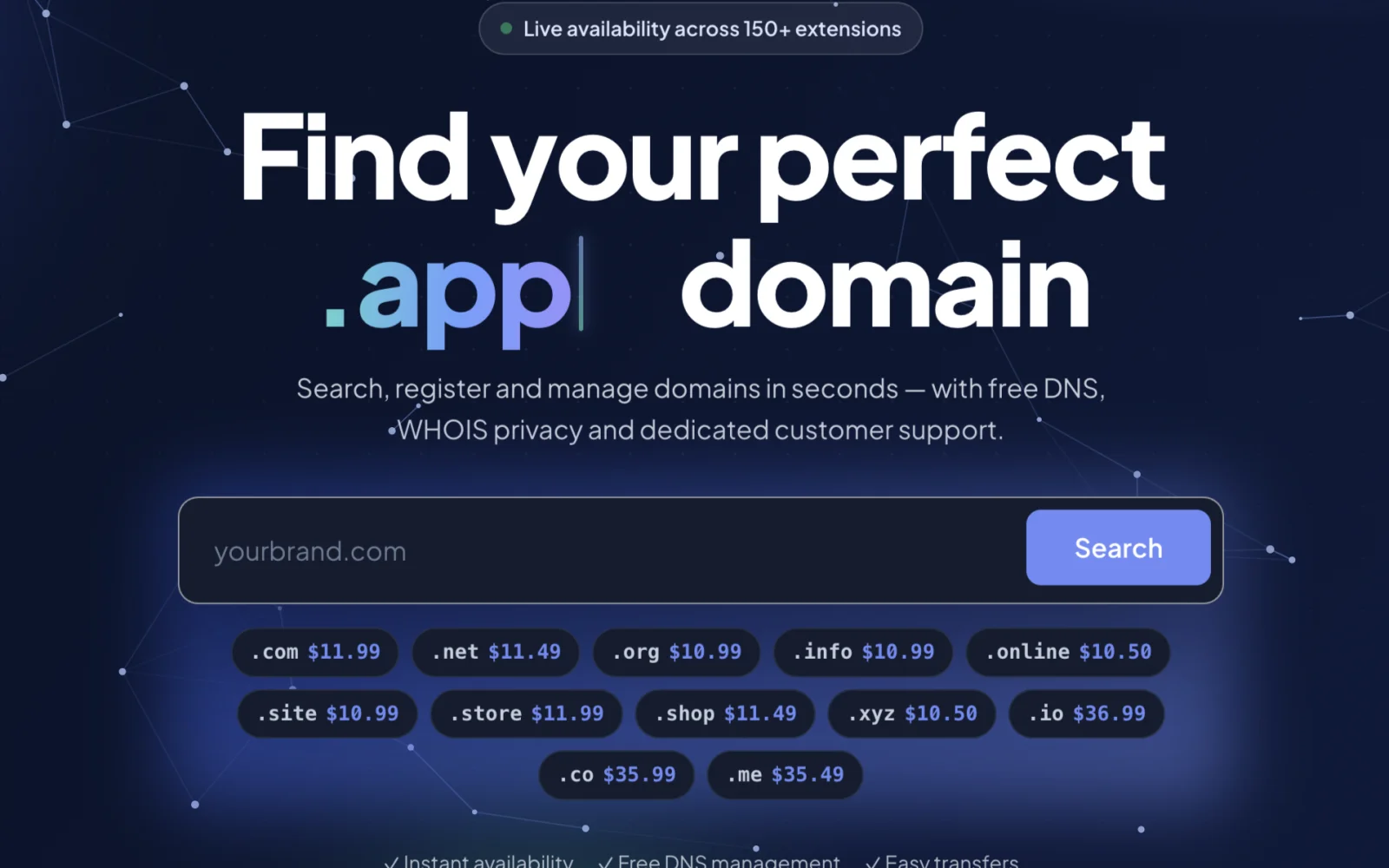
Establishing an online presence begins with securing a domain name. For individuals, startups, and businesses, managing domain registrations, transfers, and renewals can be a tedious and overwhelming task. DomRegus simplifies this process by offering a comprehensive platform for domain management. The platform is designed to be intuitive and secure, providing users with a streamlined experience for registering and managing domains across over 150 extensions. Transparency is a key aspect of DomRegus, evident in its clear pricing structure. The cost of registering various domain extensions is explicitly stated, with prices ranging from $2.99 for a .xyz domain to $46.99 for a .ai domain. One of the standout features of DomRegus is its commitment to providing essential services alongside domain registration. Users are offered free DNS management and WHOIS privacy, empowering them to maintain full control over their domain portfolio. The platform also facilitates easy domain transfers and renewals, ensuring that users can manage their online identity efficiently. By combining trusted domain infrastructure with modern technology, DomRegus delivers a reliable and efficient registration experience. As an authorized OpenSRS reseller, the platform leverages established expertise to provide a secure environment for domain management. Overall, DomRegus is a robust solution for those seeking to secure and manage their online presence, offering a compelling blend of simplicity, transparency, and powerful management tools.
 Featured
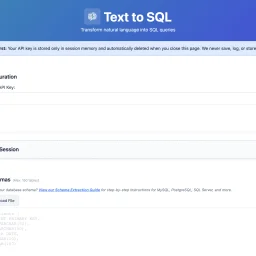
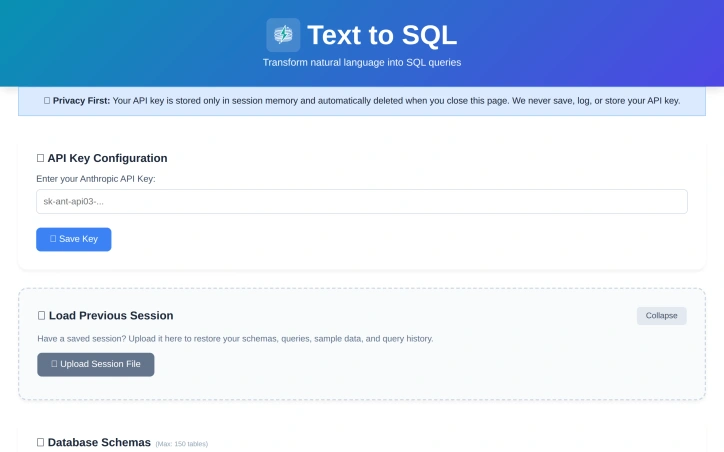
For many organizations, SQL query writing remains a bottleneck. Non-technical team members struggle to access data independently, while developers waste time on complex joins and unfamiliar schemas. Existing AI-powered SQL generators typically demand a trade-off: convenience in exchange for uploading database schemas to third-party servers—a proposition that makes security-conscious teams uncomfortable. Text2SQL breaks this pattern by architecting the problem differently. Rather than accepting user data through its own servers, the tool operates entirely client-side. Users provide their own Anthropic API key, and queries flow directly from their browser to Anthropic's endpoints, bypassing Text2SQL's infrastructure entirely. This architectural choice eliminates a crucial security risk: the company never sees, stores, or logs database schemas, sample data, or query history. For organizations handling sensitive information or operating under compliance constraints, this design addresses a genuine pain point that most competitors ignore. The product itself centers on natural language translation. Users describe their data needs in plain English—"Show me customers who purchased last month"—and receive SQL queries in return. The tool accepts database schemas as CREATE TABLE statements and uses them to generate context-aware queries. An optional feature lets users upload example queries from their codebase; the AI learns naming conventions and join patterns, improving consistency across generated queries. What distinguishes Text2SQL is its completeness without overreach. It includes schema validation, query explanations, and sample data support with a thoughtful reminder that sensitive data should be randomized first. Session management allows users to save and restore configurations across visits. The tool enforces reasonable limits: 150 tables, 300 example queries, 3,000 sample data rows. These constraints prevent runaway complexity while accommodating realistic use cases. The product is entirely free. There's no licensing tier, no gating of core functionality, no hidden costs. This positions Text2SQL less as a revenue-generating product and more as a genuinely useful utility—potentially a customer acquisition strategy for Anthropic API adoption, or simply a commitment to reducing friction around database queries. For teams looking to democratize data access or streamline SQL development without surrendering control of their schemas, Text2SQL delivers on a clear promise. It won't replace domain expertise in complex analytics, but it meaningfully lowers the barrier to ad-hoc querying and frees developers from repetitive query construction.
 Featured
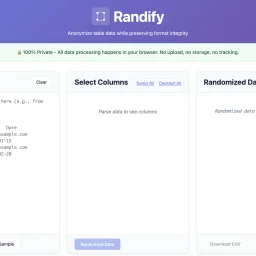
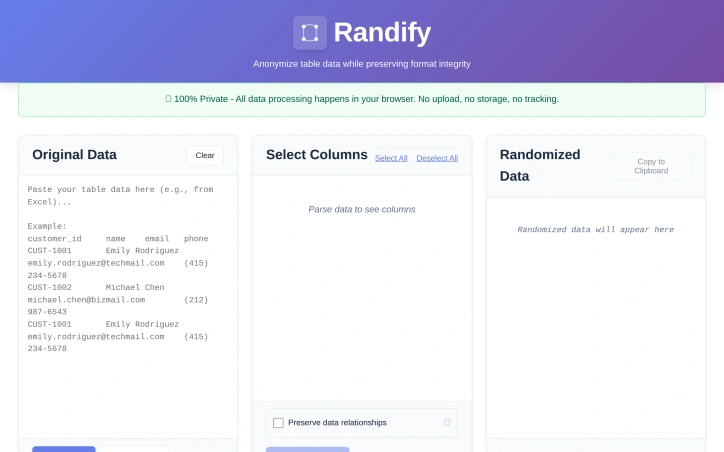
Privacy-conscious organizations managing sensitive data have long faced a troubling choice: anonymize customer or patient information for testing and demonstrations, or upload it to third-party services and accept the compliance and security risks. Randify eliminates that tension by processing all anonymization within the browser, never transmitting anything to external servers. The problem it targets is concrete. Development teams, QA engineers, and data analysts regularly need realistic test datasets without exposing actual customer records. Healthcare organizations must anonymize patient data for testing while maintaining HIPAA compliance. Financial services firms need to randomize customer information for development while staying PCI-compliant. SaaS companies want to demonstrate products with convincing but fabricated data. Randify addresses these scenarios through a single architectural commitment: all data stays local. What distinguishes the tool is its execution of this privacy-first model. It requires no registration and works offline, with zero network requests—users can verify this in their browser's developer console. For organizations subject to data protection regulations, this eliminates an entire class of security and compliance risk. The feature set reflects genuine practical needs. Rather than indiscriminately scrambling content, Randify lets users specify which columns to randomize and which to preserve, maintaining referential integrity so identical input values consistently produce identical outputs. The tool automatically detects PII patterns including email addresses, phone numbers, dates, names, addresses, and company names, applying appropriate formatting rules during randomization so results look realistic rather than obviously synthetic. It accepts data in multiple formats: CSV, TSV, pasted tables from spreadsheets, and SQL INSERT statements. Multi-language support for names and regional data patterns demonstrates attention to genuinely global use cases. The ability to preview changes before applying them reduces mistakes and friction. Randify is free and carries no monetization messaging in available materials, making it an accessible entry point for privacy-conscious teams. For organizations already skeptical of third-party data handling, a purpose-built, client-side-only solution occupies meaningful space in an otherwise server-dependent tooling landscape.

Affordable test preparation for Canada's immigration pathway has long been a gap, particularly for the PTE Core English exam now accepted by Immigration, Refugees and Citizenship Canada (IRCC). This platform fills that gap by offering 1,412 real exam questions with instant AI-powered scoring—entirely free for daily practice without requiring a credit card. The service targets Express Entry applicants and skilled workers navigating Canadian immigration requirements, where English proficiency directly impacts Comprehensive Ranking System points and eligibility. The platform's core strength lies in its use of authentic exam questions sourced from real PTE tests, combined with AI scoring that delivers instant feedback on pronunciation and fluency. This matters because applicants face significant financial barriers and preparation gaps; traditional exam prep can be expensive, and affordable alternatives have been scarce. What differentiates this offering is its specificity. Rather than generic English learning, every task mirrors the official exam structure: Read Aloud, Repeat Sentence, Describe Image, Write Email, and others spanning all 19 PTE Core task types. Users can focus on their weakest skills rather than preparing across all four domains simultaneously, an approach validated by the testimonials provided—one user raised their Listening score by 12 points in two weeks, another achieved CLB 9 across all skills in six weeks. The interface is built for practical learner constraints: mobile-ready design accommodates users practicing between shifts, detailed analytics track progress in specific competencies, and the daily free practice model removes financial barriers to getting started. The stated commitment to privacy—audio data processed securely and never sold—addresses a reasonable concern for users recording voice samples. The platform serves 2,000+ learners and incorporates community-contributed exam questions, expanding its real-question bank over time. For Canada PR applicants with limited preparation budgets, genuine exam familiarity needs, or specific skill gaps, this addresses a legitimate pain point in the immigration preparation ecosystem. The combination of real questions, task-focused practice, and free daily access creates a compelling alternative to traditional test-prep models.


WordPress site owners constantly wrestle with the dual challenge of providing responsive customer support while keeping visitors engaged. Traditional AI chatbot solutions compound this problem by demanding complex API integrations, ongoing maintenance, and technical expertise that most website administrators lack. This plugin addresses that friction directly. Rather than pulling answers from the general internet, it uses retrieval-augmented generation (RAG) to ground responses in a site's actual content, delivering answers that are both accurate and contextually relevant to the business. This architecture shift eliminates the accuracy problems that come with generic AI responses while building customer trust through transparent sourcing. The implementation philosophy prioritizes simplicity over feature complexity. Setup takes minutes without requiring API key management or external service coordination. The chatbot automatically maintains its knowledge base as site content updates, removing the burden of manual retraining or version management that plagues other solutions. There is no server to configure, no backend infrastructure to oversee. Privacy by design is another differentiator. Because the system works within a WordPress site's own ecosystem and relies on its own content rather than third-party AI services, data handling remains under the site owner's control. This matters for businesses with privacy-conscious audiences or compliance requirements. The business model reflects this accessibility-first approach. Rather than adopting the software-as-a-service subscription model that dominates the chatbot space, the product uses one-time token purchases. A light-usage tier starts at $4.95 for five million tokens, with mid-range and high-volume options at $19.50 and $95 respectively. These purchases do not expire, and there are no hidden recurring fees. For WordPress operators with limited budgets or unpredictable chatbot usage, this removes the calculus of committing to monthly subscriptions. The product targets a specific underserved segment: small to medium WordPress sites that need support automation but lack the technical resources or budget for enterprise solutions. It does not promise to replace human support entirely, but rather to handle routine inquiries, reduce response time pressure on small teams, and create a more polished visitor experience. For that narrow use case, it presents a genuinely different approach to a common pain point.

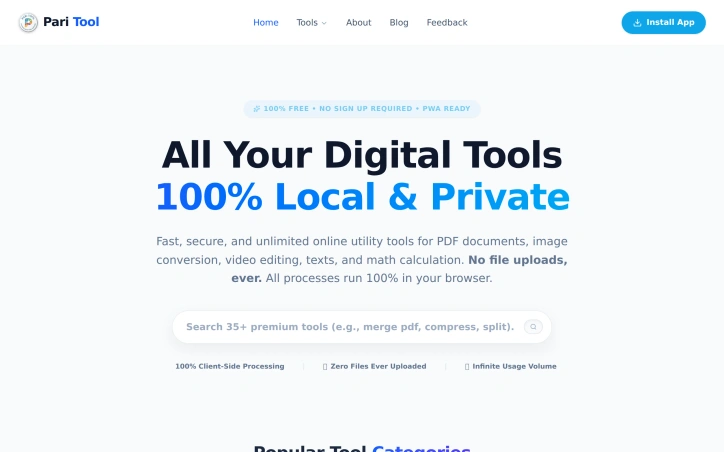
Professionals and casual users constantly face the need for quick file conversion, document manipulation, and utility operations, yet existing solutions fragment across paid subscriptions, sketchy free services that upload data to servers, and desktop software that requires installation. Pari Tool addresses this gap with a collection of over 35 browser-based utilities that operate entirely on the user's device, eliminating privacy concerns and eliminating the need for account creation or payment. The core distinction of this product lies in its execution model. All processing happens client-side within the browser, meaning files never leave the user's computer. This architecture removes the fundamental trade-off that has long plagued free online tools: either accept that your files travel to someone's server, or pay for privacy. For users managing sensitive documents—tax records, personal photos, confidential PDFs—this distinction matters considerably. The tool also operates as a progressive web application, allowing installation directly from the browser without app store intermediaries. The feature set spans practical categories. PDF functionality covers merging multiple documents, splitting or extracting specific pages, compression, format conversion to images, password protection, and annotation editing. Image tools handle resizing, cropping, background removal, watermarking, and conversion between WebP, PNG, JPG, and PDF formats. Video utilities compress footage, convert between formats (MP4 to MOV), extract audio, and transform clips into animated GIFs. Beyond media, the platform includes text utilities for word counting and reading-time analysis, case conversion, batch find-and-replace operations, and duplicate removal. Specialized tools cover QR code and barcode generation, JSON formatting, file encryption with AES protection, ZIP compression, and practical calculators for EMI and tax invoice generation. What remains unstated but obvious: the business model assumes either a future monetization pivot or funding already in place. The product explicitly commits to remaining free with unlimited usage, which creates questions about sustainability that the available information doesn't address. The strength of Pari Tool lies not in algorithmic innovation but in practical consolidation. Rather than requiring users to bounce between a dozen specialized sites, it centralizes commonly needed operations in a single, privacy-respecting interface. For anyone regularly handling documents, images, or video files, the convenience factor alone—combined with the removal of upload anxiety—positions this as a genuinely useful addition to the web utility landscape.

Salon owners typically face a familiar frustration: their days are consumed by administrative work rather than serving clients. Foohat targets this exact pain point by offering an all-in-one management platform designed specifically for beauty, wellness, and fitness businesses. The platform addresses several core operational challenges that salon owners encounter. Excessive no-show rates, scattered customer data, manual scheduling conflicts, and the constant interruption of phone calls during client services drain both productivity and revenue. Foohat's solution combines online booking, smart scheduling, and automated reminder systems to tackle these issues systematically. The 24/7 booking capability reduces dependency on phone-based reservations, while automated client reminders help lower no-show rates significantly. What distinguishes Foohat is its vertical specificity. Rather than offering generic appointment software, it recognizes that different service businesses have fundamentally different needs. A nail salon's operations differ markedly from a yoga studio's, which requires different workflows than a barbershop. The platform accommodates this with industry-tailored features: chair rental management for salons, hydrotherapy room assignment for spas, reformer equipment tracking for pilates studios, and lane assignment for swimming facilities. This granularity extends to pricing models, with breed-specific service menus for pet grooming and size-based tier pricing. Beyond scheduling, Foohat bundles comprehensive business management tools. The platform includes point-of-sale functionality, inventory tracking, staff scheduling, and analytics dashboards that provide visibility into business performance. Marketing features like text and email campaigns, membership management, and loyalty programs help owners move beyond basic operations to revenue growth. The platform's approach evolved from direct salon owner feedback. The founder's insight came from observing that the industry's core problem wasn't complexity but administrative overhead preventing talented professionals from focusing on their craft. This explains why Foohat emphasizes time-saving automation rather than adding unnecessary features. The company offers a free trial, suggesting an accessible entry point for owners evaluating solutions. No specific pricing details were disclosed in available materials, so prospective customers would need to engage directly to understand cost structure for their particular business type and scale. Foohat positions itself as a complete operating system for salon and wellness businesses, solving the fragmentation that currently forces owners to juggle multiple tools while missing opportunities for growth.


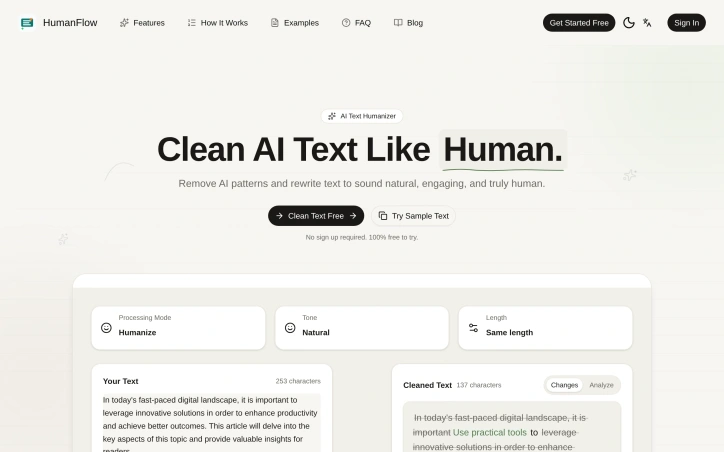
In an era where AI-generated content permeates digital communication, the gap between machine-written text and human writing has become a practical problem for many. HumanFlow targets this friction point with a straightforward solution: an AI-powered text cleaner that rewrites generated content to eliminate robotic patterns and sound more naturally human. The product addresses a specific audience spanning content creators, students, professionals, and copywriters who rely on AI drafting tools but need their output to read authentically. According to the platform's demonstration, the transformation is significant—a sample text scoring 92% as AI-generated drops to 8% after processing, accompanied by meaningful rewrite changes that maintain core meaning while improving readability and flow. The platform's strength lies in its simplicity and accessibility. The three-step workflow (paste text, let AI rewrite, copy results) requires no sign-up or payment, removing friction from adoption. The absence of account creation barriers positions it as an impulse-use tool for one-off cleaning tasks. The company emphasizes that processing occurs securely without data retention, addressing privacy concerns that might otherwise inhibit users from pasting sensitive content. User testimonials highlight practical value: a content creator reports natural-sounding results that evade detection systems, a student appreciates preserved meaning with humanized output, and a copywriter emphasizes time savings. These voices represent the core user base the product aims to serve. Notable gaps exist in the promotional materials. While the platform claims to support multiple AI model outputs and offers an API for developers, specifics remain absent from the public-facing content. The FAQ structure suggests these questions are commonly asked, yet the answers are not provided in the available materials. Pricing information focuses entirely on the free tier; any monetization strategy for advanced features or higher-volume usage remains unstated. HumanFlow occupies a defensible niche within a growing category of tools aimed at AI content post-processing. The free barrier to entry and streamlined interface make it accessible to its target audience. Whether the AI Score metric accurately predicts real-world detection evasion, or whether the rewriting approach truly preserves semantic intent across diverse content types, would require independent testing to verify. For writers seeking a low-friction way to add human polish to machine-generated drafts, the product delivers on its core proposition.

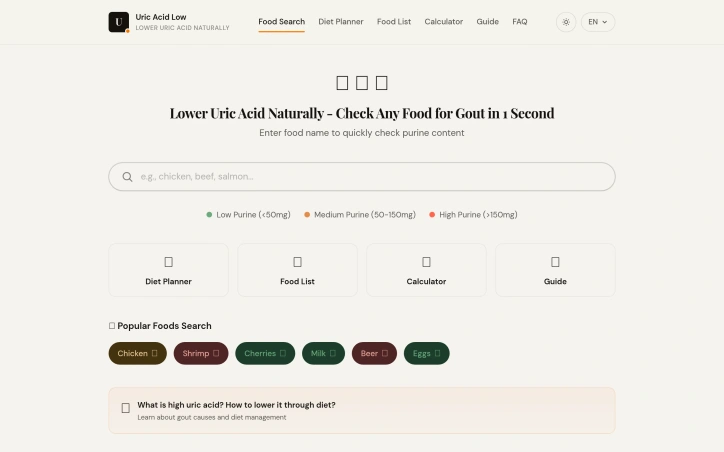
People managing gout often struggle to find practical, accessible guidance on which foods to avoid or embrace. Uric Acid Low addresses this gap by providing a free tool designed specifically for anyone looking to control their condition through dietary changes without the friction of registration. The product centers on a searchable database of over 150 foods categorized by purine content, the compound linked to elevated uric acid levels. Users can instantly check any food's classification as low, medium, or high purine, bypassing the confusion and outdated advice that typically surrounds gout management. The tool removes friction entirely: no signup required, no paywalls between users and the information they need. Beyond the core search function, the platform includes a diet planner for meal construction, a calculator for tracking purine intake, and an educational guide explaining uric acid and gout causes. A dedicated FAQ section with over 50 common questions provides quick answers to concerns that gout sufferers frequently encounter. The founder's motivation stems from real user outcomes—one user reduced their uric acid from 8.2 to 5.9 through dietary intervention, demonstrating that targeted food management can deliver measurable results. The product's accessibility sets it apart in a landscape often dominated by paywalled wellness apps or clinical referrals. By eliminating signup friction and keeping the core tool free, the platform democratizes gout management for someone diagnosed at a doctor's office who needs immediate, actionable guidance. The design philosophy prioritizes speed: searching a food takes seconds, not minutes. Commercially, Uric Acid Low operates as a free tool with affiliate income from recommended supplements like tart cherry concentrate through Amazon Associates. This model avoids direct monetization of users while still generating revenue from ancillary products, a common approach for utility-focused health tools. The main constraint lies in scope: a searchable food database and planning tools can guide dietary choices, but they cannot replace medical supervision or address all gout triggers, which can include genetics and certain medications. Still, for the segment of gout sufferers seeking diet-driven management, the tool delivers a straightforward, friction-free entry point that removes barriers to action.

Friend groups frequently encounter tension when splitting expenses—whether coordinating a group dinner, weekend trip, or ongoing shared activities. WhatsYourShare addresses this friction point by centralizing expense tracking and settlement within a single interface tailored for social groups rather than formal business entities. The product targets friend groups that regularly engage in shared activities and need to maintain clear accounting without introducing awkward money conversations. Unlike general-purpose expense-splitting apps or accounting software, WhatsYourShare positions itself specifically around the use case of sustained social groups managing multiple outings and adventures together. The founder's emphasis on maintaining friendship integrity while handling finances suggests the core value proposition centers on reducing the administrative burden that can create distance among friends. The available information positions this as free-to-access financial tooling, meaning the barrier to entry is nonexistent. This aligns with the audience—friend groups typically resist adoption friction and would be unlikely to pay for splitting casual expenses. The specific framing around one group coordinating multiple adventures indicates the platform likely emphasizes repeated use across multiple transactions rather than one-time splits, suggesting features for persistent group profiles and activity history. What distinguishes WhatsYourShare from the crowded space of expense-splitting solutions is its deliberate social framing. Rather than treating expense management as a cold accounting problem, the positioning centers friendship preservation as the primary goal, with financial accuracy as the enabler. This reflects genuine distinction in product philosophy: the tool exists not primarily to eliminate debt or maximize financial precision, but to remove the interpersonal friction that arises when money enters friend dynamics. The free pricing model and group-first architecture suggest WhatsYourShare targets organic, word-of-mouth adoption within social networks. User acquisition likely comes from friend referrals within established groups rather than marketing to individuals. This distribution model aligns naturally with the product's social focus and could create compounding adoption benefits as entire friend groups migrate to shared coordination. Without additional detail on specific capabilities, settlement mechanisms, or feature breadth, the positioning alone indicates thoughtful product design oriented toward actual user behavior and motivations. The strategic choice to center friendship preservation alongside financial management reflects understanding that the real problem isn't calculation—it's trust and coordination at the social layer.


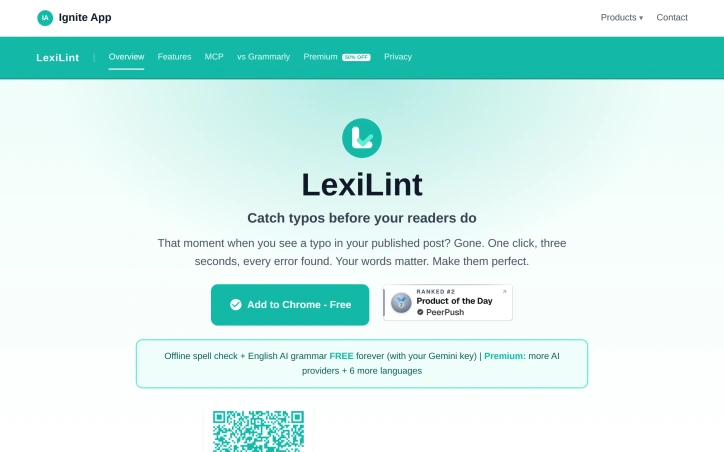
Grammar checkers have traditionally demanded accounts, monthly fees, and access to every keystroke. LexiLint inverts this model entirely. The tool carries out spelling and grammar corrections in the browser without storing text on any server, eliminating the privacy tradeoff users have long tolerated from competing services. The product targets writers and content creators who publish online and want to catch errors before readers do. It also appeals to AI users who recognize that grammar checking consumes unnecessary tokens when offloaded to a separate, local tool. The privacy-conscious find value in its core architecture, which processes text locally and never logs activity. What distinguishes LexiLint is its reliance on bring-your-own-key economics. Spell checking runs entirely offline using local dictionaries plus optional custom entries for technical terms or brand names. Grammar checking requires an AI provider, but users supply their own API credentials to services like Google Gemini, OpenAI, or Claude, keeping all text under their control. This approach sidesteps the data monetization model that fuels free grammar tools elsewhere. The feature set covers practical needs. Offline spell checking works on any webpage using curated English dictionaries. An AI grammar mode handles style, clarity, and punctuation deterministically, so the same page yields the same corrections each time. The tool supports eight languages including Spanish, French, German, Polish, Russian, and Turkish, with spell checking across all and grammar checking available in each. Users interact through a Chrome extension or tap it within AI assistants via the Model Context Protocol, enabling grammar checks inside Claude Desktop, ChatGPT, and Cursor without consuming AI tokens. The pricing structure is transparent. Spell checking costs nothing. Grammar checking through AI providers is free for users who hold Gemini API keys and charged at standard rates for OpenAI or Claude. No hidden subscriptions or per-check fees exist, and setup requires no account creation. LexiLint fills a niche for users who want reliability and privacy from their grammar tools. It trades the convenience of a single account for control of API keys themselves—a reasonable swap for those skeptical of platforms that monetize user text. The offline spell checking alone justifies installation for anyone tired of revealing their drafts to third parties.
Choosing the right professor shapes the entire college experience, yet students typically make this decision with incomplete information. Rate My Professor addresses this knowledge gap by aggregating candid assessments from actual students to help learners identify instructors whose teaching styles and classroom dynamics align with their needs. The platform targets undergraduate and graduate students navigating course selection. By collecting anonymous peer reviews without requiring an account, it lowers barriers to both contributing and accessing honest feedback. Students understand institutional incentives to remain quiet, so anonymity becomes the prerequisite for truth-telling. Their evaluations accumulate toward shaping others' decisions. What distinguishes Rate My Professor is its multi-faceted rating system. Rather than collapsing professor quality into a single score, the platform captures nuanced dimensions: teaching quality, course difficulty, personality, treatment of students, subject mastery, and research guidance capacity. This granularity acknowledges that great teaching takes different forms and matters differently across disciplines and learning preferences. A student seeking rigorous methodology critiques values a professor differently than one prioritizing accessible mentorship. The submission process emphasizes verification without friction. Respondents complete a simple verification check to prove familiarity with the professor, blocking spam while preserving anonymity. The form guides constructive feedback and explicitly discourages personal information sharing, encouraging substantive critique over character attacks. Rate My Professor operates across multiple countries and represents thousands of universities worldwide. The platform reports fifty thousand professors rated globally, over five hundred thousand reviews collected, and influence on more than one million course decisions. This breadth suggests network effects: the more students contribute, the more valuable the resource becomes for future enrollees. The product's restraint is notable. It sticks to its core function—professor reviews—without feature creep toward social networking, grade distribution, or tangential additions. This focus strengthens its utility as a decision-making tool rather than a time sink. The absence of a paywall or account requirement removes friction during registration periods when students most need this information. Rate My Professor fills a genuine void in course planning by systematizing peer knowledge and making it accessible, shifting professor selection from guesswork to informed choice.

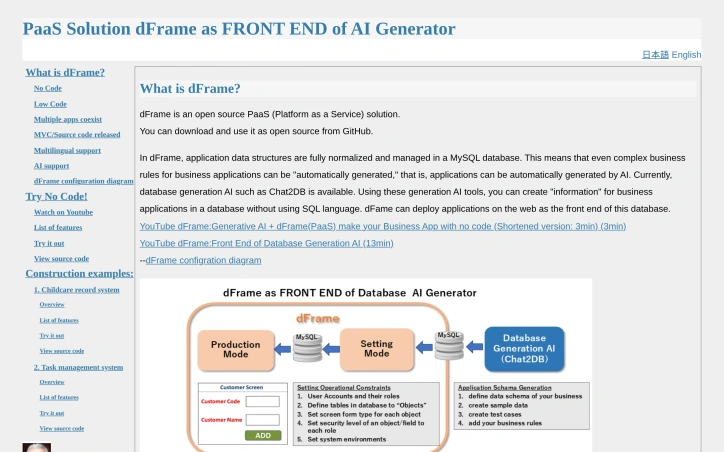
Open-source platforms that eliminate the need for custom programming have gained traction in recent years, but most still require at least some technical knowledge. dFrame tackles a specific problem: automating the creation of business applications directly from normalized database schemas, without requiring developers to write frontend code. The platform targets organizations that want to deploy operational applications quickly, particularly those working alongside AI database generation tools like Chat2DB. Rather than starting from scratch, users can leverage AI to generate database structures, then have dFrame automatically produce the web interface layer. This workflow removes two major friction points: SQL expertise and frontend development. What distinguishes dFrame from generic no-code platforms is its architectural approach. Applications generated through dFrame run against fully normalized MySQL databases, with each application stored in its own database schema. This encapsulation creates clear boundaries between applications, improving maintainability and making it feasible to host multiple applications on a single instance. For teams that need custom logic beyond basic data operations, the platform offers a low-code path through MySQL procedures, views, functions, and triggers, avoiding the need to rewrite entire application layers. The feature set covers typical business application needs: data entry, searching, editing, and list views with pagination. Export capabilities include PDF and CSV formats. The workflow follows a natural progression—users define objects and fields in a settings mode, then switch to an application mode for actual data operations. Existing database schemas can be imported directly, eliminating setup friction for teams migrating from legacy systems. The platform is available as open source through GitHub, removing licensing barriers to adoption. No explicit pricing model appears in available materials, suggesting this is positioned as a community-driven project rather than a commercial offering. The documentation positions dFrame primarily around AI integration and no-code workflows, though the practical limitations of purely no-code systems deserve consideration. The platform works best for applications with standard CRUD operations and normalized data structures. More specialized requirements would require stepping into the low-code layer, which increases complexity accordingly. dFrame positions itself as infrastructure for a specific workflow: leveraging AI to generate database structures, then exposing them through automatically generated web interfaces. Organizations with this exact need have a working solution. Those building more complex applications or requiring deep customization would need to evaluate whether the low-code extensions or hand-coding alternatives better serve their timeline and capability constraints.

Group travel planning traditionally falls on one person: the organizer who opens browser tab after tab comparing flights, hotels, restaurants, and attractions across countless platforms, never confident they've found the best option or overlooked a gem. SearchSpot targets this pain point by consolidating the research phase into a single workspace that pulls data from over twenty different OTAs, travel platforms, social media, and content sites. The product's core value proposition centers on elimination of context switching. Rather than toggling between booking sites, review aggregators, and safety databases, users describe what they want—budget constraints, trip vibe, must-haves—and SearchSpot surfaces curated recommendations with explicit reasoning for why each option was selected or rejected. The platform crawls multiple sources for pricing and card offers, filters reviews by real travelers using signals from Google Maps, Reddit, and social platforms, and includes exhaustive research on legal requirements, weather, and safety information. What distinguishes SearchSpot is its commitment to the full trip lifecycle. Beyond comparing individual components, it links flights, accommodations, activities, and restaurants into an interconnected itinerary. When a user adjusts a single detail, the entire plan recalculates to maintain budget alignment and timeline consistency. This approach recognizes that travel planning isn't actually about finding one perfect hotel—it's about orchestrating thousands of small decisions that compound. The filtering visualization is particularly instructive. Instead of dumping a thousand options at the user, SearchSpot shows the funnel of its reasoning: 250 hotels found, 50 match your vibe, 12 fit your budget, 4 finalists. This transforms research from a cognitive burden into a transparent narrowing process where users can see what was eliminated and why. The company commits to remaining free indefinitely, lowering the barrier to adoption compared to subscription-based travel planning tools. Integration with calendar and map applications suggests an opinionated view about how planning works in practice—not just in isolation, but synchronized across a user's existing digital life. SearchSpot aims at a specific problem: the exhaustion of being the trip organizer. It targets not necessarily the most frequent traveler, but the person in every group who gets voluntold to plan.


Fragmented audio production workflows have long forced music producers to bounce between specialized tools for mixing analysis and feedback, creating an environment where context gets lost between sessions. MixMaster Pro consolidates this experience by centralizing mix analysis within a single platform that maintains the full history of revisions, analyses, and reference materials. The core value proposition eliminates the friction of exporting mixes, uploading them to separate services, and manually reconciling feedback across systems. By keeping all analytical data in one place, the platform allows producers to focus on the creative work of mixing rather than tool administration. The platform includes Maya Studio coaching, a feature designed to understand a producer's specific mix evolution and provide contextual guidance. Rather than delivering generic analysis, this coaching mechanism tracks how a mix changes over time and delivers insights tailored to that progression. This approach recognizes that mixing is iterative—what matters isn't just the current state of a mix, but how it's evolving and what pattern of decisions led to it. The target audience is music producers who have reached a level of sophistication where they're actively seeking tools to improve their mixes. Producers working with multiple projects or those who struggle to identify mix issues by ear alone represent the natural customer base. The platform's success will be determined by whether the AI analysis meets professional audio standards and whether the coaching feature identifies mix problems that experienced producers typically overlook. Producers frustrated with tool fragmentation will find the unified approach compelling. Given the sparse website content and lack of detailed technical specifications, professional validation of the AI's analytical quality should precede any commitment for critical production work.

Scattered across browser tabs, notes apps, and messenger chats: this is how most people currently manage their wish lists. KeepMyWish consolidates that chaos into a single, shareable platform designed for anyone who wants to organize gift ideas and share them with friends and family. The problem is genuine and felt. Creating a wishlist traditionally means bouncing between retailers, copying links, and managing multiple documents. KeepMyWish replaces this friction with a streamlined workflow: sign up, paste product URLs or type items, and instantly generate a shareable link. Several features distinguish the product. The gift reservation system prevents the embarrassment of duplicate gifts by letting friends privately claim items before purchasing. This solves a real social pain point. The platform supports multiple wishlist types—birthdays, holidays, weddings, kids' wishlists, and baby showers—acknowledging that people wish for different things in different contexts. The invitation maker adds unexpected functionality. Users can design invitations with embedded QR codes that link directly to their wishlists, combining event planning and gift coordination. It's a small touch that suggests thoughtful product design beyond the core feature. Sharing requires no friction. Every wishlist gets a unique URL that needs no login to view, lowering the barrier to participation. Friends and family can access wishlists from any device or platform by simply clicking a link. Additional tools keep wishlists current. Users can mark items as received, maintaining an up-to-date profile visible to others. A public profile page aggregates all of someone's wishlists in one location. From a business perspective, KeepMyWish operates on a free model with no mentioned premium tier or pricing structure, positioning itself as an accessibility play rather than a monetization tool—at least at launch. The founder built this from personal frustration: maintaining dozens of tabs and scattered notes while shopping. That origin story often predicts product-market fit better than any growth metric. Whether KeepMyWish becomes the standard for organized gift-giving depends on execution and adoption, but the core product addresses a legitimate gap between how people currently manage wishlists and how they wish they could.


App developers shipping to multiple platforms face a repetitive design bottleneck: creating pixel-perfect screenshots tailored to the unique specifications of the App Store, Google Play, Microsoft Store, and dozens of other digital storefronts. ListingShots addresses this friction with a desktop application purpose-built for asset design without the overhead of general-purpose design tools. The product targets indie developers, small studios, and founders managing listings across the 47 supported platforms—ranging from major app stores to YouTube, Steam, social channels, and web stores. Rather than imposing the full complexity of professional design software, ListingShots constrains itself deliberately. It ships with presets for each platform's exact dimensions, 26 starting templates (Feature Highlight, Dark Pro, Bold Violet, Photo Story among them), and 20+ gradient swatches to accelerate the design phase beyond a blank canvas. The editor handles the essential operations: layering images, shapes, text, and device frames with both 2D and 3D transformations. A built-in search connects to Openverse's CC-licensed photo library, allowing developers to source backgrounds without leaving the app. The export path is direct: one click generates pixel-perfect PNGs at native resolution, ready for upload to any storefront. What distinguishes ListingShots most visibly is its business model and architectural philosophy. At $15.99 as a one-time purchase—not a subscription—the tool positions itself against recurring-fee screenshot generators. The application operates entirely offline, local-first, with no account, cloud storage, or dependency on external services. For teams managing unreleased builds, this offline-first approach eliminates cloud transmission and provides a straightforward cost comparison over five years of operation. ListingShots succeeds not through feature breadth but through disciplined scope. Rather than attempting to rival full design suites, it solves a singular, repetitive problem for a defined audience. For indie developers and small studios managing store listings across multiple platforms, this focused design eliminates paralysis and delivers finished, store-ready assets in minutes rather than hours. The preset-first approach and local-only operation reduce decision friction at every step—making it a credible alternative to both expensive design tools and subscription-based competitors.