Controlling staleness in an async RL stack has not been well understood, so we derived a closed-form formula that predicts staleness in advance. Our predictions match measured staleness from production RL runs within a fraction of a step. Building these simulations has led to key
Our key finding is that staleness is maximized when the RL pipeline is most efficient. Lower staleness requires slower steps and a different resource distribution between rollout generation and training. This distribution is just one input into a broader trade-off between
Join Applied Compute and @modal for an evening in Seoul! We’re hosting an ICML rooftop happy hour for top researchers, PhDs, AI lab scientists, and the people building the future of ML infrastructure and custom models. Come unwind and enjoy one of Korea’s hidden gems with us -
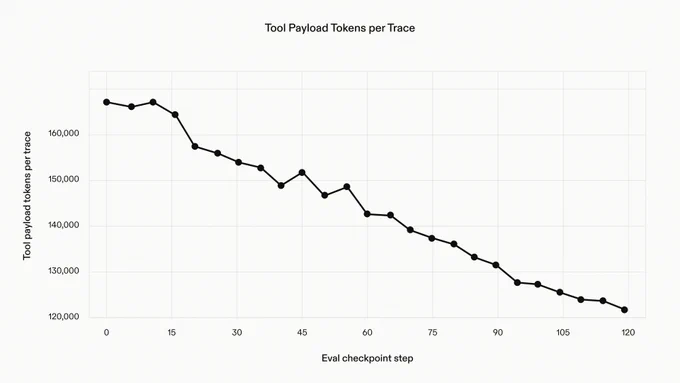
We used RL to train models that create curated context from long documents for downstream use by agents. The models sometimes learn to invent their own abbreviations and shorthand. Optimizing with RL for downstream use produces very different artifacts from ordinary summaries:
At deployment time, the trained model takes in a new knowledge artifact: an enterprise SOP, a meeting transcript, a coding agent trace, or even a novella, and outputs a dense set of notes that captures fine-grained detail and amortizes reasoning. This approach is used to build
5 takeaways from Satya:
Why every company needs its own model:
“There should be as many models in the world as firms in the world. Because after all, what is a firm? A firm is a learning system that today is mostly about human capital with digital tools. Every day compounding
"There should be as many models in the world as firms in the world."
Satya and I dig into when to own vs. rent your intelligence, why every company should be building and climbing its own private evals, and what makes for a stable frontier.
Great conversation @ypatil125! Human capital and token capital compounding together is the entire game. This is the positive-sum future we need to build to benefit everyone.
"You can always buy a tool, you can even outsource a task or even a job. But you can't outsource your learning. If you outsource your learning, then why exist?"
Thank you @Microsoft for your partnership.
"There should be as many models in the world as firms in the world."
Satya and I dig into when to own vs. rent your intelligence, why every company should be building and climbing its own private evals, and what makes for a stable frontier.
“A modelless company is sitting on shifting sand.”
Our CEO @ypatil125 sat down with @mariogabriele to talk about why owning your model is the difference between building on bedrock vs on someone else’s roadmap.
It’s the core of what we do at Applied Compute. We train better,
"A modelless company is sitting on shifting sand."
Yash Patil (@ypatil125) is the founder and CEO of @appliedcompute, a company that trains custom models on company data and serves them in production.
His conviction: every organization has its own definition of what good looks
Harvey partnered with @appliedcompute to train a legal agent.
We optimized each part of the agent stack:
- eval loop
- agent harness and compaction
- post-trained GLM-5.1 using reward signal from our Legal Agent Benchmark (LAB)
More in our agent-training deep dive:
Harvey partnered with @appliedcompute to train a legal agent.
We optimized each part of the agent stack, including the eval loop, agent harness and compaction, and post-trained the underlying GLM-5.1 model using reward signal from Harvey's Legal Agent Benchmark (LAB).
Check out
It was great collaborating with @nikogrupen, @ItsJulioPereyra, and @gabepereyra on a custom post-trained model for LAB. The rigorous work Harvey is doing to map out and build representative evals that reflect how real legal work gets done will pay massive dividends over time and
More evidence that the frontier is attainable with (1) high quality environments and domain expertise, of which @harvey has in abundance; (2) post training infrastructure to execute big runs.
This ran on our Blackwell cluster without any issues, thanks to infrastructure that
If we’ve learned anything this past week it’s that GLM is a strong base for customization.
Together with @appliedcompute, we focused on GLM-5.1 and have results that are a great example of what full-stack agent optimization looks like —> post-training + harness + verifier.
Real
We partnered with @appliedcompute to train a legal agent.
We optimized each part of the agent stack:
- the evaluation loop
- the agent harness
- and post-trained the underlying GLM-5.1 model.
The result? The agent achieved the highest rubric pass rate on our Legal Agent