WPChangeSync / Formerly BricksSync

Sync WordPress changes like code.

WPChangeSync turns WordPress content, builder settings, templates, components, media, and configuration into Git-friendly JSON that can move safely between local, staging, production, and multisite networks.
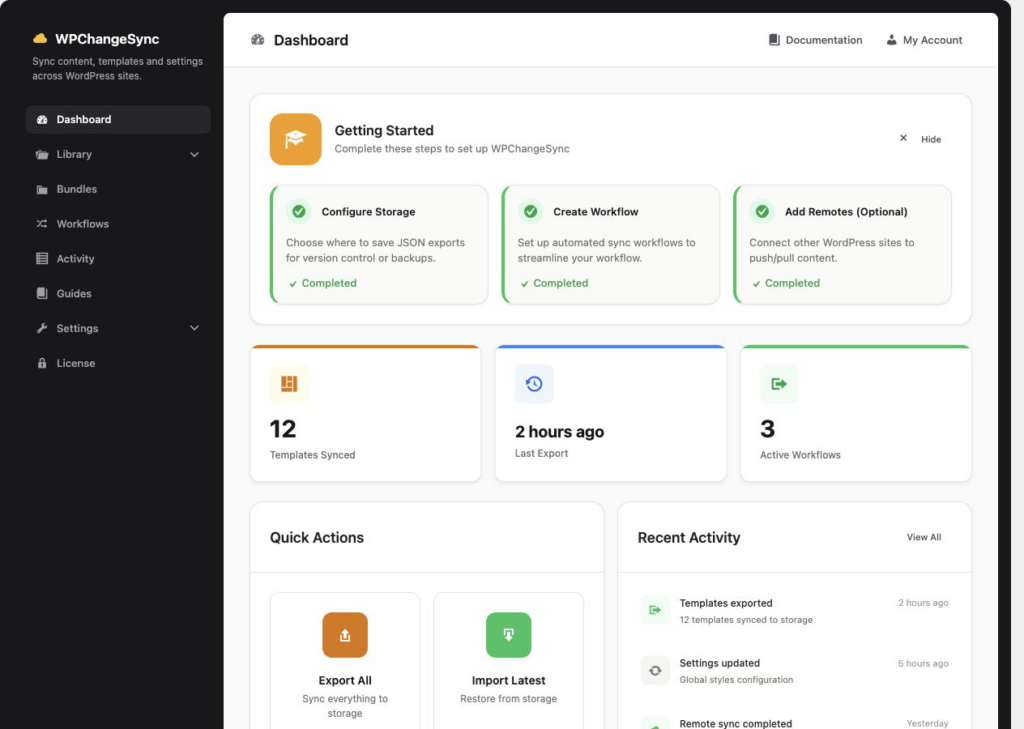
WPChangeSync dashboard
WPChangeSync Dashboard screenshot
Watch

See WPChangeSync in action

Loading the trailer…

Works with WordPress, Bricks Builder, Gutenberg, ACF, MetaBox, ACPT, Git, WP-CLI, REST API, Multisite
WordPressBricks BuilderACF ProWooCommerceCloudflareGitHubWP-CLIGit
{acf_page_sections_use_cases_no}

{acf_page_sections_use_cases_heading}

Whether you ship client sites or manage a multisite network, WPChangeSync gives every change a clear path from source to destination.
Agency

Move client changes with confidence

Push selected templates, pages, media, menus, and configuration between environments without manual exports.

Explore use cases →
Bricks

Keep the Bricks workflow you loved

WPChangeSync carries BricksSync forward with stronger template, component, global style, and variable coverage.

Bricks docs →
Product

Build repeatable release paths

Use workflows, dry runs, approvals, notifications, and activity logs to make releases predictable.

Release guide →
Network

Operate across many sites

Remote groups and batch jobs help you coordinate changes across multisite and distributed WordPress installs.

Multisite guide →
02 — Files

A file-based workflow for WordPress changes

Export WordPress state into portable JSON files that can be reviewed, committed, moved, imported, and restored.
Core capability

Git-friendly JSON, not opaque database dumps

Choose storage in your child theme, uploads folder, or a custom path. WPChangeSync writes structured files for supported integrations so your site configuration can travel with your codebase.
Core

WordPress data

Pages, posts, media, menus, widgets, categories, tags, and other supported core entities.

Fields

ACF, MetaBox, ACPT

Field groups, custom post type definitions, taxonomies, and plugin-owned configuration.

Builders

Bricks and Gutenberg

Templates, components, global styles, variables, colors, custom fonts, and reusable block patterns.

03 — Bricks

Built for Bricks. No longer limited to Bricks.

WPChangeSync is the rebranded and expanded successor to BricksSync. Bricks remains first-class, but the engine now works with WordPress even when Bricks is not installed.
Core capability

The BricksSync foundation, expanded into a universal sync engine

Bricks templates, components, global classes, CSS variables, theme styles, colors, typography, custom fonts, icon fonts, breakpoints, element defaults, sidebars, and custom code can all become part of a controlled workflow.

Templates

Headers, footers, sections, pages

Export, import, push, pull, version, and roll back Bricks template changes.

Components

Reusable Bricks components

Move components by slug/name and preserve references across environments.

Design system

Global styles and variables

Carry colors, classes, typography, CSS variables, custom CSS, and related settings with your build.

04 — Safety

Review before you apply

Safer sync means seeing what is about to change before production does.
Core capability

Dry runs, conflicts, backups, and rollback

Conflict strategies include skip, overwrite, duplicate, newer wins, backup then overwrite, merge, and prompt. Audit logs and backups make high-impact changes traceable and recoverable.

Dry run

Preview the operation

Check scope, targets, and likely outcomes before executing a workflow.

Conflict UI

Choose per item or integration

Resolve differences with clear strategies instead of blindly overwriting live data.

Audit

Know who changed what

Record sync actions, actors, timestamps, targets, results, and export logs when needed.

05 — Automation

Automate the release path

Create workflows that match how your team actually ships: local to staging, staging to production, production to staging, or one source to many sites.
Core capability

Multi-step workflows with human control

Combine export, import, push, pull, webhook, shell, approval, notification, and maintenance-mode steps. Run everything, selected items, or a dry run before the real sync.

Approvals

Pause critical steps

Require manual approval before production pushes or destructive imports.

Notifications

Email and webhook events

Notify when workflows need approval, complete successfully, or fail.

WP-CLI

Scriptable by default

Use WP-CLI commands for templates, components, settings, config, workflows, integrations, and demos.

Integrations

Connect the parts of WordPress that usually get left behind

Custom Integrations

Any plugin or theme →

No native integration yet? Build your own data source in minutes — no code.

Bricks Core

Templates

Headers, footers, sections, and content templates

Bricks Core

Components

Reusable Bricks components

Bricks Core

Bricks Settings

Global settings, palettes, and theme styles

Bricks Core

Global Classes

Global CSS classes for consistent styling

Bricks Core

Global Elements

Reusable global element presets

Bricks Core

Global Queries

Reusable query-loop definitions

Bricks Core

Theme Styles

Theme style presets

Bricks Core

Color Palette

Brand color palette

Bricks Core

Typography

Typography settings

Bricks Core

CSS Variables

Variables from the Variable Manager

Bricks Core

Custom CSS

Global custom CSS

Bricks Core

Custom Code

Header and footer scripts

Bricks Core

Custom Fonts

Custom fonts with font-file attachments

Bricks Core

Adobe Fonts

Adobe Fonts (Typekit) selections

Bricks Core

Icon Fonts

Icon font libraries

Bricks Core

Custom Icons

Custom icon sets (Bricks 2.0+)

Bricks Core

Breakpoints

Responsive breakpoints

Bricks Core

Element Defaults

Default element settings

Bricks Core

Element Manager

Enabled/disabled builder elements

Bricks Core

Pseudo Classes

Custom interactive-state classes

Bricks Core

Style Manager

Style Manager config (Bricks 2.2+)

Bricks Core

Custom Sidebars

Custom widget sidebar definitions

WordPress Core

Posts

Blog posts with categories, tags, and metadata

WordPress Core

Pages

Pages with content and metadata

WordPress Core

Media

Media library items

WordPress Core

Menus

Navigation menus and their locations

WordPress Core

Categories

Post categories with term meta

WordPress Core

Tags

Post tags with term meta

WordPress Core

Widgets

Sidebar widgets and their configuration

Custom Fields

ACF Field Groups

ACF field groups and configuration

Custom Fields

ACF Post Types

CPTs defined via the ACF UI

Custom Fields

ACF Taxonomies

Taxonomies defined via the ACF UI

Custom Fields

Meta Box

Meta Box field groups and settings pages

Custom Fields

ACPT

Advanced Custom Post Types definitions, taxonomies, and meta

CSS Frameworks

AutomaticCSS

ACSS settings, variables, and configs

CSS Frameworks

CoreFramework

CoreFramework design tokens

Bricks Add-ons

Advanced Themer

Theme styles, colors, and typography

Bricks Add-ons

BricksForge

Panel settings, global classes, and animations

Page Builders

Gutenberg

Reusable blocks and patterns

06 — Workflow

From local change to controlled release

WPChangeSync gives WordPress changes a path that feels familiar to developers and safer for site owners.

Configure storage

Choose child theme, uploads, or custom storage for generated JSON files.

Connect remotes

Authenticate staging, production, or network sites with application passwords and remote groups.

Select scope

Sync all items or only selected templates, pages, media, field groups, settings, or bundles.

Dry run first

Preview changes, conflicts, missing dependencies, and workflow steps before anything is applied.

Approve and ship

Run the workflow, pause for approval when needed, then audit the result.

07 — Compare

Stop moving WordPress changes by hand

Manual exports, database copies, and page-builder copy/paste break down as soon as a project has more than one environment.
Manual exports and database moves
  • Hard to review, easy to overwrite environment-specific settings, risky with media and IDs, and painful across many sites.
WPChangeSync workflows
  • Structured JSON, selected scope, remotes, dry runs, conflict strategies, dependency previews, backups, audit logs, and repeatable workflows.
10

Why teams choose WPChangeSync

The strongest reason to adopt it is not one export button. It is a repeatable operating model for WordPress changes.
Core capability

Turn fragile website changes into a release process.

WPChangeSync helps agencies and technical site owners reduce manual copy work, avoid broad database overwrites, keep client changes reviewable, and reuse the same workflow across local, staging, production, and multisite environments.

Client confidence

Show clients a process

Dry-runs, approvals, audit records, and rollback plans make production releases easier to explain to clients and stakeholders.

Save time

Repeat the same workflow

Once a workflow exists, teams can reuse it for weekly staging pushes, template releases, content moves, and multisite rollouts.

Avoid blunt tools

Move changes, not whole databases

Use selected JSON payloads instead of replacing entire databases when production content has moved on.

08 — Trust

Designed for careful production work

The plugin is built around traceability, reversibility, and sane defaults instead of hidden magic.
Security

Hardened REST transfers

Application-password authentication, rate limiting, sanitized input, and safe unserialize for imported data.

Recovery

Backups before overwrite

Backup-then-overwrite strategies, template version history, and restore paths for high-risk imports.

Scale

Batch and multisite aware

Remote groups, network settings, locks, retries, failure thresholds, and progress tracking for larger operations.

Plans

Simple licensing for serious WordPress workflows

Start small, then scale into remotes, workflows, audit logs, and multisite operations as your work grows.
Solo (3 Sites) - yearly payment
$129/yr
Buy now
Pro (9 Sites) - yearly payment
$149/yr
Buy now
Agency (Unlimited) - yearly payment
$179/yr
Buy now
Developer Lifetime (Unlimited) - One time payment
$249one-time
Buy now
Developer Lifetime (Unlimited) - Split payments (4x $70/mo)
$70/mo
4 payments
Buy now

Checkout, login and account management are handled on my.alterview.net, our secure billing hub.

Contact us for licensing, purchase, or BricksSync migration questions.

09 — FAQ

Questions, answered

Is WPChangeSync the same product as BricksSync?
Yes. WPChangeSync is BricksSync with a new name and additional functionality. Existing BricksSync features carry forward, Bricks remains first-class, and current BricksSync licence holders get the same licence for WPChangeSync. See the BricksSync customer update.
Does it still support Bricks Builder?
Yes. Bricks remains a first-class integration, including templates, components, global styles, variables, classes, colors, custom fonts, breakpoints, and more.
Can I use it without Bricks?
Yes. WPChangeSync is builder-agnostic and can run on WordPress sites without Bricks installed. Bricks-specific sections are skipped when Bricks is absent.
Does it replace Git?
No. It complements Git by turning WordPress-managed data into Git-friendly JSON files that can live alongside your theme or deployment workflow.
How does it avoid overwriting the wrong thing?
Use dry runs, selected scope, conflict strategies, backups, prompt queues, and approval gates before applying changes to a remote or production site.
10 — Resources

Start with the workflow that matches your team

The docs are organized around real operating models: setup, Git, staging, production, multisite, CLI, API, and troubleshooting.
Docs

First-time setup

Activate your license, configure storage, create your first workflow, dry run, then execute.

Read docs →
Guide

Staging to production sync

Push templates, components, settings, and related data to production with a dry run first.

Open guide →
Release notes

What changed in 2.0

Builder-agnostic support, conflict resolution, audit trail, deep export, onboarding, and modern UI.

View changelog →
Tour

Product tour

See the WPChangeSync workflow from setup to selected sync, dry-run, remote push, audit, and rollback.

Start tour →
Fit

Compatibility check

Check WordPress/PHP requirements, optional Bricks behavior, supported integrations, and remote prerequisites.

Check stack →
Get started

Bring your WordPress change workflow under control

Move beyond copy-paste, database dumps, and one-off exports. Give every WordPress change a reviewable, repeatable path.