Log inSign up
Nancy Grace Roman Space Telescope
NASA
1,232 posts
Image
user avatar
Nancy Grace Roman Space Telescope
NASA
@NASARoman
The Roman Telescope is a NASA mission that will study dark energy & exoplanets and serve the general astronomy community.
NASA GSFC
nasa.gov/roman
Joined September 2013
71
Following
45.1K
Followers
RepliesRepliesMediaMedia

New to X?

Sign up now to get your own personalized timeline!

Create account

By signing up, you agree to the Terms of Service and Privacy Policy, including Cookie Use.

Terms·Privacy·Cookies·Accessibility·Ads Info·© 2026 X Corp.
Don't miss what's happening
People on X are the first to know.
Log inSign up
  • Pinned
    user avatar
    Nancy Grace Roman Space Telescope
    NASA
    @NASARoman
    Jun 12
    Have you ever wanted to have your name 'Roman' a million miles away? Now you can! Send your name along the Nancy Grace Roman Space Telescope, scheduled to launch Aug. 30, 2026! Sign up here: go.nasa.gov/4ejkRcR Submissions close July 12.
    A person in a head-to-toe white clean room suit holds a large purple "boarding pass" for NASA's Nancy Grace Roman Space Telescope in Goddard's large cleanroom. The boarding pass includes an image of the 18 detectors, an artist concept image of the telescope, a QR code, and the NASA logo. "Roman Telescope" is written where the name would go.
    The plate attached to the Roman telescope, where a memory card containing names will be attached. It's a tall, thin, rectangular silver plate. At the top of the plate is the stylized Nancy Grace Roman name logo. Below is the silhouette of Roman's 18-square detectors in their iconic arch shape. Text below that reads "NASA's first chief astronomer, Nancy Grace Roman, persevered through barriers and made powerful space telescopes a reality. She envisioned a world where everyone had access to, and enthusiasm for, science. This observatory is the continuation of her legacy and dream." Below the text is an illustration of Dr. Roman looking up, next to her name and the years 1925-2018. Below the years is a small box where the memory card will be affixed. The plate is held down with two large bolts at the top and bottom.
    The fully assembled Roman telescope in the clean room, standing upright. It's a silver cylinder with solar panels peeking out from behind both sides like wings. The hood is deployed, like a black sun visor on a baseball cap. Orange lifts and people in white cleanroom suits surrounded the telescope, highlighting how large it is. The unfolded lifts only reach about one-quarter of the way up the telescope's body. Instrumentation and cables are visible in a section about one-third of the way up the body. Thousands of tiny squares on the wall behind the telescope are air filters for the clean room.
    231K
  • user avatar
    Nancy Grace Roman Space Telescope
    NASA
    @NASARoman
    Jul 10
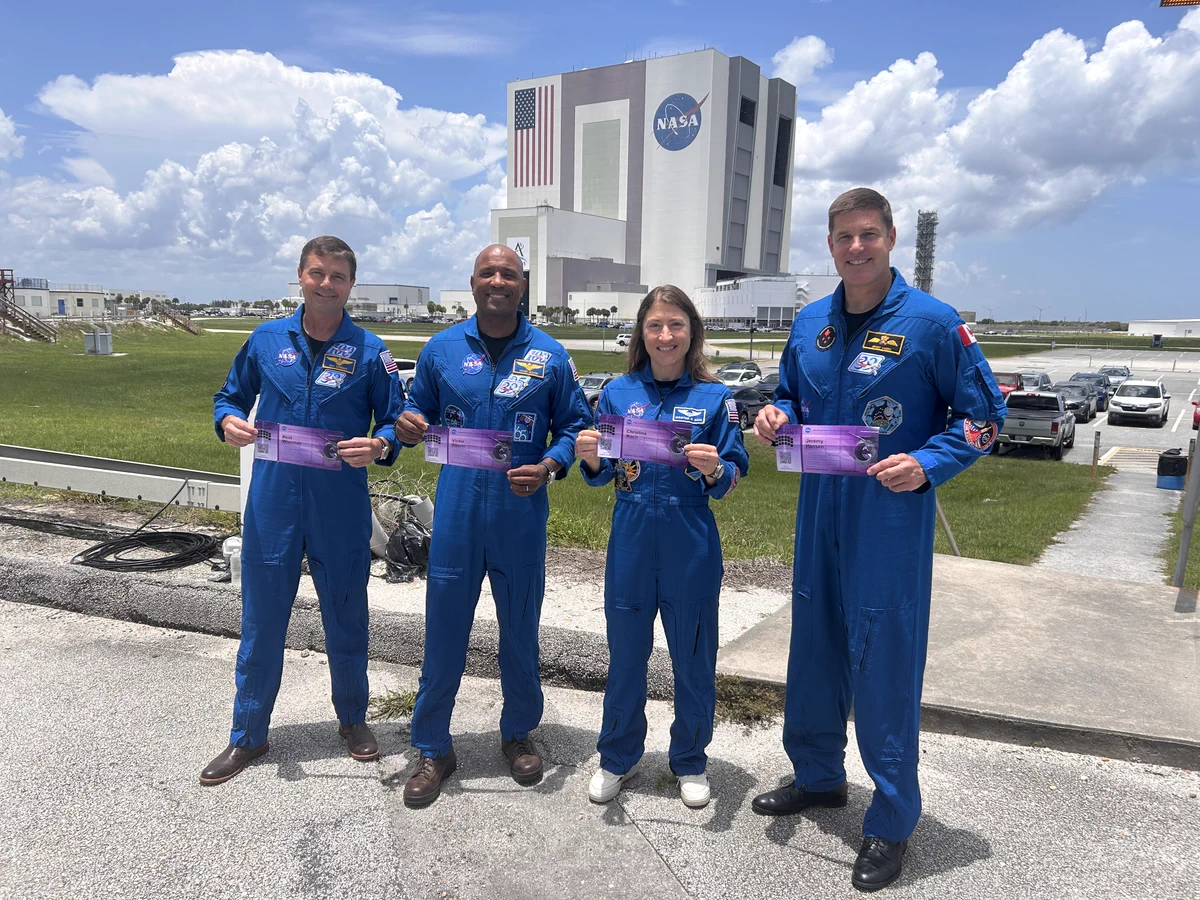
    The @NASAArtemis II astronauts have their Roman boarding passes, do you?! Just three days left to sign up to have your name sent on the Roman space telescope before it travels a million miles away! go.nasa.gov/RomanNames
    Four astronauts from the Artemis II mission Reid Wiseman,Victor Glover, Chrisitna Koch, and Jeremy Hansen  are standing in front of a large building with the NASA insignia and an American flag on it. Each astronaut is holding in front of them a purple boarding pass with their name on it to show that they have signed up to have their name aboard the Nancy Grace Roman Space Telescope.
    290K
  • Nancy Grace Roman Space Telescope reposted
    user avatar
    Learn With NASA
    NASA
    @LearnWithNASA
    Jul 7
    Have you added your name to the list to tag along with the @NASARoman Space Telescope? ➕🚀 Time is running out to send your name a million miles away! Register before the July 12 deadline. ⌛️ my.nasa.gov/specialevents/…
    A purple boarding pass to send your name with the Nancy Grace Roman Space Telescope. The boarding pass is broken up the way a ticket might be, with a tearable stub. The left third, the stub, has the stylized telescope name above the silhouette of Roman's 18 square detectors in its iconic arch shape. Space Telescope is written just below the detectors and above a QR code. Below that are nasa.gov and nasa.gov/roman. The right two thirds of the pass have the red and blue NASA meatball logo along the top. “Your “Name Here” are in large text below that. Much smaller text below that reads "Namesake: NASA's first chief of astronomy aka Mother of Hubble," then "Spacecraft: Astrophysics infrared survey observatory," and below that "Mission Focus: Dark energy, dark matter, exoplanets." Along the bottom, text reads "Launch Site: Kennedy Space Center, Destination: Sun-Earth LaGrange Point 2, Total Miles: 1,000,000." An illustration of the telescope sits along the right side.
    15K
  • Nancy Grace Roman Space Telescope reposted
    user avatar
    NASA's Kennedy Space Center
    NASA
    @NASAKennedy
    Jul 9
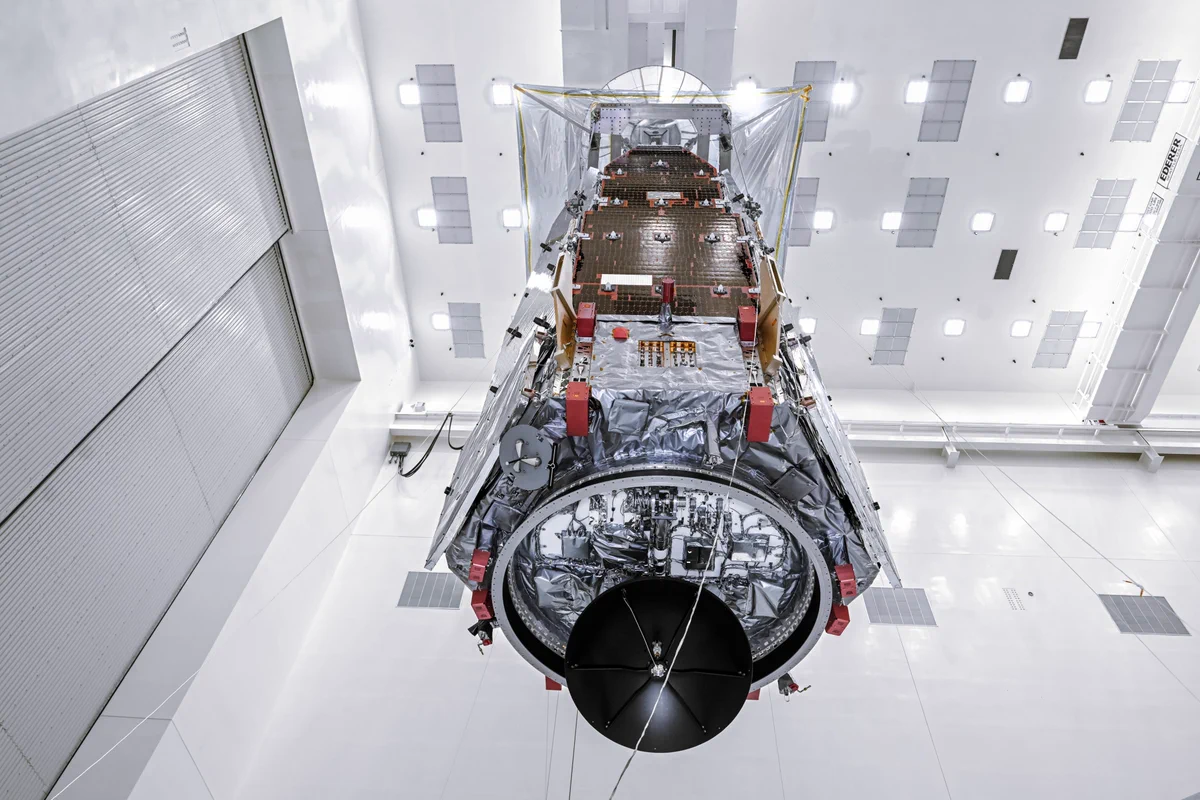
    Roman is nearly ready for its journey to L2, where it will map billions of galaxies, study exoplanets, and probe dark energy! Preparations here at Kennedy continue, and it is now on its specialized work platform, known as the Pantheon. Targeting launch no earlier than Aug. 30
    A large spacecraft suspended vertically inside a clean room, viewed from below. The spacecraft’s cylindrical base, wiring, and reflective insulation are visible, along with solar array panels folded along its sides. Bright overhead lights and white walls surround the vehicle. Photo credit: NASA/Sydney Rohde (Rocz)
    609K
  • user avatar
    Nancy Grace Roman Space Telescope
    NASA
    @NASARoman
    Jul 8
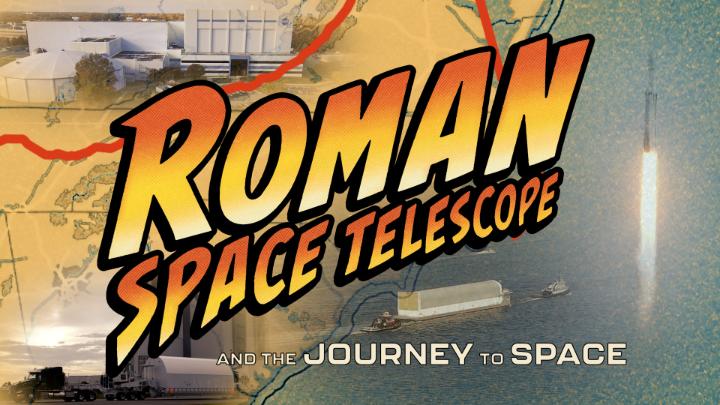
    “It’s not the years, honey, it’s the mileage.” A million in this case, all the way to L2. Roman still has a long journey ahead, but let's take a short trip down memory lane, narrated by John Rhys-Davies, to see how we got to where we are now: prepping for launch @NASAKennedy.
    Image
    00:00
    16K
  • Nancy Grace Roman Space Telescope reposted
    user avatar
    NASA Goddard
    NASA
    @NASAGoddard
    Jul 6
    How do you build a space telescope? You planet! 🌎 We’re preparing to launch the Nancy Grace Roman Space Telescope, and @NASAEarth is getting excited. Register to send your name with the telescope & get your own boarding pass. You’re wEarth it! Register: my.nasa.gov/specialevents/…
    A woman in an inflatable Earth costume smiles against a black backdrop. The costume has North and South America centered in front. She is holding a purple Roman boarding pass.
    Black Marble image of Earth at night, seen from space, centered on the Americas. The planet's surface is blacks, dark purples, and blues. Wispy, grayish clouds float across the Pacific. Major cities glow yellow with tiny dots of electric lights. The planet is off center to the lower left of the image. A purple Roman boarding pass sits at an angle in the upper right corner, slightly tucked behind the planet. The name listed is "Earth the Planet."
    7.7K
  • user avatar
    Nancy Grace Roman Space Telescope
    NASA
    @NASARoman
    Jul 6
    Mini Roman was just in Chicago and stopped by one of the city's most notable landmarks. This is a Roman Reminder: There is ONE WEEK LEFT to sign up to have your name aboard Roman as it flies a million miles away! go.nasa.gov/RomanNames This summer, we will be “Roman” Across
    A hand holds a miniature model of the Roman Telescope in front of Chicago's Cloud Gate sculpture, a large reflective bean shape. A second hand holds a purple Roman boarding pass with the words, “Your Name Here" just in front of the model. There are people walking in the background and it is a clear sunny day
    23K
  • Nancy Grace Roman Space Telescope reposted
    user avatar
    NASA's Kennedy Space Center
    NASA
    @NASAKennedy
    Jul 2
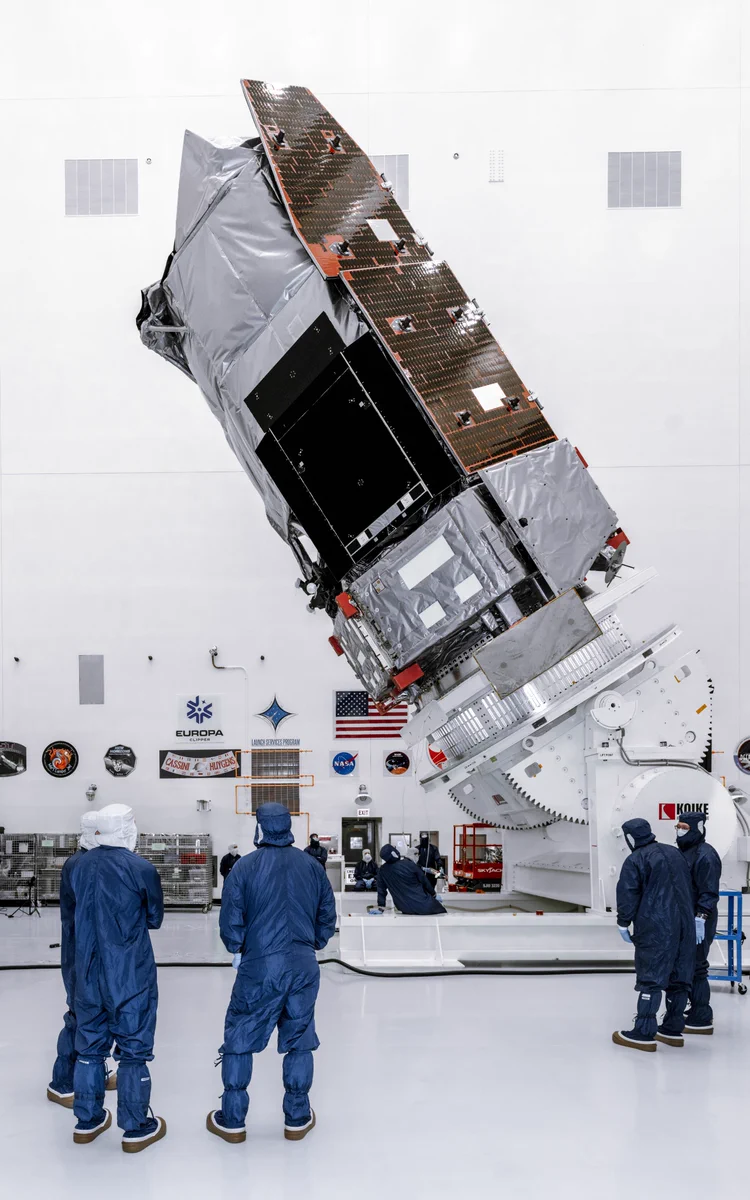
    Behold, Roman. For the first time since arriving in Florida, NASA's Nancy Grace Roman Space Telescope is on full display after being unboxed and raised to its vertical position inside the high bay. And what a sight she is! 🤩
    NASA's Nancy Grace Roman Space Telescope, large spacecraft, wrapped in silver thermal covering is tilted upright on a massive white rotation stand inside a clean room at NASA's Kennedy Space Center in Florida on Thursday, June 25, 2026. Several technicians in blue clean-room suits and protective gear stand around the base, observing the operation. The spacecraft’s solar arrays are partially deployed overhead. Mission logos, an American flag, and clean-room equipment line the white walls in the background. Photo credit: NASA/Sydney Rohde (Rocz)
    107K
  • user avatar
    Nancy Grace Roman Space Telescope
    NASA
    @NASARoman
    Jul 2
    ICYMI, the Nancy Grace Roman Space Telescope has arrived at @NASAKennedy as it preps for launch to travel a million miles into space. Learn more: go.nasa.gov/4eHWMhd
    Gray scaled comic showcasing the roman telescope arriving on a barge to a tall building with a banner that says “ Welcome Roman.”
    19K
  • user avatar
    Nancy Grace Roman Space Telescope
    NASA
    @NASARoman
    Jul 1
    🎶 So long, farewell, to you my friend, goodbye, for now, until we meet again…. at @NASAKennedy. During Roman's final days at @NASAGoddard, many people who have worked and followed this mission over many years reflect on its upcoming journey. Check out Roman’s final curtain
    Image
    00:00
    15K
  • Nancy Grace Roman Space Telescope reposted
    user avatar
    NASA Goddard
    NASA
    @NASAGoddard
    Jul 1
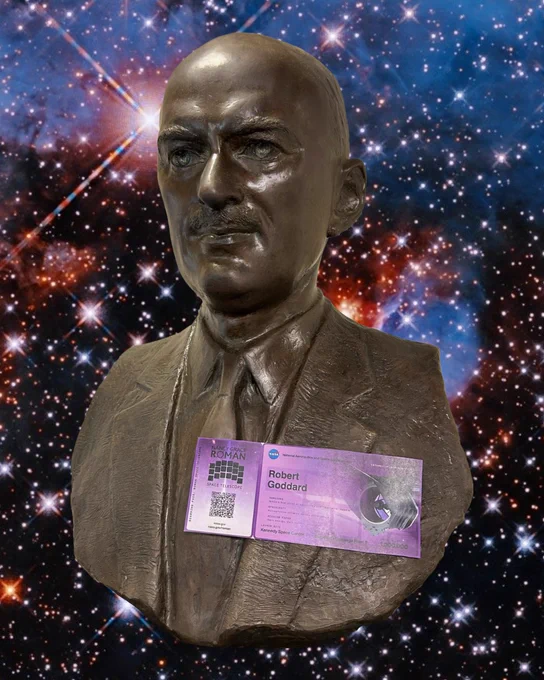
    The “Mother of Hubble” and the “Father of Modern Rocketry” are ready for launch! Nancy Grace Roman and Robert Goddard wouldn’t miss the chance to send their name aboard @NASARoman. Have you signed up for your boarding pass yet? Send your name: my.nasa.gov/specialevents/…
    A black and white cutout of Nancy Grace Roman as a young woman, smiling with her hands behind her back. She has short, curly hair, and is wearing a white blouse and long, dark skirt. A purple Roman boarding pass is attached to her torso. She is superimposed on a Hubble image of star-forming region GAL-305.20+00.2. A field of glittering multicolored stars. Bluish clouds of gas edged in glowing red cluster at the top of the image and in a clump to the right. A single shining star throws diffraction spikes across the upper left of the image.
    A bust of Robert Goddard, cast in a bronze color. He has a purple Roman boarding pass attached to his lapel. He is superimposed on a Hubble image of spiral galaxy NGC 3596. The galaxy’s center appears as a bright white spot surrounded by a golden glow. Two spiral arms extend out from the center, wrapping around the galaxy and broadening out to form the thick outer edge of the disk. Thin reddish strands of dust and bright pink spots follow the arms through the disk. Faint strands of stars extend from the tips of the spiral arms and out beyond the disk.
    34K
  • user avatar
    Nancy Grace Roman Space Telescope
    NASA
    @NASARoman
    Jul 1
    Congrats on an out-of-this-world discovery, TESS! NASA’s TESS mission used the microlensing detection method to find a planet out in the Milky Way’s disk. Roman will use the same method to find new worlds in the center of the Milky Way!
    Graphic titled "Hunting for Exoplanets," highlights search areas of NASA's upcoming Roman Space Telescope, the retired Kepler Space Telescope, and NASA’s TESS. The Milky Way covers most of the graphic with search areas overlaid. TESS's area is a central orange dot and a large lighter orange radius, covering a large portion of the bottom half of the graphic with the words "360 degree sphere, 150 light years," meaning a 150 light year radius from Earth.Kepler's area is in yellow, a small cone starting at the orange dot in the center and branching to the left, the description for Kepler states "12 degree cone, 2,000 light years." And Roman's area is a blue cone reaching from the orange dot to the bright spot at the center of the Milky Way with the description, "1.6 degree cone, 25,000 light years."
    9.1K
    user avatar
    Nancy Grace Roman Space Telescope
    NASA
    @NASARoman
    Jul 1
    Comparing notes from the two missions could shed light on how planets form in different galactic environments, including ones that may be more conducive to life. 🌱 Read more:
    Image
    NASA’s TESS Mission Finds Planetary System in New Way - NASA Science
    From science.nasa.gov
    1.5K
  • user avatar
    Nancy Grace Roman Space Telescope
    NASA
    @NASARoman
    Jun 25
    Have you signed up to send your name to space yet?! We've seen your comments and made improvements to the site so that even more of you can now send us your names to be aboard the Nancy Grace Roman Space Telescope. go.nasa.gov/RomanNames
    A person in a head-to-toe white cleanroom suit holds a large purple "boarding pass" for NASA's Nancy Grace Roman Space Telescope in Goddard's large cleanroom. To the right of the person is a large half cylinder white shaped container with the telescope inside and to the left is a banner that has the NASA Goddard logo.
    16K
  • user avatar
    Nancy Grace Roman Space Telescope
    NASA
    @NASARoman
    Jun 24
    You've got a friend in me, Euclid! Last year, @esa's Euclid space telescope paused its usual observations to look at the heart of our Milky Way Galaxy, previewing one of Roman’s major surveys.
    Image by ESA's Euclid providing an earlier snapshot of a region of our galaxy that Roman will repeatedly observe in the upcoming years. The color ombres like a sunset, from dark maroon in the upper left to a lighter orange and then yellow in the lower right. At the right of the frame, thick molecular clouds appear as dark patches that obscure parts of the galactic bulge beyond. Toward the left, the view rises to higher galactic latitudes: the yellow glow of the bulge becomes clearer, with fewer and more isolated foreground clouds interrupting the starlight.
    15K
    user avatar
    Nancy Grace Roman Space Telescope
    NASA
    @NASARoman
    Jun 24
    Now, astronomers will learn even more than they could from either telescope alone. nasa.gov/missions/roman…
    An artist’s concept outlining the areas of the galactic core covered by Euclid, compared to the future survey area of the Roman telescope. The background is navy, with the Milky Way depicted in white and light blue glowing circles. They form a loose line across the horizontal center of the image, with a higher concentration making a bulge at the center. Overlaid on the Milky Way, Euclid's coverage area is shown in an orange rectangle in the center. Roman's is depicted by 5 small green rectangles within the orange and one above. The Euclid observations overlap Roman's planned coverage.
    1.9K
Advertisement
Advertisement