Log inSign up
NASA Webb Telescope
NASA
11.5K posts
Image
user avatar
NASA Webb Telescope
NASA
@NASAWebb
The Official *NASA* Webb X account. The world's most powerful space telescope. Launched: Dec. 25, 2021. First images revealed: July 12, 2022.
Lagrange Point 2
nasa.gov/webb
Joined April 2009
63
Following
3.5M
Followers
RepliesRepliesMediaMedia

New to X?

Sign up now to get your own personalized timeline!

Create account

By signing up, you agree to the Terms of Service and Privacy Policy, including Cookie Use.

Terms·Privacy·Cookies·Accessibility·Ads Info·© 2026 X Corp.
Don't miss what's happening
People on X are the first to know.
Log inSign up
  • Pinned
    user avatar
    NASA Webb Telescope
    NASA
    @NASAWebb
    Jul 7
    Galaxy cluster formation is a messy process! Webb captured the formation of this young galaxy cluster in progress. Its two-sub-clusters have slammed through each other and travelled over a million light-years apart, repeating this process until they finally merge.
    A galaxy cluster in deep space. It is filled with elliptical galaxies: small, bright white glowing ovals. The two largest elliptical galaxies, left and right of center, are bright cores that radiate light. Unrelated, distant galaxies are scattered around as red smudges and dots.Many of these are stretched out into red arcs and lines by the galaxy cluster’s strong gravity, creating multiple images in places. Numerous spiral galaxies and bright stars appear in the foreground.
    109K
  • user avatar
    NASA Webb Telescope
    NASA
    @NASAWebb
    Jul 7
    Replying to @NASAWebb
    Each sub-cluster is anchored on a bright, massive elliptical galaxy - the two brightest points in the center, with the largest glowing halos around them. Smaller white elliptical galaxies are bound to one of them by gravity, and will be incorporated into the final galaxy cluster.
    40K
    user avatar
    NASA Webb Telescope
    NASA
    @NASAWebb
    Jul 7
    The gravity of this cluster is so strong that it can bend and focus light like a magnifying glass; the prominent orange, stretched-out arcs alongside each sub-cluster are images of distant background galaxies.
    Image
    A cosmic construction project
    From esawebb.org
    38K
  • user avatar
    NASA Webb Telescope
    NASA
    @NASAWebb
    Jul 6
    July 12th is Webb’s 4th science anniversary! When we dive deeper into the familiar galaxy Centaurus A, our view becomes richer and stranger— a vivid record of cosmic history. go.nasa.gov/4wvZJYr
    A horizontal image of the galaxy Centaurus A stretches across a black background filled with thousands of tiny purple, pink, and white points of light. The galaxy is brightest at its center, where a brilliant white and pale pink glow radiates outward. Eight diffraction spikes extend from the central glow. Delicate loops and wispy ribbons of pink and lavender arc above and below the center of the image in the shape of an ‘S’. A band of gray and white dust in the shape of a parallelogram cuts across the middle of the galaxy. Mottled patches and bright knots are scattered throughout the dusty band. The galaxy’s outer edges fade into soft, cloud-like plumes with feathery textures that stretch toward the left and right sides of the image. Against the surrounding darkness, a few bright foreground stars shine with Webb’s distinctive diffraction spikes, while countless fainter stars create a speckled backdrop.
    120K
    user avatar
    NASA Webb Telescope
    NASA
    @NASAWebb
    Jul 6
    Replying to @NASAWebb
    Many of the glowing red points in the MIRI image are dust-rich stars or stellar nurseries. Dust is a raw ingredient for new stars and planets and vital to the ongoing life cycle of the galaxy. At the heart of the galaxy, an actively feeding supermassive black hole shines
    36K
    user avatar
    NASA Webb Telescope
    NASA
    @NASAWebb
    Jul 6
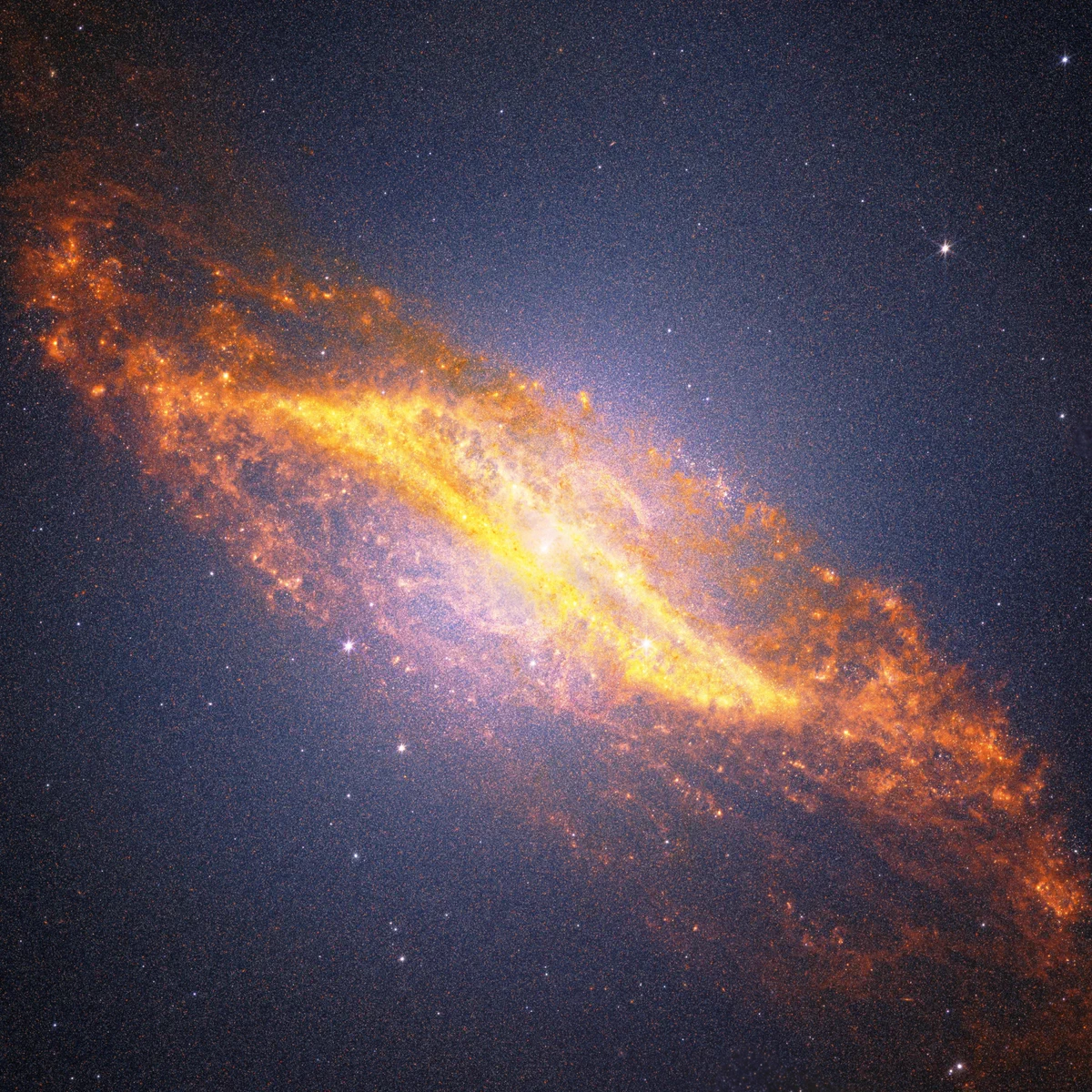
    This combined view of Centaurus A from Webb in near and mid-infrared exposes a warped disk of gas and dust left behind by a collision with another galaxy billions of years ago. The grainy glow is actually a dense field of millions of individually resolved stars.
    A diagonal image of Centaurus A stretches from the upper left to the lower right against a black background filled with tiny orange, blue, and white points of light. The galaxy is brightest at its center with a white glowing core. A broad band of golden-orange dust cuts across the middle of the galaxy, forming a distinctive parallelogram shape. The dust in this feature is richly textured, with mottled patches, bright knots, and intricate filaments throughout. Just above the center, delicate peach-colored ribbons trace an S-shaped structure. Rather than appearing smooth, the galaxy has a finely speckled texture created by millions of individually resolved stars, which fill the central regions and extend into the surrounding glow. The galaxy’s outer edges are reddish-orange and dissolve into diffuse, cloud-like plumes with feathery textures that stretch beyond the dust lane. Against the surrounding darkness, several bright foreground stars display Webb’s distinctive diffraction spikes.
    32K
  • user avatar
    NASA Webb Telescope
    NASA
    @NASAWebb
    Jul 2
    Gonna shine across that sky 🎶 In the infrared, Webb reveals bright protostars flowering from within the thick dust of the FS Tau star system. Set against a tapestry of background galaxies, this star-forming nebula is home to baby stars. science.nasa.gov/missions/webb/…
    FS Tau, a star-forming nebula. Clouds of transparent blue and purple gas and dust stretch from the center to the right. Several yellow and white protostars, some showing Webb’s eight-pronged diffraction pattern, are dispersed throughout the clouds. Orange wisps and filaments of gas extend from one of the protostars at the center toward the top left and bottom right corners. There are numerous, distant yellow and white galaxies strewn about the black background of space.
    83K
    user avatar
    NASA Webb Telescope
    NASA
    @NASAWebb
    Jul 2
    Though dust obscures background stars and galaxies, in @NASAHubble’s image of FS Tau (right) we can see protostar FS Tau b, its dusty protoplanetary disk, and its jet of matter (colored cyan). Compare to the Webb image on the left!
    Side-by-side images of FS Tau, a star-forming nebula. The left, labeled Webb, shows clouds of transparent blue and purple gas and dust extending from the center to the right. Several yellow and white protostars, some showing Webb’s eight-pronged diffraction pattern, are within the clouds. Orange wisps of gas extend from one of the protostars at the center toward the top left and bottom right corners. The right, labeled Hubble, shows a bright white point made up of two orbiting stars with a four-pronged diffraction pattern to the right of center. At 2 o’clock from this star, there is another, smaller protostar, surrounded by a dark disk of matter. In the center of the image is a cavity where the clouds are thinner and background stars shine through. The stars and protostar are on the edges of this cavity and are surrounded by dark clouds that appear like thick smoke
    57K
  • user avatar
    NASA Webb Telescope
    NASA
    @NASAWebb
    Jul 1
    You’re a spark in the dark 🎶 Webb looked at gas giant planet WD 1856 b, which closely orbits a white dwarf - the remains of a Sun-like star. Did it survive the death of its star or did it migrate to its current location later? science.nasa.gov/missions/webb/…
    An orange gas giant planet at left, taking up about one-third of the frame, facing a star, which appears at top right as a far smaller bright dot. The planet has subtle orange cloud bands. The star illuminates the right side of the planet like the crescent of a waxing moon. Both are on the black background of space. The words “artist’s concept” are in the bottom right corner.
    109K
  • user avatar
    NASA Webb Telescope
    NASA
    @NASAWebb
    Jun 23
    Webb’s new view of M82, added to archival data from @NASAHubble, is giving us a more complete picture of this starburst galaxy. science.nasa.gov/missions/webb/…
    Composite image of edge-on spiral starburst galaxy Messier 82 as observed by NASA's James Webb and Hubble space telescopes. Hourglass-shaped plumes of gas are shooting outward from above and below a bright blue-white, disk-shaped center. The plumes are yellow near the galaxy’s bright center, denoting areas of ionized hydrogen gas as observed by Hubble, and gradually become redder as you move farther away. Messier 82 is set against the black background of space, which has many distant galaxies that appear as small white and orange spirals, ovals, and points of light. Toward the right of Messier 82 is a blue-white star with eight-pointed diffraction spikes that are characteristic of Webb.
    112K
    user avatar
    NASA Webb Telescope
    NASA
    @NASAWebb
    Jun 23
    Because Webb can see infrared light, it is able to peer through clouds of dust and gas to see the shape of this edge-on galaxy, as well as approximately 16.5 million of its stars.
    Edge-on spiral starburst galaxy Messier 82 as imaged by NASA's James Webb Space Telescope. Hourglass-shaped red-orange plumes of material are shooting outward from above and below a bright blue-white, disk-shaped center. Messier 82 is set against the black background of space, which has many distant galaxies that appear as small white and orange spirals, ovals, and points of light. Toward the right of Messier 82 is a blue-white star with eight-pointed diffraction spikes that are characteristic of Webb.
    37K
    user avatar
    NASA Webb Telescope
    NASA
    @NASAWebb
    Jun 23
    M82’s rapid star formation, thought to be the result of its merger with another galaxy, will only be a brief period in its history. The extreme star formation is causing plumes of material to be ejected above and below the disk of the galaxy disrupting future stellar birth.
    31K
  • user avatar
    NASA Webb Telescope
    NASA
    @NASAWebb
    Jun 22
    You might have heard of interstellar comet 3I/ATLAS. We don't get the opportunity to study objects like this often. Webb took a look at the comet's composition. It's showing us how unusual our own solar system might be. Here's what we've learned 👇
    NIRSpec map of specific chemical and molecular signatures in comet 3I/ATLAS. Three images, two on top and one on the bottom left show different signatures, H2O, CO2, and CO. Each signature looks like a pixelated dot. H2O is blue, CO2 is yellow, and CO is red.
    168K
    user avatar
    NASA Webb Telescope
    NASA
    @NASAWebb
    Jun 22
    Replying to @NASAWebb
    There’s only one planet we know of with life - our own. Getting to study objects that formed in a different system than our own is a rare opportunity for learning how common, or uncommon, the conditions are for the evolution of life elsewhere in the universe.
    36K
    user avatar
    NASA Webb Telescope
    NASA
    @NASAWebb
    Jun 22
    Learn more:
    Image
    NASA’s Webb Finds Clues to Ancient, Distant Origin of Comet 3I/ATLAS - NASA Science
    From science.nasa.gov
    36K
  • user avatar
    NASA Webb Telescope
    NASA
    @NASAWebb
    Jun 16
    One well-done gas giant planet, coming right up! Webb examined a “hot Jupiter” exoplanet called HD 80606 b, with four times Jupiter’s mass, and a very elliptical orbit that sweeps close by its Sun-like star. go.nasa.gov/3QtN6xr
    Illustration of a planet and a star, labeled artist’s concept at the bottom left. The planet fills more than a quarter of the image to the upper right, with the bright star to its lower left. The planet is white hot on the star side, fading to yellow that mixes with swirls of bright red across its middle, and eventually fading to black on the side most distant from the star. Distant stars dot the background of space, which is black near the edges of the frame.
    71K
  • user avatar
    NASA Webb Telescope
    NASA
    @NASAWebb
    Jun 16
    Webb teamed up with @NASAHubble to examine a relic from our galaxy’s formation. This object might look like a globular cluster of stars, but is actually something much odder and rarer - a “bulge fossil fragment.” science.nasa.gov/missions/webb/…
    A dramatically crowded starfield that looks like a just-shaken snow globe. The black background of space, which is clearer at the edges, is covered by thousands of tiny white, orange, and blue points of light, which are stars. The stars are most concentrated in the center, forming a roughly circular orb, and sparser at the edges of the image. Several larger orange stars, particularly those largest near the edges of the frame, have prominent diffraction spikes.
    85K
Advertisement
Advertisement