@reve 2.1 is here.
It ranks #2 on the @arena leaderboard, with an almost 30-point lead over @Meta's Muse Image and @Google's Nano Banana 2.
Compared to Reve 2.0 just a month ago, we significantly scaled up our layout model—in model size, training compute, and our biggest
Video diffusion models generate high-quality videos but are too slow for interactive applications.
We @MIT_CSAIL@AdobeResearch introduce CausVid, a fast autoregressive video diffusion model that starts playing the moment you hit "Generate"!
A thread 🧵
For more details, please visit the project website at causvid.github.io We plan to release an implementation based on an open-source model soon.
I am incredibly grateful to all my collaborators at Adobe and MIT, including @qiangz_ai, @xunhuang1995, @rzhang88,
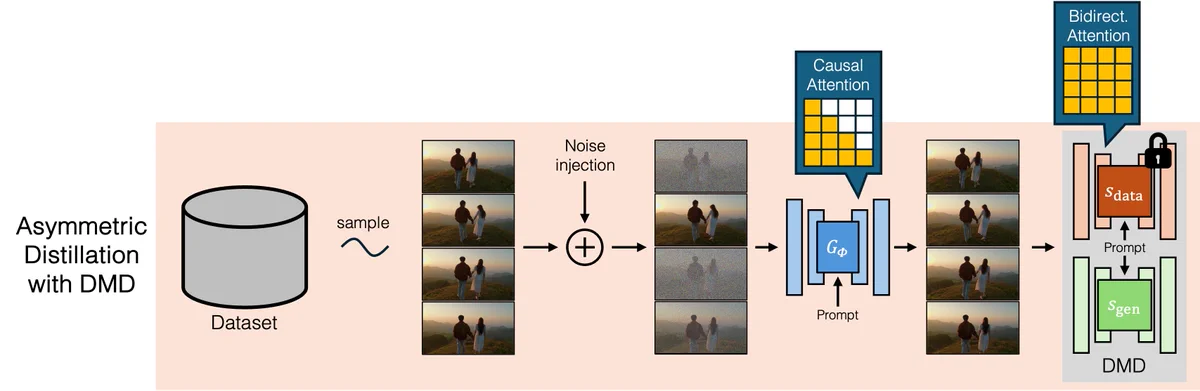
CausVid trains a four-step autoregressive diffusion model to generate videos. Unlike previous bidirectional diffusion models that denoise all frames simultaneously, CausVid generates videos frame by frame. This approach enables users to watch the video while it is being
To perform diffusion generation in just 4 steps instead of 50, we apply distribution matching distillation (DMD) to videos. For an excellent overview of DMD, see the following thread.
Diffusion models generate high-quality images but require hundreds of forward passes.
@MIT_CSAIL and @AdobeResearch introduce Distribution Matching Distillation (DMD), a distillation approach that converts costly multi-step diffusion models into fast one-step generators.
A
A bidirectional teacher with privileged future information during training proves surprisingly effective in reducing error accumulation in the causal student (see video below). This form of asymmetric distillation, where the student and teacher use different architectures, is
One crucial issue with previous autoregressive diffusion approach is error accumulation: As the video generates future frames conditioned on previously generated ones, any imperfections in earlier frames compound over time, causing the video to drift off track. This eventually
There’s little difference in quality, but the distilled bidirectional model may handle local details better, while the distilled causal model offers much lower latency.