1. X
  2. Ahmad Beirami ✈️ ICML
Log inSign up
Ahmad Beirami ✈️ ICML
4,836 posts
user avatar
Ahmad Beirami ✈️ ICML
@abeirami
stealth // ex Gemini RL+Inference @GoogleDeepMind // Chat AI @AIatMeta // RL Agents @EA // ML+Information Theory @MIT+@Harvard+@GeorgiaTech
{NYC, SFO, YYZ}
beirami.github.io
Joined December 2018
2,982
Following
11.9K
Followers
1
Subscription
RepliesRepliesArticlesArticlesMediaMedia

New to X?

Sign up now to get your own personalized timeline!

Create account

By signing up, you agree to the Terms of Service and Privacy Policy, including Cookie Use.

Terms·Privacy·Cookies·Accessibility·Ads Info·© 2026 X Corp.
Don't miss what's happening
People on X are the first to know.
Log inSign up
  • Pinned
    user avatar
    Ahmad Beirami ✈️ ICML
    @abeirami
    Jul 4
    I've been saying for a while that aggregate benchmark scores often hide what actually matters. When building and evaluating a model, an agent, or a system, a few things are crucial: 1. Evaluation rubrics should be derived and stated unambiguously from the spec or policies. Any
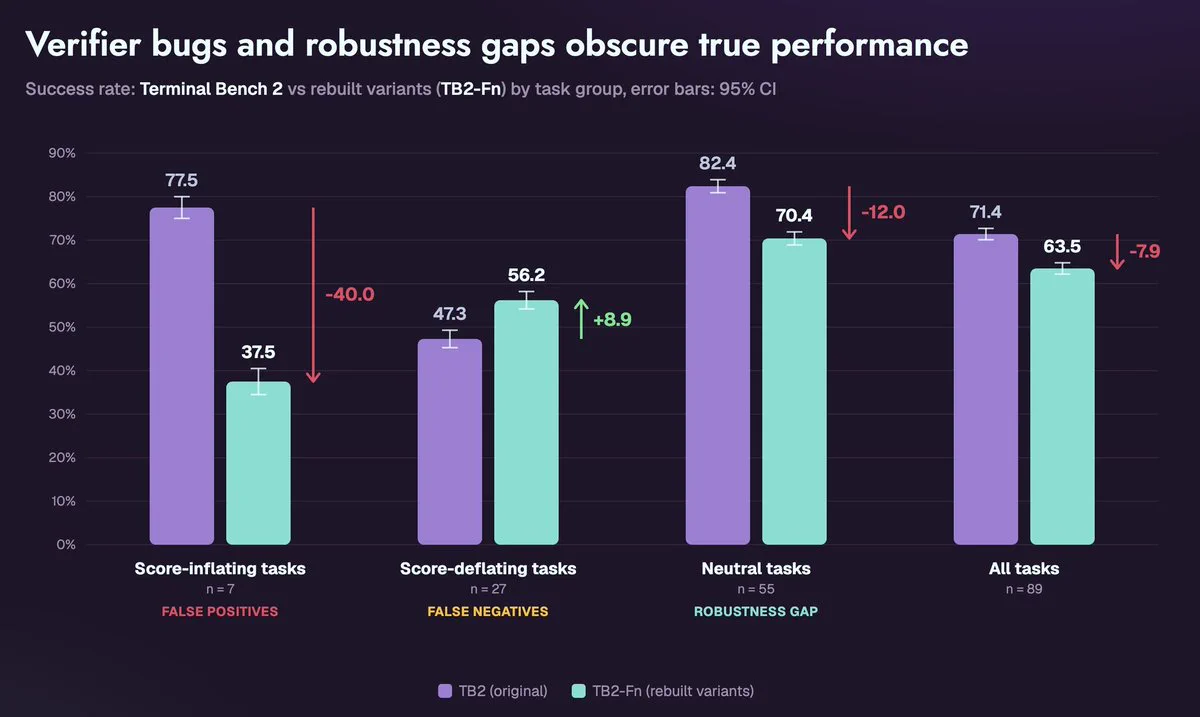
    Bar chart comparing success rates on Terminal Bench 2 (original) vs rebuilt task variants (TB2-Fn) across four task groups, with 95% confidence intervals. Score-inflating tasks (n=7, labeled false positives): 77.5% drops to 37.5%, a 40-point fall. Score-deflating tasks (n=27, labeled false negatives): 47.3% rises to 56.2%, up 8.9 points. Neutral tasks (n=55, labeled robustness gap): 82.4% drops to 70.4%, down 12 points. All tasks (n=89): 71.4% drops to 63.5%, down 7.9 points. Title: Verifier bugs and robustness gaps obscure true performance.
    13K
  • user avatar
    Ahmad Beirami ✈️ ICML
    @abeirami
    Oct 21, 2025
    They should have broken the 10k to 10-100 stacks of $100-1k and given them to the identical copies of the same model to be able to see anything remotely meaningful. Right now we are looking at noise!
    This post is unavailable.
    118K
  • user avatar
    Ahmad Beirami ✈️ ICML
    @abeirami
    Aug 25, 2025
    What are the founders going to own? 🤔
    Image
    127K
  • user avatar
    Ahmad Beirami ✈️ ICML
    @abeirami
    Aug 25, 2025
    There is no free lunch here. Pruning hurts robustness and capabilities other than those captured by the success metric used to prune.
    user avatar
    Avi Chawla
    @_avichawla
    Aug 25, 2025
    I removed 74% of neurons from a neural network. It dropped the accuracy by just 0.50%. Here's a breakdown (with code):
    92K
  • user avatar
    Ahmad Beirami ✈️ ICML
    @abeirami
    Jun 2, 2025
    After three incredible years, today is my last day at Google DeepMind! I am truly grateful to the amazing colleagues who made the journey 1000x more fruitful and enjoyable! I am forever indebted to my collaborators who showed me how to be better at everything via demonstrations.
    Image
    85K
  • user avatar
    Ahmad Beirami ✈️ ICML
    @abeirami
    Sep 10, 2025
    This is a great example of what good research looks like. You start with a real problem. You peel it layer by layer to find the root cause. You form a new hypothesis and keep digging. At the end, you have something insightful to share!
    user avatar
    Thinking Machines
    @thinkymachines
    Sep 10, 2025
    Today Thinking Machines Lab is launching our research blog, Connectionism. Our first blog post is “Defeating Nondeterminism in LLM Inference” We believe that science is better when shared. Connectionism will cover topics as varied as our research is: from kernel numerics to
    Image
    54K
  • user avatar
    Ahmad Beirami ✈️ ICML
    @abeirami
    Aug 12, 2025
    The best AI researchers zoom at three abstraction levels: - High: paper-level ideas & math - Mid: code-level implementation - Low: GPU/TPU reality (kernels/memory) Low exposes bottlenecks. High accelerates exploration. Mid makes it real. The job is to translate between them!
    39K
  • user avatar
    Ahmad Beirami ✈️ ICML
    @abeirami
    Aug 9, 2025
    The main ingredient that led to GRPO's performance leap is the calibration of the reward/value via multiple rollouts per prompt. Let me elaborate on what I mean by that and a cheaper way of doing it offline.
    Image
    118K
  • user avatar
    Ahmad Beirami ✈️ ICML
    @abeirami
    May 27, 2025
    As we go through a lot of excitement about RL recently with lots of cool work/results, here is a reminder that RL with a reverse KL-regularizer to the base model cannot learn new skills that were not already present in the base model. It can only amplify the existing weak skills.
    Image
    78K
  • user avatar
    Ahmad Beirami ✈️ ICML
    @abeirami
    Feb 4, 2025
    A very nice blogpost on GRPO (the method that was used to train R1) by Youssef Mroueh
    Image
    54K
  • user avatar
    Ahmad Beirami ✈️ ICML
    @abeirami
    Aug 10, 2025
    Post-training research was fueled by the KL-regularized RL mathematical foundation. That led to a lot of algorithmic research and a ton of progress over a few years. This helped us learn how to "distill" metrics back into models. But today we are optimizing workflows/agents.
    Image
    42K
  • user avatar
    Ahmad Beirami ✈️ ICML
    @abeirami
    Sep 6, 2025
    Unpopular opinion: When a paper has a senior mentor and a junior mentee, the senior author must make sure the claims are correct and well supported. They must check every claim and gate the submission until it meets that bar. The junior author is the generator. The senior author
    43K
  • user avatar
    Ahmad Beirami ✈️ ICML
    @abeirami
    Apr 13, 2022
    The question that a reviewer should ask themselves is: Does this paper take a gradient step in the right direction? Is the community better off with this paper published? If the answer is yes, then the recommendation should be to accept.
  • user avatar
    Ahmad Beirami ✈️ ICML
    @abeirami
    Oct 4, 2025
    This post should have been titled "Finetuning without regret" Finetuning models for specific narrow use cases to save costs, and to keep data on prem during inference, makes sense in general. However, that is bottlenecked by two main issues IMO: 1. Today, OSS models are lacking
    user avatar
    Thinking Machines
    @thinkymachines
    Oct 1, 2025
    Introducing Tinker: a flexible API for fine-tuning language models. Write training loops in Python on your laptop; we'll run them on distributed GPUs. Private beta starts today. We can't wait to see what researchers and developers build with cutting-edge open models!
    Image
    70K
Advertisement
Advertisement