1. X
  2. Mor Geva
Log inSign up
Mor Geva
629 posts
user avatar
Mor Geva
@megamor2
Assistant Professor at @TelAvivUni and Research Scientist at @Irregular; previously at @GoogleResearch, @GoogleDeepMind and @allen_ai
mega002.github.io
Joined April 2017
572
Following
2,983
Followers
RepliesRepliesMediaMedia

New to X?

Sign up now to get your own personalized timeline!

Create account

By signing up, you agree to the Terms of Service and Privacy Policy, including Cookie Use.

Terms·Privacy·Cookies·Accessibility·Ads Info·© 2026 X Corp.
Don't miss what's happening
People on X are the first to know.
Log inSign up
  • user avatar
    Mor Geva
    @megamor2
    May 1, 2023
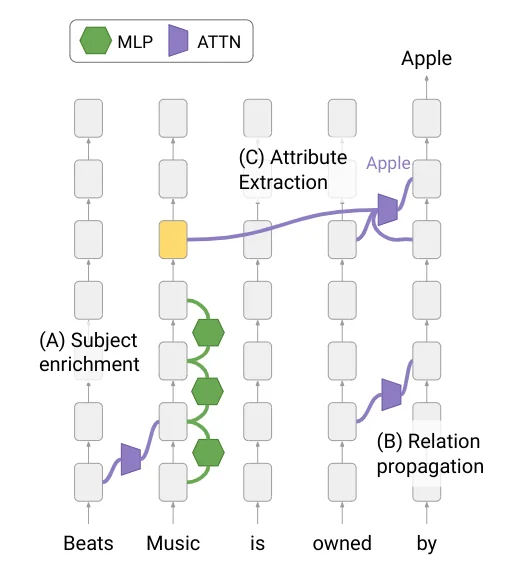
    LMs capture many factual associations, but how do they recall them internally during inference? In a new preprint, we find that LMs build attribute-rich subject representations, from which attention heads extract the predicted attribute. @jasmijnbastings @fajtak @amirgloberson 🧵
    Image
    61K
  • user avatar
    Mor Geva
    @megamor2
    Apr 27, 2022
    What if I told you that you can *easily* control the behavior of GPT and change it in particular directions of your choice, with only a few simple and intuitive steps? Meet ✨LM-Debugger✨, an open-source interactive tool for inspection and intervention in transformer LMs 👇1/8
  • user avatar
    Mor Geva
    @megamor2
    Mar 29, 2022
    New preprint!📣 How do transformer LMs construct predictions? We tackle this question by reverse-engineering the FFN layers in LMs and the mechanism in which they update the prediction across layers.🧵 (1/6) @clu_avi, @k3vwang, @yoavgo
    Image
  • user avatar
    Mor Geva
    @megamor2
    Jan 1, 2021
    "Transformer Feed-Forward Layers Are Key-Value Memories" Check out our new preprint where we analyze the role of FF layers in transformer models. arxiv.org/abs/2012.14913 With @RoeiSchuster @JonathanBerant @omerlevy_ 1/3
    Image
  • user avatar
    Mor Geva
    @megamor2
    Dec 18, 2024
    What's in an attention head? 🤯 We present an efficient framework – MAPS – for inferring the functionality of attention heads in LLMs ✨directly from their parameters✨ A new preprint with @AmitElhelo 🧵 (1/10)
    Image
    26K
  • user avatar
    Mor Geva
    @megamor2
    Jun 13, 2025
    ✨MLP layers have just become more interpretable than ever ✨ In a new paper: * We show a simple method for decomposing MLP activations into interpretable features * Our method uncovers hidden concept hierarchies, where sparse neuron combinations form increasingly abstract ideas
    Image
    64K
  • user avatar
    Mor Geva
    @megamor2
    Jan 8, 2021
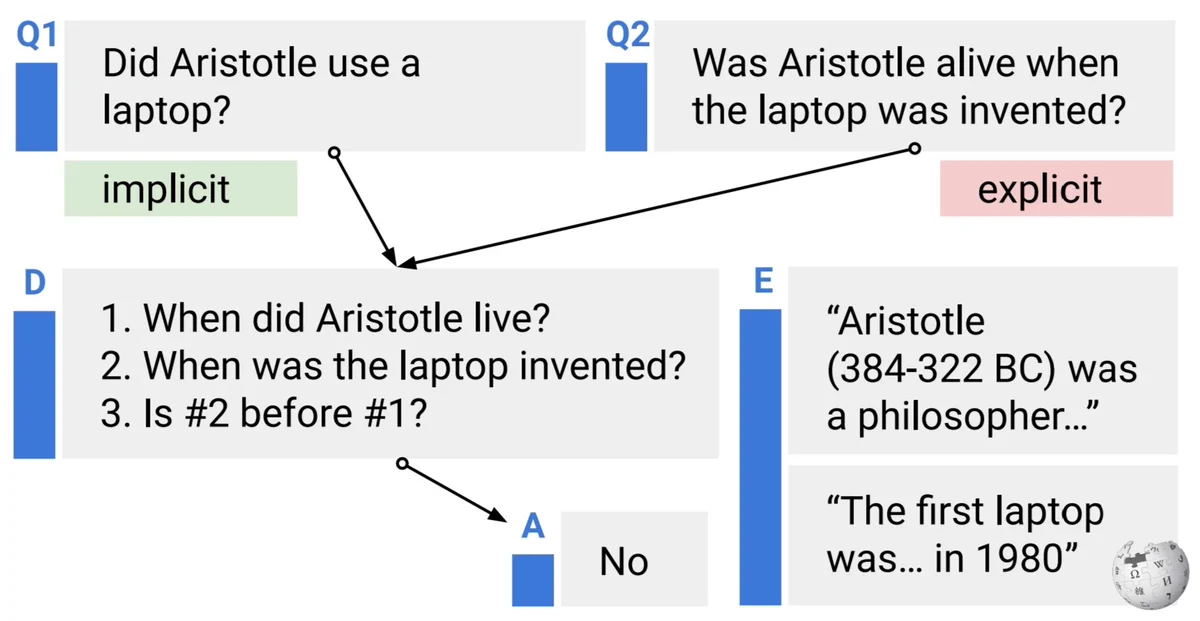
    We present StrategyQA, a question answering benchmark with *implicit* reasoning strategies, accepted to TACL, 2021. Dataset --> allenai.org/data/strategyqa Paper --> arxiv.org/abs/2101.02235 With @DanielKhashabi @eladsegal @tusharkhot @dannydanr @JonathanBerant
    Image
  • user avatar
    Mor Geva
    @megamor2
    Apr 14, 2021
    New preprint! We show that training transformer models with multiple output heads leads to non-trivial interactions between the heads and emergent head behaviour that generalizes beyond the task the head was trained for. arxiv.org/abs/2104.06129 @UrikaUri Aviv BA @JonathanBerant
    Image
  • user avatar
    Mor Geva
    @megamor2
    Jun 19, 2024
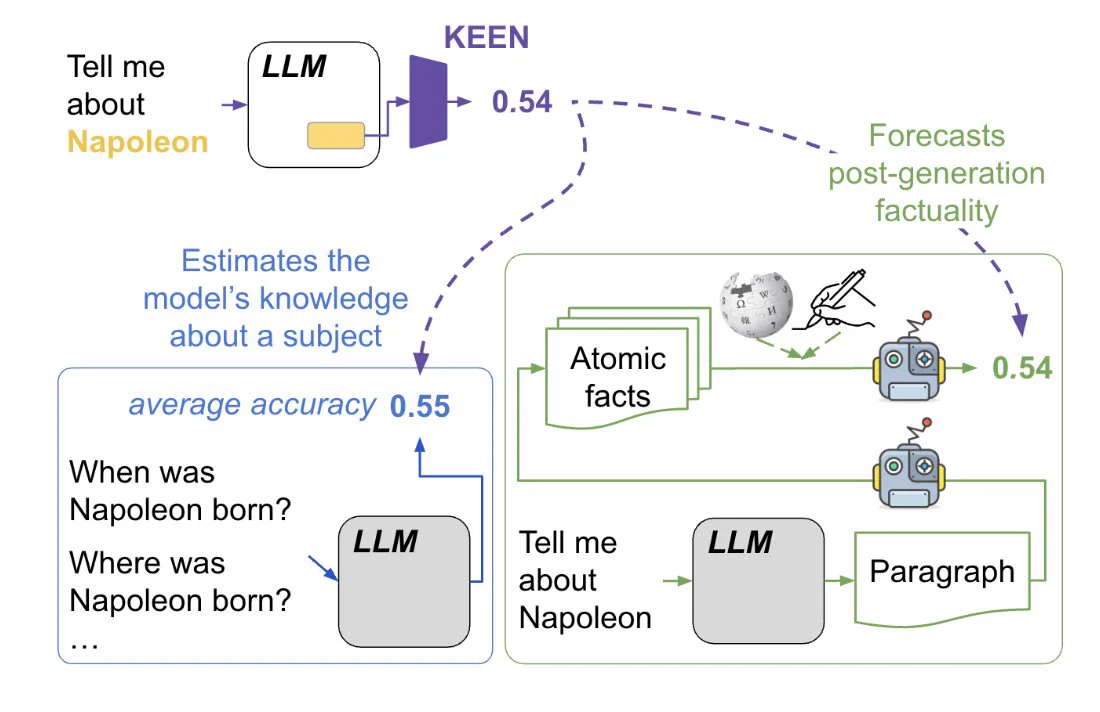
    Do you have a "tell" when you are about to lie? We find that LLMs have “tells” in their internal representations which allow estimating how knowledgeable a model is about an entity 𝘣𝘦𝘧𝘰𝘳𝘦 it generates even a single token. Paper: arxiv.org/abs/2406.12673… 🧵 @dhgottesman
    Image
    7.3K
  • user avatar
    Mor Geva
    @megamor2
    Apr 10, 2020
    Numerical reasoning skills are difficult to learn from a LM objective. In our new paper, we show how to inject the skills into pre-trained LMs, such that numerical computations are performed internally by the model. arxiv.org/abs/2004.04487 @ankgup2 @JonathanBerant
    arXiv logo
    arxiv.org
    Injecting Numerical Reasoning Skills into Language Models
    Large pre-trained language models (LMs) are known to encode substantial amounts of linguistic information. However, high-level reasoning skills, such as numerical reasoning, are difficult to learn...
  • user avatar
    Mor Geva
    @megamor2
    Jan 15, 2025
    How can we interpret LLM features at scale? 🤔 Current pipelines use activating inputs, which is costly and ignores how features causally affect model outputs! We propose efficient output-centric methods that better predict how steering a feature will affect model outputs. New
    Image
    GIF
    7.4K
  • user avatar
    Mor Geva
    @megamor2
    Aug 21, 2025
    Removing certain knowledge from LLMs is hard. Our lab has been tackling this problem at the level of model parameters. Excited to have two papers on this topic accepted at #EMNLP2025 main conf: ⭐️Precise In-Parameter Concept Erasure in Large Language Models
    user avatar
    Yihuai Hong
    @YihuaiH91773
    Jun 20, 2024
    🚀The first-ever parametric LLM Unlearning Benchmark! We find current unlearning only modify model’s behavior without truly erasing encoded knowledge in parameters, presenting ConceptVectors Benchmark, with each vector strongly tied to a specific concept.🔗yihuaihong.github.io/ConceptVectors…
    Image
    Image
    7K
  • user avatar
    Mor Geva
    @megamor2
    Sep 2, 2024
    Replying to @goodside
    Transformers have an inherent limitation in solving this task: arxiv.org/abs/2407.15160
    110K
  • user avatar
    Mor Geva
    @megamor2
    Feb 3, 2020
    Check out BREAK - a new NLU benchmark for testing the ability of models to break down a question into the required steps for computing its answer. allenai.github.io/Break/ A work by Tomer Wolfson, accepted to TACL 2020. @JonathanBerant @yoavgo @ankgup2 @nlpmattg
    allenai.github.io
    A Question Understanding Benchmark
    A Question Understanding Benchmark
Advertisement
Advertisement