1. X
  2. Selena Ling 凌子涵
Log inSign up
Selena Ling 凌子涵
156 posts
Image
user avatar
Selena Ling 凌子涵
@seleniumlzh
U of Toronto CS PhD at DGP | Prev. @AdobeResearch @NVIDIA : )
Toronto, Canada
iszihan.github.io
Joined August 2012
938
Following
1,080
Followers
RepliesRepliesMediaMedia

New to X?

Sign up now to get your own personalized timeline!

Create account

By signing up, you agree to the Terms of Service and Privacy Policy, including Cookie Use.

Terms·Privacy·Cookies·Accessibility·Ads Info·© 2026 X Corp.
Don't miss what's happening
People on X are the first to know.
Log inSign up
  • Pinned
    user avatar
    Selena Ling 凌子涵
    @seleniumlzh
    Jun 5
    Check out our latest work on image model merging for stylization!
    user avatar
    Chenxi Liu
    @chenxil21
    Jun 4
    Paper announcement📢 GimmBO: Interactive Generative Image Model Merging via Bayesian Optimization Chenxi Liu, Selena Ling (@seleniumlzh), Alec Jacobson 🏆 SIGGRAPH 2026 Best Paper Selena and I will be presenting in LA (July 19-23)! 🌐 Project: gimmbo-project.github.io [1/7]
    Image
    855
  • user avatar
    Selena Ling 凌子涵
    @seleniumlzh
    Oct 29, 2022
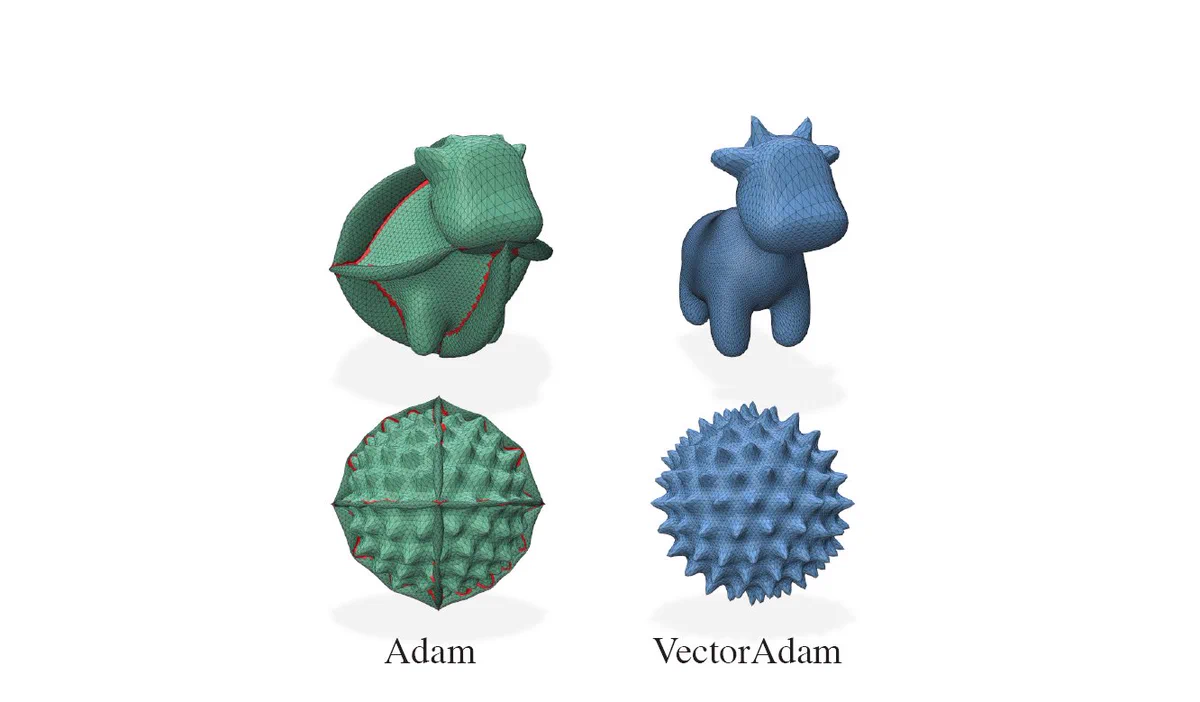
    Adam works amazingly well for both ML and geometry problems. But when parameters are geometric, Adam is not rotation-equivariant and leads to artifacts. We propose a fix with "VectorAdam for Rotation Equivariant Geometry Optimization" w/ @nmwsharp @_AlecJacobson #NeurIPS22 (1/7)
    Image
  • user avatar
    Selena Ling 凌子涵
    @seleniumlzh
    May 28, 2025
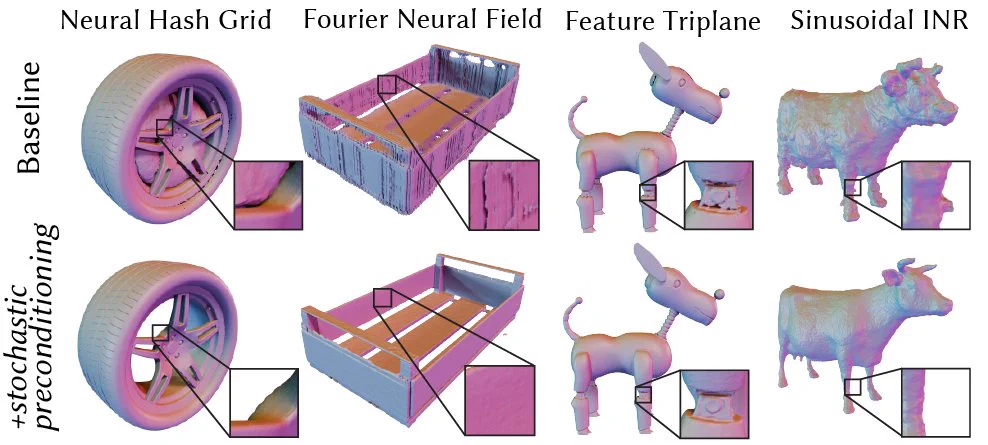
    Our #Siggraph25 work found a simple, nearly one-line change that greatly eases neural field optimization for a wide variety of existing representations. “Stochastic Preconditioning for Neural Field Optimization” w/ @merlin_ND @_AlecJacobson @nmwsharp
    Image
    57K
  • user avatar
    Selena Ling 凌子涵
    @seleniumlzh
    Jun 10, 2025
    Our #SGP25 work studies a simple and effective way to uniformly sample implicit surfaces by casting rays. (1/9) “Uniform Sampling of Surfaces by Casting Rays” w/ @_abhishekmadan @nmwsharp @_AlecJacobson
    Image
    GIF
    13K
  • user avatar
    Selena Ling 凌子涵
    @seleniumlzh
    Oct 29, 2022
    Replying to @seleniumlzh
    With a common Laplacian regularization energy that is intrinsic to a mesh, Adam’s first optimization step results in a different output while VectorAdam preserves the optimization trajectory under rotation. (6/7)
    Image
    GIF
  • user avatar
    Selena Ling 凌子涵
    @seleniumlzh
    Oct 29, 2022
    Replying to @seleniumlzh
    We show many more experiments across geometric optimization and machine learning in our paper. We also provide a PyTorch implementation here github.com/iszihan/Vector…. Please check out our #NeurIPS22 paper here bit.ly/3DGcsyZ and reach out if you have any questions! (7/7)
  • user avatar
    Selena Ling 凌子涵
    @seleniumlzh
    Oct 29, 2022
    Replying to @seleniumlzh
    We introduce VectorAdam as a solution by extending the per-scalar operation of Adam to vectors. (3/7)
    Image
  • user avatar
    Selena Ling 凌子涵
    @seleniumlzh
    Oct 29, 2022
    Replying to @seleniumlzh
    We observe that Adam’s first and second moment estimation operates per-scalar, which results in uniform rescaling for each component of the gradient vector, snapping the gradient along the diagonal direction of the current coordinate system. (2/7)
    Image
  • user avatar
    Selena Ling 凌子涵
    @seleniumlzh
    Oct 29, 2022
    Replying to @seleniumlzh
    This simple change preserves the gradient direction and ensures uniform rescaling wrt gradient norm. (4/7)
    Image
  • user avatar
    Selena Ling 凌子涵
    @seleniumlzh
    Oct 29, 2022
    Replying to @seleniumlzh
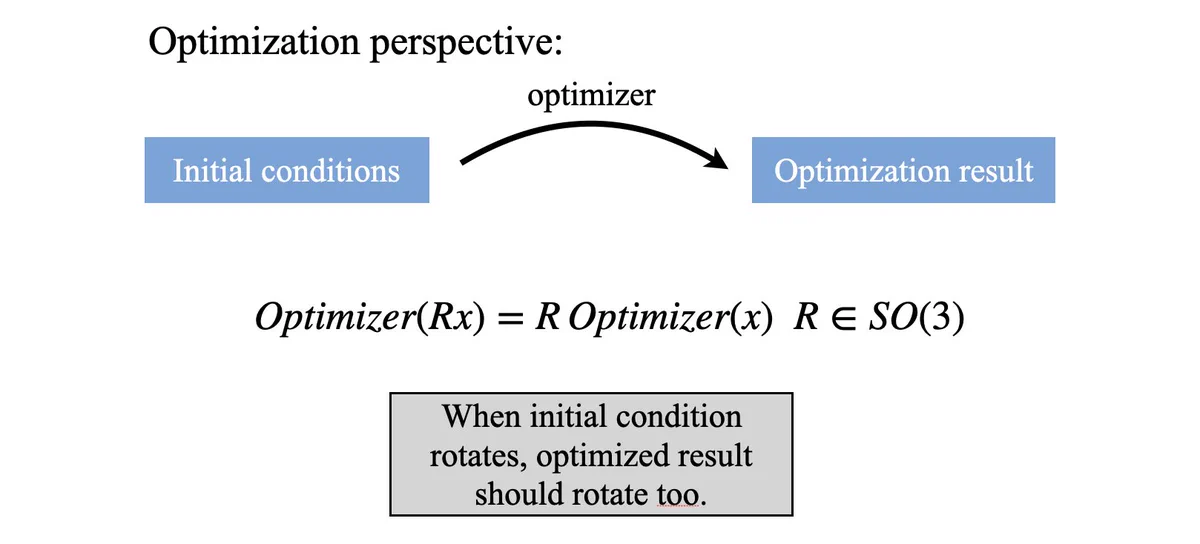
    Most importantly, if we take a functional perspective for optimizers, considering it as a function that maps initial condition to optimized result, we prove that VectorAdam is rotation-equivariant. (5/7)
    Image
  • user avatar
    Selena Ling 凌子涵
    @seleniumlzh
    May 28, 2025
    Replying to @seleniumlzh
    It’s as simple as perturbing query locations according to a normal distribution. This produces a stochastic estimate of the blurred neural field, with the level of blur proportional to a scale parameter 𝛼.
    Image
    2.3K
  • user avatar
    Selena Ling 凌子涵
    @seleniumlzh
    May 28, 2025
    Replying to @seleniumlzh
    We show many more experiments across different neural field representations in our paper. Please check out our #Siggraph25 paper here research.nvidia.com/labs/toronto-a… and reach out if you have any questions!
    1.6K
  • user avatar
    Selena Ling 凌子涵
    @seleniumlzh
    May 28, 2025
    Replying to @seleniumlzh
    We argue that this is a quick and easy form of coarse-to-fine optimization, applicable to nearly any objective or field representation. It matches or outperforms custom designed polices and staged coarse-to-fine schemes.
    Image
    GIF
    1.3K
  • user avatar
    Selena Ling 凌子涵
    @seleniumlzh
    May 28, 2025
    Replying to @seleniumlzh
    And implementing our method requires changing just a few lines of code!
    Image
    1.6K
Advertisement
Advertisement