Big news: StackAI is joining @asana!
We created StackAI to empower enterprises with secure, powerful agentic workflows that automate manual processes; Asana created the operating system for human-agent teams.
Now, we're building the place where humans and AI agents execute
I’m thrilled to share that StackAI is joining forces with Asana.
From the moment we met Dan Rogers, Asana’s CEO, Arnab Bose, Asana’s CPO, and the rest of the team, it was clear they deeply understood what makes StackAI different: how we build, who we serve, and why it matters.
One question I hear constantly while filming inside AI startups is: what happens when OpenAI just builds this?
While filming INSIDE @stackai, co-founder @BernAceituno gave a pretty compelling answer.
StackAI has raised $16.6M to build an enterprise AI agent platform that lets
Proud to partner with @Egnyte to accelerate agentic workflows for document-heavy processes⚡️
Excited for the use cases across financial services, construction, engineering, and more that this integration will unlock.
AI agents are only as powerful as the data they can reliably access.
That's why we are excited to announce our latest integration with @stackai —bringing no-code AI agents directly into the Egnyte environment, where your enterprise content already lives & is already governed.
95% of AI pilots fail. Bernard Aceituno has seen why firsthand — and the mistakes are more avoidable than you think. Read his breakdown of the 5 deployment errors costing enterprises the most.
➡️spr.ly/6016BB3rfa#FoundryExpert#EnterpriseAI
For a company automating enterprise workflows, @stackai couldn’t let their website become a bottleneck. After building their site in Framer in just two weeks, their lean team now ships site updates daily and has scaled to nearly 2,000 pages, all without relying on developers.
We’re excited to introduce subagents on StackAI 🚀
The manager/orchestrator AI agent breaks a high-level goal into tasks, delegates to specialist subagents – each with their own tools, context, and expertise – then reviews & delivers one polished result.
Why it matters?
⚡
We at @stackai got early access to GPT-5.4 — and the results are remarkable.
One of our benchmarks (analyzing financial records across 50,000 pages) had never been passed by any LLM. GPT-5.4 is the first to clear it.
Impressive work, @OpenAI 😮
GPT-5.4 Thinking and GPT-5.4 Pro are rolling out now in ChatGPT.
GPT-5.4 is also now available in the API and Codex.
GPT-5.4 brings our advances in reasoning, coding, and agentic workflows into one frontier model.
95% of AI agent demos never make it to production.
Yet 79% of enterprises expect full-scale agentic AI adoption within three years.
So what's the disconnect?
Most companies jump into AI agents without understanding what makes them fail at scale. The gap between demo and
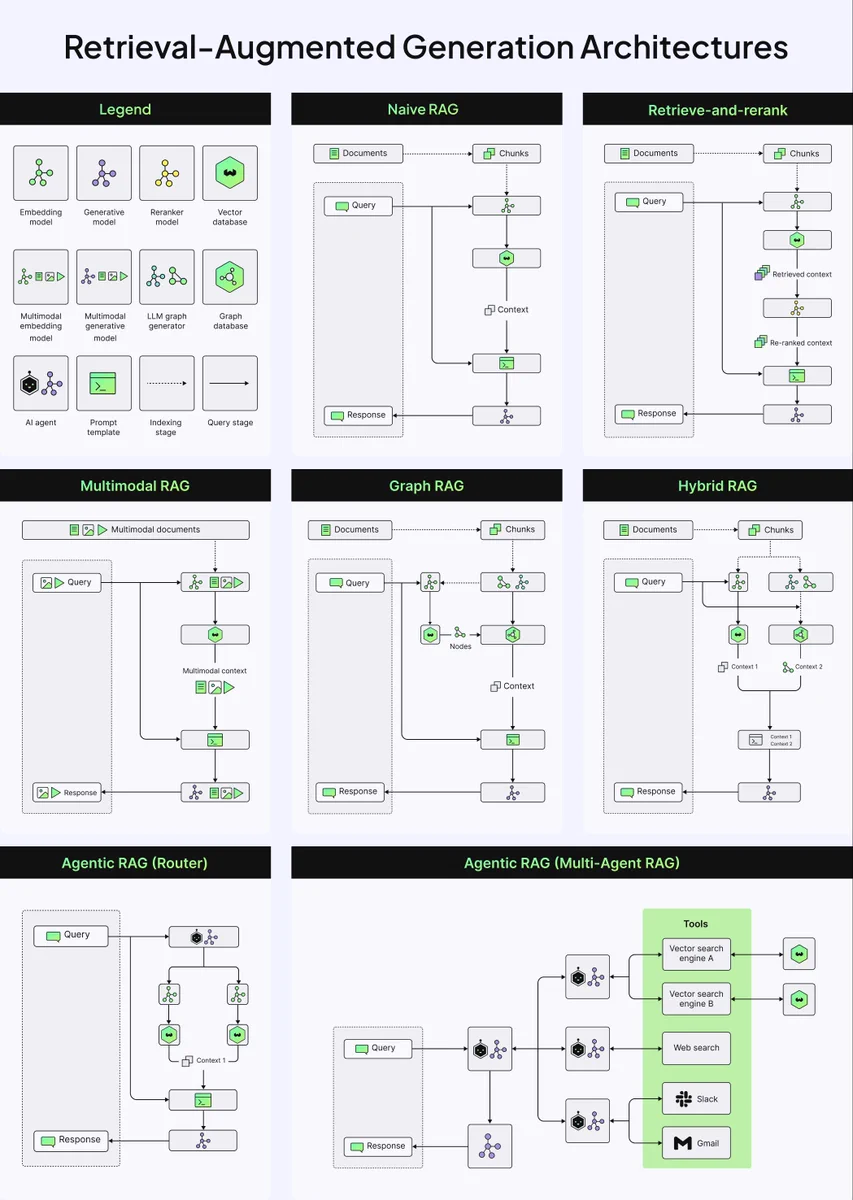
Think RAG is just vector search and retrieval?
It's actually 7+ different architectures (you might be using the wrong one)
1️⃣ 𝗡𝗮𝗶𝘃𝗲 𝗥𝗔𝗚 - The Vanilla approach. Documents get chunked, embedded, and stored in a vector database. When a query comes in, you retrieve the most
Proud to be named in The Agentic List 2026, which recognizes the top agentic AI companies most admired by enterprise leaders.
StackAI makes it easy for teams to turn processes into AI agents in minutes. With a no-code workflow builder, a robust governance and ADLC suite, and
You've heard of SDLC. Now, meet ADLC: the framework for scaling AI across the whole enterprise.
As organizations deploy more AI agents, they're hitting the same challenges software teams solved decades ago: How do you prevent unauthorized changes? Track what changed when? Test