Categories
Recently Listed
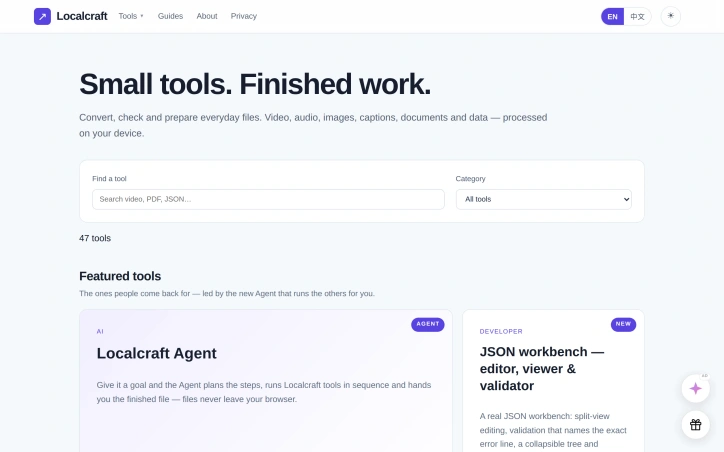
1,167 launchesA collection of 47 browser-based tools addresses a persistent friction point for digital workers: the need to convert, compress, and process files without surrendering them to cloud services or enduring lengthy uploads. Localcraft targets anyone handling routine file work across media formats, documents, and data—from content creators managing video and audio to developers needing quick utilities and everyday users who want to shrink PDFs for email or strip backgrounds from photos. The defining characteristic is uncompromising privacy. Every tool runs client-side, meaning files stay on the user's device throughout processing. This design principle shapes the entire product: no account creation, no credit packs, no quotas, and no watermarks. The founder's positioning—"files never leave your browser"—is not marketing flourish but functional reality reflected in tool design. The tool roster spans practical categories. Video and audio compression handles common formats like MP4 and WebM, while PDF compression tackles a universal workflow bottleneck. Image tools include background removal and a newly added watermark repair feature. The developer category includes a JSON workbench with validation and tree navigation. A subtitle editor handles caption management. Data tools and calculators round out the collection. The standout innovation is the Agent, which fundamentally changes how users interact with the suite. Rather than manually threading files through individual tools, users state a goal and the Agent orchestrates the sequence, presenting a step-by-step plan for approval before execution. This transforms the collection from a browser tab of one-off utilities into a coherent workflow engine. A secondary innovation addresses the API-key era. Localcraft offers AI integrations—chat, summarization, translation, and writing assistance—powered by the user's own OpenAI, Claude, or Gemini credentials. The mechanism is transparent: keys remain in the browser, requests route directly to providers, and Localcraft acts as interface rather than intermediary. For users uncomfortable with third-party services handling sensitive API credentials or file content, this inversion of trust carries weight. The business model is explicitly non-extractive: complete functionality arrives free, with no signup friction, no time-based restrictions, and no artificial scarcity mechanics. This eliminates the typical SaaS conversion funnel and positions Localcraft as infrastructure rather than service. The product succeeds in a crowded converter market by ruthlessly constraining scope—no cloud processing, no premium tiers, no frills—and coupling that constraint to a privacy guarantee and a novel Agent layer that elevates mundane file processing into something closer to personal automation.

Weekly launch boards address a specific problem for product builders: launching into the void without audience discovery. Launchpadly tackles this by offering founders a structured, recurring venue where new products can gain visibility among a community of fellow builders and early adopters. The platform operates around a simple but effective constraint: each week accepts exactly 100 product launches, ranked primarily by community upvotes rather than editorial selection. This scarcity creates genuine competition and incentivizes founders to build products users actually want to support. The community voting model keeps rankings organic, though the platform does offer paid featured placements that sit alongside the organic leaderboard, creating two tiers of visibility. What distinguishes Launchpadly from other launch venues is its deliberate positioning within existing founder communities. The site explicitly draws inspiration from Indie Hackers, Hacker News, Product Hunt, and Y Combinator—platforms whose audiences overlap significantly. This positioning targets serious builders rather than casual browsers. The current userbase includes 947 active founders, with 1,234 all-time product launches across the platform. The product itself is straightforward. Founders submit their work to the weekly board; visitors browse listings by category, upvote projects, and search. The interface emphasizes recency and momentum through multiple views: a live board for the current week, previous weeks' rankings, and a highlight reel of recent top performers. This structure rewards both new launches and products gaining traction, encouraging return visits. The business model balances community integrity with monetization. Paid featured placements exist as a separate section, visually distinct from community-ranked products. This separation preserves the credibility of the organic upvoting system while creating a revenue stream for the platform. Founders get a clear choice: compete purely on merit through community voting, or pay for guaranteed homepage visibility. For indie developers, bootstrapped founders, and product teams without traditional marketing budgets, the platform offers real value. It provides a built-in audience of hundreds of potential customers and collaborators, filtered for the specific demographic most likely to engage with early-stage products. The weekly cadence creates recurring launch opportunities rather than a one-time posting. The site's technical footprint suggests established credibility. For founders serious about validating ideas with a warm audience of peers, Launchpadly delivers a focused alternative to broader product platforms.


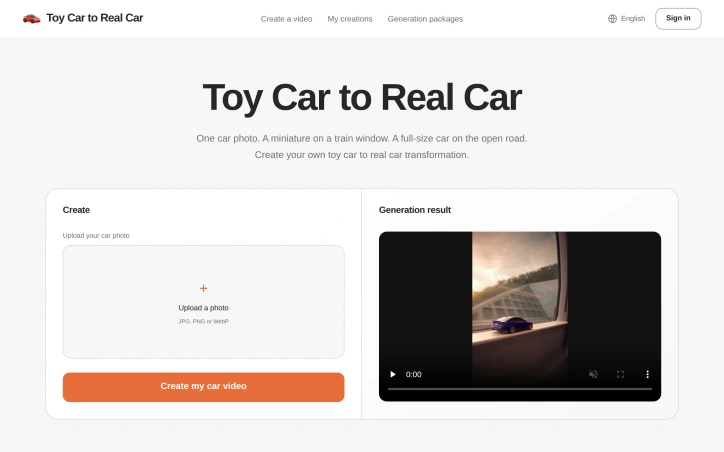
Creators chasing viral video trends without film equipment or video editing skills have a new shortcut. AI Car Video generates cinematic transformation sequences from a single photograph, turning the labor-intensive "toy car to real car" trend into a straightforward three-step process. Users upload a clear car photo, trigger generation, and receive a fifteen-second vertical video showing a miniature vehicle on a train window that scales up to full size on a night road. The product's core advantage is its template-driven approach. Rather than asking users to write prompts or assemble footage, AI Car Video ships with a pre-built scene and camera path. This eliminates the technical barriers that would otherwise require either filming a physical miniature and matching footage, or learning video compositing software. The setup is deliberately opinionated: you provide the car, the system provides the setting and transformation logic. What distinguishes this from general-purpose video generation tools is the specificity. The trend itself—revealing a toy car as full-sized—has become recognizable enough online to warrant dedicated tooling. AI Car Video doesn't generate arbitrary videos; it executes one transformation sequence repeatedly with different input cars. This narrow focus means faster generation and more consistent output than a flexible alternative would offer. The technical requirements are straightforward. A clear three-quarter view car photo works best, with simple backgrounds and even lighting. The system needs the entire vehicle visible and unobstructed. Users targeting the effect understand these constraints intuitively, since the same composition appears in the viral originals they're emulating. Output is mobile-native. Videos are formatted in 9:16 aspect ratio, built for vertical playback on social platforms where the trend circulates. The roughly fifteen-second length fits short-form video timelines without padding or cuts. Pricing follows a straightforward pay-as-you-go model with no subscription requirement. Three-tier generation packs start at $9.90 for a single video and scale to $44.90 for five videos. This removes commitment friction and lets occasional creators experiment without recurring charges. Volume pricing suggests the per-unit cost decreases with larger purchases, roughly halving from the one-pack rate to the five-pack rate. The business model assumes either hobbyist creators running short campaigns or dedicated content producers who stockpile generations. There's no free tier mentioned, meaning the minimum commitment is under ten dollars—a low barrier for casual experimentation but a requirement nonetheless.
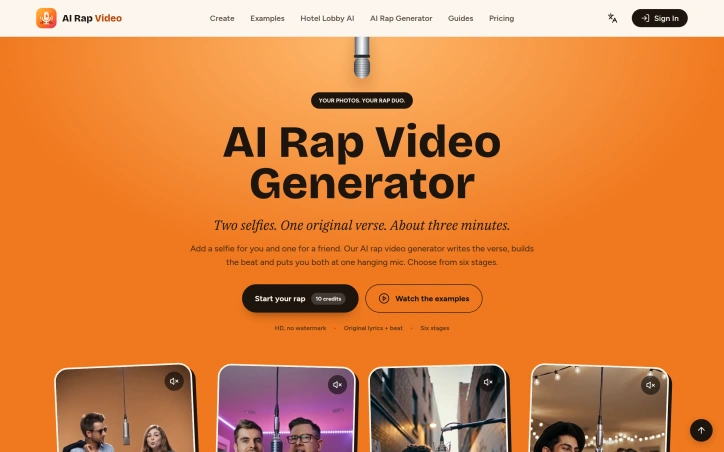
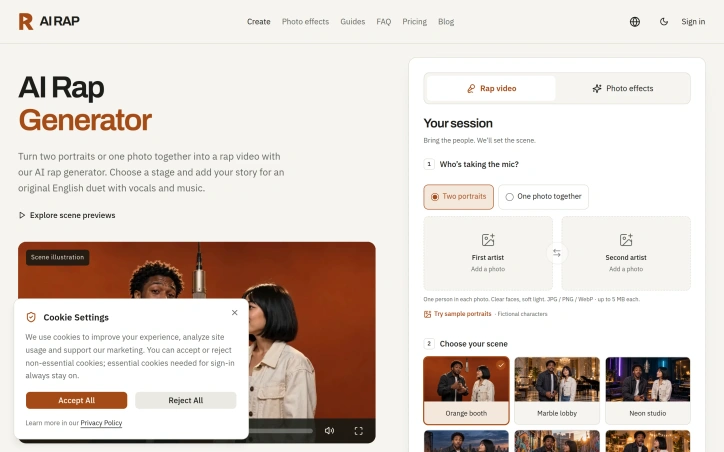
Generating personalized music videos has traditionally required significant creative effort, specialized software, and often, musical ability. AI Rap Video addresses this friction by automating the entire creative pipeline—from lyric writing through beat production to video generation—in a single, straightforward workflow. The product targets users seeking shareable entertainment content with friends or family. The use cases span birthday tributes to meme remakes, appealing to anyone wanting novelty content without the skill barrier. The core appeal is accessibility: upload two selfies, select a backdrop, and receive a fully realized music video in approximately three minutes. Several capabilities distinguish this offering. The AI generates original lyrics and beats tailored to each generation, rather than relaying stock templates. The product offers six distinct stage aesthetics—ranging from an Orange Booth to Rooftop Night to Graffiti Alley—allowing users to customize the visual context. The generated videos feature lip-synced performances that map the AI vocals to the uploaded faces, creating a cohesive illusion of live performance. The output is delivered in vertical format at 720p resolution without watermarks. The platform incorporates meaningful safeguards. Generated videos automatically delete after seven days, and the creator explicitly states user photos are not used for AI model training. Failed generations trigger automatic credit refunds, reducing financial friction. Users can optionally specify topics for the AI lyrics—birthday shout-outs, relationship origins, lighthearted competition themes—or let the system choose. The business model relies on a credit system, with songs priced at 10 credits. The company does not publicly disclose credit-to-dollar conversion rates on the provided materials, making the true cost per video unclear to prospective users without visiting the full site. This opacity is a minor friction point, though the auto-refund policy and privacy commitments address legitimate user concerns around trust. The product execution is polished. The sample outputs shown across all six stages demonstrate consistent video quality and convincing facial animation. The interface design guides users through a logical progression—photo selection, stage choice, optional customization, then generation. AI Rap Video succeeds in lowering the barrier to music video creation. For users seeking entertaining, shareable content without creative skill, the streamlined workflow delivers clear value. The combination of AI-driven content generation, multiple aesthetic options, and user-protective policies positions it as a viable entry point to video creation for casual audiences.
Converting ordinary photos into personalized rap videos, AI Rap targets a straightforward niche: people who want to celebrate moments with friends, partners, or loved ones through AI-generated music and performance. The platform takes two portraits or a single photo of two people and transforms them into short English-language duets with original lyrics, vocals, and instrumental backing, presented across one of six themed stages. The core strength lies in its focused execution and creative flexibility. Users select from distinct visual settings—ranging from an intimate orange booth to a street cypher—each providing a different aesthetic direction for the generated content. The AI generates original lyrics and vocals tailored to the user's chosen topic or memory, rather than repurposing existing tracks. This originality distinguishes it from simpler video-generation tools that layer existing music over footage. The platform handles the technical complexity invisibly: users need only provide clear photos and a topic, leaving the lyrical composition and vocal synthesis to the system. The product acknowledges its limitations transparently. Video quality, lip-sync accuracy, and vocal likeness can vary, and the interface requires photos where the user has permission to use them—a necessary legal boundary. The generation process isn't instantaneous; users confirm their submission and monitor progress in a private library before reviewing the result. The business model employs a straightforward credit system. Individual videos cost 10 credits at roughly nine dollars per video, while bulk purchases offer modest savings—50 credits for twenty-nine dollars cuts the per-video cost to about six dollars. Credits never expire and carry a refund guarantee for confirmed failed generations. The pricing page indicates monthly and yearly subscription tiers under development, signaling intentions around recurring revenue. The product occupies practical entertainment use cases: personalized birthday messages, friendship tributes, or relationship milestones. It trades sophisticated video realism for accessibility and speed, making it viable for casual users rather than production professionals. The combination of controlled image generation, original music composition, and themed presentation creates something functionally distinct from generic AI video tools, even if the underlying technologies are familiar.
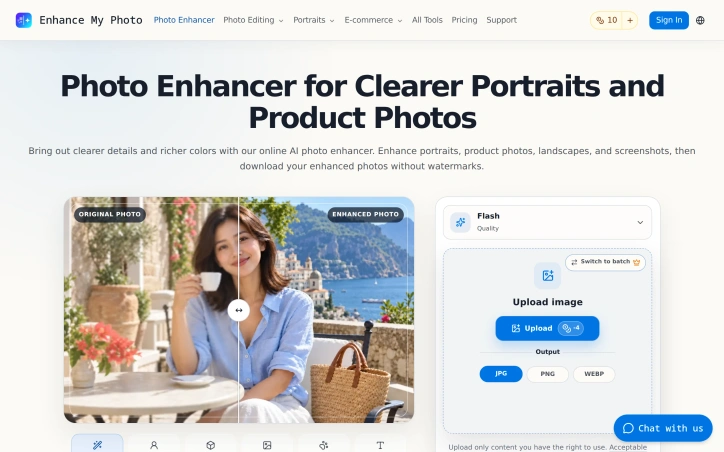
Bringing clarity and polish to everyday photographs without the expense of professional editing software, this online AI photo enhancer targets anyone from product sellers to memory restorers. The platform uses machine learning to sharpen portraits, enhance landscapes, improve product photography, and restore faded or damaged scans through a workspace built around six specialized starting points. The product differentiates itself through its modular toolkit rather than a single one-size-fits-all enhancement. Users can select from preset enhancements tailored to different image types—whether they're working with pet photos that need whisker clarity, product images requiring label and material detail, or old photographs requiring restoration and colorization. This approach acknowledges that optimal enhancement varies by subject matter, moving beyond generic sharpening tools. Core capabilities include background removal with transparent PNG export, an AI image editor for describing lighting and composition changes, text unblurring for screenshots and photographed documents, and batch processing for handling multiple images at once. Output files can be exported as JPEG, PNG, or WebP up to 16 megapixels, with no watermarks applied to the finished work—a meaningful advantage over many competing services that brand their output. The interface emphasizes comparison between original and enhanced versions before download, allowing users to verify that important details like faces, fur texture, or text remain recognizable rather than over-processed. For text-heavy images, the tool specifically handles legibility; for pets, it highlights potential artifacts around fine details like whiskers and eyes. This comparison workflow reduces the risk of unusable output. Monetization follows a freemium model, with users starting with a free tier and purchasing additional credits for continued use. Subscription plans offer expanded capacity for regular users, though specific pricing details remain undisclosed. The structure serves both casual photographers and those with ongoing enhancement needs. The toolkit's breadth—encompassing restoration, background manipulation, enhancement, and colorization—positions this as more than a simple photo sharpener. It addresses common photograph problems across different genres and use cases, from archival work to e-commerce product listings.
Competing for attention in startup directories requires a novel approach, and TopBid takes that literally with an interactive leaderboard built around a 3D tower where companies bid for floor placement. Rather than earn positions through merit or community voting, organizations stake their place by outbidding competitors, creating a transparent and dynamic ranking system where visibility is directly proportional to investment. The product addresses a straightforward problem: established startup directories rely on organic discovery or algorithmic rankings that may not reflect a company's actual desire for prominence. TopBid inverts this model, letting companies purchase their placement explicitly. This appeals to founders and marketers seeking immediate visibility without relying on unclear ranking factors or the uncertainty of organic growth. What distinguishes TopBid is its gamified execution. The 3D tower interface transforms what could be a bland payment ledger into an engaging visual experience. Users navigate the tower with interactive controls, explore which companies occupy which floors, and watch rankings shift in real time as payments clear. This playful design choice makes monitoring competitive activity more entertaining than checking a static directory, which may encourage repeated visits and engagement. The mechanics are elegant in their simplicity. New listings begin at a one-dollar entry point, lowering friction for first-time participants. Climbing the rankings requires paying only the difference between a company's current position and its target, creating a transparent cost model. This approach eliminates surprise fees and lets organizations budget for their desired tier. Multiple payment options, including account balance and card transactions, provide flexibility for various user preferences. The business model is clearly transaction-based, with revenue derived directly from bidding activity. The dynamic nature of the system incentivizes ongoing engagement as companies that see competitors climbing the tower face pressure to maintain or improve their positions. This creates a potential escalation dynamic where visibility becomes increasingly expensive as competition intensifies. TopBid fills a niche that hybrid directory models struggle to address: the market for explicit, pay-for-placement visibility. Traditional directories resist this openness, while organic-only platforms frustrate founders seeking immediate traction. For companies willing to monetize visibility directly, TopBid offers genuine clarity and a surprisingly transparent alternative to opaque ranking systems and algorithmic black boxes.


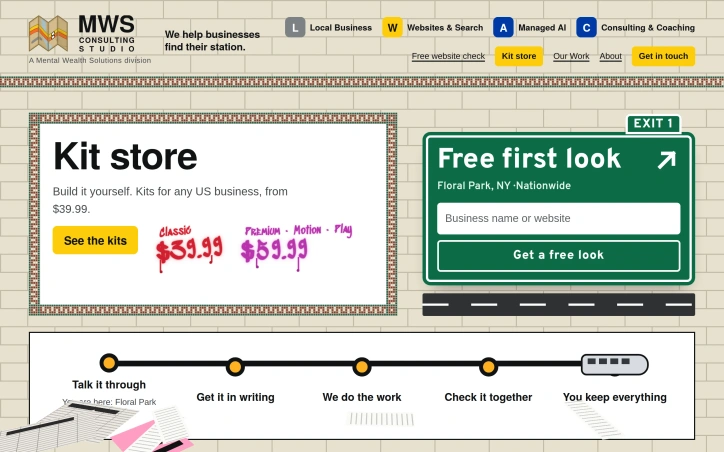
Small businesses lose customers every day to broken search results, outdated contact information, and websites that don't work on phones. Many turn to web builders or freelancers, only to face recurring monthly fees or lock-in arrangements that trap their data and logins. MWS Consulting Studio addresses both the visibility problem and the operational chaos that plagues small business owners. The company operates across four service lines. Its flagship offering is a free audit of what potential customers see when they search for a business online, identifying the five most impactful fixes needed. The company also sells website kits starting at $39.99 that customers can build themselves, positioning this as a one-time cost alternative to subscription-based builders that charge monthly. For those wanting professional help, MWS builds and optimizes websites, setting up the business to appear in Google search and AI-powered search tools. A third offering involves configuring AI automation on the business owner's own accounts, along with staff training and process documentation. The fourth pillar is consulting and coaching to help owners streamline workflows and tool selection. What distinguishes MWS from many competitors is its ownership model. The company explicitly promises that customers retain all logins, files, and documentation, avoiding the dependency traps common when working with some agencies and platform providers. This appeals to owners who want lasting control. The founder emphasizes that the company builds and tests its own methods on its own products before applying them to clients, signaling a bootstrap mentality rather than pure service arbitrage. The business model mixes low-cost self-service options with higher-margin consulting. The $39.99 kit targets budget-conscious operators willing to do the work themselves, while the free audit funnel pulls in prospects for premium services. The consulting line addresses the operational side, not just visibility, expanding the addressable market beyond web-focused businesses. The website copy itself demonstrates a deliberate voice—conversational, process-focused, and free of overclaimed promises. The company avoids the industry standard of guaranteeing search rankings, a choice that trades flashiness for credibility. This restraint carries through to the free audit, which explicitly notes when a business is already in good shape rather than manufacturing urgency to sell services. For small business owners tired of subscription traps and lost control, MWS Consulting Studio offers an alternative framed around ownership and transparency. Whether the execution lives up to the positioning remains a question only customers can answer.

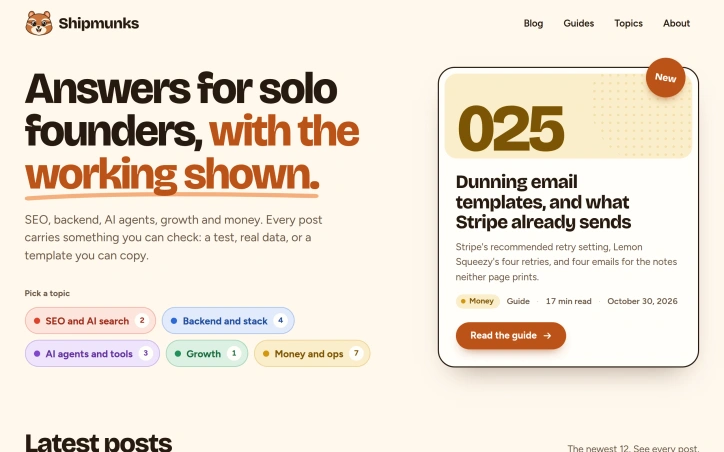
Solo founders tackling the full technical stack without specialized team members struggle to answer fundamental questions about architecture, growth mechanics, and SaaS operations. Shipmunks addresses this gap by collecting practical, worked-through guidance on the specific tools and decisions these founders face daily. The site functions as a reference library across five core areas: SEO and search visibility, backend infrastructure choices, AI agent tooling and integration, growth channels, and the financial and operational side of running a SaaS. Rather than offer generic best practices, each guide leads with a direct answer, then backs it up with concrete tests, real measurements, or reusable templates. Recent posts compare Drizzle and Prisma by actual bundle size impact, benchmark SQLite against Postgres on identical hardware, and provide the specific dunning email sequences that payment processors like Stripe and Lemon Squeezy recommend—details typically hidden in documentation footnotes. What distinguishes Shipmunks is its emphasis on verifiable content. The guides do not speculate; they measure or demonstrate. Posts include downloadable calculators for metrics where formula disagreement creates confusion, such as NRR, churn rate, and CAC payback period, and they link to original data sources. This appeals to founders who need to move quickly without hiring specialists, replacing the role of a fractional CTO or finance advisor with credible, self-serve information. The site is free to access across all guides and tools. The business model emerges through ContextBolt SEO, a related tool priced at 35 dollars monthly with a seven-day trial, which integrates keyword data, live Google results, and Search Console data directly into Claude. This positions the revenue stream as an optional extension for founders who want SEO guidance automated, rather than as a paywall restricting core content. The breadth of topics—from technical architecture through growth strategy and SaaS metrics—reflects the realities of solo operation, where one person touches every function. The specificity of the guidance, whether comparing exact database migration patterns or listing the exact retry settings different payment processors use, makes it immediately actionable rather than aspirational. For bootstrapped founders and small teams building with AI tools, this combination of breadth, depth, and verifiable examples fills a real void in the typical advice landscape, which tends toward either surface-level generality or context-heavy narratives divorced from measurable data.

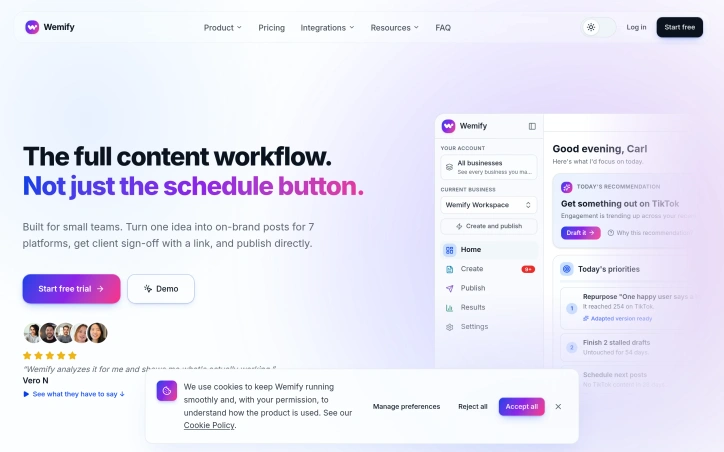
Content creation for small marketing teams has become increasingly fragmented, requiring teams to bounce between ideation tools, writing assistants, design platforms, approval systems, and scheduling software just to publish a single post. Wemify consolidates this sprawling workflow into a single workspace. The platform addresses a real pain point: the inefficiency of managing seven different tools to produce content for seven different platforms. Rather than writing once in ChatGPT, resizing in Canva, approving via Slack, and scheduling through Buffer, users create one draft that Wemify automatically adapts for LinkedIn, Instagram, X, TikTok, and other channels. Several features distinguish the product. Its AI-powered content generation works within the platform itself, eliminating context switching. The system learns a user's brand voice and applies it consistently across adaptations. More notably, Wemify learns visual style from uploaded reference photos, generating on-brand images without requiring separate design work. The platform also provides engagement-based recommendations, surfacing trending content types and suggesting when and where to post based on historical performance data. Approval workflows stand out as particularly practical. Rather than sending draft PDFs or links that require login credentials, teams share a simple approval link that clients can review and approve from their phone. This removes friction from a step that typically requires back-and-forth emails or Slack messages. The editing interface combines planning, drafting, and multi-platform adaptation. A campaign framework lets teams set goals and define audience before writing. The platform then suggests opening approaches for content and shows trending topics and visual inspiration inline, directly addressing the blank page problem that often delays content creation. What remains unclear from the marketing material is whether Wemify serves as a complete replacement for dedicated schedulers or whether its publishing capabilities are more limited. The product also does not elaborate on how well its AI adaptations maintain consistent voice across vastly different platforms, or what customization options exist for teams with non-standard content needs. For small marketing teams that currently spend significant time on content logistics rather than strategy, Wemify presents a straightforward value proposition: consolidation without compromise on platform-specific optimization.

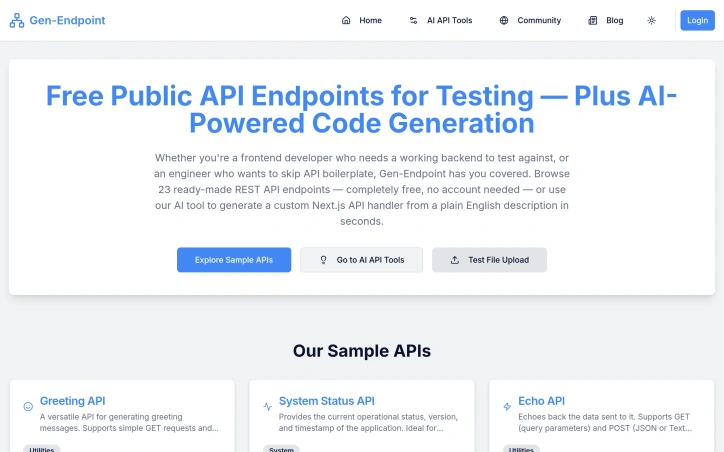
For developers tired of boilerplate and the friction of building test infrastructure, Gen-Endpoint offers a straightforward solution: instant access to a curated collection of working REST API endpoints that require no setup or authentication. The platform addresses a genuine pain point in development workflows. Frontend engineers often need a functioning backend to build against, while full-stack developers frequently find themselves writing repetitive API scaffolding code. Gen-Endpoint eliminates both friction points by providing 23 pre-built endpoints across domains like user management, e-commerce, authentication, and analytics, accessible immediately without account creation. What distinguishes the offering is its dual approach to the problem. The API repository itself covers common application needs: user CRUD operations, product catalogs, shopping carts, payment processing, and file uploads, among others. Each endpoint category includes anywhere from one to eight distinct endpoints, giving developers concrete examples to test against. The endpoints support standard HTTP verbs and data formats, from simple GET requests to JSON and text payloads. The supplementary offering—an AI-powered code generation tool—extends utility beyond exploration into productivity. Developers describe desired API behavior in plain language, and the tool generates production-ready Next.js handlers. This addresses the secondary problem of boilerplate elimination more directly than the sample endpoints alone. The breadth of coverage is noteworthy. Rather than offering generic echo or health-check endpoints, Gen-Endpoint models realistic scenarios: webhook management, inventory tracking, notification systems, advanced search with filtering and pagination, and blog publishing workflows. This moves the product beyond a mere sandbox into something closer to a reference implementation library. Pricing aligns with the project's positioning. The entire collection—endpoints and code generation—operates under a free model with no account requirement, reducing barriers to trial. This approach targets early-stage teams and individual developers who cannot justify infrastructure spend on testing tools. The primary limitation implicit in the content is the absence of customization detail. While the AI generator suggests flexibility, the extent to which generated endpoints can be deployed or integrated into actual projects remains unclear. For developers seeking immediate, realistic testing infrastructure or API reference implementations without the overhead of account management or cost, Gen-Endpoint delivers a functional alternative to building from scratch.

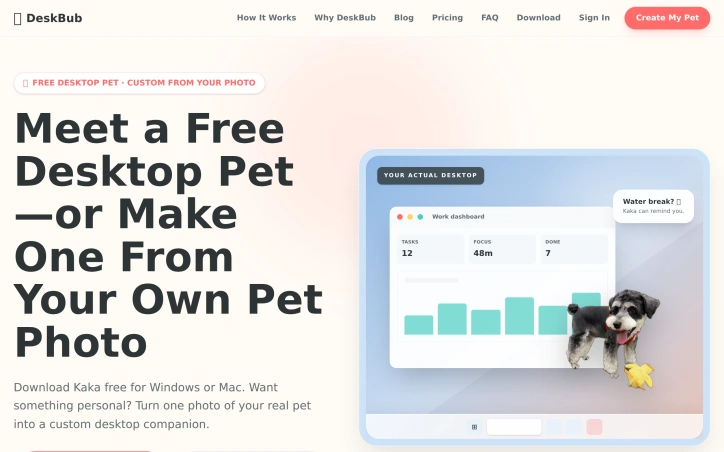
Productivity tools have long ignored the emotional dimension of work environments. DeskBub addresses this gap by turning pet photographs into animated desktop companions that float above your applications, offering both personalization and gentle behavioral nudges without cluttering your workspace. The product targets a straightforward audience: Windows and macOS users who want a familiar face visible during work or study sessions. Rather than push generic cartoon characters, DeskBub anchors itself to actual pets, making each instance genuinely personal. A photo of your dog, cat, or rabbit becomes the source material for an animated companion that stays on screen during your work day. The technical approach distinguishes DeskBub from simple wallpaper or video-based solutions. The companion floats as an independent window element that can be instantly resized, moved, faded, or hidden. This design choice respects context switching: when you need a clear desktop, the pet vanishes without friction. When you want the company, it reappears. Built-in water and stretch break reminders transform the companion from pure decoration into a gentle accountability partner, addressing the well-documented productivity costs of sedentary work. The free tier provides genuine value. Kaka, a real dog owned by the founder, ships with the desktop application at no cost and without requiring an account. Users get five pre-built animations immediately, making the product immediately usable for anyone curious about desktop pets. The monetization strategy respects this entry point. Custom pets created from user photos carry a one-time purchase model starting at 2.99 dollars for a basic option that includes a single generated animation. A Plus tier at 9.99 dollars supports up to five source photos and generates eight candidate animations, letting users keep their five favorites. This avoids subscription fatigue while creating clear differentiation between free exploration and personalization. The product also addresses practical aspects of modern digital life. Users can export their pet animations with captions directly for social platforms including TikTok, Instagram, and X, extending the product's reach through user-generated sharing. The pairing code system connecting photos to the desktop application simplifies what could otherwise be a friction-laden handoff. DeskBub succeeds because it commits to a specific use case without overreaching. It remains genuinely minimal while solving a problem—emotional continuity during focused work—that larger productivity suites overlook entirely.

Creators generating images with AI models often face a fundamental friction point: the gap between their creative vision and the technical precision required to produce quality results. Visora addresses this by providing a free, accessible library of pre-crafted prompts designed specifically for popular generative models like GPT Image 2.5 and Nano Banana. The service solves a real problem in the AI creative workflow. Rather than spending hours iterating on prompt language through trial and error, users can browse a categorized collection of proven prompts, customize them for their specific needs, and generate images with minimal setup. The three-step process is straightforward: select a prompt, adjust the description to match your vision, and generate the result using an available model. What distinguishes Visora is its emphasis on accessibility. The entire prompt library is free to use, requires no sign-up, and allows users to copy prompts for use in their preferred AI image generation tool. This low-friction approach removes barriers to entry that often discourage new creators. The library spans diverse creative categories—from cinematic edits and couple photography to car images, cartoon styles, and photo collages—suggesting the founder recognized that prompt engineering challenges cut across different visual styles and use cases. The platform includes an integrated AI Studio feature that lets users generate images directly within Visora, though the interface also supports external workflows where users copy prompts and apply them elsewhere. Sample prompts range from specific visual directions like "IMAX-level Netflix-style cinematic anime-sketch collage poster" to more atmospheric descriptors like "On a quiet afternoon, a relaxed, romantic moment unfolds," indicating the library captures both stylistic and narrative prompt types. The roadmap signals expansion beyond the current core offering. Upcoming tools include a dedicated photo collage maker, an AI photo editor for enhancement and retouching, and a style transfer feature. These additions suggest the founder is mapping out a fuller creative toolkit rather than stopping at prompt curation alone. From a business model perspective, the free-first approach prioritizes user adoption and library usefulness, establishing Visora as a baseline resource for creators before monetization. This strategy works well in the competitive AI image generation space, where low friction and proven utility drive engagement.


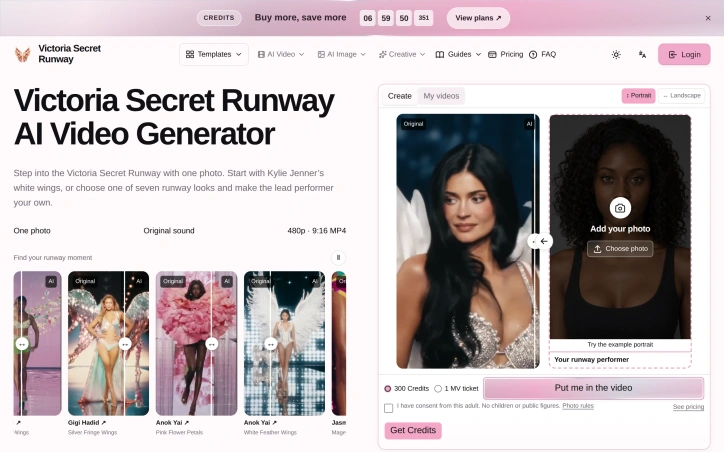
Fashion enthusiasts and curious users seeking personalization in their digital media now have a tool that inserts them into Victoria's Secret runway shows. The platform takes a single front-facing photo from a user and generates a 14-second video of that person performing in a curated runway look with original audio intact. The product solves the fantasy gap between aspiring and professional fashion models. Rather than imagining what they might look like on a high-fashion runway, users can now create a concrete, visual version of themselves in professional footage. The target audience spans fashion enthusiasts, social media creators, and anyone interested in AI-generated personalization, particularly those drawn to Victoria's Secret's iconic aesthetic. What distinguishes this offering is its execution specificity. Instead of creating generic runway videos, the platform leans entirely into Victoria's Secret's branding and visual language, offering seven distinct runway looks featuring recognizable model names and outfit styles. Each template comes with a reference clip, which the AI uses to guide the substitution of the user's face into the original footage. The constraints are similarly specific: one clear, front-facing adult portrait at 10 MB or less, no public figures, no minors, and verified consent. This narrow input requirement reflects a deliberate design choice to maximize video quality while maintaining ethical guardrails around consent and identity. The output format supports both portrait and landscape orientations, rendering videos at 480p in MP4 format. Users can compare the original footage against their AI-generated version through a built-in slider tool before downloading. The platform emphasizes simplicity—no watermarks on completed videos, no application required, and failed processing runs return the credit or ticket spent without penalty. The business model operates on a dual-currency system: either a one-time MV ticket or 300 Credits per video generation. MV tickets are limited to specific video templates, while Credits work across any available template. This structure encourages either single-use purchasers or credit account holders who can generate multiple videos without re-purchasing. The product occupies a niche intersection of fashion fantasy, AI personalization, and entertainment. By constraining itself to a single, well-executed use case rather than attempting broad video generation, it positions itself as a destination for a specific type of wish-fulfillment content. The clarity around consent and ethical use signals that the team understands both the legal and reputational risks of identity-substitution technology.

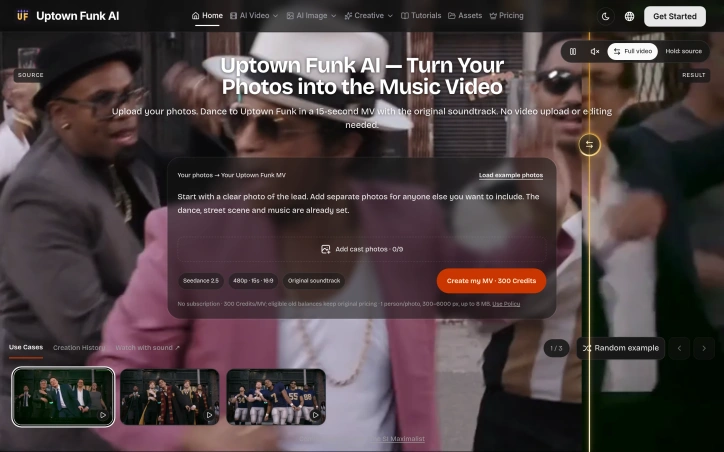
Creating personalized music videos without production expertise is typically the domain of professionals or expensive software. This web-based tool eliminates both barriers by letting users generate a 15-second "Uptown Funk" music video using only photographs. The platform addresses a specific but popular desire: quickly creating fun, shareable video content without mastering video editing software or requiring any video recording equipment. The product targets anyone seeking effortless social media content or novelty videos. Users upload a lead photo and up to eight supporting images, and the system automatically positions them into a pre-choreographed dance sequence set to the original "Uptown Funk" soundtrack. The video outputs at 480p resolution in MP4 format, making it immediately shareable. What distinguishes this offering is its radical simplicity and specificity. Rather than positioning itself as a general video editor, it commits to a single, well-defined creative template. The dance performance, camera angles, and audio track are locked in; users contribute only their cast photos. This constraint-based approach actually streamlines the creative process by eliminating decision paralysis around styling, timing, and editing choices. The platform succeeds by limiting options to accelerate output. Community examples demonstrate solid technical execution, with recognizable faces integrated into the choreography, though results vary depending on photo quality. The system accepts images between 300 and 6000 pixels and up to 8 MB each. The comparison feature lets users watch their creation alongside the original "Uptown Funk" music video, providing useful context and reinforcing the novelty value. Financially, the business model operates on a credit system rather than subscriptions. Creating one video costs 300 credits, priced at $9.90 per generation. Users can purchase bulk credit packages ranging from 800 credits at $39.90 up to 160,000 credits for $2,599. Credits remain valid for one year. This approach removes friction for casual users while enabling sustained monetization from power users. Failed generation jobs return credits to the user's account, showing confidence in the underlying system reliability. The tool succeeds by identifying a narrow use case and executing it thoroughly. It's not a general creative platform but rather a tightly focused novelty generator designed for quick wins and social sharing rather than serious video production.
Video production represents a significant cost barrier for creators and marketers who need multiple versions of the same content for different campaigns. Burning Bridges AI directly addresses this friction by enabling users to reimagine existing footage with new cast members, outfits, and environments while preserving the original performance, camera movement, and soundtrack. The platform centers on three core capabilities. Motion transfer allows creators to replace performers and settings while maintaining the underlying movement and cinematography of the source footage. Object swap provides granular control, letting users target specific elements like character appearance or product placement while the rest of the scene remains cohesive. A restyle mode extends this further, reframing the entire visual aesthetic around different references. Together, these features compress what would typically require expensive reshoots into a single editing workflow. The workflow itself is straightforward: select a 4- to 30-second source video, upload reference images to guide the transformation, choose a mode, receive a credit cost estimate, generate the output, and compare results against the original. Users can provide up to eight reference images, each mapping to a specific element in the scene. The interface emphasizes clarity and directional input, asking users to upload ordered images so the system understands which references correspond to which roles. The business model reflects the use case. Rather than forcing users into subscriptions, the platform operates on a pay-per-video basis, requiring 300 credits for a standard output. This positions the tool as accessible for occasional creators while allowing marketers to generate campaign variants without ongoing commitments. The company mentions credit packs and subscription options for higher-volume needs, suggesting flexible pricing tiers. A notable constraint is the technical scope. The platform targets 15-second maximum outputs, limiting it to short-form content like music videos, product shots, or social clips. This actually aligns well with the creator and marketing demographics most likely to benefit from rapid video variation, where short assets dominate distribution channels. Burning Bridges AI tackles a genuine production bottleneck for a specific use case: creators who have motion they like but need casting variations. By automating the most expensive part of that process, it meaningfully reduces barriers to multichannel content strategies.


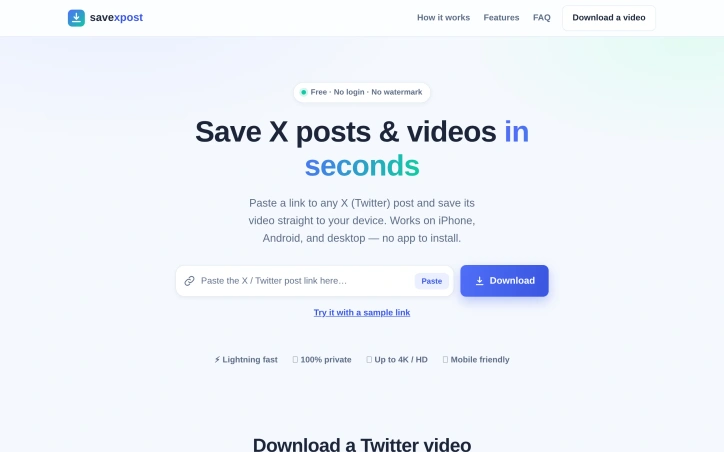
X's lack of a native video download feature has spawned a straightforward solution in SaveXPost. The service addresses a real friction point for users who want to archive their favorite videos from the platform without navigating through third-party apps or logging into additional services. The product's core appeal lies in its simplicity. Users copy an X video link, paste it into the SaveXPost interface, and download the file to their device within seconds. The workflow requires no account creation, no browser extensions, and no proprietary app. This no-friction approach works across iPhone, Android, and desktop browsers, making it genuinely accessible regardless of device or operating system. Several features distinguish SaveXPost from competitors in this space. The service preserves original resolution rather than offering degraded copies, supporting downloads up to 4K quality. The platform explicitly avoids adding watermarks to downloaded files, delivering clean originals as they exist on X's servers. A private-by-design architecture means SaveXPost never stores user links or downloaded videos, addressing privacy concerns that often deter adoption of download tools. The underlying infrastructure prioritizes speed. An edge network brings servers closer to users, eliminating the typical delays associated with video conversion tools. The service handles various content types beyond standard videos, including X's MP4-based GIFs and photo collections, with guides addressing specific use cases like HD extraction and format conversion. The business model reinforces the product's positioning. SaveXPost operates entirely free with no subscription tiers, login requirements, or artificial download limits. This approach lowers the barrier to adoption and removes the conversion friction that plagues freemium competitors. SaveXPost's website includes comprehensive educational content, with guides explaining X's quality hierarchy, platform-specific download methods for iOS and Android, and clarifications on common misconceptions like whether X embeds watermarks natively. This content serves dual purposes: addressing user questions upfront while building search visibility. The service occupies a narrow but valuable niche. It solves a specific problem for a large user base—anyone who archives X content—without overcomplicating the solution. The emphasis on privacy, speed, and open pricing creates clear differentiation in a crowded landscape of download tools.

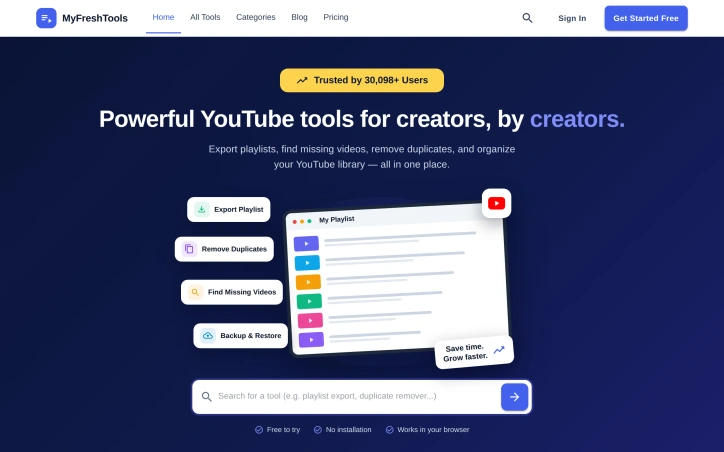
Creators managing extensive YouTube libraries often resort to manual spreadsheets and fragmented tools to organize their content. MyFreshTools consolidates this scattered workflow into a single browser-based platform designed specifically for YouTube playlist administration. The service targets channels of all sizes seeking to export, curate, and protect their video collections without installing software or navigating complex interfaces. The platform's strength lies in its focused feature set. Rather than attempting to serve broad video editing needs, MyFreshTools concentrates on specific pain points: exporting playlists to CSV and Excel formats, identifying and removing duplicate videos, recovering metadata from deleted or private videos, and backing up playlists for restoration. This narrow scope translates to straightforward execution. Users select a tool, provide a YouTube URL or relevant input, and receive downloadable results or instant previews. The approach matches how creators actually work—quickly and directly. What distinguishes the offering is its browser-based architecture, which eliminates the friction of software installation and updates. The tool collection spans 54 dedicated applications, ranging from playlist management to music and video research utilities. Notably, the company offers free previews of most tools before charging for full functionality, allowing users to evaluate the service before committing financially. The pricing structure reflects a usage-based model. Four subscription tiers range from Starter at $5.99 monthly with 100 credits to Business at $39.99 monthly with 1000 credits. The credit system allows users to purchase capabilities incrementally rather than paying for unnecessary features. This approach removes the barrier to entry—creators can start free and scale spending only when the tools deliver measurable value. The company's positioning around speed and ease aligns with a real creator need. Growing YouTube channels demand efficient library management, and cobbling together multiple services wastes time that could fund content production. By consolidating these functions, MyFreshTools addresses a genuine operational inefficiency in creator workflows. The core limitation is scope: this serves a specific subset of YouTube management tasks and won't replace broader creator platforms. Yet this focused strategy, combined with immediate usability and flexible pricing, makes the offering credible for creators seeking a straightforward playlist-handling solution.

Enterprises seeking to accelerate their digital transformation through custom artificial intelligence face a crowded marketplace of vendors, making differentiation through genuine implementation capability essential. Viston AI positions itself as a specialized development shop targeting Fortune 500 companies and fast-growing enterprises, offering end-to-end AI solutions rather than off-the-shelf tools. The company's approach centers on custom development across several connected domains. Their portfolio spans conversational AI chatbots built on established models like ChatGPT and Gemini, generative AI for content production leveraging platforms like Midjourney and DALL-E 3, predictive analytics for forecasting and anomaly detection, strategic consulting for AI roadmaps, and natural language processing for unstructured data analysis. This breadth positions Viston as a full-service implementation partner rather than a point solution provider. What distinguishes Viston in messaging is their emphasis on measurable business outcomes. Rather than selling capabilities in isolation, they publish specific impact metrics: 70 percent reduction in response times for chatbot implementations, 45 percent increase in lead conversion, 62 percent savings in content creation costs, and improvements to forecasting accuracy. The framing suggests they sell outcomes, not hours, though the underlying methodology remains opaque. The company claims to have driven over 236 billion dollars in AI transformation value across their enterprise client base, a figure that warrants scrutiny regarding its calculation and scope. More concretely, they report generating returns between 1.7x and 10x on AI implementations, a range that reflects the variability inherent in custom project work. On the product side, Viston operates somewhat unusually for an AI agency by offering interactive demonstrations of their capabilities: a live chatbot, a creative studio for content generation, a predictive analytics simulator, and a computer vision playground. This hands-on approach lowers barriers for prospects unfamiliar with AI and provides a tangible sense of what implementation might deliver. The business model remains opaque from publicly available information. The website advertises a Black Friday discount without publishing baseline pricing, suggesting a custom, enterprise-focused sales process rather than transparent, tier-based pricing. This is typical for high-touch implementation firms but creates friction for cost comparison. Viston appeals to organizations mature enough to consider custom AI development but potentially skeptical of its value. Their emphasis on outcomes over features, combined with service breadth and interactive demos, represents thoughtful positioning in a market that has historically struggled with hype.

Brands increasingly struggle to maintain visibility as search behavior fragments across AI chatbots, voice assistants, and conversational platforms rather than concentrating in Google results alone. SEO Jetty tackles this fragmentation by helping companies position themselves across the full spectrum of how modern buyers discover information. The agency specializes in what it calls Generative Engine Optimization and Answer Engine Optimization, concepts that acknowledge a fundamental shift: customers now ask ChatGPT, Gemini, Claude, and Perplexity for recommendations and answers rather than scrolling through search results. Traditional SEO optimization alone cannot address this new discovery landscape. SEO Jetty bridges that gap by optimizing not just for ranking, but for being cited and recommended within AI-generated responses. The service lineup combines multiple demand-generation approaches: optimizing digital authority and content ecosystems for AI visibility, capturing high-intent audiences through voice and conversational search, implementing advanced technical SEO, running hyper-personalized email campaigns, and deploying predictive lead-generation systems. This integrated approach reflects the company's core insight that sustainable growth now requires coordination across multiple channels rather than a single, siloed SEO strategy. The company presents evidence of practical traction through case examples showing qualified leads captured through LLM citations, share of voice dominance across multiple AI engines, significant traffic gains from answer-engine sources, and high-intent query volume. These results target companies in specific verticals such as cybersecurity SaaS. The company claims 250 client relationships, 12 years of operating experience, and a 4.9 out of 5 client satisfaction rating, though these figures appear on the website without independent verification. Positioning itself as focused on growth-forward brands rather than small businesses experimenting with AI, SEO Jetty targets enterprises and established companies that recognize their traditional SEO investments may not translate to visibility in AI-powered search experiences. The messaging emphasizes that the buying behavior of modern customers has fundamentally changed, and that visibility strategies must evolve accordingly. On pricing, the company advertises promotional discounts during seasonal campaigns but provides no published rate card on the website. Inquiries require a strategy call.