


Scout-S
 Anywhere
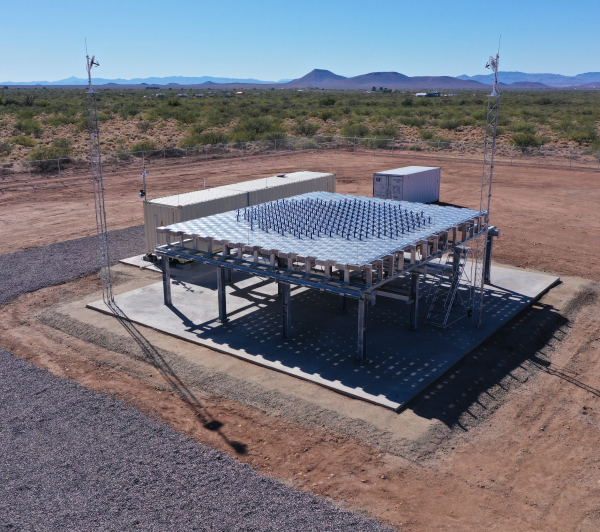
LeoLabs' new class of transportable 3D search radars enable persistent custody of high-interest objects in LEO and VLEO. Scout-S combines advanced 3D scanning with direct radiating array (DRA) and S-band technology in a compact design that can be rapidly deployed, repositioned, and reconstituted in contested environments. This is the first operational system in LeoLabs' new family of Scout radars.
- Housed in a standard 20 ft ISO container
- Transportable by land, sea, and air
- Uncued object search and discovery
- >10cm debris tracking
- Persistent monitoring of High Interest Objects
- Foreign launch detection & tracking

SEEKER
Arizona, Indo-Pacific (In-Development)
LeoLabs' ultra high frequency (UHF) planar DRA radars have higher power and a wider field of regard, enabling high-altitude search and detection of more targets through longer tracks.
- Spacecraft tracking
- High Interest Object search & tracking
- >10cm debris tracking
- Launch & early operations support
- Foreign launch search
- Tracking in MEO, GEO & Cislunar (R&D)
- Hypersonics (R&D)

RANGER
In Development
LeoLabs' scalable S-band DRA radars offer the ability to detect small, sub-catalog objects in support of advanced space traffic management missions.
- Spacecraft tracking including High Interest Objects
- <10 cm debris tracking
- Hypersonics (R&D)

Tracker
Australia, Azores, Costa Rica, New Zealand, Texas
LeoLabs' first and most proliferated system to date, LeoLabs’ Phased Array Offset-Fed Reflector (PAFR) radars enable reliable, superior tracking and monitoring of objects in LEO.
- Spacecraft tracking including High Interest Objects
- >10 cm debris tracking
- Launch & early operations support

Poker Flat Incoherent Scatter Radar
Alaska
Through a partnership with SRI International, LeoLabs utilizes time on this large UHF DRA radar, which some of LeoLabs’ co-founders were instrumental in building and operating.
- Spacecraft tracking
- Space debris tracking
- Launch & early operations support

Probability of Detection
This supervised model optimizes the relative priority of space objects for radar scheduling and tracking by forecasting the probability of collecting a measurement on that object for a given radar pass and the operational utility that would result from it. If multiple objects are in a radar’s field of view, higher priority objects are tracked first.
Beam Length
This model, also supervised, dynamically adjusts the length of time an object is tracked during a given radar pass. This increases efficiency by reducing the average amount of radar time needed to collect measurements on each passing object.
