How to revise:
As an editor and author I have seen many revised papers return to journals. Given effort, most go well (ie step toward acceptance). Some go pear-shaped. I’ve slowly improved and have an approach known by my group as the ‘Breakspear method”. Here is its essence
Michael Breakspear
3,891 posts
- "How to cover letter"; a brief thread from a scientific editor's perspective Yes, in brief editors do read cover letters although like myself, most pay far less attention than to the abstract and main elements of the paper! First, a few "do's"
- Sister in Lismore with 5 now homeless friends. Thousands of homes likely destroyed. 5 days with no power, no shops, no fuel, no roads in or out, no communication from govt. Local lives lost But apparently no climate emergency. No planning, no mitigation, no net zero
- One hundred years of wave equations of physical systems from Schrödinger's model of the atom to neural field theory of the brain Both formulations predict that the system's expressed energy is constrained into natural modes - "eigenstates - determined by the system's geometry
00:00 - The brain is metabolically hungry but most accounts of cognition do not consider the energy cost of neural activity Here we review the metabolic budget of neural homeostasis + cognition; associated evolutionary constraints; plus disturbances in disease osf.io/preprints/osf/…
- How to perform inference on a spatial network: (and some things this reveals about the human brain)
00:00 - My term as Editor-in-Chief of NeuroImage @NeuroImage_EiC concludes at the end of this month Delighted to announce that @fmrib_steve is the incoming Editor-in-Chief @bttyeo is stepping up to a Senior Editor post @emrobSci and @cately00 join NeuroImage as new Handling Editors
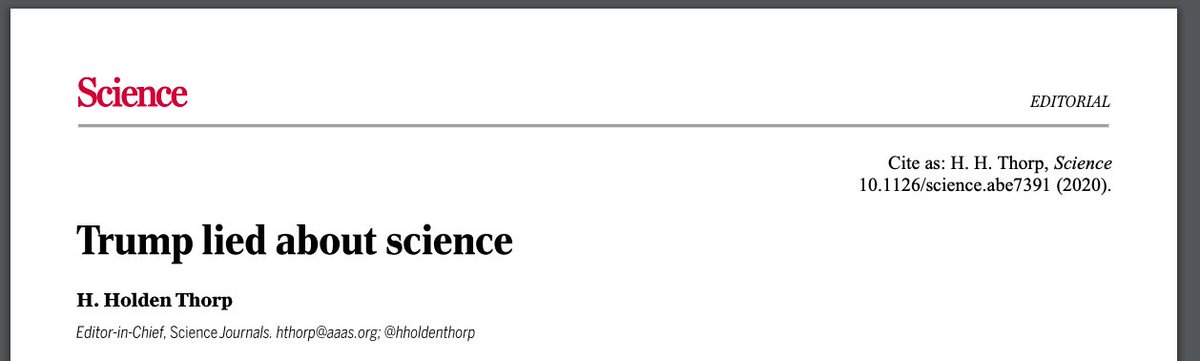
- From the Editor-in-Chief of Science, "This may be the most shameful moment in the history of U.S. science policy" science.sciencemag.org/content/early/…
- Replying to @DrBreaky2/ Approach the revision as a way of improving the paper, not as a way of placating the editors and reviewers. Despite it's caveats, IMO constructive peer review followed by careful revisions almost always makes the paper better: More accurate, clearer and better contextualized.
- Replying to @NSWHealthThis is inconsistent with the National Roadmap, inconsistent with Doherty modelling, inconsistent with international experience The language & political branding are fundamentally inconsistent with the basic tenets of public health messaging For the sake of a few more weeks ...
- Replying to @DrBreaky5/ Treat the reviews as the most careful technical, independent reading you will get. If you think the reviews are off target, don't get mad. Aim to make something good out of every point. If the reviewer is misguided take this as a sign that the text wasn’t sufficiently clear
- New 3 yr post-doc in our Systems Neuroscience Group "Generative models of brain disorders" Applications open now -> July 15th uniofnewcastle.secure.force.com/academicext/ts…
- 1/6: Excited to share our new hierarchical atlas of human subcortex! 3T and 7T versions in CIFTI and NIFTI format. Integrated into existing cortical atlases to enable holistic connectomes. Work by @yetianmed, @DanielMargulies, @DrBreaky + Andrew Zalesky. github.com/yetianmed/subc…